Home / Journals / FDMP / Vol.21, No.9, 2025
Special Issues
Table of Content
cover

On the Cover

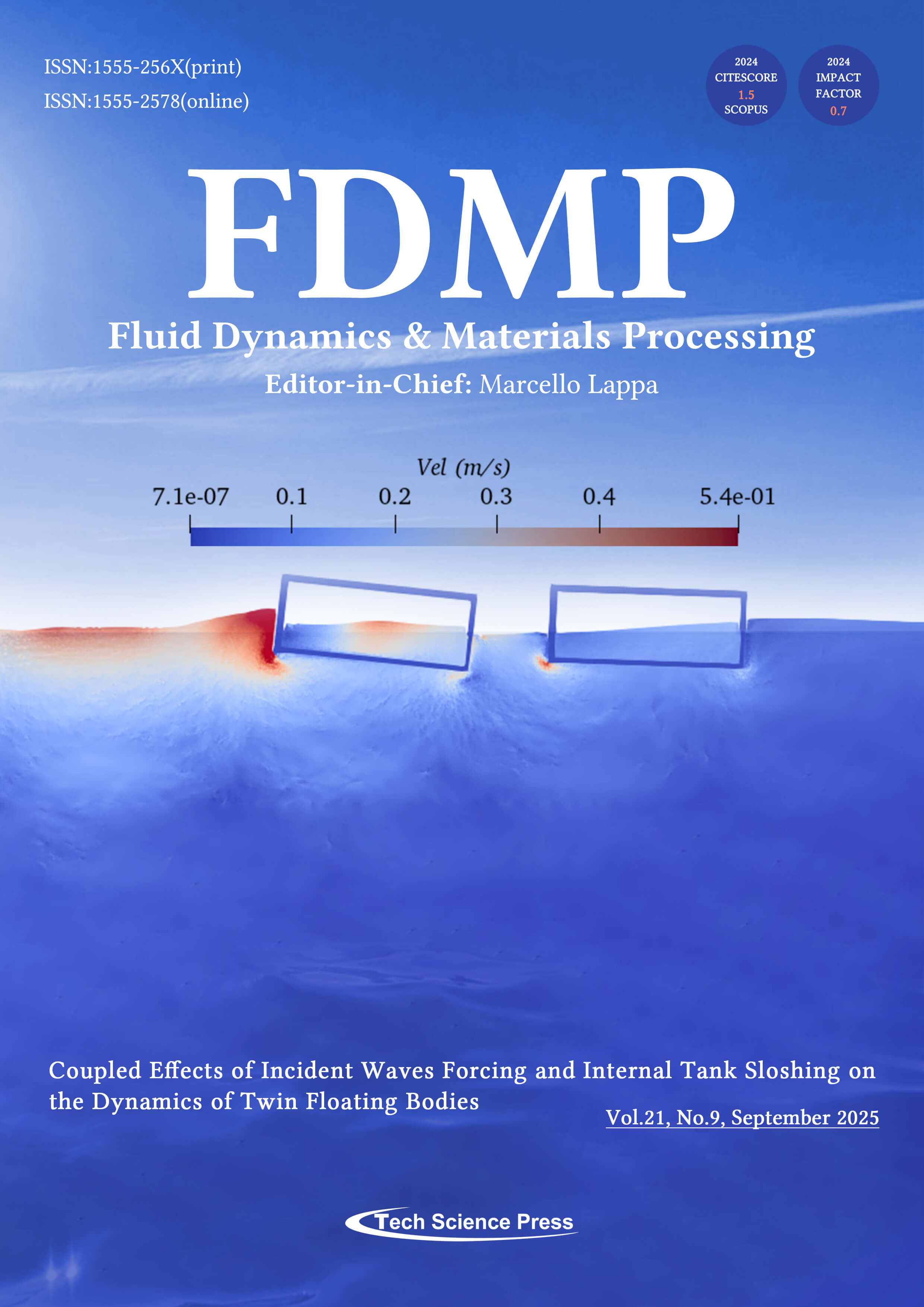
This study employs smoothed particle hydrodynamics (SPH) simulations to investigate the dynamic responses and load characteristics of two free-floating bodies arranged side by side, undergoing both incident wave forcing and internal sloshing effects. The figure illustrates the configuration of the twin floating bodies within the tank, together with the associated flow field distributions.

View this paper

  • Open AccessOpen Access

    ARTICLE

    Coupled Effects of Incident Waves Forcing and Internal Tank Sloshing on the Dynamics of Twin Floating Bodies

    Jialong Jiao1, Mengyun Jiang1, Hang Xie2,3,*, Yuanming Chen1
    FDMP-Fluid Dynamics & Materials Processing, Vol.21, No.9, pp. 2075-2100, 2025, DOI:10.32604/fdmp.2025.069064 - 30 September 2025
    Abstract The growing demand for ocean space has generated significant interest in multi-body floating systems, where gap resonance in confined regions plays a critical role in ensuring the safety of offshore operations. This study develops a numerical tank model using the Smoothed Particle Hydrodynamics (SPH) method, implemented through the open-source code DualSPHysics, to investigate hydrodynamic resonance in a twin-floater system and to examine the influence of internal tank sloshing on its hydrodynamic characteristics. The hydrodynamic behavior of the gap flow between a fixed twin-floater system in the numerical tank is validated through systematic comparison with experimental… More >

  • Open AccessOpen Access

    REVIEW

    Fluid Dynamics of Quantum Dot Inks: Non-Newtonian Behavior and Precision Control in Advanced Printing

    Zhen Gong#, Siyu Chen#, Zhenyu Feng, Dawang Li, Le Zhang, Meiting Xu, Yanping Lin, Huixin Huang, Dan Jiang, Caiyi Wu, Yichun Ke, Zhonghui Du*, Ning Zhao, Hongbo Liu*
    FDMP-Fluid Dynamics & Materials Processing, Vol.21, No.9, pp. 2101-2129, 2025, DOI:10.32604/fdmp.2025.068946 - 30 September 2025
    Abstract Quantum dot inks (QDIs) represent an emerging functional material that integrates nanotechnology and fluid engineering, demonstrating significant application potential in flexible optoelectronics and high-color gamut displays. Their wide applicability is due to a unique quantum confinement effect that enables precise spectral tunability and solution-processable properties. However, the complex fluid dynamics associated with QDIs at micro-/nano-scales severely limit the accuracy of inkjet printing and pattern deposition. This review systematically addresses recent advances in the hydrodynamics of QDIs, establishing scientific mechanisms and key technical breakthroughs from an interdisciplinary perspective. Current research has focused on three optimization directions:… More >

  • Open AccessOpen Access

    ARTICLE

    Two-Dimensional Numerical Study on the Flow Past Two Staggered Cylinders in a Channel

    Zenan Lai, Deming Nie*
    FDMP-Fluid Dynamics & Materials Processing, Vol.21, No.9, pp. 2131-2148, 2025, DOI:10.32604/fdmp.2025.068091 - 30 September 2025
    (This article belongs to the Special Issue: Recent Advances in Computational Fluid Dynamics)
    Abstract The lattice Boltzmann method (LBM) is employed to simulate flow around two staggered cylinders within a confined channel. The numerical model is validated against existing experimental data by comparing drag coefficients and Strouhal numbers in the single-cylinder configuration. The study systematically investigates the influence of vertical () and horizontal () spacing between the cylinders, as well as the Reynolds number ( = 0.1–160), on the hydrodynamic forces, streamline patterns, and vortex dynamics. Results indicate that reducing the horizontal spacing  suppresses flow separation behind the upstream cylinder, while either excessively small or large vertical spacing  diminishes separation… More >

  • Open AccessOpen Access

    ARTICLE

    Unsteady Flow Dynamics and Phase Transition Behavior of CO2 in Fracturing Wellbores

    Zihao Yang1,*, Jiarui Cheng1, Zefeng Li2, Yirong Yang1, Linghong Tang1, Wenlan Wei1
    FDMP-Fluid Dynamics & Materials Processing, Vol.21, No.9, pp. 2149-2176, 2025, DOI:10.32604/fdmp.2025.067739 - 30 September 2025
    (This article belongs to the Special Issue: Multiphase Fluid Flow Behaviors in Oil, Gas, Water, and Solid Systems during CCUS Processes in Hydrocarbon Reservoirs)
    Abstract This study presents a two-dimensional, transient model to simulate the flow and thermal behavior of CO2 within a fracturing wellbore. The model accounts for high-velocity flow within the tubing and radial heat exchange between the wellbore and surrounding formation. It captures the temporal evolution of temperature, pressure, flow velocity, and fluid density, enabling detailed analysis of phase transitions along different tubing sections. The influence of key operational and geological parameters, including wellhead pressure, injection velocity, inlet temperature, and formation temperature gradient, on the wellbore’s thermal and pressure fields is systematically investigated. Results indicate that due to… More >

  • Open AccessOpen Access

    ARTICLE

    Biomimetic Flow Field Inspired by Sunflower Phyllotaxis: Design and Performance Optimization for Solid Oxide Fuel Cells

    Liangxiu Zhang1, Qinghai Zhao2,3,*, Feiteng Cheng1
    FDMP-Fluid Dynamics & Materials Processing, Vol.21, No.9, pp. 2177-2199, 2025, DOI:10.32604/fdmp.2025.068499 - 30 September 2025
    (This article belongs to the Special Issue: Fluid Mechanics & Thermodynamics in Renewable Energy and HVAC Systems)
    Abstract To advance the performance of solid oxide fuel cells (SOFCs), this work proposes a novel biomimetic flow field architecture inspired by the geometric arrangement of sunflower florets. Drawing on natural principles of optimal spatial distribution, a multi-physics simulation model of the resulting Sunflower Bionic Flow Field (SBFF) was developed. Building upon this foundation, an enhanced configuration was introduced by integrating an annular channel, yielding a modified variant referred to as Modified Sunflower Bionic Flow Field (MSBFF). For comparative purposes, a conventional Traditional Parallel Flow Field (TPFF) was also analyzed under identical conditions. Simulation results underscore… More >

  • Open AccessOpen Access

    ARTICLE

    Six-Degree-of-Freedom Motion Analysis of High-Speed Craft Navigating through Variable Marine Environments

    Xiaoyang Wu1, Wenchao Han2, Min Kuang2,*, Xinqi Wang2, Wenhao Xie2
    FDMP-Fluid Dynamics & Materials Processing, Vol.21, No.9, pp. 2201-2223, 2025, DOI:10.32604/fdmp.2025.067081 - 30 September 2025
    (This article belongs to the Special Issue: Recent Advancements in Wave Dynamics Models for Fluids: Analytical and Numerical Approaches)
    Abstract The dynamic behavior of high-speed craft navigating through variable sea states plays a pivotal role in ensuring maritime safety. However, many existing simulation approaches rely on linear or overly simplified representations of the marine environment, thereby limiting the fidelity of motion predictions. This study explores the motion characteristics of a 4.5-t high-speed vessel by conducting fully coupled numerical simulations using the STAR-CCM+ software. The analysis considers both calm and varying sea conditions, incorporating fluctuations in wave height, wavelength, and wind speed to reflect more realistic operating scenarios. Simulation results reveal that the vessel’s hydrodynamic response… More >

  • Open AccessOpen Access

    ARTICLE

    Temperature-Difference Driven Aggregation of Pulling- and Pushing-Typed Microswimmers in a Channel

    Jingwen Wang, Ming Xu, Deming Nie*
    FDMP-Fluid Dynamics & Materials Processing, Vol.21, No.9, pp. 2225-2251, 2025, DOI:10.32604/fdmp.2025.068327 - 30 September 2025
    (This article belongs to the Special Issue: Effect of Materials Surface Properties on Fluid Dynamics Behavior)
    Abstract This study employs the fluctuating-lattice Boltzmann method to investigate temperature-gradient-driven aggregation of microswimmers, specifically, pulling-type (pullers) and pushing-type (pushers), within a fluid confined by two channel walls. The analysis incorporates the Brownian motion of both swimmer types and introduces key dimensionless parameters, including the swimming Reynolds, Prandtl, and Lewis numbers, to characterize the influences of self-propulsion strength, thermal diffusivity, and Brownian diffusivity on aggregation efficiency and behavior. Our findings reveal that pushers tend to aggregate either along the channel centerline or near the channel walls under conditions of thermal gradients imposed by heated or cooled More >

  • Open AccessOpen Access

    ARTICLE

    Multiphysics Simulation of Flow and Heat Transfer in Titanium Slag Smelting within an Electric Arc Furnace

    Yifan Wang1, Shan Qing1,2,*, Jifan Li1,3,*, Xiaohui Zhang1,3, Junxiao Wang4
    FDMP-Fluid Dynamics & Materials Processing, Vol.21, No.9, pp. 2253-2272, 2025, DOI:10.32604/fdmp.2025.067429 - 30 September 2025
    Abstract Heat and mass transfer within an electric arc furnace are strongly influenced by extreme temperatures and complex electromagnetic fields. Variations in temperature distribution play a crucial role in determining melt flow patterns and in the formation of stagnant regions, commonly referred to as dead zones. To better understand the internal flow dynamics and thermal behavior of the furnace, this study develops a multiphysics coupled model that integrates fluid heat transfer with Maxwell’s electromagnetic field equations. Numerical simulations are conducted to systematically examine how key operational parameters, such as electric current and arc characteristics, affect the… More >

  • Open AccessOpen Access

    ARTICLE

    Shallow Water Waves with Surface Tension by Laplace–Adomian Decomposition

    Oswaldo González-Gaxiola1, Yakup Yildirim2,3,4, Luminita Moraru5,6, Anjan Biswas7,8,9,10,*
    FDMP-Fluid Dynamics & Materials Processing, Vol.21, No.9, pp. 2273-2287, 2025, DOI:10.32604/fdmp.2025.067959 - 30 September 2025
    (This article belongs to the Special Issue: Recent Advancements in Wave Dynamics Models for Fluids: Analytical and Numerical Approaches)
    Abstract This study presents a numerical investigation of shallow water wave dynamics with particular emphasis on the role of surface tension. In the absence of surface tension, shallow water waves are primarily driven by gravity and are well described by the classical Boussinesq equation, which incorporates fourth-order dispersion. Under this framework, solitary and shock waves arise through the balance of nonlinearity and gravity-induced dispersion, producing waveforms whose propagation speed, amplitude, and width depend largely on depth and initial disturbance. The resulting dynamics are comparatively smoother, with solitary waves maintaining coherent structures and shock waves displaying gradual… More >

    Graphic Abstract
    Shallow Water Waves with Surface Tension by Laplace–Adomian Decomposition

  • Open AccessOpen Access

    ARTICLE

    Optimized Foil-Based Impeller Design for Enhanced Power Recovery in Pump-as-Turbine Applications

    Ali Abdulshaheed1,*, Faizal Mustapha1, Mohd Anuar2
    FDMP-Fluid Dynamics & Materials Processing, Vol.21, No.9, pp. 2289-2304, 2025, DOI:10.32604/fdmp.2025.066983 - 30 September 2025
    Abstract A pump operating as a turbine (PAT) is a type of hydraulic machine capable of functioning both as a pump and as a turbine by reversing the flow direction. The pump-as-turbine (PAT) approach presents an effective method of hydropower generation, particularly suitable for addressing the increasing global energy demands in rural and remote areas. In addition to its adaptability, PAT-based micro-hydropower systems typically incur lower operating costs than conventional hydrodynamic turbines, despite requiring higher initial investment. Recent research has focused on integrating PATs into pipe distribution systems to harness untapped hydraulic energy. This study presents… More >

  • Open AccessOpen Access

    ARTICLE

    CFD Simulation of Passenger Car Aerodynamics and Body Parameter Optimization

    Jichao Li, Xuexin Zhu, Cong Zhang, Shiwang Dang, Guang Chen*
    FDMP-Fluid Dynamics & Materials Processing, Vol.21, No.9, pp. 2305-2329, 2025, DOI:10.32604/fdmp.2025.067087 - 30 September 2025
    (This article belongs to the Special Issue: Recent Advances in Computational Fluid Dynamics)
    Abstract The rapid advancement of technology and the increasing speed of vehicles have led to a substantial rise in energy consumption and growing concern over environmental pollution. Beyond the promotion of new energy vehicles, reducing aerodynamic drag remains a critical strategy for improving energy efficiency and lowering emissions. This study investigates the influence of key geometric parameters on the aerodynamic drag of vehicles. A parametric vehicle model was developed, and computational fluid dynamics (CFD) simulations were conducted to analyse variations in the drag coefficient () and pressure distribution across different design configurations. The results reveal that More >

  • Open AccessOpen Access

    ARTICLE

    CO2 Injection to Mitigate Reservoir Damage in Edge/Bottom-Water Condensate Gas Reservoirs

    Wen Wang1,*, Yulong Zhao1, Bo Li2, Bowen Guan1, Haoran Sun1,3, Tao Zhang1
    FDMP-Fluid Dynamics & Materials Processing, Vol.21, No.9, pp. 2331-2357, 2025, DOI:10.32604/fdmp.2025.068990 - 30 September 2025
    (This article belongs to the Special Issue: Fluid and Thermal Dynamics in the Development of Unconventional Resources III)
    Abstract Condensate gas reservoirs have attracted increasing attention in recent years due to their significant development potential and dual value from both natural gas and condensate oil. However, their exploitation is often hindered by the dual challenges of retrograde condensation and water invasion, which can markedly reduce recovery factors. CO2 injection offers a promising solution by alleviating condensate blockage, suppressing water influx, and simultaneously enabling geological CO2 storage. Accordingly, research on optimizing CO2 injection to mitigate formation damage is critical for the efficient development and management of edge- and bottom-water condensate gas reservoirs. In this study, a long-core… More >

Per Page:

Share Link