Home / Journals / FDMP / Vol.21, No.12, 2025
Special Issues
Table of Content
cover

On the Cover

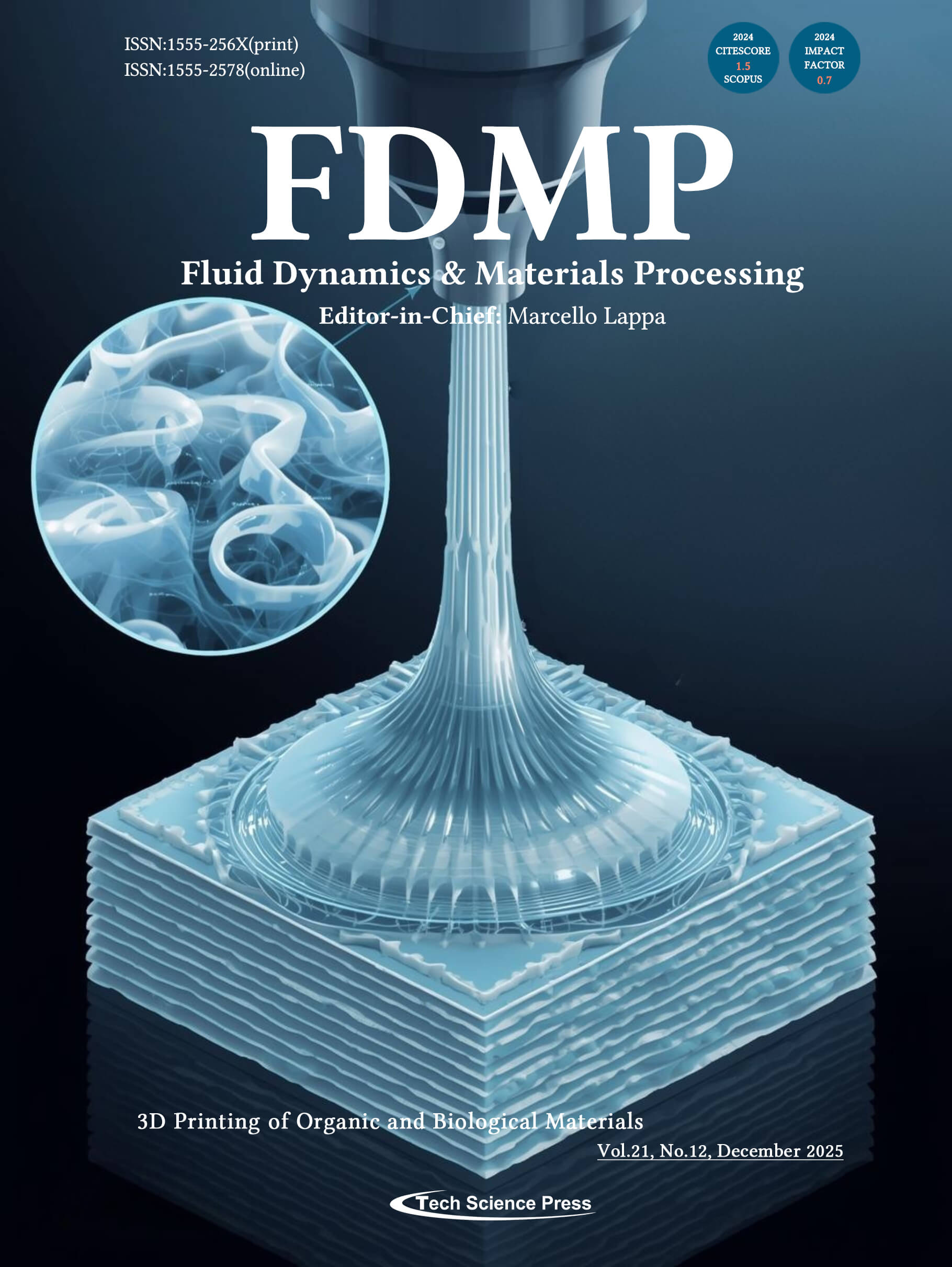
This review examines the use of biomaterials in 3D bioprinting for tissue engineering, focusing on how their rheological properties, such as viscoelasticity and thixotropy, influence printability, structural fidelity, and cell viability. The cover illustration depicts a 3D bioprinted construct being fabricated layer by layer, with distinct bioinks flowing through an extrusion nozzle and assembling into complex, tissue-mimetic architectures. The magnified views highlight the interplay between material flow, scaffold geometry, and cellular distribution, illustrating how bioink selection and printing technique collectively govern the mechanical stability and biological performance of engineered tissues. Together, the figure conveys the core mechanisms by which 3D bioprinting translates biomaterial properties into functional, transplantable tissue constructs.
The cover image was produced with AI-generated content via Canva, and the authors verify that it contains no copyrighted elements or misleading representations.

View this paper

  • Open AccessOpen Access

    REVIEW

    3D Printing of Organic and Biological Materials

    Priyadarshini Patel, Komal Parmar*
    FDMP-Fluid Dynamics & Materials Processing, Vol.21, No.12, pp. 2855-2903, 2025, DOI:10.32604/fdmp.2025.069428 - 31 December 2025
    Abstract Tissue engineering has advanced remarkably in developing functional tissue substitutes for pharmaceutical and regenerative applications. Among emerging technologies, three-dimensional (3D) printing, or additive manufacturing, enables precise fabrication of biocompatible materials, living cells, and scaffolds into complex, viable constructs. Within regenerative medicine, 3D bioprinting addresses the growing demand for transplantable tissues and organs by assembling biological materials that replicate native architectures. This paper reviews biomaterials used in 3D bioprinting, emphasizing how their rheological behavior, particularly viscoelasticity and thixotropy, governs printability, structural fidelity, and cellular viability. The advantages and limitations of natural, synthetic, and composite bioinks are More >

    Graphic Abstract

    3D Printing of Organic and Biological Materials

  • Open AccessOpen Access

    ARTICLE

    Vortex-Induced Vibration Prediction in Floating Structures via Unstructured CFD and Attention-Based Convolutional Modeling

    Yan Li1,2,*, Yibin Wu1,2, Bo Zhang1,2
    FDMP-Fluid Dynamics & Materials Processing, Vol.21, No.12, pp. 2905-2925, 2025, DOI:10.32604/fdmp.2025.072979 - 31 December 2025
    Abstract Traditional Computational Fluid Dynamics (CFD) simulations are computationally expensive when applied to complex fluid–structure interaction problems and often struggle to capture the essential flow features governing vortex-induced vibrations (VIV) of floating structures. To overcome these limitations, this study develops a hybrid framework that integrates high-fidelity CFD modeling with deep learning techniques to enhance the accuracy and efficiency of VIV response prediction. First, an unstructured finite-volume fluid–structure coupling model is established to generate high-resolution flow field data and extract multi-component time-series feature tensors. These tensors serve as inputs to a Squeeze-and-Excitation Convolutional Neural Network (SE-CNN), which… More >

  • Open AccessOpen Access

    ARTICLE

    Effect of Fin Spacing on Frost Growth and Airflow Dynamics in ASHP Evaporators

    Zhengqing Zhang1,2,3,*, Xiaojun Yuan2, Hui Wu2
    FDMP-Fluid Dynamics & Materials Processing, Vol.21, No.12, pp. 2927-2943, 2025, DOI:10.32604/fdmp.2025.071115 - 31 December 2025
    (This article belongs to the Special Issue: Fluid Mechanics & Thermodynamics in Renewable Energy and HVAC Systems)
    Abstract Frost accumulation on the evaporator fins of air source heat pumps (ASHPs) severely degrades heat transfer performance and overall system efficiency. To address this, the present study employs computational fluid dynamics (CFD) to investigate how fin spacing influences frosting behavior, emphasizing the coupled evolution of frost thickness, density, airflow, and temperature distribution within fin channels. Results reveal that fin spacing is a key parameter governing both the extent and rate of frost growth. Wider fin spacing enhances frost accumulation, with a final frost mass of 6.41 g at 12 mm, about 71.8% higher than at More >

  • Open AccessOpen Access

    ARTICLE

    Jet Pump Structural Optimization through CFD Analysis and Experimental Validation

    Zhengqiang Peng1,*, Rendong Feng1, Fang Han1, Jing Guo1, Shen Chi1, Wenao Huang1, Jie Luo2
    FDMP-Fluid Dynamics & Materials Processing, Vol.21, No.12, pp. 2945-2961, 2025, DOI:10.32604/fdmp.2025.073281 - 31 December 2025
    (This article belongs to the Special Issue: Model-Based Approaches in Fluid Mechanics: From Theory to industrial Applications)
    Abstract Jet pumps often suffer from efficiency losses due to the intense mixing of power and suction fluids, which leads to significant kinetic energy dissipation. Enhancing the efficiency of such pumps requires careful optimization of their structural parameters. In this study, a computational fluid dynamics (CFD) model of a hydraulic jet sand-flushing pump is developed to investigate the effects of throat-to-nozzle distance, area ratio, and throat length on the pump’s sand-carrying performance. An orthogonal experimental design is employed to optimize the structural parameters, while the influence of sand characteristics on pumping performance is systematically evaluated. Complementary… More >

  • Open AccessOpen Access

    ARTICLE

    Structural Optimization of Nozzles for Gas-Liquid Two-Phase Jets

    Fengxia Shi1, Jian Zhao2,3,*, Xiaodong Dai1, Guoxin Zhang4, Yuan Lu4, Yuyan Shang1
    FDMP-Fluid Dynamics & Materials Processing, Vol.21, No.12, pp. 2963-2980, 2025, DOI:10.32604/fdmp.2025.073836 - 31 December 2025
    Abstract Gas–liquid two-phase jets exhibit markedly enhanced impact performance due to the violent collapse of entrained bubbles, which generates transient microjets and shock waves. The geometry of the nozzle is a decisive factor in controlling jet formation, flow modulation, and impact efficiency. In this work, the structural optimization of gas–liquid two-phase nozzles was investigated numerically using the Volume of Fluid (VOF). Simulation results show that the aero-shaped nozzle delivers a significantly stronger impact on the target surface than conventional geometries. Specifically, its impact pressure is 21% higher than that of a conical straight nozzle and 37%… More >

    Graphic Abstract

    Structural Optimization of Nozzles for Gas-Liquid Two-Phase Jets

  • Open AccessOpen Access

    ARTICLE

    Sand Production in Unconsolidated Sandstone: Experimental Analysis of Multiphase Flow During Cyclic Injection and Production

    Tianen Liu1,2, Kun Dai1,2, Shiju Ren1,2, Chuanxiang Zhang1,2, Xiaoling Tang3,*, Jinghong Hu3,*, Yidong Cai3, Jun Lu3
    FDMP-Fluid Dynamics & Materials Processing, Vol.21, No.12, pp. 2981-2995, 2025, DOI:10.32604/fdmp.2025.073859 - 31 December 2025
    (This article belongs to the Special Issue: Subsurface Fluid Flow Dynamics and Applications in Carbon Reduction Technologies)
    Abstract Many mature onshore oilfields have entered a high-water-cut stage, with reservoir recovery approaching economic limits. Converting these depleted or nearly depleted reservoirs into underground gas storage (UGS) facilities offers an efficient way to leverage their substantial storage potential. During cyclic gas injection and withdrawal, however, the reservoir experiences complex three-phase flow and repeated stress fluctuations, which can induce rock fatigue, inelastic deformation, and ultimately sand production. This study uses controlled physical experiments to simulate sand production in reservoir rocks subjected to alternating gas injection and production under three-phase conditions. After preparing oil-water-saturated cores through waterflooding,… More >

  • Open AccessOpen Access

    ARTICLE

    Numerical Investigation of Carbon Capture, Utilization, and Storage–Enhanced Gas Recovery

    Nan Qin1, Shaofeng Ning2,*, Zihan Zhao1,2, Yu Luo1, Bo Chen1, Xiaoxu Liu1, Yongming He2
    FDMP-Fluid Dynamics & Materials Processing, Vol.21, No.12, pp. 2997-3009, 2025, DOI:10.32604/fdmp.2025.074456 - 31 December 2025
    (This article belongs to the Special Issue: Multiphase Fluid Flow Behaviors in Oil, Gas, Water, and Solid Systems during CCUS Processes in Hydrocarbon Reservoirs)
    Abstract Balancing CO2 emission reduction with enhanced gas recovery in carbonate reservoirs remains a key challenge in subsurface energy engineering. This study focuses on the Maokou Formation gas reservoir in the Wolonghe Gas Field, Sichuan Basin, and employs a mechanistic model integrated with numerical simulations that couple CO2–water–rock geochemical interactions to systematically explore the principal engineering and chemical factors governing Carbon Capture, Utilization, and Storage–Enhanced Gas Recovery (CCUS–EGR). The analysis reveals that both the injection–production ratio and gas injection rate exhibit optimal ranges. Maximum gas output under single-parameter variation occurs at an injection–production ratio of 0.7 and… More >

  • Open AccessOpen Access

    ARTICLE

    A Dynamic IPR Framework for Predicting Shale Oil Well Productivity in the Spontaneous Flow Stage

    Sheng Lei1,2,3, Guanglong Sheng1,2,3,*, Hui Zhao1,2,3
    FDMP-Fluid Dynamics & Materials Processing, Vol.21, No.12, pp. 3011-3031, 2025, DOI:10.32604/fdmp.2025.073802 - 31 December 2025
    (This article belongs to the Special Issue: Multiphase Fluid Flow Behaviors in Oil, Gas, Water, and Solid Systems during CCUS Processes in Hydrocarbon Reservoirs)
    Abstract This study investigates the unsteady flow characteristics of shale oil reservoirs during the depletion development process, with a particular focus on production behavior following fracturing and shut-in stages. Shale reservoirs exhibit distinctive production patterns that differ from traditional oil reservoirs, as their inflow performance does not conform to the classic steady-state relationship. Instead, production is governed by unsteady-state flow behavior, and the combined effects of the wellbore and choke cause the inflow performance curve to evolve dynamically over time. To address these challenges, this study introduces the concept of a “Dynamic IPR curve” and develops… More >

  • Open AccessOpen Access

    ARTICLE

    Time-Resolved Experimental Analysis of Granite–Mortar Interface Permeability under High-Temperature Conditions

    Wei Chen*, Yuanteng Zhao, Yue Liang
    FDMP-Fluid Dynamics & Materials Processing, Vol.21, No.12, pp. 3033-3053, 2025, DOI:10.32604/fdmp.2025.073778 - 31 December 2025
    Abstract In deep underground engineering, geological disposal of nuclear waste, and geothermal development, the granite–mortar interface represents a critical weak zone that strongly influences sealing performance under high-temperature conditions. While previous studies have primarily focused on single materials, the dynamic evolution of interface permeability under thermal loading remains insufficiently understood. In this study, time-resolved gas permeability measurements under thermal cycling (20°C → 150°C → 20°C) were conducted, complemented by multi-scale microstructural characterization, to investigate the nonlinear evolution of permeability. Experimental results indicate that interface permeability at room temperature is approximately one order of magnitude higher than… More >

  • Open AccessOpen Access

    ARTICLE

    Experimental Study of Hydrogen Distribution in Natural Gas under Static Conditions

    Mengjie Wang1, Jingfa Li2,*, Bo Yu2, Nianrong Wang3, Xiaofeng Wang3, Tao Hu4
    FDMP-Fluid Dynamics & Materials Processing, Vol.21, No.12, pp. 3055-3072, 2025, DOI:10.32604/fdmp.2025.071675 - 31 December 2025
    (This article belongs to the Special Issue: Theoretical Foundations and Applications of Multiphase Flow in Pipeline Engineering)
    Abstract The adaptation of existing natural gas pipelines for hydrogen transportation has attracted increasing attention in recent years. Yet, whether hydrogen and natural gas stratify under static conditions remains a subject of debate, and experimental evidence is still limited. This study presents an experimental investigation of the concentration distribution of hydrogen–natural gas mixtures under static conditions. Hydrogen concentration was measured using a KTL-2000M-H hydrogen analyzer, with a measurement range of 0–30% (by volume), an accuracy of 1% full scale (FS), and a resolution of 0.01%. Experiments were conducted in a 300 cm riser, filled with uniformly… More >

  • Open AccessOpen Access

    ARTICLE

    Numerical Simulation of Microscopic Seepage Mechanisms in Gas Reservoir Storage Systems

    Yulong Zhao1, Yang Luo1,*, Yuming Luo2, Yulai Pang2, Ruihan Zhang1, Zihan Zhao3
    FDMP-Fluid Dynamics & Materials Processing, Vol.21, No.12, pp. 3073-3090, 2025, DOI:10.32604/fdmp.2025.070685 - 31 December 2025
    (This article belongs to the Special Issue: Fluid and Thermal Dynamics in the Development of Unconventional Resources III)
    Abstract The development of underground gas storage (UGS) systems is vital for maintaining stability between energy supply and demand. This study explores the dynamic response mechanisms of carbonate reservoirs subjected to intense injection–production cycling during UGS operations. By integrating three-dimensional digital core technology with a coupled poro-mechanical model, we simulate the pore-scale behavior of a representative Huangcaoxia UGS carbonate core. The results demonstrate that fluid–solid coupling effects markedly amplify permeability reduction, far exceeding the influence of porosity variations alone. More significantly, gas production leads to a pronounced decline in permeability driven by rising effective stress, arising More >

  • Open AccessOpen Access

    ARTICLE

    Numerical Investigation of Load Generation in U-Shaped Aqueducts under Lateral Excitation: Part II—Non-Resonant Sloshing

    Yang Dou1, Hao Qin1, Yuzhi Zhang1,2, Ning Wang1, Haiqing Liu3,4, Wanli Yang1,2,4,*
    FDMP-Fluid Dynamics & Materials Processing, Vol.21, No.12, pp. 3091-3122, 2025, DOI:10.32604/fdmp.2025.070082 - 31 December 2025
    Abstract In recent years, tuned liquid dampers (TLDs) have emerged as a focal point of research due to their remarkable potential for structural vibration mitigation. Yet, progress in this field remains constrained by an incomplete understanding of the fundamental mechanisms governing sloshing-induced loads in liquid-filled containers. Aqueducts present a distinctive case, as the capacity of their contained water to function effectively as a TLD remains uncertain. To address this gap, the present study investigates the generation mechanisms of sloshing loads under non-resonant cases through a two-dimensional (2D) computational fluid dynamics (CFD) model developed in ANSYS Fluent.… More >

Per Page:

Share Link