
 Login
Login Register
 Submit a Paper
 Propose a Special lssue
 Open Access
REVIEW

3D Printing of Organic and Biological Materials
ROFEL Shri G.M. Bilakhia College of Pharmacy, Rajju Shroff ROFEL University, Vapi, 396191, India
* Corresponding Author: Komal Parmar. Email:
Fluid Dynamics & Materials Processing 2025, 21(12), 2855-2903. https://doi.org/10.32604/fdmp.2025.069428
Received 23 June 2025; Accepted 26 December 2025; Issue published 31 December 2025
 View Full Text
 Download PDF
Abstract
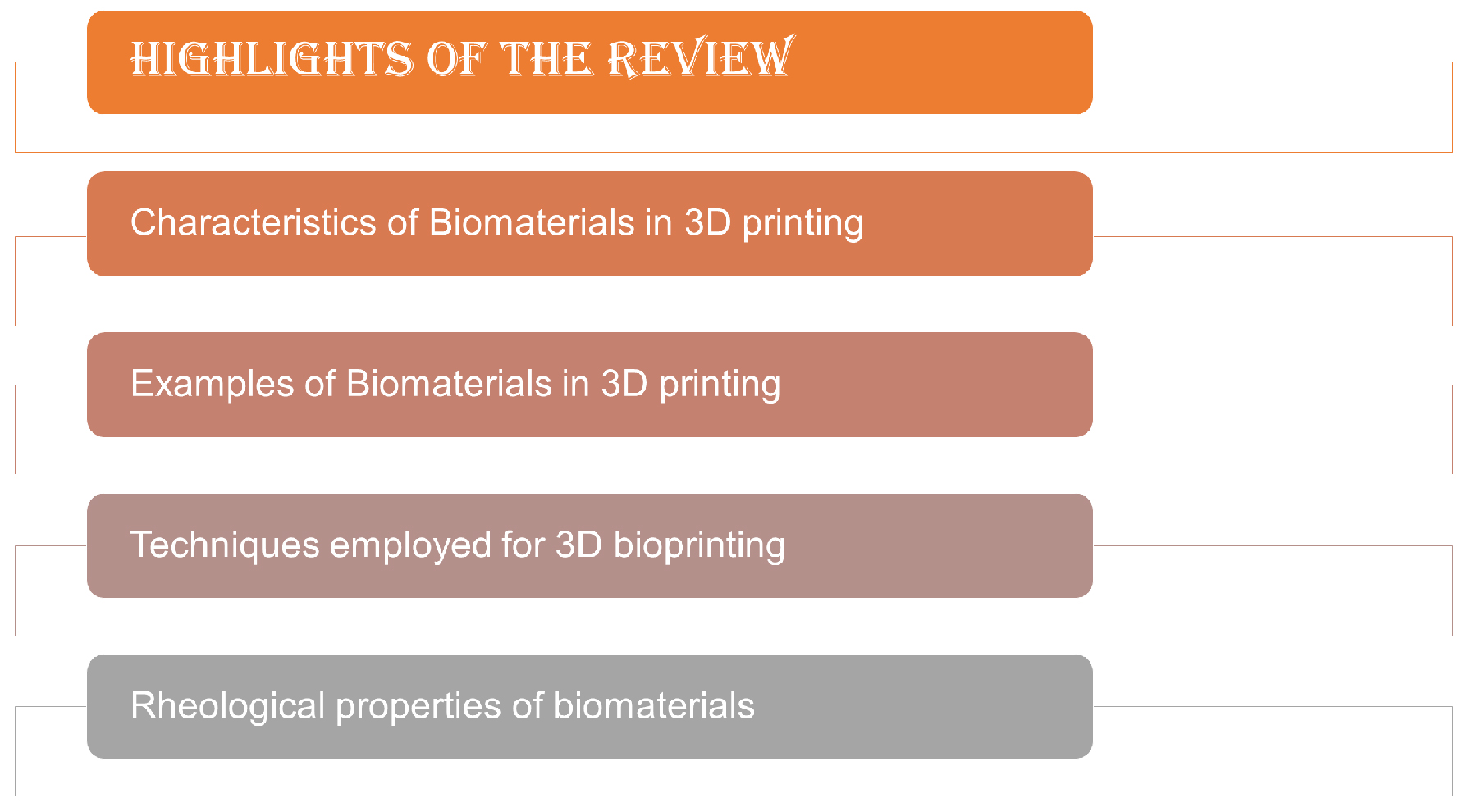
Tissue engineering has advanced remarkably in developing functional tissue substitutes for pharmaceutical and regenerative applications. Among emerging technologies, three-dimensional (3D) printing, or additive manufacturing, enables precise fabrication of biocompatible materials, living cells, and scaffolds into complex, viable constructs. Within regenerative medicine, 3D bioprinting addresses the growing demand for transplantable tissues and organs by assembling biological materials that replicate native architectures. This paper reviews biomaterials used in 3D bioprinting, emphasizing how their rheological behavior, particularly viscoelasticity and thixotropy, governs printability, structural fidelity, and cellular viability. The advantages and limitations of natural, synthetic, and composite bioinks are analyzed in relation to their mechanical performance and flow properties. In addition, common 3D bioprinting techniques such as extrusion, inkjet, and laser-assisted methods are outlined with reference to their compatibility with various material systems. Recent applications in bone, cartilage, vascular, skin, neural, cardiac, hepatic, and pulmonary tissue engineering are briefly summarized.Graphic Abstract
Keywords
3D bioprinting; biomaterials; scaffolds; tissue engineering
Cite This Article
APA Style
Patel, P., Parmar, K. (2025). 3D Printing of Organic and Biological Materials. Fluid Dynamics & Materials Processing, 21(12), 2855–2903. https://doi.org/10.32604/fdmp.2025.069428
Vancouver Style
Patel P, Parmar K. 3D Printing of Organic and Biological Materials. Fluid Dyn Mater Proc. 2025;21(12):2855–2903. https://doi.org/10.32604/fdmp.2025.069428
IEEE Style
P. Patel and K. Parmar, “3D Printing of Organic and Biological Materials,” Fluid Dyn. Mater. Proc., vol. 21, no. 12, pp. 2855–2903, 2025. https://doi.org/10.32604/fdmp.2025.069428
 Copyright © 2025 The Author(s). Published by Tech Science Press.
This work is licensed under a Creative Commons Attribution 4.0 International License , which permits unrestricted use, distribution, and reproduction in any medium, provided the original work is properly cited.
 Downloads
 Citation Tools
