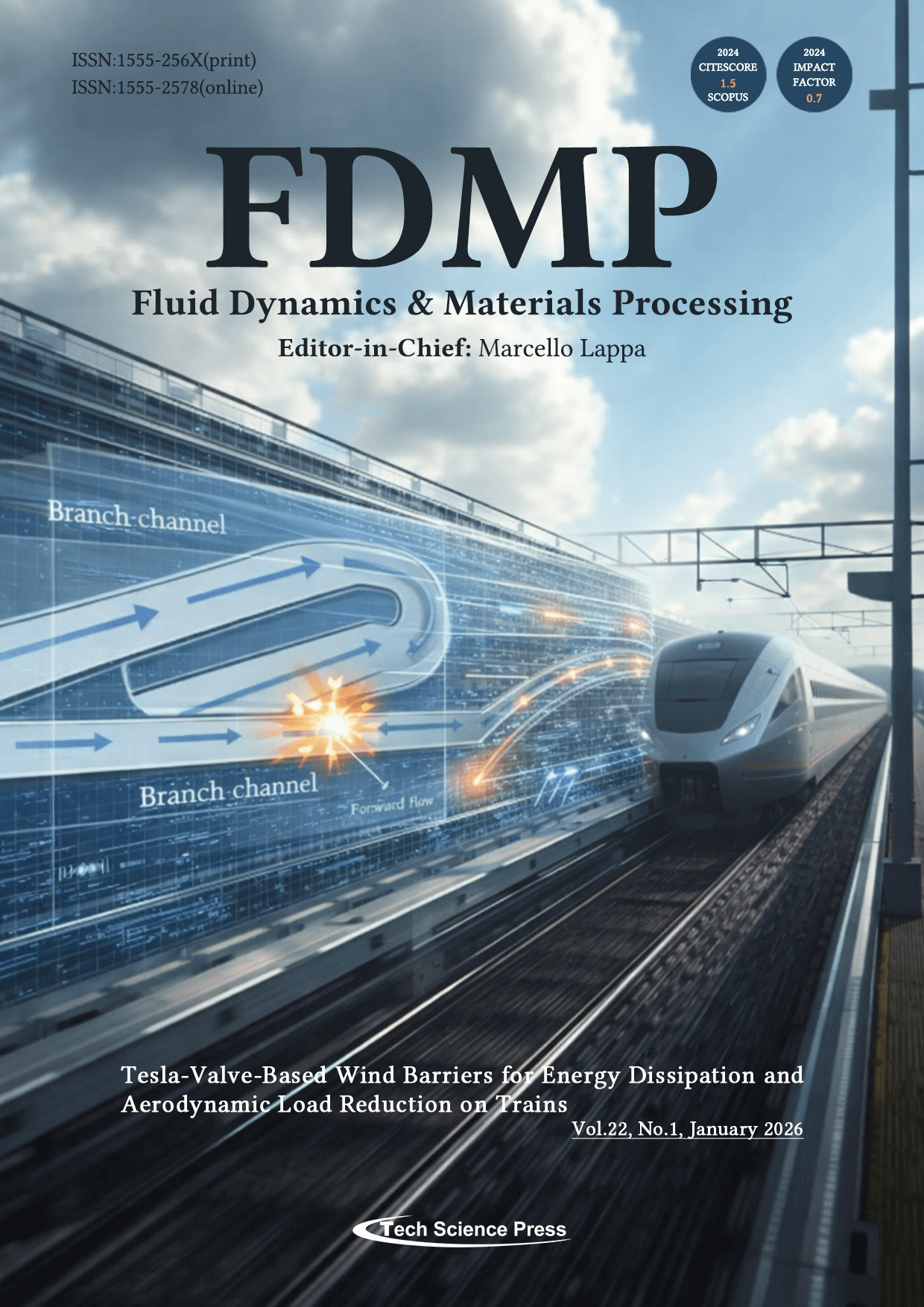
This study presents a novel wind barrier based on the Tesla valve concept, developed to improve the aerodynamic safety of high-speed trains exposed to extreme crosswind conditions. By integrating experimental measurements, numerical simulations, and parametric optimization, the work demonstrates that the proposed design enhances energy dissipation and substantially mitigates aerodynamic loads. Relative to conventional straight-channel barriers, the Tesla-type configuration significantly reduces lateral forces acting on the train and introduces additional stabilizing effects. These features make it a promising strategy for strengthening rail infrastructure resilience in the context of a changing climate. The accompanying illustration depicts the redirection and dissipation of incoming crosswinds within the Tesla-type channels.
This cover image was created using AI-generated content from "Canva". The authors confirm that no human likenesses, copyrighted elements, or misleading representations are included in the image.
View this paper

 Login
Login Register
 Submit a Paper
 Propose a Special lssue