
 Login
Login Register
 Submit a Paper
 Propose a Special lssue
 Open Access
ARTICLE
Flowback Behavior of Deep Coalbed Methane Horizontal Wells
1 China United Coalbed Methane National Engineering Research Center Co., Ltd., Beijing, China
2 PetroChina Coalbed Methane Co., Ltd., Beijing, China
3 Petrochina (Tianjin) International Petroleum Exploration & Development Technology Co., Ltd., Tianjin, China
4 School of Energy Resources, China University of Geosciences, Beijing, China
* Corresponding Author: Yanqing Feng. Email:
(This article belongs to the Special Issue: Multiphase Fluid Flow Behaviors in Oil, Gas, Water, and Solid Systems during CCUS Processes in Hydrocarbon Reservoirs)
Fluid Dynamics & Materials Processing 2026, 22(1), 10 https://doi.org/10.32604/fdmp.2026.075630
Received 05 November 2025; Accepted 27 January 2026; Issue published 06 February 2026
 View Full Text
 Download PDF
Abstract
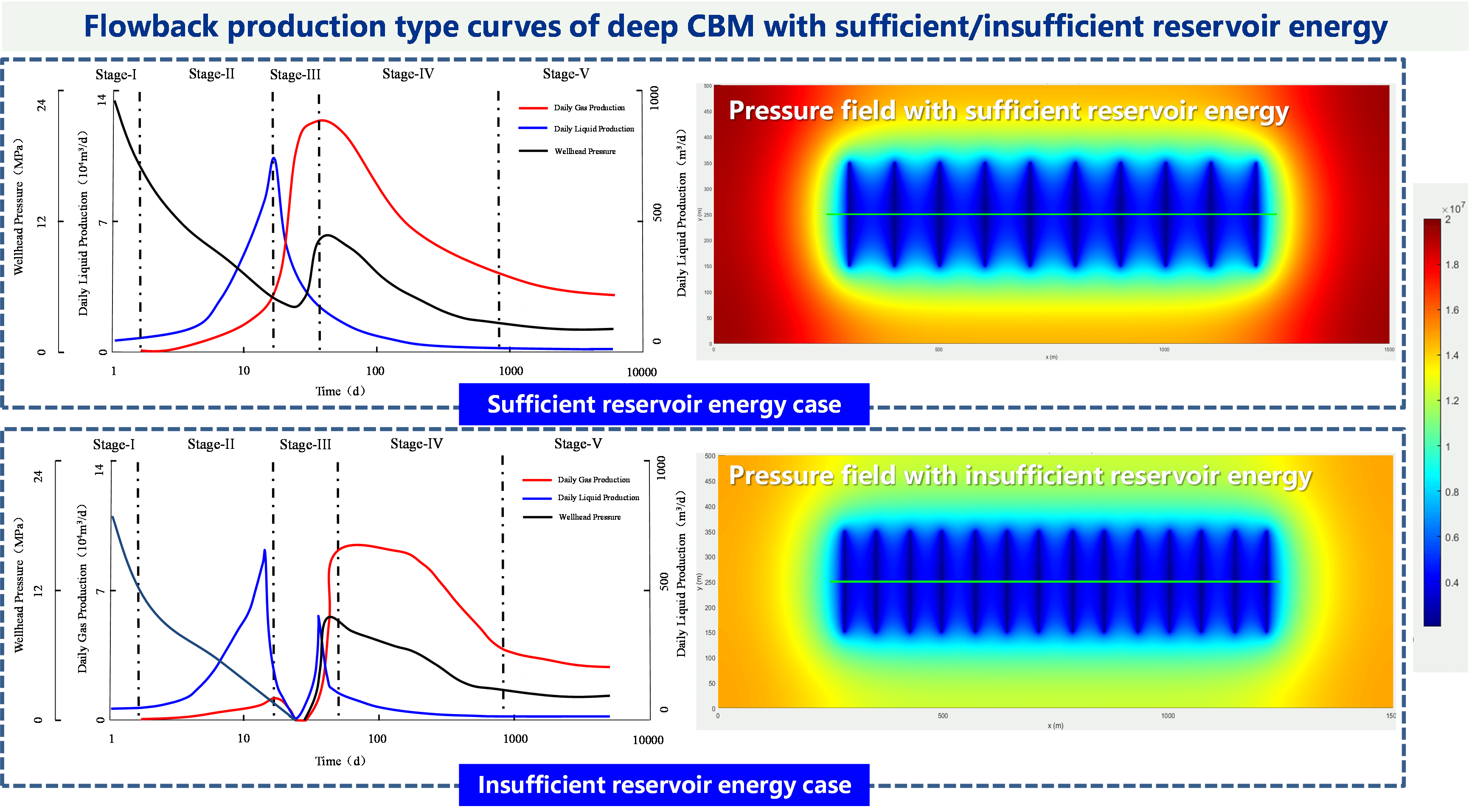
Significant differences exist between deep and medium-shallow coalbed methane (CBM) reservoirs. The unclear understanding of flowback and production behavior severely constrains the development of deep CBM resources. To address this challenge, guided by the gas-liquid two-phase flow theory in ultra-low permeability reservoirs, and integrating theoretical analysis, numerical simulation, and insights from production practices, this study classifies the flowback and production stages of deep CBM well considering the Daning-Jixian Block, Eastern Ordos Basin as a representative case. We summarize the flowback characteristics for each stage and establish a standard flowback production type curve, aiming to guide field operations. The results indicate that: (a) The production process of deep CBM horizontal wells can be divided into five distinct stages: initial single-phase water dewatering stage, initial gas appearance to peak water production stage, gas breakthrough to peak gas production stage, stable production and decline stage, and low-rate production stage. (b) Based on reservoir energy, two standard type curves for horizontal well flowback production are established: the ‘Sufficient Reservoir Energy’ type and the ‘Insufficient Reservoir Energy’ type. The former achieves a higher initial gas rate (up to 12 × 104 m3/d) but exhibits poorer stability, while the latter achieves a lower stable rate (up to 8 × 10⁴ m3/d) but demonstrates stronger stability. Numerical simulation confirms these behavioral patterns and reveals the underlying mechanisms related to the effectively drained area where pressure is significantly depleted. The findings from this study have guided the flowback production operations in 53 deep CBM wells with positive results, demonstrating high potential for broad application.Graphic Abstract
Keywords
Cite This Article
 Copyright © 2026 The Author(s). Published by Tech Science Press.
This work is licensed under a Creative Commons Attribution 4.0 International License , which permits unrestricted use, distribution, and reproduction in any medium, provided the original work is properly cited.
 Downloads
 Citation Tools
