
 Login
Login Register
 Submit a Paper
 Propose a Special lssue
 Open Access
ARTICLE
Pore-Scale Simulations to Enhance Development Strategies in Offshore Weak Water-Drive Reservoirs
1 CNOOC China Limited, Shanghai Branch, Shanghai, China
2 Hainan Institute of China University of Petroleum (Beijing), Sanya, China
3 State Key Laboratory of Petroleum Resources and Engineering, China University of Petroleum, Beijing, China
* Corresponding Author: Keliu Wu. Email:
(This article belongs to the Special Issue: Subsurface Fluid Flow Dynamics and Applications in Carbon Reduction Technologies)
Fluid Dynamics & Materials Processing 2026, 22(1), 6 https://doi.org/10.32604/fdmp.2026.074990
Received 22 October 2025; Accepted 26 January 2026; Issue published 06 February 2026
 View Full Text
 Download PDF
Abstract
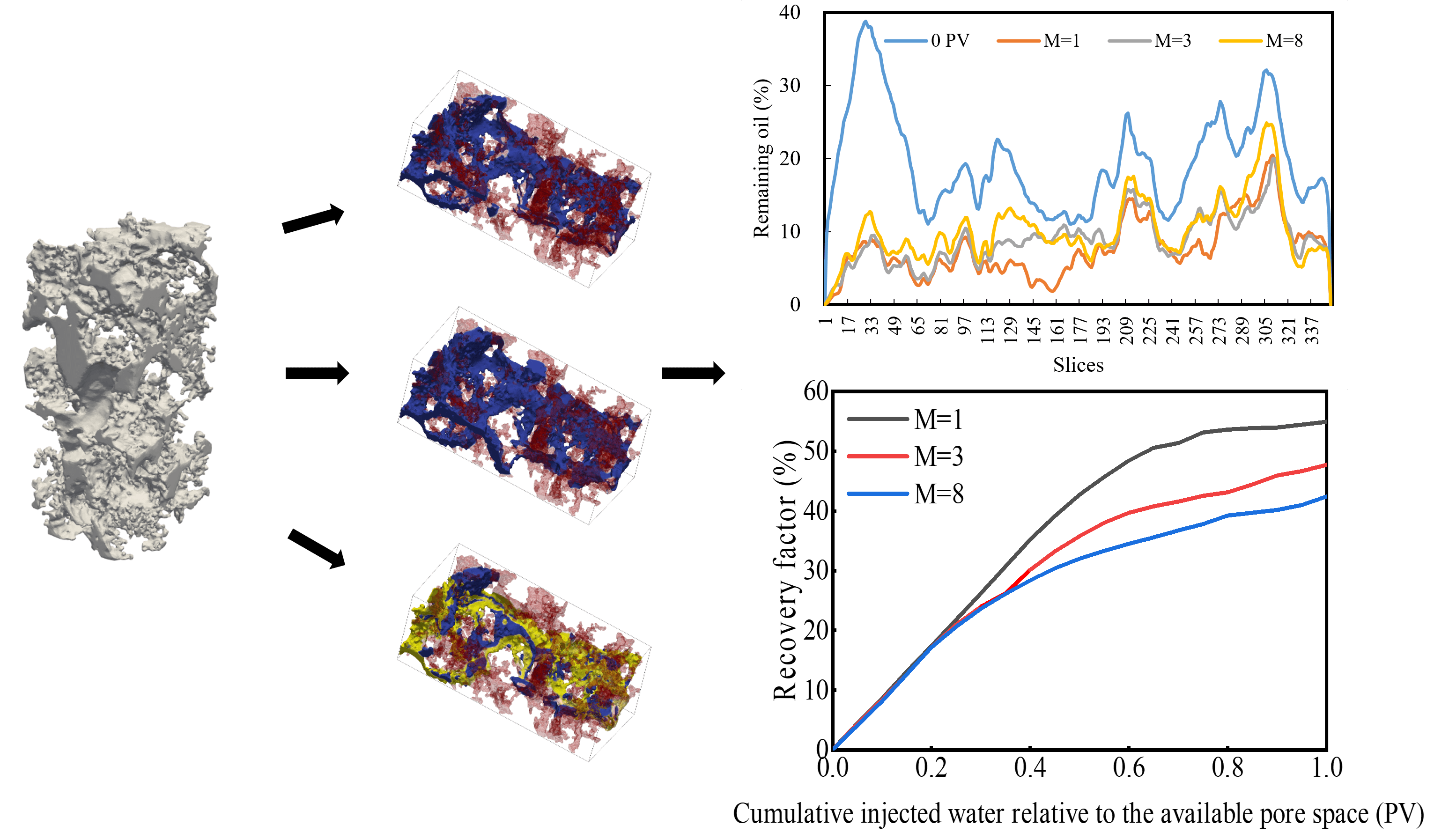
Weak water-drive offshore reservoirs with complex pore architecture and strong permeability heterogeneity present major challenges, including rapid depletion of formation energy, low waterflood efficiency, and significant lateral and vertical variability in crude oil properties, all of which contribute to limited recovery. To support more effective field development, alternative strategies and a deeper understanding of pore-scale flow behavior are urgently needed. In this work, CT imaging and digital image processing were used to construct a digital rock model representative of the target reservoir. A pore-scale flow model was then developed, and the Volume of Fluid (VOF) method was applied to simulate and optimize waterflooding schemes aimed at boosting oil recovery. Optimization focused on adjusting injection rates, varying the oil–water viscosity ratio, and implementing a water-alternating-gas (WAG) process. Results show that, for equal injection volumes, higher injection rates cause early water breakthrough through high-permeability pathways, yielding slower gains in recovery. Lowering the oil–water viscosity ratio improves mobility control, suppresses viscous fingering, enlarges sweep volume, and enhances recovery. When CH4 becomes fully miscible, it dissolves into the crude oil, lowering viscosity and eliminating interfacial tension, thereby providing greater displacement efficiency than partially miscible injection. Following a switch from water to gas injection, residual oil saturation decreases and becomes more uniformly distributed, indicating that the combined action of water and gas significantly improves both sweep efficiency and microscopic displacement.Graphic Abstract
Keywords
Cite This Article
 Copyright © 2026 The Author(s). Published by Tech Science Press.
This work is licensed under a Creative Commons Attribution 4.0 International License , which permits unrestricted use, distribution, and reproduction in any medium, provided the original work is properly cited.
 Downloads
 Citation Tools
