
 Login
Login Register
 Submit a Paper
 Propose a Special lssue
 Open Access
ARTICLE

Sand Production in Unconsolidated Sandstone: Experimental Analysis of Multiphase Flow During Cyclic Injection and Production
1 CNPC Engineering Technology R&D Company Limited, Beijing, 102206, China
2 National Engineering Research Center of Oil & Gas Drilling and Completion Technology, Beijing, 102206, China
3 School of Energy Resources, China University of Geoscience (Beijing), Beijing, 100083, China
* Corresponding Authors: Xiaoling Tang. Email: ; Jinghong Hu. Email:
(This article belongs to the Special Issue: Subsurface Fluid Flow Dynamics and Applications in Carbon Reduction Technologies)
Fluid Dynamics & Materials Processing 2025, 21(12), 2981-2995. https://doi.org/10.32604/fdmp.2025.073859
Received 27 September 2025; Accepted 12 December 2025; Issue published 31 December 2025
 View Full Text
 Download PDF
Abstract
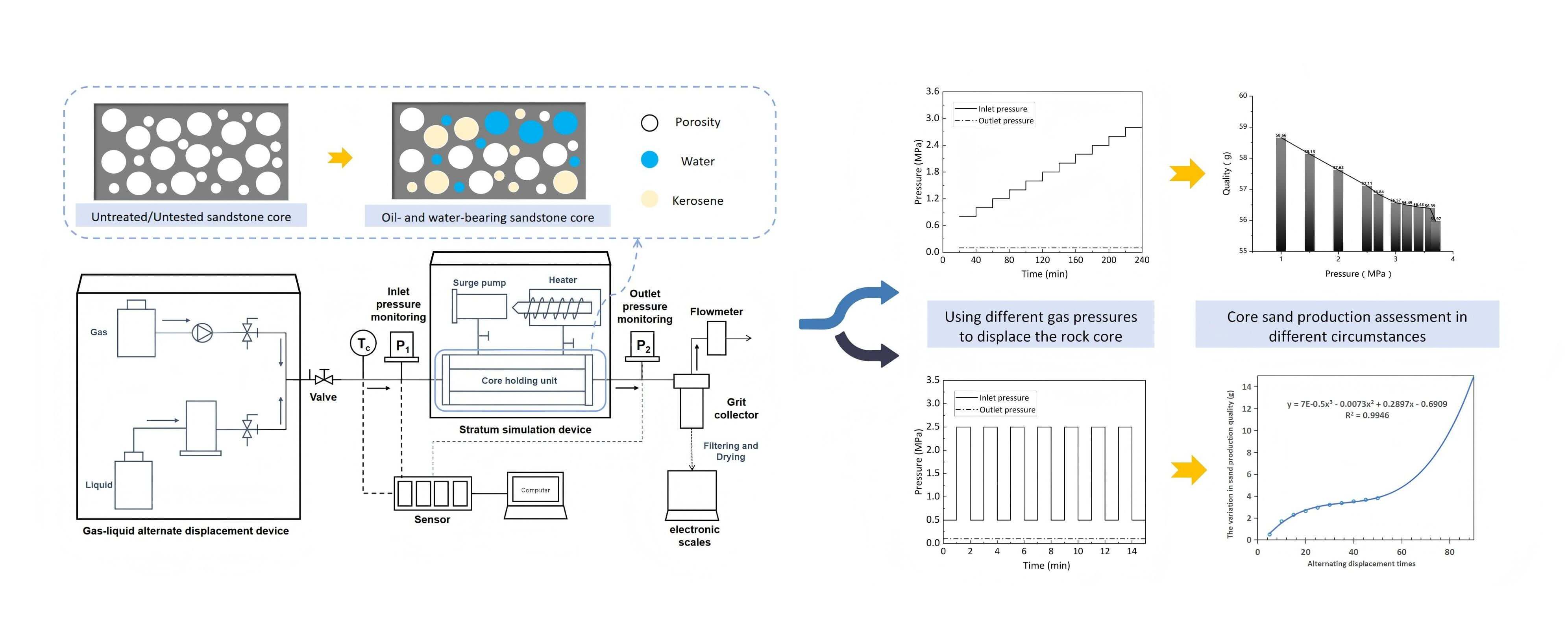
Many mature onshore oilfields have entered a high-water-cut stage, with reservoir recovery approaching economic limits. Converting these depleted or nearly depleted reservoirs into underground gas storage (UGS) facilities offers an efficient way to leverage their substantial storage potential. During cyclic gas injection and withdrawal, however, the reservoir experiences complex three-phase flow and repeated stress fluctuations, which can induce rock fatigue, inelastic deformation, and ultimately sand production. This study uses controlled physical experiments to simulate sand production in reservoir rocks subjected to alternating gas injection and production under three-phase conditions. After preparing oil-water-saturated cores through waterflooding, gas is introduced to perform repeated displacement cycles. Polynomial models relating core mass loss to water-oil ratio and cycle number are developed using the Newton interpolation method, enabling prediction of sand production under various operating conditions. Results show that, within the critical pressure-difference range for sand onset, permeability increases with water-oil ratio. When the water-oil ratio lies between 0.3 and 1, sand production decreases progressively; beyond a ratio of 1, sand production increases with further increases in water-oil ratio. The number of displacement cycles exerts a dominant influence: sand production remains relatively stable between 25 and 55 cycles but rises sharply thereafter. Average sand production during cycles 55–100 is 5.27 times higher than during cycles 5–55. These findings indicate that cumulative structural damage to the rock framework intensifies significantly with repeated cycling, making cycle number a critical factor governing sand production in UGS operations.Graphic Abstract
Keywords
Cite This Article
 Copyright © 2025 The Author(s). Published by Tech Science Press.
This work is licensed under a Creative Commons Attribution 4.0 International License , which permits unrestricted use, distribution, and reproduction in any medium, provided the original work is properly cited.
 Downloads
 Citation Tools
