
 Login
Login Register
 Submit a Paper
 Propose a Special lssue
 Open Access
REVIEW

Fluid Flow in Fractured Rocks: From Multiphysics Paradigms to AI-Driven Predictive Modeling
School of Civil Engineering and Architecture, Xi’an University of Technology, Xi’an, China
* Corresponding Author: Yi Xue. Email:
(This article belongs to the Special Issue: Fluid Dynamics and Multiphysical Coupling in Rock and Porous Media: Advances in Experimental and Computational Modeling)
Fluid Dynamics & Materials Processing 2026, 22(2), 2 https://doi.org/10.32604/fdmp.2026.075809
Received 09 November 2025; Accepted 12 February 2026; Issue published 04 March 2026
 View Full Text
 Download PDF
Abstract
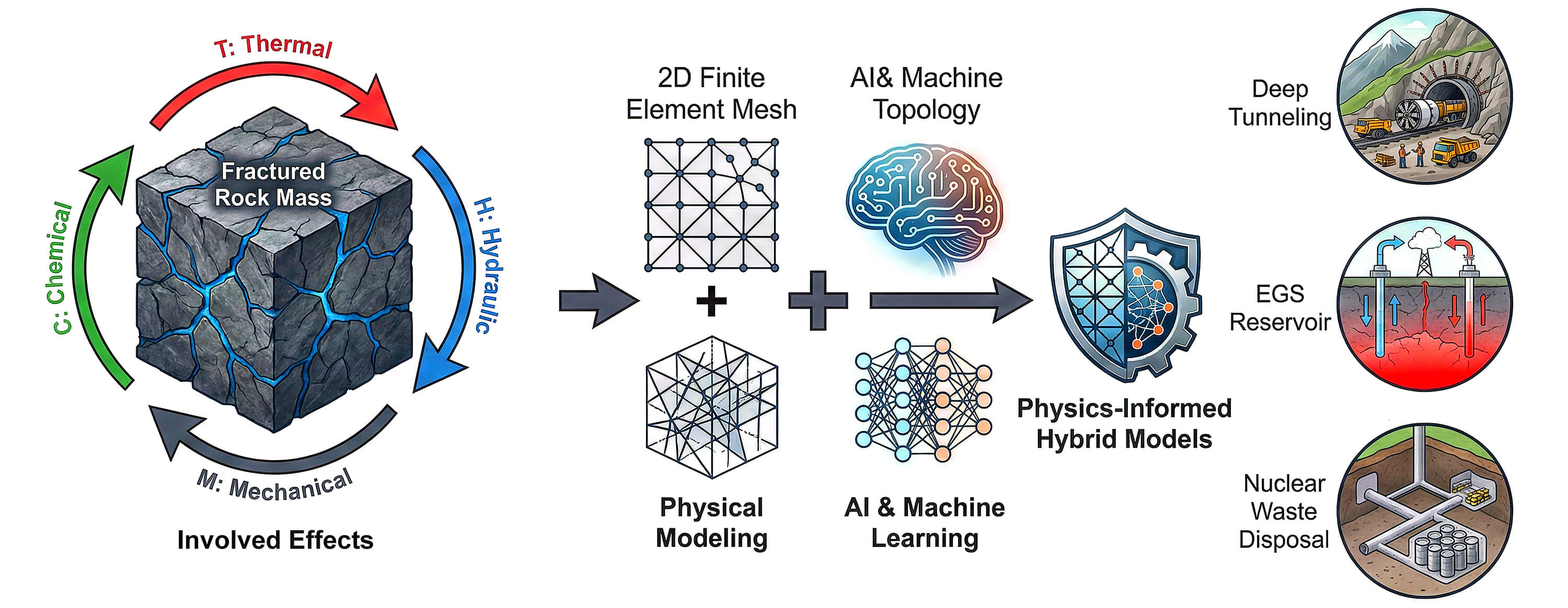
Fluid flow through fractured rock masses is a key process controlling the safety and performance of deep geoengineering systems, shaped by the complex interactions of thermal, hydraulic, mechanical and chemical (THMC) fields. This paper presents a systematic review of this subject with special emphasis on the multi-physics governing it. First, we elucidate the interdependent mechanisms and governing equations, highlighting the nonlinear, path-dependent, and evolving nature of the relationship between stress and permeability. Next, mainstream modeling approaches, including equivalent continuum, discrete fracture network (DFN), and dual-porosity/dual-permeability methods, are critically evaluated, and a strategy for model selection based on project scale and geological context is proposed accordingly. Moreover, experimental insights from single-fracture and triaxial flow studies are synthesized, revealing how effective stress, shear displacement, and fracture roughness control permeability evolution. In particular, the practical significance of THMC coupling is demonstrated through case studies on nuclear waste disposal, Enhanced Geothermal Systems, and tunneling projects. The review further explores AI- and machine learning-driven innovations, particularly physics-informed neural networks and hybrid modeling, which address limitations in computational efficiency, data scarcity, and physical consistency. Finally, persistent challenges, including multi-scale coupling, parameter uncertainty, and complex fracture network representation are identified and critically discussed while paying attention to future developments.Graphic Abstract
Keywords
Cite This Article
 Copyright © 2026 The Author(s). Published by Tech Science Press.
This work is licensed under a Creative Commons Attribution 4.0 International License , which permits unrestricted use, distribution, and reproduction in any medium, provided the original work is properly cited.
 Downloads
 Citation Tools
