
 Login
Login Register
 Submit a Paper
 Propose a Special lssue
 Open Access
ARTICLE

Biomimetic Volute Tongue Design for Combined Hydraulic and Acoustic Optimization in Centrifugal Pumps
1 School of Energy and Power Engineering, Lanzhou University of Technology, Lanzhou, China
2 Key Laboratory of Fluid Machinery and Systems, Gansu Province, Lanzhou University of Technology, Lanzhou, China
3 Key Laboratory of Advanced Pumps, Valves and Fluid Control System of the Ministry of Education, Lanzhou, China
4 State-owned Sida Machinery Manufacturing Company, Xianyang, China
* Corresponding Author: Rong Guo. Email:
Fluid Dynamics & Materials Processing 2026, 22(3), 11 https://doi.org/10.32604/fdmp.2026.077602
Received 12 December 2025; Accepted 11 March 2026; Issue published 31 March 2026
 View Full Text
 Download PDF
Abstract
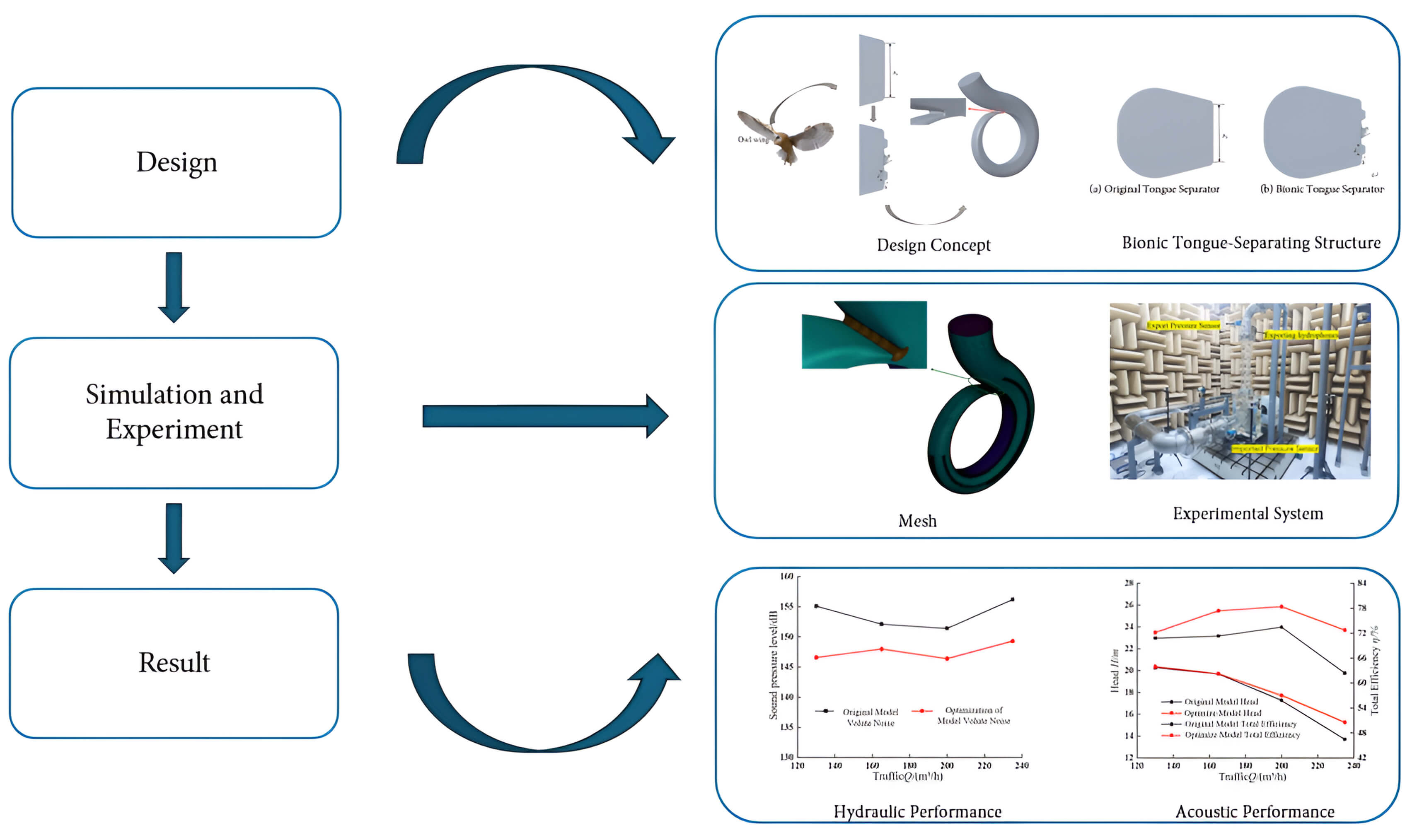
To simultaneously reduce flow-induced noise and enhance hydraulic performance in centrifugal pumps, this study proposes a bionic volute tongue inspired by the serrated trailing-edge morphology of the long-eared owl wing. Hydraulic performance and volute-induced noise are integrated into a unified evaluation framework, enabling multi-objective optimization of the tongue geometry. An orthogonal experimental design coupled with Computational Fluid Dynamics (CFD) and Computational Fluid Acoustics (CFA) is employed to systematically assess the influence of serration parameters. A matrix-based decision method is then used to identify the optimal configuration balancing efficiency, head, and acoustic performance. The optimized design reduces the area fraction of extremely high-velocity regions (>18 m/s) from 15.21% to 5.38%, corresponding to a 64.63% decrease, while the flow non-uniformity coefficient ζ is reduced by 26.1%. Under rated operating conditions, the pump head increases by 0.5 m, hydraulic efficiency improves by 5%, and volute-induced noise is reduced by approximately 5 dB. Flow-field analysis indicates that volute-induced noise is the dominant source of hydrodynamic noise, and that the serrated bionic tongue effectively suppresses its intensity. The noise reduction mechanism is attributed to improved rotor-stator interaction, decomposition of large-scale vortical structures, and delayed flow separation, which collectively reduce pressure pulsation at the rotor-stator interface.Graphic Abstract
Keywords
Cite This Article
 Copyright © 2026 The Author(s). Published by Tech Science Press.
This work is licensed under a Creative Commons Attribution 4.0 International License , which permits unrestricted use, distribution, and reproduction in any medium, provided the original work is properly cited.
 Downloads
 Citation Tools
