
 Login
Login Register
 Submit a Paper
 Propose a Special lssue
 Open Access
ARTICLE

Numerical Analysis of Non-Uniform Pollutant Distribution in an Internal Space of Tank and the Efficacy of an Active Purification Strategy
Key Laboratory of Thermo-Fluid Science and Engineering of MOE, School of Energy and Power Engineering, Xi’an Jiaotong University, Xi’an, 710049, China
* Corresponding Author: Peng Yang. Email:
(This article belongs to the Special Issue: Microscale Heat and Mass Transfer and Efficient Energy Conversion)
Frontiers in Heat and Mass Transfer 2025, 23(6), 1767-1788. https://doi.org/10.32604/fhmt.2025.070537
Received 18 July 2025; Accepted 11 October 2025; Issue published 31 December 2025
 View Full Text
 Download PDF
Abstract
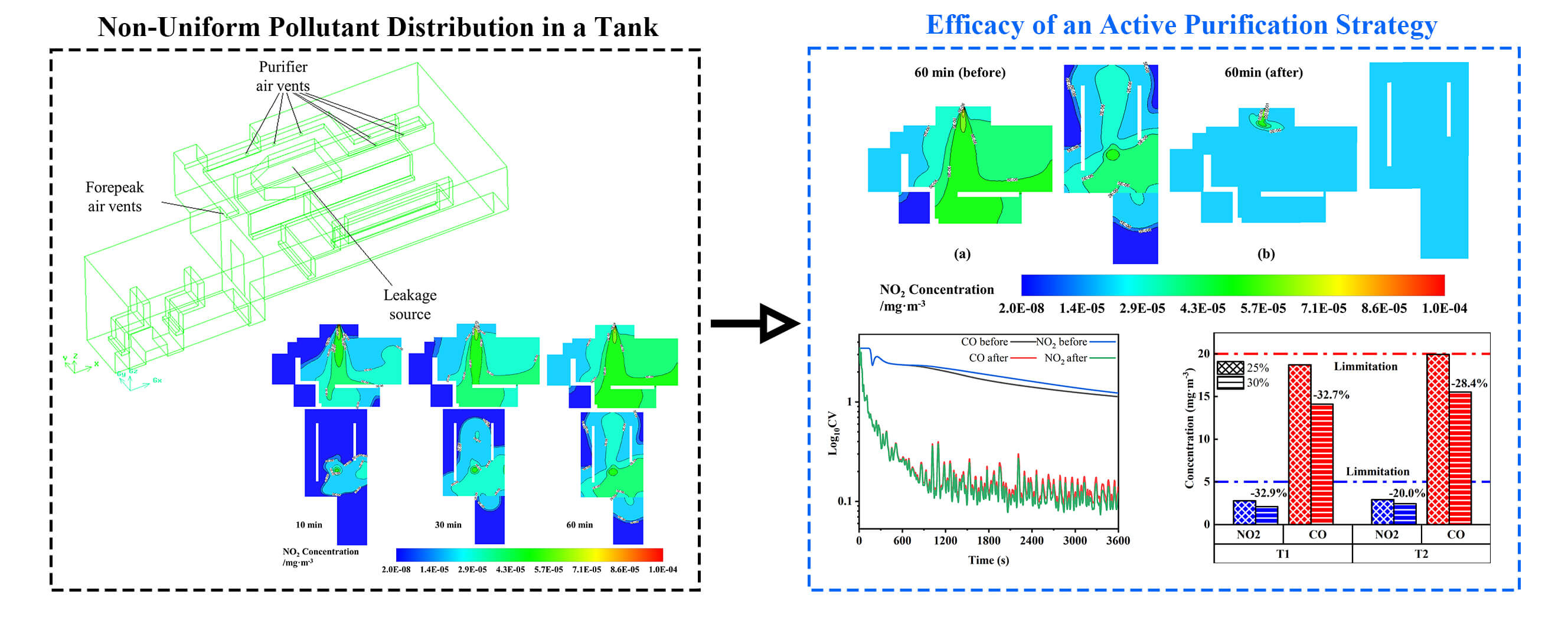
Hazardous gas intrusion in tightly sealed and geometrically complex confined spaces, such as armored tanks, poses a critical threat to occupant health. The intricate internal structure of these systems may lead to non-intuitive pollutant transport pathways. However, the spatial and temporal evolution of these structures, as well as the intrinsic mechanisms of the purification systems, remain poorly elucidated. In this study, a high-fidelity, transient three-dimensional computational fluid dynamics (CFD) model was developed to simulate the leakage and dispersion of carbon monoxide (CO) and nitrogen dioxide (NO2) using the RNG k-ε turbulence model. Scenarios with and without an active purification system were systematically investigated under four leakage rate conditions: 0.33, 0.66, 1.32, and 2.64 m·s−1. Our results reveal that, flow recirculation driven by the compartment’s geometry leads to the formation of stable, high-concentration “hazard zones”. Following the activation of the purification system,Graphic Abstract
Keywords
Cite This Article
 Copyright © 2025 The Author(s). Published by Tech Science Press.
This work is licensed under a Creative Commons Attribution 4.0 International License , which permits unrestricted use, distribution, and reproduction in any medium, provided the original work is properly cited.
 Downloads
 Citation Tools
