
 Login
Login Register
 Submit a Paper
 Propose a Special lssue
 Open Access
ARTICLE

Thermal Performance Assessment of a Trombe Wall in Social Housing through Numerical Simulation: A Case Study in Mexico
1 División de Estudios de Posgrado e Investigación, Tecnológico Nacional de México/IT de Pachuca, Colonia Venta Prieta, Pachuca de Soto, C.P. 42080, Mexico
2 Grupo de Investigación IRSE, Departamento de Ingeniería Mecánica, División de Ingenierías, Campus Irapuato-Salamanca, Universidad de Guanajuato, Salamanca, C.P. 36885, Mexico
3 Departamento de Ingeniería en Aeronáutica, Universidad Politécnica Metropolitana de Hidalgo, Tolcayuca, C.P. 43860, Mexico
* Corresponding Author: J. Serrano-Arellano. Email:
(This article belongs to the Special Issue: Innovative Cooling Systems: Design, Optimization, and Applications)
Frontiers in Heat and Mass Transfer 2025, 23(6), 2073-2107. https://doi.org/10.32604/fhmt.2025.069564
Received 26 June 2025; Accepted 19 September 2025; Issue published 31 December 2025
 View Full Text
 Download PDF
Abstract
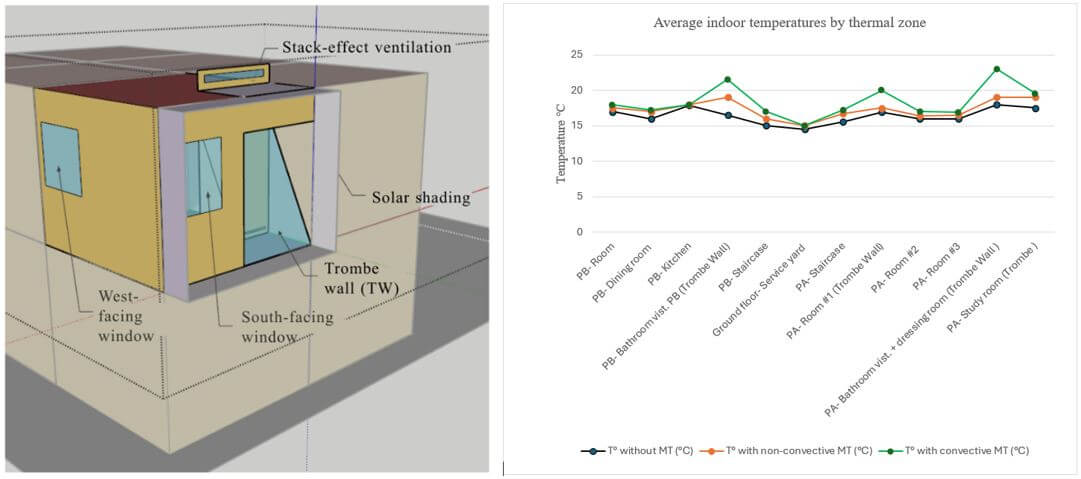
The Trombe Wall (TW) is a low-cost, passive heating system known for its high thermal efficiency, particularly in cold and temperate climates. Recent research has explored its adaptability to warm-dry climates with high thermal variability, such as those found in central Mexico. This study presents a dynamic simulation-based analysis of the TW’s thermal performance in a representative social housing unit located in Pachuca de Soto, Hidalgo. Two models were compared—one with a south-facing TW system and one without—to evaluate indoor thermal comfort throughout a full annual cycle. The simulations were conducted using OpenStudio and EnergyPlus, integrating detailed climate data and construction parameters. Results indicate significant improvements in interior temperature stability and comfort during winter, with temperature increases of up to 5.1°C in living areas. The system’s implementation made it possible to attain a new level of average winter indoor temperature of 18.3°C by using solar energy, up from 14.4°C without mechanical heating. The introduction of the TW significantly reduces the interior thermal oscillation and enhances the habitability conditions during the winter, with an increase of 167% in the annual number of hours within the thermal comfort range of 18°C–24°C vs. the base model. Currently, temperature fluctuations inside buildings due to climate change affect the health of users. The system presented in this study reduces these temperature fluctuations to improve quality of life.Graphic Abstract
Keywords
Cite This Article
 Copyright © 2025 The Author(s). Published by Tech Science Press.
This work is licensed under a Creative Commons Attribution 4.0 International License , which permits unrestricted use, distribution, and reproduction in any medium, provided the original work is properly cited.
 Downloads
 Citation Tools
