
 Login
Login Register
 Submit a Paper
 Propose a Special lssue
 Open Access
ARTICLE

Short-Term Penetration beyond Diffusion Spinodal of a Mixture: Interaction of Liquid-Liquid and Liquid-Vapour Transitions
1 Ural Federal University, Ekaterinburg, 620002, Russia
2 Institute of Thermal Physics, Ural Branch of Russian Academy Sciences, Ekaterinburg, 620016, Russia
3 Heat and Mass Transfer Laboratory, National Research Tomsk Polytechnic University, Tomsk, 634050, Russia
* Corresponding Author: Pavel Skripov. Email:
Frontiers in Heat and Mass Transfer 2025, 23(3), 721-737. https://doi.org/10.32604/fhmt.2025.066528
Received 10 April 2025; Accepted 29 May 2025; Issue published 30 June 2025
 View Full Text
 Download PDF
Abstract
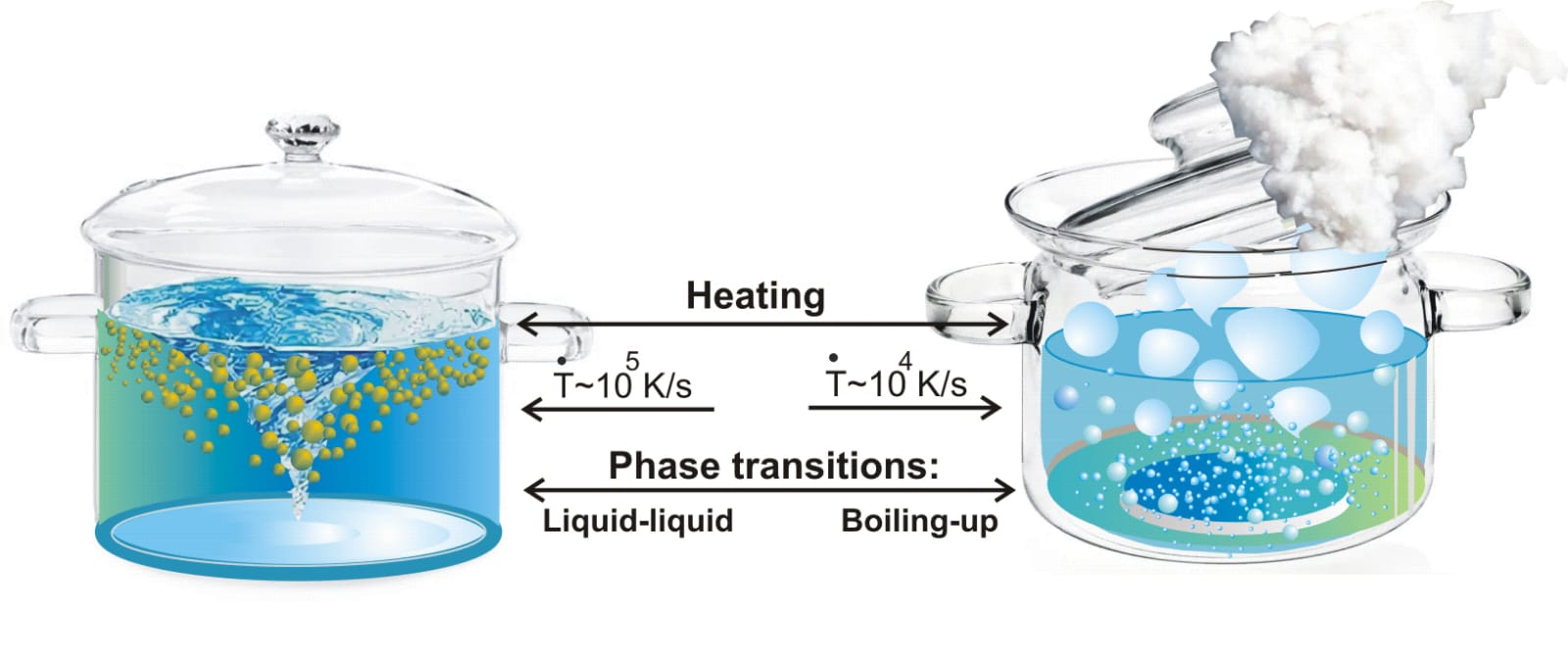
The article considers a relaxation of the water/polypropylene glycol-425 solution with a lower critical solution temperature (LCST) following its pulsed superheating concerning liquid-liquid and liquid-vapor equilibrium lines, as well as the liquid-liquid spinodal. Superheating was performed using the pulsed heat generation method in a micro-sized wire probe. The main heating mode was the constant (over the pulse length) power mode. Characteristic heating rates ranged from 0.05 × 10⁵ to 2 × 10⁵ K/s, while the degree of superheating concerning the spinodal was up to 200 K. The temperature of spontaneous boiling-up and the amplitude of the corresponding signal were monitored as functions of the heating rate set by the power value. The results demonstrate an example of the interaction of liquid-liquid and liquid-vapor phase transitions, as well as the spinodal decomposition of a solution with LCST against the background of its unstable states. We proposed a physical model to explain the minimum spontaneous boiling-up temperature revealed within a certain range of heating rates, which is not typical of completely miscible solutions. Further research will focus on establishing a general criterion for the possibility of spinodal decomposition of such solutions under the conditions of rapid heating.Graphic Abstract
Keywords
Cite This Article
 Copyright © 2025 The Author(s). Published by Tech Science Press.
This work is licensed under a Creative Commons Attribution 4.0 International License , which permits unrestricted use, distribution, and reproduction in any medium, provided the original work is properly cited.
 Downloads
 Citation Tools
