
 Login
Login Register
 Submit a Paper
 Propose a Special lssue
 Open Access
ARTICLE

Simulation and Performance Analysis of a Photovoltaic-Thermal Heat Pump System
1 School of Ecological Environment and Urban Construction, Fujian University of Technology, Fujian, 350118, China
2 Key Laboratory of New Energy and Energy Conservation in Buildings, Fujian University of Technology, Fujian, 350118, China
3 School of Electronic and Mechanical Engineering, Fujian Polytechnic Normal University, Fuqing, 350300, China
4 Shanghai Electric Power Co., Ltd., Minhang Power Plant, Shanghai, 200245, China
* Corresponding Author: Yubing Li. Email:
Frontiers in Heat and Mass Transfer 2025, 23(6), 2025-2049. https://doi.org/10.32604/fhmt.2025.072260
Received 22 August 2025; Accepted 04 November 2025; Issue published 31 December 2025
 View Full Text
 Download PDF
Abstract
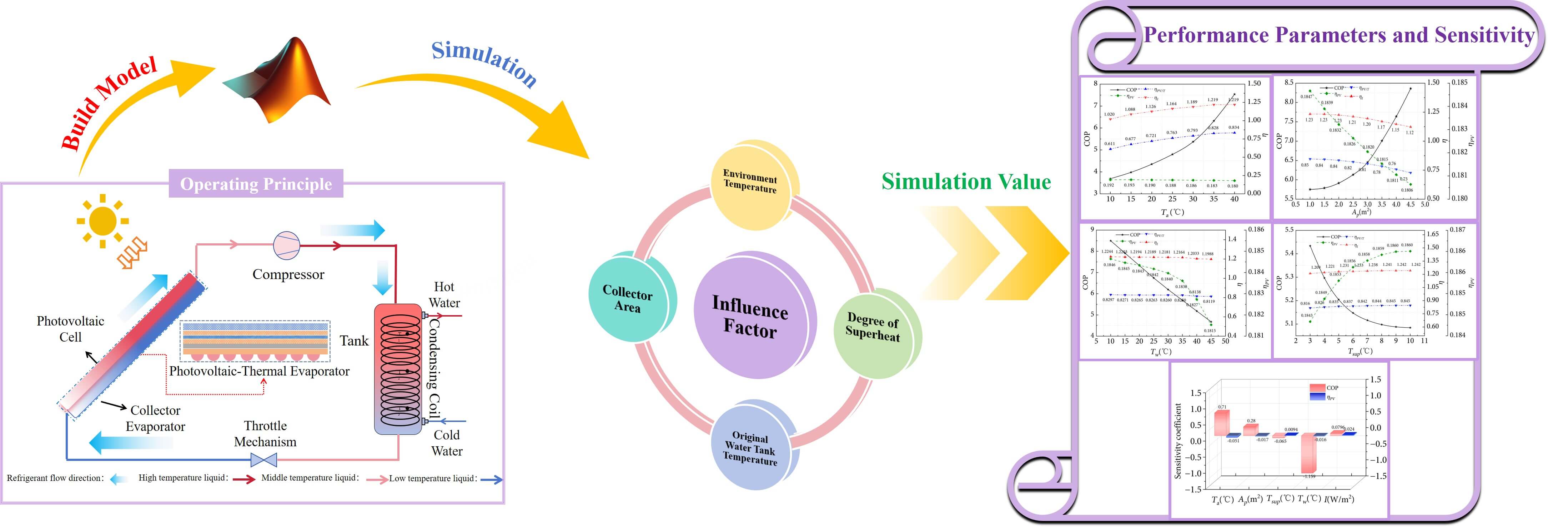
The growing demand for energy-saving and renewable heating solutions has made photovoltaic/thermal (PV/T) heat pump systems a promising technology. However, their thermal and electrical performance, as well as the overall utilization of solar energy, strongly depend on capacity configuration and operating parameters. To address this issue, this study proposes a PV/T heat pump system featuring a novel rhombic flow channel structure that functions as the collector-evaporator. An experimental test bench was established to evaluate system performance, and a one-dimensional numerical model was developed to investigate the effects of environmental and operating parameters. The simulation results deviated by approximately 10% from the experimental data, indicating good agreement between the two approaches. Analysis shows that hot-water heating time decreases with increasing solar radiation intensity. The system coefficient of performance (COP) rises by 50.9% and 45.9% with higher environmental temperature and collector area, respectively, but decreases by 6.61% and 45% with greater superheat and higher original tank temperature. The photovoltaic (PV) generation efficiency decreases by 6.25%, 2.16%, and 1.63% with increases in environmental temperature, collector-evaporator area, and original tank temperature, respectively, but increases by 0.92% with higher superheat. Sensitivity analysis further reveals that original tank temperature exerts the strongest influence on system COP, with a sensitivity coefficient of 1.159, while environmental temperature most significantly affects PV efficiency, with a sensitivity coefficient of −0.051. Overall, this study provides a pathway to enhance system stability and energy efficiency, offering theoretical and practical contributions to the intelligent control of PV/T heat pump systems.Graphic Abstract
Keywords
Cite This Article
 Copyright © 2025 The Author(s). Published by Tech Science Press.
This work is licensed under a Creative Commons Attribution 4.0 International License , which permits unrestricted use, distribution, and reproduction in any medium, provided the original work is properly cited.
 Downloads
 Citation Tools
