
 Login
Login Register
 Submit a Paper
 Propose a Special lssue
 Open Access
ARTICLE
Experimental Investigation on Heating Performance and Frosting Behavior of an Integrated R290 Secondary Loop Heat Pump
1 China Three Gorges Renewables (Group) Co., Ltd. (CTGR), Beijing, China
2 School of Energy and Power Engineering, University of Shanghai for Science and Technology, Shanghai, China
3 School of Computing, Engineering & Digital Technologies, Teesside University, Middlesbrough, UK
4 Department of Chemical and Biochemical Engineering, Dongguk University, 30, Pildong-ro 1-gil, Seoul, Republic of Korea
* Corresponding Authors: Kang Li. Email: ; Soheil Mohtaram. Email:
Frontiers in Heat and Mass Transfer 2026, 24(2), 4 https://doi.org/10.32604/fhmt.2026.077274
Received 05 December 2025; Accepted 19 January 2026; Issue published 30 April 2026
 View Full Text
 Download PDF
Abstract
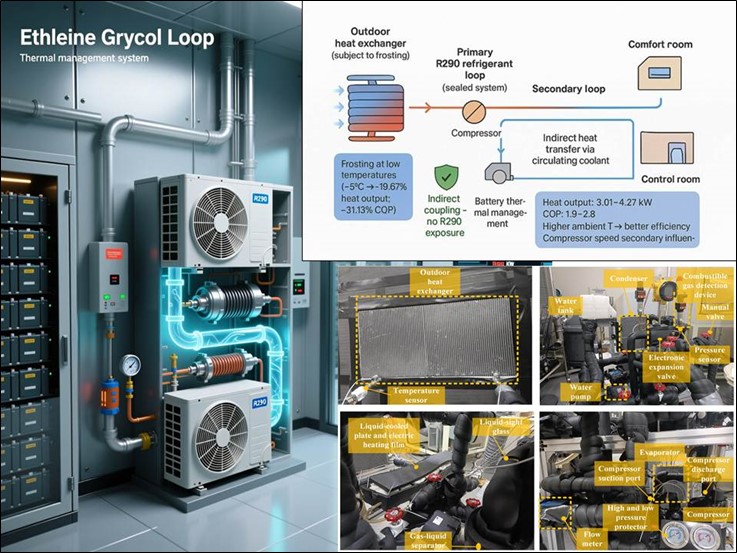
Energy storage batteries require strict thermal management due to temperature sensitivity, operating optimally within a narrow thermal range. Simultaneously, control rooms demand stable and comfortable ambient conditions for staff staying long-term. Conventional temperature control systems typically employ isolated solutions, resulting in functional fragmentation and inefficient resource utilization. To address these challenges, this study proposes and implements an integrated R290 secondary loop heat pump air-conditioning system designed to simultaneously manage the thermal environments of both energy storage batteries and control rooms. By adopting a secondary-loop coupling architecture, all thermal regulation is achieved indirectly via indirect heat transfer with a circulating ethylene glycol-based coolant, eliminating the risk of direct refrigerant (R290) exposure in occupied spaces and enhancing safety. The system supports multiple operational modes, enabling flexible and efficient dual-zone climate control. The heating performance—evaluated in terms of heat exchange capacity and coefficient of performance (COP)—is analyzed under varying ambient temperatures and compressor speeds. Additionally, the frosting behavior of the outdoor heat exchanger and its impact on heat transfer and system performance are examined. Results showed heat output ranged from 3.01 to 4.27 kW, and COP varied between 1.9 and 2.8. Ambient temperature (more dominant than compressor speed) and speed both affected performance: higher speed/warmer temperatures improved heat transfer efficiency; low temperatures accelerated frosting (e.g., −5°C reduced heat output by 19.67% and COP by 31.13%, vs. 13.72% and 12.40% at 5°C). These findings provide critical insights for optimizing heat transfer design and operation of integrated thermal management systems in energy storage facilities.Graphic Abstract
Keywords
Cite This Article
 Copyright © 2026 The Author(s). Published by Tech Science Press.
This work is licensed under a Creative Commons Attribution 4.0 International License , which permits unrestricted use, distribution, and reproduction in any medium, provided the original work is properly cited.
 Downloads
 Citation Tools
