
 Login
Login Register
 Submit a Paper
 Propose a Special lssue
 Open Access
REVIEW

Hydrodynamic Intensification in Wastewater Treatment: A Critical Review of Atomization, Cavitation, and Pulsed Jets from Multiscale Mechanistic Perspectives
1 College of Chemistry and Chemical Engineering, Chongqing University of Technology, Chongqing, China
2 Huahong Integrated Circuit (Chengdu) Co., Ltd., Chongqing, China
* Corresponding Author: Facheng Qiu. Email:
Frontiers in Heat and Mass Transfer 2026, 24(4), 13 https://doi.org/10.32604/fhmt.2026.080472
Received 10 February 2026; Accepted 08 May 2026; Issue published 31 August 2026
 View Full Text
 Download PDF
Abstract
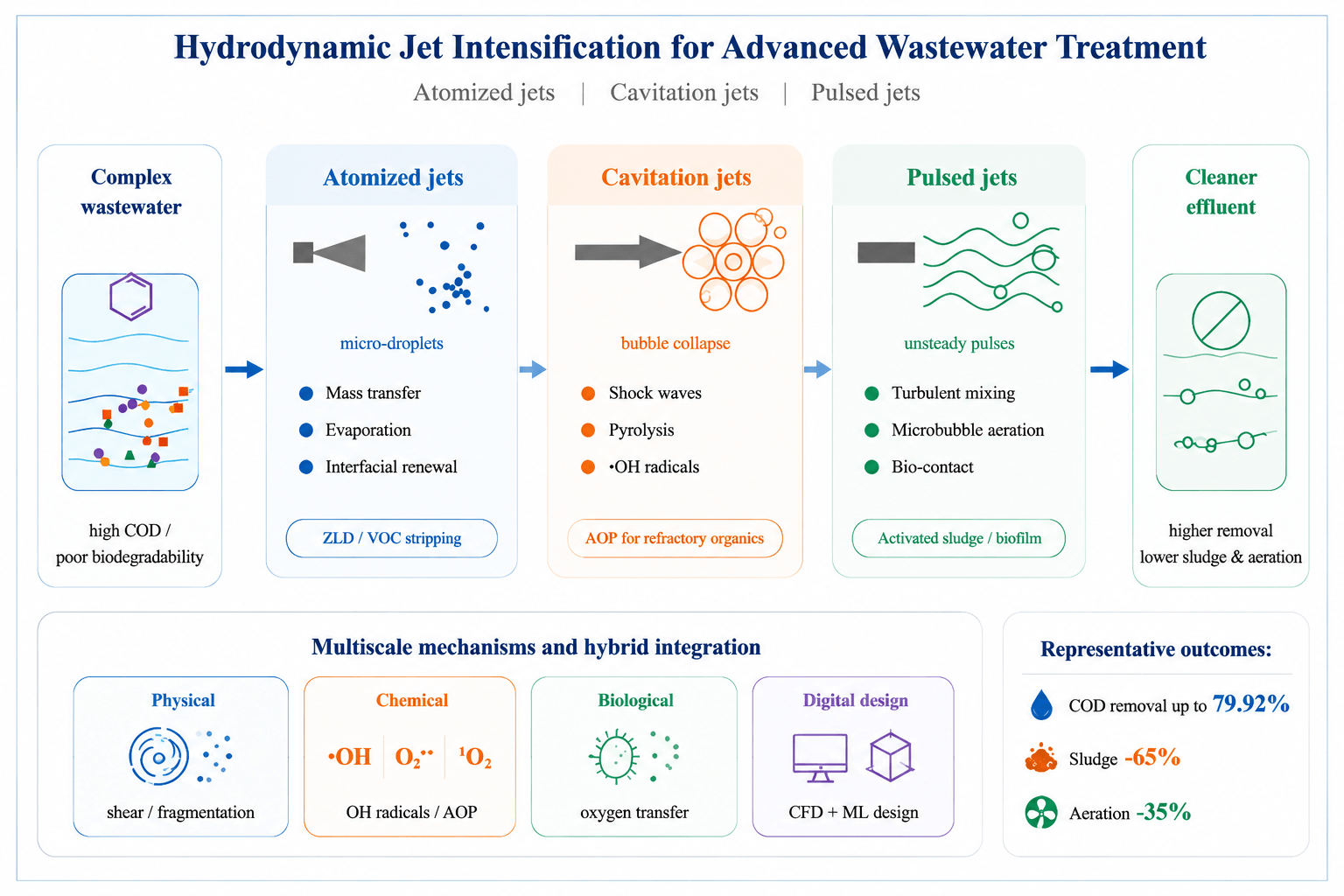
Hydrodynamic jet technologies have emerged as a promising approach for advanced wastewater treatment, offering engineering advantages through operational efficiency and system simplicity. As a critical review, this work examines three major hydrodynamic approaches—atomized jets, cavitation jets, and pulsed-jet systems—and analyzes their degradation mechanisms and practical applications in pollutant abatement. By systematically evaluating current research trends, this review elucidates the synergistic interplay between hydrodynamic effects, including turbulent shear, microbubble implosion, and reactive radical generation, and contaminant-decomposition pathways. Quantitative evidence from the reviewed literature further reveals significant performance enhancements achieved by these technologies. Optimized cavitating jets (e.g., at an inlet pressure of 10 MPa) coupled with synergistic advanced oxidation processes, such as UV/Fenton, can achieve chemical oxygen demand (COD) removal rates of nearly 80% (up to 79.92%) in refractory antibiotic wastewater. Similarly, the integration of ultrasonic atomization with modified photocatalysis (e.g., Ag/CB-TiO2) increases the degradation efficiency of hydrophobic organics from 40% to 65%. Furthermore, the application of high-pressure jets in conventional activated sludge processes demonstrates notable cost-effectiveness by reducing waste activated sludge by 65% and decreasing aeration airflow rates by 35% through enhanced microbubble oxygenation. The review further discusses innovative applications of these hydrodynamic technologies, including: (1) design optimization of reactor configurations for specific pollutant categories (persistent organics, bio-recalcitrant compounds, and micropollutants); (2) performance benchmarking against conventional treatment modalities; and (3) development of hybrid systems integrating hydrodynamic cavitation with complementary processes, such as advanced oxidation, catalytic treatment, and biological augmentation. By synthesizing cross-disciplinary insights from environmental engineering, fluid dynamics, and process intensification research, this work provides a foundational framework for the design of next-generation wastewater treatment systems.Graphic Abstract
Keywords
The rapid advance of industrialization has created a critical environmental challenge: the treatment of complex industrial wastewaters, including pharmaceutical, petrochemical, chemical, and paint effluents [1]. These wastewaters typically exhibit two characteristics that challenge conventional treatment: exceptionally high organic loading (with chemical oxygen demand [COD] often exceeding 10^4 mg/L) and poor biodegradability (BOD5/COD < 0.3). Traditional physicochemical approaches—including coagulation-flocculation, adsorption, and activated sludge treatment—have inherent limitations in disrupting stable aromatic compounds, halogenated organics, and persistent pharmaceutical metabolites. This technological gap not only complicates compliance with increasingly stringent discharge regulations but also highlights the need for advanced remediation strategies that combine mechanical, chemical, and biological destruction mechanisms.
Recently, hydrodynamic intensification through precision-engineered water jet systems has emerged as a promising approach for wastewater valorization. Unlike energy-intensive advanced oxidation processes or membrane separation technologies, submerged turbulent jet reactors can promote contaminant degradation by harnessing fluid-dynamic effects in a compact process unit (Fig. 1). In recent years, several reviews have discussed the application of hydraulic jets in wastewater treatment. Duan et al. [2] systematically summarized the fundamental principles of cavitation, while Yang et al. [3] outlined jet atomization mechanisms and their applications in non-Newtonian fluids. However, most existing reviews focus on a single technology or lack a critical, integrative comparison of atomization, cavitation, and pulsed jets from the perspectives of mechanism, engineering performance, and process synergy.

Figure 1: Structure diagram of a free submerged turbulent circular jet (Schematic created by the authors).
The discharge of high-velocity jets (typically 15–300 m/s) generates three synergistic remediation mechanisms [4]: (i) microscale turbulence that enhances interfacial mass transfer by 2–3 orders of magnitude; (ii) shear-induced molecular dissociation under localized energy densities exceeding 107 W/m3; and (iii) cavitation-mediated radical generation through transient bubble collapse, producing localized temperatures above 5000 K. Together, these phenomena enable concurrent physical fragmentation, non-catalytic oxidation, and the formation of more bioavailable intermediates—a tripartite degradation mechanism fundamentally different from that of conventional sequential treatment trains.
Current technological development focuses on tailoring jet hydrodynamics to specific contaminant profiles through three principal operating modes:
• Atomized jets (droplet diameter <50 μm) exploit enhanced gas–liquid oxygen transfer for aerobic biodegradation intensification.
• Cavitating jets utilize shockwave-mediated pyrolysis (20~100 kHz) for halogenated hydrocarbon mineralization.
• Pulsed jets (frequency 10~200 Hz) generate resonance-enhanced shear gradients for nanoparticle dispersion and biofilm detachment.
As illustrated in Fig. 2, the three jet modes—atomization, cavitation, and pulsed operation—exhibit distinct physical mechanisms and application advantages. Atomization jets generate fine droplets through bag, multimode, and sheet breakup, thereby enhancing interphase heat and mass transfer. Cavitation jets induce violent bubble collapse, producing localized high temperatures and pressures together with reactive species such as hydroxyl radicals. Pulsed jets generate unsteady flow fields and strong mixing, which intensify momentum transfer, energy dissipation, and oxygen dispersion.

Figure 2: Three jet-technology mechanisms (Schematic created by the authors).
Building upon these mechanistic foundations, Fig. 3 illustrates the application of these jet technologies in wastewater treatment and their integration with complementary processes. The physical effects—including high-speed jets, hammer pressure, and intense energy dissipation—facilitate organic cleavage, while chemical effects driven by radical generation further enhance contaminant degradation. Moreover, jet-based systems are increasingly combined with photocatalytic technology, advanced oxidation processes, and aeration membrane technologies to achieve synergistic treatment performance.

Figure 3: Applications of the three jet technologies (Schematic created by the authors).
Despite empirical success in pilot-scale applications, critical knowledge gaps persist regarding (i) the quantitative relationship between jet parameters (Reynolds number, Strouhal number, cavitation index) and contaminant degradation kinetics; (ii) long-term stability of erosion-prone components under multiphase flow conditions; (iii) systemic integration with downstream biological or membrane processes. Moreover, existing literature lacks a mechanistic framework to guide the selection of jet configurations (continuous vs. pulsed, coaxial vs. swirling) for complex wastewater matrices containing multiple contaminant classes.
Therefore, this critical review aims to: (1) analyze and compare the core degradation mechanisms of atomization, cavitation, and pulsed jets from a multiscale mechanistic perspective; (2) evaluate the advantages, limitations, and applicable scenarios of each technology based on engineering application cases; (3) systematically outline the synergistic principles and latest advancements of multi-technology integration; (4) propose a preliminary framework for jet technology selection based on water quality characteristics through comparative analysis; (5) identify current knowledge gaps and highlight key future research directions to facilitate the transition of hydraulic enhancement technology from laboratory to large-scale engineering applications.
2 Applications in Wastewater Treatment
2.1 Applications of Atomized Jets
2.1.1 Mechanism of Atomized Jets in Wastewater Degradation
Atomized jets are generated through high-pressure extrusion of liquid streams, where hydrodynamic instability arises from the interplay of aerodynamic drag, surface tension, inertial forces, and viscous effects. Under elevated temperature and pressure conditions, surface wave formation on the liquid jet leads to interfacial rupture, producing micron-scale droplets. Droplets exceeding critical dimensions undergo secondary atomization, achieving enhanced dispersion through iterative fragmentation [5,6].
Although atomized jets are widely used in industrial spraying, pharmaceutical manufacturing, and aerospace propulsion, their direct application in wastewater treatment remains comparatively underexplored. Chen and Yang [7] showed that controlled droplet generation can markedly increase gas–liquid interfacial contact, thereby accelerating surface renewal and mass-transfer kinetics. These characteristics are particularly relevant to spray evaporation, VOC stripping, and other scenarios in which rapid interphase transport is required.
The superior performance of atomized jet systems in wastewater intensification arises from several coupled thermophysical effects. First, the generation of micro- to nanoscale droplets (<100 μm) greatly enlarges the specific surface area and shortens diffusion paths, which can accelerate VOC desorption and gas–liquid mass transfer. When combined with high-enthalpy gas streams, atomized systems can also promote rapid flash evaporation, enabling concentration of non-volatile species such as heavy-metal complexes and hypersaline residues into recoverable solids. In addition, sustained thermal exposure at elevated temperatures may assist the cleavage of bio-recalcitrant aromatic and halogenated structures. From an engineering perspective, this route may reduce overall energy demand relative to conventional bulk evaporation because finer liquid dispersion improves heat-transfer efficiency. These attributes indicate that atomized jets are particularly promising as process-intensification units for evaporation, concentration, and mass-transfer enhancement in wastewater treatment (Table 1).

2.1.2 Engineering Applications and System Integration
The practical implementation of atomized-jet evaporation has gained prominence in coal-fired power-generation systems. Modern limestone-gypsum wet flue gas desulfurization (WFGD) units generate hypersaline wastewater containing Hg2+, Pb2+, and Cl− at concentrations exceeding 10,000 mg/L. Field trials have shown that direct injection of atomized WFGD effluent (Sauter mean diameter [SMD] <80 μm) into 120°C–180°C flue-gas streams can achieve complete moisture evaporation within a residence time of 2.3–4.1 s [11].
Computational fluid dynamics (CFD) simulations coupled with pilot-scale validation have identified optimal operating thresholds: pH 6.2–6.8 minimizes chloride volatilization (<12% Cl− emission), while maintaining flue-gas velocities below 14 m/s prevents droplet entrainment in downstream ducts. Guo et al. [12] developed a laser Doppler-based evaluation platform to quantify atomization efficiency under varying compressed-air pressures (0.4–1.2 MPa) and thermal gradients. Their findings revealed a non-linear relationship between the gas–liquid ratio (GLR 0.1–0.5) and evaporation completeness, with optimal performance at GLR 0.32 (R2 = 0.89).
In addition to evaporation and photocatalytic enhancement, atomization-based spraying can also improve gas–liquid contacting in adjacent environmental processes. For instance, Deng et al. [8] reported that coupling high-voltage electrostatic assistance with spray atomization produced finer droplets and more uniform liquid distribution, which improved desulfurization efficiency by 10%–30%. Although this case is not a direct wastewater-degradation example, it illustrates the mass-transfer advantages that atomized spraying can provide in coupled treatment systems.
While atomized jet systems exhibit compelling advantages in specific wastewater treatment scenarios, several implementation barriers require resolution:
• Nozzle clogging susceptibility when processing high-solids (>5% total suspended solids [TSS]) streams.
• Trade-offs between droplet size distribution and evaporation kinetics.
• Limited operational data for hypersaline (total dissolved solids [TDS] > 200 g/L) or extreme pH (pH < 2) effluents.
Future research directions should prioritize:
• Development of abrasion-resistant nozzle materials (e.g., tungsten carbide-cobalt [WC-Co] composites).
• Machine learning-driven optimization of gas–liquid flow parameters.
• Lifecycle analysis of hybrid ZLD systems incorporating membrane preconcentration.
• Pilot-scale validation under transient industrial operating conditions.
Table 2 illustrates the performance and challenges of atomization jet technology across various applications. This technology’s ultimate viability will depend on successful integration with existing plant infrastructure and on demonstrable economic advantages over competing options such as forward osmosis, conventional evaporative concentration, or catalytic wet oxidation.

2.2 Applications of Cavitation Jets
2.2.1 Mechanism of Cavitation Jets in Wastewater Degradation
Cavitation is a pressure-dependent phenomenon that occurs when the local pressure in a liquid drops below the vapor pressure corresponding to the liquid temperature. It can be categorized into several forms, including acoustic cavitation, cavitating jets, optical cavitation, and particle-induced cavitation. Hydrodynamic cavitation is distinguished by its formation mechanism: cavitation bubbles develop progressively as fluid velocity increases in a constricted region and the local pressure decreases. When the fluid subsequently expands downstream of throttling valves, orifice plates, or venturi tubes, pressure recovery drives the collapse of the previously formed bubbles, giving rise to cavitation jets.
The cavitation process involves a localized phase transition from liquid to vapor and back to liquid. Rapid flow acceleration followed by downstream pressure recovery induces bubble collapse. This phenomenon is unique to liquids and is fundamentally governed by this two-step phase change. The theoretical foundation for bubble dynamics was established by Rayleigh (1917) [13], who solved the problem of cavity collapse in liquids under isothermal gas compression. Later, Plesset (1949) [14] incorporated liquid viscosity and surface tension into the bubble-collapse model, leading to the development of the R-P equation and further advancing the understanding of bubble dynamics.
Cavitation jets exert three major effects in wastewater treatment: mechanical, thermal, and chemical effects (Fig. 4). The mechanical effect arises from the high-velocity jets and shock waves generated during bubble collapse. Experimental studies have shown that collapse-induced pressure peaks in cavitation jets can exceed 6000 MPa (Pecha & Gompf, 2000) [15], with the mechanical effect intensifying as jet velocity and collapse pressure increase (Ren et al.) [16,17].

Figure 4: Triple effects of cavitation jets (Schematic created by the authors).
The thermal effect is associated with the localized high temperatures generated during bubble collapse. Acoustic cavitation measurements have shown that peak temperatures during bubble break-up can approach 10,000 K, sufficient to induce pyrolysis of organic pollutants [18]. This thermal effect is widely acknowledged in the academic community as a critical factor in cavitation-induced degradation.
The chemical effect involves the breakdown of chemical bonds and generation of free radicals due to the extreme conditions (high temperature and pressure) created during bubble collapse [19]. Although bubble lifetimes are brief, the continuous generation and collapse of cavitation bubbles result in significant instantaneous energy release, exceeding the bond energy of water molecules. This energy conversion leads to the production of reactive species such as ·OH, H, HO2, and H2O2. The presence of these strong oxidizing radicals facilitates rapid degradation of organic pollutants [20].
Table 3 summarizes representative applications of cavitation technology in treating different wastewater matrices. For example, Lalwani et al. (2020) reported improved oxidation performance in pharmaceutical wastewater, whereas Wang et al. (2020) demonstrated that combining hydrodynamic cavitation with ozone strengthened treatment of textile wastewater. Overall, these studies illustrate the versatility of cavitation-assisted processes, although the reported outcomes are often highly dependent on wastewater composition and operating conditions.

2.2.2 Engineering Applications of Cavitation Jets in Wastewater Treatment
Cavitation jets have attracted considerable attention in mechanical engineering, nuclear energy, petroleum, and marine science because of their high jet energy and the extreme temperatures and pressures generated by bubble collapse. Their superior performance relative to conventional jets has encouraged increasing application in chemical wastewater treatment. For example, Pandit et al. (2021) [27] demonstrated effective treatment of castor-oil and safflower-oil wastewater by hydrodynamic cavitation, outperforming traditional hydrolysis in energy efficiency. Similarly, Kalumuck and Chahine (2000) [28] used cavitation jets to degrade p-nitrophenol in simulated wastewater, achieving degradation rates 100 times higher than those of ultrasonic methods. The efficiency of cavitation jets is primarily determined by cavitation intensity, which depends on the cavitation number (Cv) and the cavitation event rate (J). These parameters are defined as:
where P2 is the fully recovered pressure downstream,
Tao et al. [29,30] showed that, under single-operation conditions at an inlet pressure of 10 MPa, a vertical double-cavitating-jet impingement device achieved a COD removal rate of 30.04%. When coupled with UV/Fenton, the COD removal increased to 71.16%, and further integration with quasi-Fenton and photocatalytic oxidation raised the maximum reported degradation efficiency to 79.92%. These results highlight the importance of hybridization when cavitation jets are used for refractory wastewater treatment.
The mechanical effect of cavitation jets enhances mass and heat transfer by generating micro-jets during bubble collapse. This mechanism disrupts boundary layers, prevents wall scaling, and reduces mass-transfer resistance, making it particularly valuable in industrial applications such as food and pharmaceutical processing. The thermal effect occurs within and near the bubble, where high temperatures and pressures promote reactions such as pyrolysis and supercritical water oxidation of recalcitrant pollutants. For instance, Fe3+ impurities in ammonium phosphate solutions were effectively removed using air-driven microchannels, although this method remains limited in treatment scale (Cao et al., 2022) [31]. Hydrodynamic cavitation has also been shown to enhance organic–aqueous phase mixing and interfacial contact, achieving 96.7% extraction efficiency in a two-stage process at an inlet pressure of 0.2 MPa. The chemical effect involves free-radical oxidation, which occurs both near the bubble and in the bulk liquid. While the mechanical and thermal effects are bubble-dependent [32], radicals generated during collapse can migrate and react with contaminants in regions of lower temperature and pressure. The primary reactions facilitated by these radicals include addition, substitution, and electron-transfer pathways [20].
To optimize cavitation jet performance, external and internal factors influencing degradation must be considered. External factors, such as inlet pressure, cavitation time, and pH, are summarized in Table 4. Internal factors, including bubble size, vapor pressure, viscosity, and surface tension, also significantly affect cavitation intensity and degradation efficiency. In summary, cavitation jets offer a versatile and efficient approach to wastewater treatment, leveraging their unique mechanical, thermal, and chemical effects. Ongoing research focuses on optimizing operational parameters to enhance their performance, making them a promising technology for addressing complex wastewater challenges. The technical overview of cavitation jet technology is summarized in Table 5.


2.3 Applications of Pulsed Jets
2.3.1 Mechanism of Pulsed Jets in Wastewater Degradation
Pulsed-jet technology represents an important hydrodynamic-intensification route in wastewater treatment because its unsteady flow field can simultaneously strengthen mixing, heat transfer, and oxygen transfer. Previous studies indicate that pulsed jets can promote treatment through three main mechanisms: turbulent mixing, which disrupts pollutant aggregation and enhances contact between phases; convective heat transfer, which can accelerate evaporation or thermal conversion in suitable systems; and oxygenation/aeration, which supports microbial activity and improves biological-treatment performance.
• Turbulent Stirring Effect
When a pulsed jet impacts the target liquid, it generates a strong disturbance on the liquid surface due to the high kinetic energy of the ejected water mass. Combined with the turbulent motion transmitted to the liquid interior, this creates a wide-ranging disturbance effect across both width and depth [36,37]. Continuous pulsed jet injection further enhances internal mixing.
• Convective Heat Transfer Effect
Pulsed jets generate highly unsteady exhaust fields that can significantly enhance heat-transfer efficiency. The turbulence produced by pulsed operation has been reported to increase convective heat-transfer coefficients by roughly two- to five-fold relative to steady jets, thereby improving droplet evaporation and thermal transport. Pakhomov and Terekhov (2020) [38] further showed that suitable pulse forms can increase flow disorder compared with steady-state jets, which benefits both heat and mass transfer. These effects are commonly attributed to rapid pressure fluctuations around droplets and to stronger turbulent mixing in the surrounding gas phase.
• Oxygenation Aeration Effect
Pulsed jets enable aeration through the injection of oxygenated bubbles [39–41]. High-speed water flows pass through a streamlined mini-nozzle and enter a water-gas mixing chamber, creating a localized vacuum that draws atmospheric air into the chamber via external guide tubes. The high-speed water flow then divides into countless microbubbles, which, due to their large surface area and small diameter, carry a significant amount of oxygen into the target liquid. These microbubbles enhance oxygen transfer and thereby facilitate microbial oxidation of organic matter. Furthermore, the strong oxygenation capability of pulsed jets allows for efficient mixing and stirring of the liquid, which can be further optimized by using recirculated water or mixed water from aerated tanks. This technology not only improves oxygen transfer efficiency but also supports three-phase mixing (mud, water, and gas), thereby enhancing mass transfer and enabling advanced wastewater treatment applications.
2.3.2 Applications of Pulsed Jets in Wastewater Treatment
In earlier wastewater treatment systems, particularly in low-pollution industrial plants, pulsed-jet agitation was commonly used for dilution due to the relatively low concentration of pollutants. However, modern pollutants are often complex, difficult to degrade naturally, and harmful to ecosystems when discharged in excess, necessitating more advanced treatment approaches.
• Synergy with Activated Sludge Processes
In practical pilot-scale applications, pulsed jets enhance the efficiency of activated sludge processes by optimizing mixing and microbial activity, demonstrating not only pollutant-removal capability but also improved resource efficiency in conventional activated sludge (CAS) systems. Research by Yoshino et al. [37] indicates that the microbubble effect of pulsed jets can reduce aeration air volume by 35% while achieving 65% sludge reduction, and can further enable deep denitrification with an average total nitrogen (TN) removal rate of 97.3% under minimal external carbon-source addition. Additionally, as demonstrated by Khan et al. [40], the application of pulsed jets in aerated artificial wetlands achieved a 99% ammonia-nitrogen removal rate, significantly outperforming non-aerated systems (59%). These findings collectively highlight the superior performance of pulsed jets in conjunction with activated sludge processes for enhanced nutrient removal and resource efficiency.
• Treatment of Complex, Viscous Wastewaters
Pulsed jets are particularly effective in treating highly viscous and concentrated organic wastewaters. For instance, in nuclear waste management, homogenizing effluents before vitrification is challenging yet critical for safe disposal. Pulsed jet burners generate high-temperature, high-speed exhaust jets that atomize viscous solutions, preventing clogging and corrosion while enhancing solvent evaporation. This technology is especially effective for treating soluble and concentrated organic effluents.
Pulsed combustion further enhances efficiency by enabling cyclic fuel injection and combustion, as described by three distinct phases: (1) injection of fuel and air under pressure, (2) rapid combustion accompanied by pressure rise and reactant cutoff, and (3) a stationary phase where pressure decreases, allowing fresh fuel and oxidizer intake. This process improves combustion intensity and efficiency, addressing limitations of conventional spray drying techniques and offering a novel approach for separating solutes in near-saturated solutions.
• Advanced Aeration Systems
Pulsed-jet aeration systems enhance oxygen transfer through microbubble injection. By pumping water through a streamlined nozzle into a mixing chamber, a vacuum is created that draws atmospheric air into the system. High-speed water flow generates microbubbles, which slowly ascend through the liquid, facilitating prolonged contact with microorganisms and organic matter. This mechanism not only boosts oxygen transfer efficiency but also supports energy savings compared to continuous aeration methods. Experimental comparisons between intermittent and continuous aeration systems have shown that intermittent aeration achieves superior denitrification efficiency at lower operational costs [41]. Intermittent aeration promotes synergies between anaerobic ammonia-oxidizing bacteria and denitrifying bacteria during the non-aeration phase, while increased surface contact during the aeration phase enhances overall efficiency. However, the pulsed nature of the technology imposes higher structural demands on equipment, necessitating robust designs to prevent wear and tear.
Overall, pulsed-jet technology offers a versatile way to intensify wastewater treatment by enhancing mixing, heat transfer, and aeration. Through turbulent stirring, convective heat transfer, and oxygenation, pulsed jets can improve pollutant conversion and biological-process performance across several scenarios. At the same time, their practical deployment still depends on equipment durability, hydraulic control, and reactor-specific optimization. The major applications and challenges of pulsed-jet technology are summarized in Table 6.

2.4 Comparison and Selection of the Three Jet Technologies
Because the reported performances were obtained using different wastewater matrices, reactor geometries, operating pressures, and auxiliary processes, the following comparison should be interpreted as a technology-selection framework rather than a strictly normalized ranking. Based on the mechanistic and application analyses presented in Sections 2.1–2.3, Table 7 summarizes the three hydrodynamic jet technologies in terms of mechanism, target pollutants, representative performance, energy/cost implications, scalability, durability, limitations, and recommended applications.

Atomized jets enable volume reduction, zero liquid discharge (ZLD), and resource recovery; cavitation jets provide strong oxidation capacity without the continuous addition of large amounts of chemicals; and pulsed jets can intensify biological processes while offering relatively energy-efficient aeration. Despite these advantages, several factors still limit broader industrial application. Cavitation jets suffer from material erosion caused by repeated bubble implosion, and the high inlet pressures required for stable cavitation can increase energy consumption. Atomized jets are prone to nozzle clogging when treating wastewater containing suspended solids or viscous flocs, which may require pre-filtration and raise operating costs. Pulsed jets, although attractive for mixing and oxygen transfer, may experience valve fatigue, water-hammer effects, and performance fluctuations if pulse parameters are not well matched to reactor design.
In Fig. 5, cavitation-based hybrid systems achieve the highest reported COD removal performance, reaching 79.92% under optimized coupled-oxidation conditions. Atomization-assisted systems mainly show advantages in evaporation/concentration and in mass-transfer-enhanced degradation, whereas pulsed jets display particularly strong performance in biological-process intensification, including total nitrogen removal of 97.3%, ammonia-nitrogen removal of 99%, 65% sludge reduction, and 35% lower aeration demand in representative studies.

Figure 5: Key performance indicators of the three jet technologies.
3 Applications of Multi-Technology Combinations
3.1 Multi-Technology Combinations of Atomized Jets
In a typical atomized-jet reactor configuration, two symmetric liquid jets strike each other at a specific angle to form an expanding liquid sheet perpendicular to the jet direction. In a reactor setup, two fluid streams enter through nozzles 1 and 6 and flow uniformly along a distribution cone (8) within the annular region between the reactor wall (4) and a diversion tube (3). The first impingement occurs in the middle of the reactor and forms a circular impact surface, whereas the second occurs at the center. This configuration preserves the benefits of efficient mixing and the uniform reaction characteristics of impinging flows while maintaining flow-rate stability and reducing apparatus vibration.
The integration of atomized shock flow with photocatalysis offers a promising approach for wastewater treatment. Atomized shock flow enhances mass transfer by creating high turbulence and thin, lamellar liquid structures conducive to photon penetration. According to recent studies [42–44], higher Reynolds numbers (Re = 15,000~31,000) further improve degradation efficiency through reduced deflection scales and enhanced micro-mixing. Experimental investigations by Royaee and Sohrabi (2021) [43] on p-nitrophenol (PNP) degradation demonstrated optimal conditions: PNP concentration of 50 mg/L, catalyst loading of 0.5 g/L, and Re = 31,000, achieving removal rates of 55.78% at 180 min and 71.91% at 360 min.
3.2 Multi-Technology Combinations of Cavitation Jets
Cavitation jets generate extreme transient conditions (high temperatures and pressures) during bubble implosion, inducing direct decomposition, free radical oxidation, and supercritical water oxidation of organic pollutants [45]. While effective, standalone cavitation jets exhibit limitations such as high energy consumption and extended treatment times. However, combining cavitation jets with impinging flows enhances radical generation, improves mixing efficiency, and accelerates pollutant degradation [30]. Flow field characterization distinguishes four zones: inlet, impingement, radial jet, and vortex regions (Fig. 6).

Figure 6: Schematic diagram of the main reactor device [30].
In the inlet region, intense cavitation produces thermal and oxidative effects. At the impingement zone, fluid interaction fragments uncollapsed bubbles into microbubbles, increasing surface area and oxidation potential. The radial-jet and vortex zones facilitate rapid dispersion of hydroxyl radicals (·OH) and other oxidants, thereby enhancing pollutant oxidation efficiency. Recent advancements include double-cavitation-jet impingement systems [46] and multi-jet shock reactors (Fig. 7) that combine cavitation with advanced oxidation processes such as the Fenton reaction and UV treatment. These hybrid approaches demonstrate significant efficiency improvements, reducing H2O2 demand and achieving COD reduction rates exceeding 79%.

Figure 7: Schematic diagram of the main reactor device [46].
3.3 Multi-Technology Combinations of Pulsed Jets
Pulsed-jet technology can synergize with biofilm processes for effective organic-wastewater treatment. As demonstrated in jet-aerated biofilm reactors (HCR) [47], these systems achieve high oxygen-transfer rates (20%) and efficient contaminant removal (Fig. 8). Innovations such as corn cob-based biological aeration membranes further optimize performance, although operating parameters such as aeration rate require careful adjustment to prevent efficiency losses. These combined approaches highlight the potential of hybrid pulsed-jet systems in modern wastewater treatment.

Figure 8: Experimental equipment and process flow of a jet-aerated biofilm reactor (HCR) [47].
Based on the literature reviewed in this paper, atomized, cavitating, and pulsed jets represent three complementary hydrodynamic intensification routes for wastewater treatment. Rather than being direct substitutes, these technologies should be understood as process-specific tools with distinct functional niches. Atomized jets are primarily suitable for evaporation/concentration, gas–liquid mass-transfer enhancement, and zero-liquid-discharge-oriented treatment of high-salinity wastewater. Cavitating jets are particularly advantageous for degrading refractory organic pollutants through mechanical disruption, localized thermal effects, and radical-mediated oxidation, especially when coupled with advanced oxidation processes. Pulsed jets, by contrast, show strong potential in mixing intensification, oxygen transfer, sludge reduction, and biological-process enhancement. The reviewed studies further indicate that hybrid configurations generally outperform single-jet operation. For example, cavitating jets coupled with UV/Fenton and photocatalytic oxidation have achieved COD removal of up to 79.92% in antibiotic wastewater, while jet-assisted activated sludge processes have reduced excess sludge by 65% and lowered aeration demand by 35%. Representative atomization-assisted systems also demonstrate clear advantages in rapid evaporation, interfacial renewal, and coupled mass-transfer enhancement under optimized operating conditions.
Despite these encouraging results, the current evidence base remains fragmented. Reported performances were obtained under different wastewater matrices, reactor geometries, pressure regimes, hydraulic conditions, and auxiliary treatment processes, which limits direct quantitative comparison across studies. Several barriers to engineering translation therefore remain unresolved. Atomized systems still face nozzle clogging, droplet-size control, and energy-consumption challenges when treating high-solids or highly saline streams. Cavitating systems are constrained by erosion, noise, pressure loss, and the high energy input required to sustain effective cavitation. Pulsed systems, although promising for aeration and biological intensification, require improved control of pulse frequency, hydraulic stability, valve durability, and long-term reliability under multiphase operating conditions. These limitations suggest that future technology selection should not rely on a single removal index, but should instead consider pollutant characteristics, treatment objectives, energy input, reactor scalability, material durability, operating cost, and compatibility with downstream biological, membrane, or oxidation units.
Future research should therefore focus on five interrelated priorities. First, standardized benchmarking protocols should be established to evaluate atomized, cavitating, and pulsed jets under comparable hydraulic conditions, wastewater compositions, and performance indicators, including removal efficiency, energy consumption, chemical demand, sludge generation, and life-cycle cost. Second, multiscale mechanistic studies should be strengthened to link flow-field evolution, bubble/droplet dynamics, interfacial mass transfer, radical generation, and pollutant transformation pathways, thereby supporting mechanism-based reactor design. Third, more continuous-flow pilot demonstrations are needed under real industrial wastewater conditions, with particular attention to long-term stability, component erosion, nozzle fouling, maintenance frequency, and energy-aware operation. Fourth, hybrid treatment systems should be rationally designed according to the dominant function of each jet mode: atomized jets for evaporation and interfacial renewal, cavitating jets for oxidation enhancement, and pulsed jets for mixing, aeration, and biological-process intensification. Fifth, data-driven and CFD-assisted optimization should become an important direction for next-generation hydrodynamic reactors. Recent studies on jet-impact negative-pressure reactors have shown that intelligent two-phase-flow prediction, machine-learning-driven CFD surrogate modeling, and coupled CFD–machine-learning optimization of inlet water-jet orifices can provide efficient tools for flow-field prediction, reactor-structure optimization, and scale-up design [48–50]. Integrating CFD, machine learning, real-time monitoring, and experimental validation will help shift hydrodynamic jet technologies from empirical trial-and-error development toward predictive, adaptive, and application-oriented engineering design.
Overall, hydrodynamic jet technologies provide a promising platform for process intensification in wastewater treatment. Their future impact, however, will depend on the transition from proof-of-concept demonstrations to standardized, energy-efficient, digitally optimized, and industrially robust treatment systems. With improved mechanistic understanding, quantitative performance benchmarking, hybrid-process integration, and intelligent reactor optimization, atomized, cavitating, and pulsed jets can contribute to more efficient and sustainable solutions for complex wastewater treatment.
Acknowledgement: Not applicable.
Funding Statement: The study was supported by Chongqing Natural Science Foundation Innovation and Development Joint Fund (CSTB2023NSCQ-LZX0095), the Science and Technology Research Program of Chongqing Municipal Education Commission of China (KJQN202401157), and the Key Laboratory of Manufacturing and Application of Intelligent Well Control for Oil and Gas Production and Transportation of Luzhou (2024LZOGB-05).
Author Contributions: Wensheng Li and Facheng Qiu conceived and designed the study; Zeyang Zhang performed data curation and formal analysis; Xinjie Chai contributed to the drafting and revision of the manuscript. All authors reviewed and approved the final version of the manuscript.
Availability of Data and Materials: Not applicable.
Ethics Approval: Not applicable.
Conflicts of Interest: The authors declare that they have no known competing financial interests or personal relationships that could have appeared to influence the work reported in this paper.
Abbreviations
| COD | Chemical Oxygen Demand |
| BOD5 | Five-day biochemical oxygen demand |
| CFD | Computational Fluid Dynamics |
| Cv | Cavitation number |
| GLR | Gas–liquid ratio |
| HCR | Jet-aerated biofilm reactor |
| J | Cavitation Event Rate |
| PNP | p-Nitrophenol |
| SMD | Sauter mean diameter |
| TDS | Total dissolved solids |
| TSS | Total suspended solids |
| VOC | Volatile organic compound |
| WC-Co | Tungsten Carbide-Cobalt |
| WFGD | Wet flue gas desulfurization |
References
1. Balci B, Ahmed Al Dafiry MH, Erkurt FE, Basibuyuk M, Zaimoglu Z, Budak F, et al. Fe2O3-powder activated carbon/CaO2 as an efficient hybrid process to remove a reactive dye from textile wastewater. Chem Eng Commun. 2023;210(9):1445–64. doi:10.1080/00986445.2022.2107511. [Google Scholar] [CrossRef]
2. Duan ZM, Yang Q, Zhang DM, Shao GC, Wang YW. Mechanistic exploration and application progress of cavitation-enhanced mass transfer. Contemp Chem Eng Res. 2025;10:12–4. (In Chinese). doi:10.20087/j.cnki.1672-8114.2025.10.004. [Google Scholar] [CrossRef]
3. Yang LJ, Liu LH, Fu QF. Research progress on jet atomization characteristics of non-newtonian fluids. J Aeronaut. 2021;42(12):69–95. (In Chinese). [Google Scholar]
4. Kohan KF, Gaskin SJ. On the scalar turbulent/turbulent interface of axisymmetric jets. J Fluid Mech. 2022;950:A32. doi:10.1017/jfm.2022.825. [Google Scholar] [CrossRef]
5. Huang J, Zhao X. Numerical simulations of atomization and evaporation in liquid jet flows. Int J Multiph Flow. 2019;119(4):180–93. doi:10.1016/j.ijmultiphaseflow.2019.07.018. [Google Scholar] [CrossRef]
6. Hwang H, Kim D, Moin P. Atomization of the optimally disturbed liquid jets. Phys Rev Fluids. 2022;7(11):110508. doi:10.1103/physrevfluids.7.110508. [Google Scholar] [PubMed] [CrossRef]
7. Chen X, Yang V. Recent advances in physical understanding and quantitative prediction of impinging-jet dynamics and atomization. Chin J Aeronaut. 2019;32(1):45–57. doi:10.1016/j.cja.2018.10.010. [Google Scholar] [CrossRef]
8. Deng YT, Chen HL, Zhao YC. Experimental study and mechanism analysis of high-pressure electrostatic atomization desulfurization using lime slurry. J Power Eng. 2011;31(09):693–9. [Google Scholar]
9. Deng JJ, Pan LM, Chen DQ, Dong YQ, Wang CM, Liu H, et al. Numerical simulation and field test study of desulfurization wastewater evaporation treatment through flue gas. Water Sci Technol. 2014;70(7):1285–91. doi:10.2166/wst.2014.359. [Google Scholar] [PubMed] [CrossRef]
10. Ding J, Tang Q, Zhang T. Numerical simulation of atomization and combustion characteristics of high-moisture organic wastewater. E3S Web Conf. 2021;245(4):02042. doi:10.1051/e3sconf/202124502042. [Google Scholar] [CrossRef]
11. Ma L, Duan X, Wu J, Li J, Peng L, Wang L, et al. Simultaneous desulfurization and denitrification of flue gas enabled by hydrojet cyclone. J Clean Prod. 2022;377:134205. doi:10.1016/j.jclepro.2022.134205. [Google Scholar] [CrossRef]
12. Guo H, Wang J, Wu J, Du X. Study on spray evaporation treatment of desulfurization wastewater. Coatings. 2021;11(4):418. doi:10.3390/coatings11040418. [Google Scholar] [CrossRef]
13. Rayleigh L. On the dynamics of revolving fluids. Proc R Soc Lond Ser A Contain Pap A Math Phys Character. 1917;93(648):148–54. doi:10.1098/rspa.1917.0010. [Google Scholar] [CrossRef]
14. Plesset MS. The dynamics of cavitation bubbles. J Appl Mech. 1949;16(3):277–82. doi:10.1115/1.4009975. [Google Scholar] [CrossRef]
15. Pecha R, Gompf B. Microimplosions: cavitation collapse and shock wave emission on a nanosecond time scale. Phys Rev Lett. 2000;84(6):1328–30. doi:10.1103/physrevlett.84.1328. [Google Scholar] [PubMed] [CrossRef]
16. Ren Z, Zuo Z, Wu S, Liu S. Particulate projectiles driven by cavitation bubbles. Phys Rev Lett. 2022;128(4):044501. doi:10.1103/physrevlett.128.044501. [Google Scholar] [PubMed] [CrossRef]
17. Yang G, Jiang G, Qiu F, Zhang L, Zhang X, Li L, et al. Numerical simulation of jet impact process with different jet velocities in a negative pressure ambient. Chem Eng Process. 2023;193:109547. (In Chinese). doi:10.1016/j.cep.2023.109547. [Google Scholar] [CrossRef]
18. Zhang WH, Quan X, Chen S. Mechanism of the ultrasonic cavitation degradation of organic contaminants in water. Chemistry. 2005. doi:10.3969/j.issn.0441-3776.2005.01.012. [Google Scholar] [CrossRef]
19. Wright MM, Epps B, Dropkin A, Truscott TT. Cavitation of a submerged jet. Exp Fluids. 2013;54(6):1541. doi:10.1007/s00348-013-1541-3. [Google Scholar] [CrossRef]
20. Sun X, Liu J, Ji L, Wang G, Zhao S, Yoon JY, et al. A review on hydrodynamic cavitation disinfection: the current state of knowledge. Sci Total Environ. 2020;737:139606. doi:10.1016/j.scitotenv.2020.139606. [Google Scholar] [PubMed] [CrossRef]
21. Lalwani J, Gupta A, Thatikonda S, Subrahmanyam C. Oxidative treatment of crude pharmaceutical industry effluent by hydrodynamic cavitation. J Environ Chem Eng. 2020;8(5):104281. doi:10.1016/j.jece.2020.104281. [Google Scholar] [CrossRef]
22. Wang J, Chen H, Yuan R, Wang F, Ma F, Zhou B. Intensified degradation of textile wastewater using a novel treatment of hydrodynamic cavitation with the combination of ozone. J Environ Chem Eng. 2020;8(4):103959. doi:10.1016/j.jece.2020.103959. [Google Scholar] [CrossRef]
23. Innocenzi V, Prisciandaro M, Vegliò F. Study of the effect of operative conditions on the decolourization of azo dye solutions by using hydrodynamic cavitation at the lab scale. Can J Chem Eng. 2020;98(9):1980–8. doi:10.1002/cjce.23782. [Google Scholar] [CrossRef]
24. Zampeta C, Arvanitaki F, Frontistis Z, Charalampous N, Dailianis S, Koutsoukos PG, et al. Printing ink wastewater treatment using combined hydrodynamic cavitation and pH fixation. J Environ Manag. 2022;317:115404. doi:10.1016/j.jenvman.2022.115404. [Google Scholar] [PubMed] [CrossRef]
25. Wang T, Wang P, Zhang K, Yang F, Huang Y, Huang C. Lumped kinetic model for degradation of chitosan by hydrodynamic cavitation. Arab J Chem. 2021;14(2):102939. doi:10.1016/j.arabjc.2020.102939. [Google Scholar] [CrossRef]
26. Yi C, Lu Q, Wang Y, Wang Y, Yang B. Degradation of organic wastewater by hydrodynamic cavitation combined with acoustic cavitation. Ultrason Sonochem. 2018;43:156–65. (In Chinese). doi:10.1016/j.ultsonch.2018.01.013. [Google Scholar] [PubMed] [CrossRef]
27. Pandit AV, Sarvothaman VP, Ranade VV. Estimation of chemical and physical effects of cavitation by analysis of cavitating single bubble dynamics. Ultrason Sonochem. 2021;77(1):105677. doi:10.1016/j.ultsonch.2021.105677. [Google Scholar] [PubMed] [CrossRef]
28. Kalumuck KM, Chahine GL. The use of cavitating jets to oxidize organic compounds in water. J Fluids Eng. 2000;122(3):465–70. doi:10.1115/1.1286993. [Google Scholar] [CrossRef]
29. Tao Y, Cai J, Huai X, Liu B, Guo Z. Application of hydrodynamic cavitation to wastewater treatment. Chem Eng Technol. 2016;39(8):1363–76. doi:10.1002/ceat.201500362. [Google Scholar] [CrossRef]
30. Tao Y, Cai J, Huai X, Liu B. A novel antibiotic wastewater degradation technique combining cavitating jets impingement with multiple synergetic methods. Ultrason Sonochem. 2018;44:36–44. doi:10.1016/j.ultsonch.2018.02.008. [Google Scholar] [PubMed] [CrossRef]
31. Cao Y, Liu X, Ren XE, Huang Y. Removal of Fe3+ from ammonium dihydrogen phosphate solution in an impact-jet hydraulic cavitation extractor. Arab J Chem. 2022;15(2):103637. doi:10.1016/j.arabjc.2021.103637. [Google Scholar] [CrossRef]
32. Gogate PR, Wilhelm AM, Pandit AB. Some aspects of the design of sonochemical reactors. Ultrason Sonochem. 2003;10(6):325–30. doi:10.1016/S1350-4177(03)00103-2. [Google Scholar] [PubMed] [CrossRef]
33. Sun H, Qin J, Yi L, Ruan Y, Sun Y, Wang J, et al. Study on negative pressure assisted hydrodynamic cavitation (NPA-HC) degradation of methylene blue in dye wastewater. Chem Eng Res Des. 2022;181(39):1–13. doi:10.1016/j.cherd.2022.03.003. [Google Scholar] [CrossRef]
34. Lu YY, Li XH, Ge Q, Cheng J, Kang Y. Experimental study on cavitating water jet treatment of waste leachate. J Chongqing Univ Archit. 2008;30(6):111–5. [Google Scholar]
35. Zupanc M, Kosjek T, Petkovšek M, Dular M, Kompare B, Širok B, et al. Shear-induced hydrodynamic cavitation as a tool for pharmaceutical micropollutants removal from urban wastewater. Ultrason Sonochem. 2014;21(3):1213–21. doi:10.1016/j.ultsonch.2013.10.025. [Google Scholar] [PubMed] [CrossRef]
36. Ji H, Lan Y, Nie S, Qin T, Nie S, Zhou J. Synergistic effect of hydrodynamic cavitation characteristics of self-excited oscillation cavity for degradation of dye wastewater. J Clean Prod. 2022;380:135116. doi:10.1016/j.jclepro.2022.135116. [Google Scholar] [CrossRef]
37. Yoshino H, Suenaga T, Fujii T, Hori T, Terada A, Hosomi M. Efficacy of a high-pressure jet device for excess sludge reduction in a conventional activated sludge process: pilot-scale demonstration. Chem Eng J. 2017;326:78–86. doi:10.1016/j.cej.2017.05.084. [Google Scholar] [CrossRef]
38. Pakhomov MA, Terekhov VI. RANS simulation of the effect of pulse form on fluid flow and convective heat transfer in an intermittent round jet impingement. Energies. 2020;13(15):4025. doi:10.3390/en13154025. [Google Scholar] [CrossRef]
39. Zhong FP, Pei JH. Experimental study on optimal oscillation cavity of pulse jet aerator. Mach Des Manuf. 2012;12:217–19. doi:10.1109/icbbe.2011.5781193. [Google Scholar] [PubMed] [CrossRef]
40. Khan HIUH, Groot CK, Schepers O, van Oirschot D, Martens M, Ronsse F, et al. Effect of controlled aeration on COD and nitrogen removal in aerated constructed wetlands used for effluent polishing. J Environ Chem Eng. 2022;10(3):108043. doi:10.1016/j.jece.2022.108043. [Google Scholar] [CrossRef]
41. Miao Y, Zhang L, Yu D, Zhang J, Zhang W, Ma G, et al. Application of intermittent aeration in nitrogen removal process: development, advantages and mechanisms. Chem Eng J. 2022;430:133184. doi:10.1016/j.cej.2021.133184. [Google Scholar] [CrossRef]
42. Royaee SJ, Sohrabi M, Shafeghat A. Wastewater treatment using photo-impinging streams cyclone reactor: computational fluid dynamics and kinetics modeling. Korean J Chem Eng. 2014;31(2):240–7. doi:10.1007/s11814-013-0191-8. [Google Scholar] [CrossRef]
43. Royaee SJ, Sohrabi M. Application of photo-impinging streams reactor in degradation of phenol in aqueous phase. Desalination. 2010;253(1–3):57–61. doi:10.1016/j.desal.2009.11.033. [Google Scholar] [CrossRef]
44. Sohrabi MR, Royaei M. Numerical study on the effect of atomized shock flow on photocatalytic degradation of organic pollutants. J Environ Chem Eng. 2020;8(6):104538. doi:10.1016/j.jece.2020.104538. [Google Scholar] [CrossRef]
45. Li GC, Chen J, Yu SL, Yang T, Sun JQ. The treatment of synthetic organic wastewater in a novel internal circulation impinging stream biofilm reactor. Adv Mat Res. 2011;281:30–4. doi:10.4028/www.scientific.net/amr.281.30. [Google Scholar] [CrossRef]
46. Tao Y, Cai J, Huai X, Liu B. A novel device for hazardous substances degradation based on double-cavitating-jets impingement: parameters optimization and efficiency assessment. J Hazard Mater. 2017;335:188–96. doi:10.1016/j.jhazmat.2017.04.046. [Google Scholar] [PubMed] [CrossRef]
47. Yildiz E, Keskinler B, Pekdemir T, Akay G, Nuhogˇlu A. High strength wastewater treatment in a jet loop membrane bioreactor: kinetics and performance evaluation. Chem Eng Sci. 2005;60(4):1103–16. doi:10.1016/j.ces.2004.09.071. [Google Scholar] [CrossRef]
48. Xu P, Liao X, Qiu F, Cheng Z, Li W, Liu Z. Intelligent prediction of gas-liquid two-phase flow fields in jet impact negative pressure reactors: an integrated DA-WOA-CNN framework based on CFD. Chem Eng Sci. 2026;325(6):123495. doi:10.1016/j.ces.2026.123495. [Google Scholar] [CrossRef]
49. Pan C, Hu L, Qiu F, Cheng Z, Li Z, Guo L. Theory and construction of machine learning-driven CFD agent model: a Bayesian-optimized CNN-LSTM framework. J Taiwan Inst Chem Eng. 2026;182:106577. doi:10.1016/j.jtice.2025.106577. [Google Scholar] [CrossRef]
50. Hu L, Pan C, Hu D, Yan H, Qiu F, Cheng Z. Coupled CFD-machine learning optimization of inlet water-jet orifices in jet impact negative pressure reactors. J Taiwan Inst Chem Eng. 2025;175(7):106248. doi:10.1016/j.jtice.2025.106248. [Google Scholar] [CrossRef]
Cite This Article
 Copyright © 2026 The Author(s). Published by Tech Science Press.
This work is licensed under a Creative Commons Attribution 4.0 International License , which permits unrestricted use, distribution, and reproduction in any medium, provided the original work is properly cited.
 Downloads
 Citation Tools
