Home / Journals / FHMT / Vol.24, No.4, 2026
Special Issues
cover

On the Cover

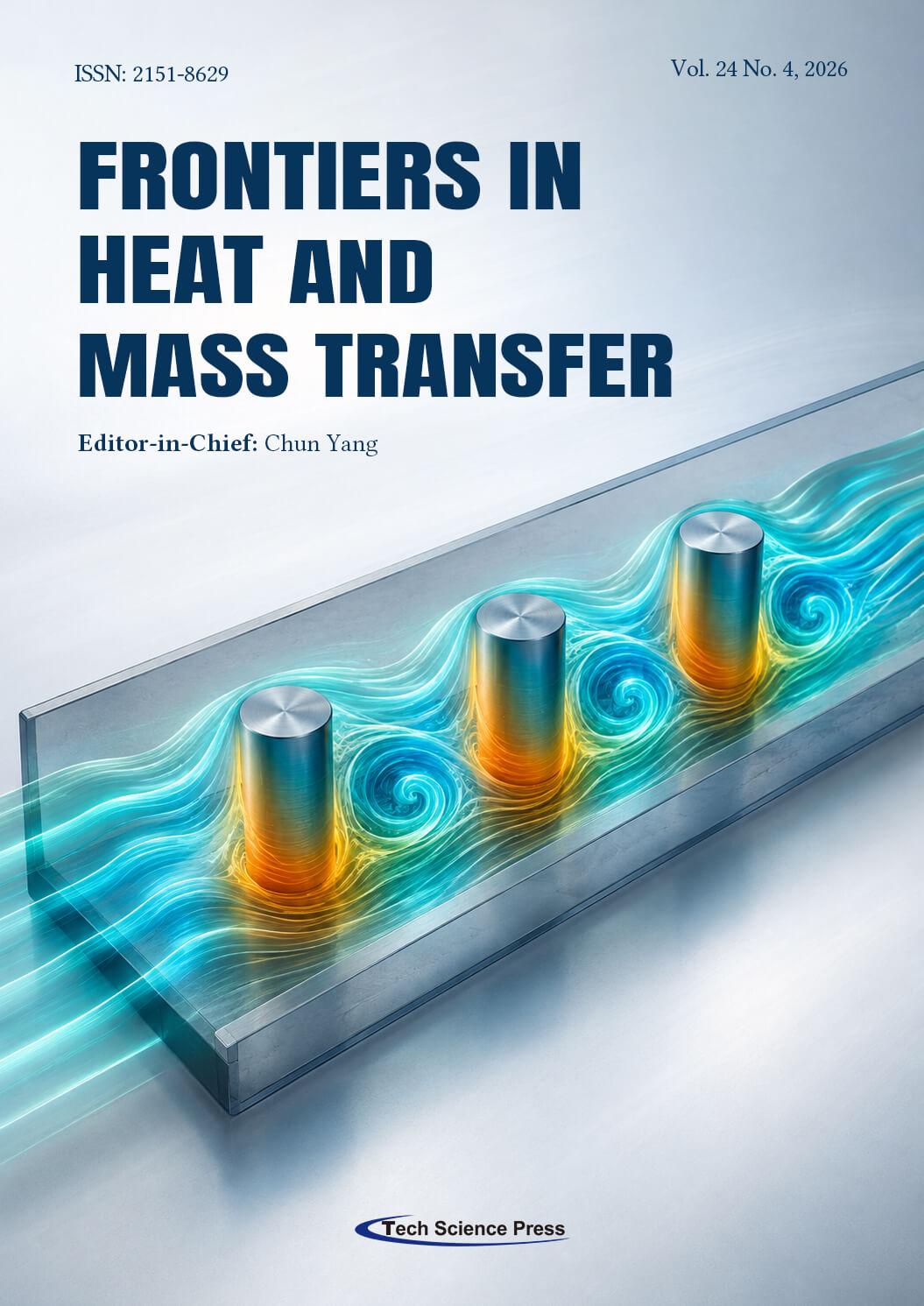
This study explores pulsating-flow heat transfer enhancement over a pin fin array in a rectangular channel. Experiments and CFD analyses show that heat transfer improves with increasing fin spacing, though the benefit saturates at larger gaps. The pulsating Strouhal number is the key parameter, with peak performance occurring around 0.3-0.7, where asymmetric vortex structures develop and significantly enhance wake region fluid mixing. A predictive correlation is proposed, incorporating Strouhal number, fin spacing, Reynolds number, and Prandtl number, which reproduces numerical results within 2.78% average error in the low St regime. These findings provide quantitative design guidelines for energy efficient liquid cooling systems in compact electronic applications. The cover image was created by ChatGPT and contains no copyrighted elements or misleading representations.

View this paper

  • Open AccessOpen Access

    ARTICLE

    Dynamic Thermal Characteristics of Engine Oil Loop Integrated with Fuel Thermal Management

    Shiyu Yang, Yuanfang Lin, Yancong Qiao, Longfei Zhang, Haiyu Yu, Xianghua Xu*, Xingang Liang*
    Frontiers in Heat and Mass Transfer, Vol.24, No.4, 2026, DOI:10.32604/fhmt.2026.084170 - 31 August 2026
    (This article belongs to the Special Issue: Heat and Mass Transfer in Aero-Engines and Gas Turbines)
    Abstract The rapid increase in onboard heat loads has made aircraft thermal management a critical issue. As an important part of the fuel thermal management system (FTMS), the dynamic thermal characteristics of the engine oil system (EOS) directly determine temperature regulation and fuel heat sink utilization, necessitating further investigation. In this paper, a novel dynamic heat transfer model for the oil pump was firstly developed through temperature step experiments. Subsequently, a transient flow and heat transfer model of the oil loop was established using the thermal fluid network (TFN) method, and the influence of thermal inertia… More >

    Graphic Abstract

    Dynamic Thermal Characteristics of Engine Oil Loop Integrated with Fuel Thermal Management

  • Open AccessOpen Access

    ARTICLE

    Relationship between Pulsation Conditions and Pin Fin Spacing for Heat Transfer Enhancement under Pulsating Flow Conditions

    Jumpei Hatakeyama1,2,*, Takashi Fukue2, Hidemi Shirakawa1, Yasuhiro Sugimoto2
    Frontiers in Heat and Mass Transfer, Vol.24, No.4, 2026, DOI:10.32604/fhmt.2026.086397 - 31 August 2026
    (This article belongs to the Special Issue: Enhancement Technologies for Fluid Heat and Mass Transfer)
    Abstract This paper describes a pin fin spacing designed to maximize forced convection heat transfer performance by combining pulsating flow with a pin fin array. With the recent miniaturization and high-density packaging of electronic equipment, thermal management has become a critical issue due to the increasing heat generation density. To address this challenge, we have focused on pulsating flow, commonly observed in blood circulation systems, and investigated its potential to enhance heat transfer. Previous studies have shown that pulsating flow enhances the overall heat transfer around heating elements and ribs by supplying low-temperature coolant to the… More >

  • Open AccessOpen Access

    ARTICLE

    Effect of Surface Roughness on Flow Behavior and Conjugate Heat Transfer between TBC and Cooling Film

    Yuzhang Wang1,2,*, Zhuning Liu1, Haozhe Sun1, Zhuo Li3, Kanru Cheng1, Chaoran Yang1
    Frontiers in Heat and Mass Transfer, Vol.24, No.4, 2026, DOI:10.32604/fhmt.2026.084530 - 31 August 2026
    (This article belongs to the Special Issue: Heat and Mass Transfer in Aero-Engines and Gas Turbines)
    Abstract During the operation of a gas turbine, the surface morphology of thermal barrier coatings (TBCs) of the high temperature blades inevitably evolves due to sintering, particle deposition or other factors, leading to an increase in surface roughness. This altered roughness can significantly influence the flow behavior of cooling films and the heat transfer performance of the coupled cooling film-TBC system. In this work, the flow behavior and conjugate heat transfer between cooling film and TBC under varying surface roughness conditions were investigated using the double distribution function lattice Boltzmann method (DDF-LBM) coupled with large eddy… More >

  • Open AccessOpen Access

    REVIEW

    Electronic Cooling Technologies: A Comprehensive Review of Fundamentals, Advanced Strategies, and Future Directions

    Wei Tong1,2, Chuyi Peng2, Yugang Zhao3,4,*
    Frontiers in Heat and Mass Transfer, Vol.24, No.4, 2026, DOI:10.32604/fhmt.2026.087420 - 31 August 2026
    Abstract The relentless pursuit of higher performance in electronics, driven by the demands of artificial intelligence and high-performance computing, has led to unprecedented power densities that exceed the capabilities of conventional cooling methods. This comprehensive review examines the landscape of electronic cooling technologies, spanning from fundamental heat generation mechanisms to state-of-the-art thermal management strategies. We analyze twelve distinct cooling technologies across the full performance spectrum, from conventional air cooling and heat pipes to advanced microchannel heat sinks, jet impingement, spray cooling, immersion cooling, and AI-optimized intelligent thermal management, comparing their heat transfer coefficients (10–250,000 W/m²·K), critical More >

  • Open AccessOpen Access

    ARTICLE

    Spray Parameter and Additive Concentration Effects on Smooth Surface Spray Cooling: From Flow Visualization to Nusselt Correlation

    Dawar Asfandyar Khan, Yanyu Chen, Haokang Zhang, Yu Wang*
    Frontiers in Heat and Mass Transfer, Vol.24, No.4, 2026, DOI:10.32604/fhmt.2026.083157 - 31 August 2026
    (This article belongs to the Special Issue: High Efficiency Cooling Technology in New and Renewable Energy System)
    Abstract Efficient thermal management of high heat flux systems is critical in modern electronic and energy devices. Spray cooling, with its high heat removal capability and uniform surface cooling, is widely recognized as an effective technique. Extensive studies have explored spray cooling using water and other working fluids, focusing on droplet dynamics, surface wetting, and heat transfer enhancement. However, the influence of low-concentration alcohol additives on spray cooling performance and evaporation dynamics remains insufficiently understood. This work systematically investigates the non-monotonic heat-transfer behaviour by varying spray height, flow rate, and heat input individually, focusing on the… More >

  • Open AccessOpen Access

    ARTICLE

    Evaluation of Local Thermal Environment in Operational Data Center

    Yan Xiao1, Ruoyi Xie1, Song Gao2, Jinhui Yang1, Luyao Liang1, Shaozhi Zhang1,*
    Frontiers in Heat and Mass Transfer, Vol.24, No.4, 2026, DOI:10.32604/fhmt.2026.077396 - 31 August 2026
    Abstract When redeploying servers or installing new racks within an existing data center, assessing the local rack-level thermal environment is crucial to ensure target areas meet stringent cooling requirements. To date, limited research has addressed this specific issue. In this study, experimental measurements and CFD simulations were conducted to evaluate the local thermal environment of an operational data center. The Index of Mixing (IOM) was selected as the primary metric for thermal evaluation. To closely mimic real-world conditions, a 2U server simulator featuring adjustable air volume and heating power was constructed. Experimental results indicated that the… More >

  • Open AccessOpen Access

    ARTICLE

    In3SbTe2-Based Wideband Radiator with Gradient Emittance and Low Solar Absorptance

    Yang Long1, Bowei Xie2,*, Linkang Wang1, Mu Du2,*
    Frontiers in Heat and Mass Transfer, Vol.24, No.4, 2026, DOI:10.32604/fhmt.2026.082479 - 31 August 2026
    Abstract This work proposes a simple multilayer smart coating with wide-band response characteristics based on In3SbTe2 (IST) phase change material, which can achieve significant and gradient dynamic regulation of infrared emittance while ensuring a low solar absorptance. The spectral directional emittance and absorptance characteristics are calculated by the rigorous coupled wave analysis method, and the genetic algorithm is used for global optimization design of the structural parameters. The simulated results show that the smart coating can maintain excellent optical performance with a solar absorptance lower than 0.325, while achieving a significant regulation range of infrared emittance over… More >

  • Open AccessOpen Access

    ARTICLE

    Experimental Study of the Effects of Surface Structure on Frosting Characteristics of Corrugated Surfaces Based on Single-Factor and Taguchi Methods

    Yannian Zhang1, Weilong Zhao2, Haikun Zheng3,*
    Frontiers in Heat and Mass Transfer, Vol.24, No.4, 2026, DOI:10.32604/fhmt.2026.083846 - 31 August 2026
    (This article belongs to the Special Issue: Advances in Microscale Fluid Flow, Heat Transfer, and Phase Change)
    Abstract Aiming at the frosting problem of heat exchanger with fins and tubes under low temperature and high humidity conditions, this study combines the single factor method with the Taguchi experimental method. A corrugated surface was used as the experimental object instead of a corrugated fin, and the frosting characteristics of corrugated surfaces with different structural parameters, including corrugation angle, corrugation depth, and corrugation distribution, were investigated. The Taguchi experimental method was further employed to evaluate the frosting performance of the corrugated surfaces. At the same frosting duration, the surface with a corrugated left section and… More >

  • Open AccessOpen Access

    ARTICLE

    Fine-Scale Velocity Measurement of High-Pressure Transient Multiphase Jets via Adaptive Feature Enhancement and Improved Window Deformation PIV

    Jialei Jiang1, Jiayuan Luo2,3,*, Yan Su1, Weiqiang Xiao1, Jiajun Lu4, Haodong Liu5, Yuqi Huang2
    Frontiers in Heat and Mass Transfer, Vol.24, No.4, 2026, DOI:10.32604/fhmt.2026.083123 - 31 August 2026
    (This article belongs to the Special Issue: Thermal, Mass, and Life Management of Advanced Batteries and Fuel Cells)
    Abstract Quantitative measurement of the high-speed gas-liquid-solid multiphase jets generated during the transient discharge of high-pressure vessels remains a significant challenge. Traditional Particle Image Velocimetry (PIV) techniques often fail in these scenarios due to the intense self-luminous interference, high transient velocities, and the absence of pre-seeded tracer particles. To address these issues, this paper proposes a robust non-intrusive measurement scheme integrating an adaptive image enhancement strategy with an improved cross-correlation algorithm. First, a preprocessing framework combining Contrast Limited Adaptive Histogram Equalization (CLAHE) and frequency-domain high-pass filtering is developed to suppress background noise and reconstruct fluid textures… More >

  • Open AccessOpen Access

    ARTICLE

    Numerical Study on Hydrothermal Characteristics and Entropy Generation of Composite Grooves in Various Microchannels

    Guang Wen1, Wenling Liao1,2,*, Shuaimei Lian1, Pingping Liu1,*
    Frontiers in Heat and Mass Transfer, Vol.24, No.4, 2026, DOI:10.32604/fhmt.2026.081270 - 31 August 2026
    Abstract In this work, FLUENT is used to systematically investigate the effects of two key factors on the hydrothermal performance and entropy generation within a mass flow rate range of 0.3–1.1 g/s: (1) the coupling modes between grooves (simple and composite) and microchannels (straight, convergent, and divergent), and (2) the cross-sectional shape of composite grooves. Results show that, compared with simple grooves, composite grooves induce stronger spiral fluid disturbances between the mainstream and near-wall zones, enhancing direct fluid impingement on groove walls and thus improving the cooling effect on the microchannel. Among the configurations, the coupling More >

  • Open AccessOpen Access

    ARTICLE

    Thermomechanical Optimization Design of TGV Weight Respecting Restrictive Condition and Highly Sensitive Variables

    Peng Guan*, Ming-Ran Li, Si-Bo-Wen Wang
    Frontiers in Heat and Mass Transfer, Vol.24, No.4, 2026, DOI:10.32604/fhmt.2026.082595 - 31 August 2026
    (This article belongs to the Special Issue: Heat and Mass Transfer in Aero-Engines and Gas Turbines)
    Abstract This paper develops a thermomechanical optimization method for turbo guide vane (TGV) weight reduction under restrictive conditions and highly sensitive variables. The proposed method integrates a flow-thermo-structural model, orthogonal experimental design (OED), and an optimization framework based on response surface methodology (RSM) and a genetic algorithm (GA). To address both the plastic limit and temperature distribution of the TGV, a new parameter termed the stress ratio is introduced as a constraint during optimization. Six highly sensitive variables were selected from ten cooling channel diameters using OED. Simulation results based on the thermal-fluid coupling model were… More >

  • Open AccessOpen Access

    ARTICLE

    Heat Transfer Modeling and Failure Analysis of Dry Cooling Systems

    Jiaxi Shen, Zhiyun Wang*
    Frontiers in Heat and Mass Transfer, Vol.24, No.4, 2026, DOI:10.32604/fhmt.2026.081961 - 31 August 2026
    Abstract This study focuses on the modeling and performance prediction of the condensation heat transfer process within an ACC system of a 100 MW unit. A one-dimensional physical model was established, and solutions were obtained using an iterative numerical method based on the first law of thermodynamics. The core of this work involves precise modifications to the heat transfer coefficient. Firstly, the Shah correlation for horizontal tube condensation was improved by incorporating the air mass fraction and the Jakob number to quantify the impact of non-condensable gases. Secondly, to assess the influence of the pipe installation More >

  • Open AccessOpen Access

    REVIEW

    Hydrodynamic Intensification in Wastewater Treatment: A Critical Review of Atomization, Cavitation, and Pulsed Jets from Multiscale Mechanistic Perspectives

    Wensheng Li1, Zeyang Zhang1, Xinjie Chai2, Facheng Qiu1,*
    Frontiers in Heat and Mass Transfer, Vol.24, No.4, 2026, DOI:10.32604/fhmt.2026.080472 - 31 August 2026
    (This article belongs to the Special Issue: Advances in Heat and Mass Transfer for Enhanced Solar Desalination Technologies)
    Abstract Hydrodynamic jet technologies have emerged as a promising approach for advanced wastewater treatment, offering engineering advantages through operational efficiency and system simplicity. As a critical review, this work examines three major hydrodynamic approaches—atomized jets, cavitation jets, and pulsed-jet systems—and analyzes their degradation mechanisms and practical applications in pollutant abatement. By systematically evaluating current research trends, this review elucidates the synergistic interplay between hydrodynamic effects, including turbulent shear, microbubble implosion, and reactive radical generation, and contaminant-decomposition pathways. Quantitative evidence from the reviewed literature further reveals significant performance enhancements achieved by these technologies. Optimized cavitating jets (e.g.,… More >

    Graphic Abstract

    Hydrodynamic Intensification in Wastewater Treatment: A Critical Review of Atomization, Cavitation, and Pulsed Jets from Multiscale Mechanistic Perspectives

  • Open AccessOpen Access

    ARTICLE

    Graphical Analysis and 3D Thermodynamic Cycle Construction for Variable-Composition Ejector Refrigeration Cycle

    Anxiang Shen1, Xinxin Ren2, Tao Wang1, Jianqiu Zhou1,2,*
    Frontiers in Heat and Mass Transfer, Vol.24, No.4, 2026, DOI:10.32604/fhmt.2026.082573 - 31 August 2026
    (This article belongs to the Special Issue: High Efficiency Cooling Technology in New and Renewable Energy System)
    Abstract To address the growing number of variable-composition ejector refrigeration cycles, this study proposes analyzing the matching performance between working fluids and cycles through 3D (Temperature-Entropy-Mass fraction) Thermodynamic Diagrams. The ejector refrigeration cycle is decoupled into a driving module and a refrigeration module, and a theoretical upper-bound model (COPlimiting) that depends only on working-fluid properties is derived from the T-s diagram. Graph-theoretic analysis yields an explicit relation between COPlimiting and fluid-specific parameters such as Δsb-bsa-b and Δse-e/Δsd-e. Definition of k1T47se-e) and k2T34sb-b) reveals that wet fluids favour the refrigeration module, whereas dry fluids favour the driving module. The influence… More >

  • Open AccessOpen Access

    ARTICLE

    Performance Study of Cu Nanofluids in Spectral Beam Splitting Photovoltaic/Thermal Systems

    Guofen Rui1, Xiangyu Hu2, Jingyu Cao3,4,*, Yibo Zhang2, Yangyang Zhu2, Haifei Chen1,2,*
    Frontiers in Heat and Mass Transfer, Vol.24, No.4, 2026, DOI:10.32604/fhmt.2026.086281 - 31 August 2026
    Abstract Spectral beam splitting is a promising approach for thermally decoupling photovoltaic and photothermal processes in PV/T systems. However, existing liquid spectral splitters still suffer from insufficient short-wavelength absorption and/or the high cost of noble-metal nanoparticles. In this study, a water-based Cu@SiO2 nanofluid was developed as a low-cost absorption/transmission spectral splitting filter for monocrystalline silicon PV/T systems. The full solar spectrum considered in this system covers both photovoltaic and thermal utilization, while 750–1000 nm was selected only as the target transmission window for the c-Si cell. This window was chosen because c-Si cells can effectively utilize this… More >

  • Open AccessOpen Access

    ARTICLE

    Flow and Heat Transfer Characteristics in Porous Media with Explicit Structure: A Multi-Physical Field Coupling Study

    Kai Luo1, Yifei Xie1, Kun Chen1, Haibing Chen2,*, Wei Tang1,*, Shaohua Bi3, Jirong Zhang3, Weifeng He3
    Frontiers in Heat and Mass Transfer, Vol.24, No.4, 2026, DOI:10.32604/fhmt.2026.084890 - 31 August 2026
    (This article belongs to the Special Issue: Phase-Change Heat Transfer and Thermal-Hydraulics for Advanced Nuclear Systems)
    Abstract The internal structure of porous media is strongly correlated with flow and thermal transport characteristics, which further influences the overall heat transfer performance of the entire system. Based on explicit structural representation, a three-dimensional numerical method for coupled flow and heat transfer in multi-layered porous sheet arrays is established, utilizing momentum source terms for porous media and a local thermal equilibrium heat transfer model. The impacts from porosity, inlet velocity, and heating power on the flow and heat transfer characteristics within the segment are systematically investigated, with the porosity range determined based on microstructural observations,… More >

  • Open AccessOpen Access

    ARTICLE

    Regulation of Critical Capillary Number: High-Efficiency Displacement Mechanism of Deep Coalbed Methane Considering Wettability Heterogeneity of Proppants between Fractures

    Zeliang Liang1,2, Jia Tan1,*, Jiachao She2, Fengnian Wang2, Yi Wang2, Donghao Li3, Rugang Duan3, Haotian Chu4
    Frontiers in Heat and Mass Transfer, Vol.24, No.4, 2026, DOI:10.32604/fhmt.2026.078050 - 31 August 2026
    (This article belongs to the Special Issue: Multi-Scale Heat and Mass Transfer: From Intensification to System Integration)
    Abstract Significant wettability differences between proppants and coal matrices in deep coal reservoirs limit gas–water mass transfer, a key factor for coalbed methane recovery. This study develops a hybrid wettability fracture model using in-situ data, coupling Navier–Stokes equations with a phase-field method to simulate multi-scale gas–water flow. A random wettability mapping technique captures spatial heterogeneity. The critical capillary number (Ca)-balancing capillary and viscous forces-serves as the key threshold governing flow pathways. At low Ca, capillary forces dominate, causing liquid film aggregation and gas blockage; at high Ca, viscous forces break films and open pathways. Wettability gradients drive asynchronous More >

Per Page:

Share Link