
 Login
Login Register
 Submit a Paper
 Propose a Special lssue
 Open Access
ARTICLE

Childhood psychological maltreatment and online trolling among college students: The mediating role of moral disengagement and the moderating role of mindfulness
1 School of Psychology, Sichuan Normal University, Chengdu, 610066, China
2 Sichuan Urban Vocational College, Chengdu, 610110, China
3 Sichuan Key Laboratory of Psychology and Behaviour of Discipline Inspection and Supervision, Sichuan Normal University, Chengdu, 610066, China
4 Center of Mental Health Education, Guangzhou University of Chinese Medicine, Guangzhou, 510006, China
* Corresponding Author: Fang Li. Email:
Journal of Psychology in Africa 2025, 35(2), 215-221. https://doi.org/10.32604/jpa.2025.067163
Received 06 May 2024; Accepted 13 October 2024; Issue published 30 June 2025
 View Full Text
 Download PDF
Abstract
This study explored the connection between childhood psychological maltreatment and online trolling, as well as the influence of moral disengagement and mindfulness in that relationship. A total of 984 college students (54% females, Mean age = 20.9 years, SD = 1.57 years) took part in the current research. The students responded to standardized measures of childhood psychological maltreatment, online trolling, moral disengagement, mindfulness. Results following the regression and the mediation analyses showed that childhood psychological maltreatment was associated with higher online trolling among college students. Moral disengagement played a mediating role in the link between childhood psychological maltreatment and online trolling, predicting to increased trolling behavior. Furthermore, mindfulness moderated the direct connection between moral disengagement and online trolling. Specifically, compared to those with high mindfulness, individuals with high moral disengagement were more inclined to engage in online trolling when they had low mindfulness. These findings add to our understanding of how and when childhood psychological maltreatment relates to online trolling of which moral engagement and mindfulness would be protective.Keywords
Young adults spend an enormous amount of time online, risking online antisocial behavior known as online trolling. Online trolling, which is a typical online aggressive behavior, is characterized as the intentional posting of inflammatory, offensive, and harmful statements to start a quarrel with multiple people on the internet (Li et al., 2024). Online trolling and cyberbullying are both forms of online aggression, but online trolling differs from cyberbullying in that the former is not targeted at a specific person and appears to have no apparent purpose (Wu et al., 2023). Approximately 74% of a sample of college students had experienced online trolling in the past week (Hong & Cheng, 2018). Online trolling is currently increasing due to the popularity of online social media (Buckels et al., 2014; March & Marrington, 2019), and its victims frequently experience significant distress (Craker & March, 2016) and can even exhibit suicidal ideation as well as self-harming behaviors (Coles & West, 2016). Therefore, to find ways to decrease online trolling, it is vital to investigate the factors that contribute to online trolling and the mechanisms underlying the impacts of these factors.
The propensity for online trolling may stem from adverse childhood experiences or psychological maltreatment within the family context. Related studies have reported that childhood psychological maltreatment is a substantial risk factor for cyberbullying (Wang et al., 2023). The General Aggression Model suggests that input variables (personal and situational factors) have an impact on an individual’s internal states (cognitive states), which influence an individual’s judgment and decision-making, and then affect the individual’s aggression (Allen et al., 2018). According to this model, childhood psychological maltreatment may trigger moral disengagement (internal cognitive states), which in turn affects an individual’s tendency to engage in online trolling (aggressive behavior).
Therefore, in this study, we explored the relationship between childhood psychological maltreatment and online trolling as well as the mechanism underlying this relationship.
Childhood psychological maltreatment and online trolling
Childhood psychological maltreatment refers the adverse caregiving practices or behaviors exhibited by caregivers during a child’s normal developmental process, such as neglect, derogation, and even intimidation of the child (Pan et al., 2010). Parental psychological maltreatment is a typical manifestation of a negative family environment. The General Aggression Model (Allen et al., 2018) posits that the interaction of individual and situational factors can influence an individual’s internal appraisal and decision-making processes, thereby leading to aggressive behavior. Consequently, childhood psychological maltreatment, as a familial situational factor, may be a key risk factor in increasing the likelihood of engaging in cyberbullying behavior. Many empirical studies have also demonstrated that childhood psychological maltreatment is closely related to multiple types of aggressive behavior (Li et al., 2023; Zhang et al., 2023). Online trolling shares certain characteristics with cyberbullying, including bullying (March & Marrington, 2019) and aggression (Hardaker, 2010). Based on this reasoning, we propose the hypothesis that there is a positive correlation between childhood psychological maltreatment and online trolling.
The mediating role of moral disengagement
Moral disengagement denotes an individual’s cognitive inclination to evade guilt by negating moral self-regulation and self-reproach when partaking in unethical conduct (Bandura et al., 1996). Moral disengagement has a high risk of causing cyber harm (Yang et al., 2010), which may be due to less attention to aggressive behavior (Allen et al., 2018). For instance, moral disengagement could serve as a mediator between family parenting styles and higher cyberbullying (Li et al., 2023). This observation aligns with the “external environment-moral disengagement-aggressive behavior” model (Yang et al., 2010). However, no study has investigated the role of moral disengagement in the relationship between childhood psychological maltreatment and online trolling. Quantitative research has revealed a robust positive association between childhood psychological maltreatment and moral disengagement (Wang et al., 2017). Wang et al. (2023) demonstrated that childhood psychological maltreatment significantly predicts moral disengagement (Yin & Yao, 2021). Many cross-sectional studies have demonstrated that moral disengagement is positively correlated with several forms of online antisocial behavior, such as cyberbullying and cyberattacks (Jeong et al., 2022; Wang et al., 2022).
Consequently, we proposed the hypothesis that moral disengagement could serve as a mediator in the association between childhood psychological maltreatment and online trolling behaviors among university students.
The moderating role of mindfulness
Mindfulness is an awareness that results from conscious and nonjudgmental attention to the present moment that helps enhance an individual’s awareness of the present state and monitor his or her behavior (Brown & Ryan, 2003). People exhibiting elevated mindfulness are less prone to concentrate intensely or ruminate on the adverse elements of an incident after experiencing psychological maltreatment (Shapiro et al., 2006), instead they tend to view the experience flexibly, thus reducing their likelihood of engaging in online trolling. Cross-sectional and longitudinal studies have also shown that mindfulness is negatively related to a variety of antisocial behaviors, such as cyberbullying and online trolling (Liu et al., 2024; Wu et al., 2023). Accordingly, it is suggested that mindfulness could potentially act as a moderating factor in the associations between childhood psychological maltreatment and online trolling, as well as between moral disengagement and online trolling.
Previous research has extensively investigated online trolling through the lens of individual personality characteristics, without examining it from the perspective of an individual’s early family environment. In this study, we bridged the research gap by examining the association between the early family environment, specifically childhood psychological maltreatment, and online trolling, along with the mechanisms that underlie this relationship. In addition, based on the general aggression model (GAM), we investigated the mediating role of moral disengagement and the moderating role of mindfulness in the relationship between childhood psychological maltreatment and online trolling for the first time. Therefore, we proposed the following hypotheses (see Figure 1):
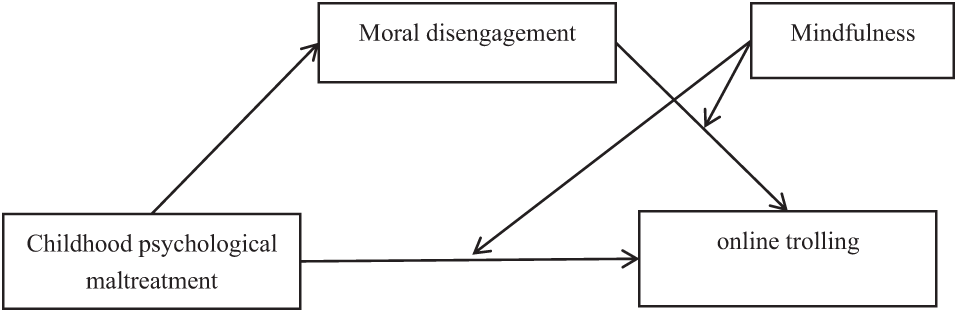
Figure 1: Moderated mediation model
H1: Childhood psychological maltreatment is associated with higher levels of online trolling.
H2: Moral disengagement serves as a mediator in the link between childhood psychological maltreatment and online trolling, leading to increased trolling behavior.
H3: Mindfulness moderates the relationship between childhood psychological maltreatment and online trolling, attenuating online trolling when the level of mindfulness is high.
H4: Mindfulness moderates the relationship between moral disengagement and online trolling. when the level of mindfulness is high.
The sample comprised 984 college students (46% were male and 54% were female). Their ages ranged from 17 to 25 with an average age of 20.90 (SD = 1.57 years). By college enrollment, the sample comprised freshmen (18.3%), sophomores (18.8%), juniors (19.2%), seniors (43.7%) (Nfreshmen = 180, Nsophomores = 185, Njuniors = 189, Nseniors = 430).
Childhood psychological maltreatment
The Chinese version of the Childhood Psychological Maltreatment Scale (CPM, Pan et al., 2010) was used to measure the degree of psychological maltreatment. The survey consists of 23 items that are scored on a 5-point Likert scale ranging from 0 (never) to 4 (always). Higher scores indicating higher levels of perceived psychological maltreatment. Example items include: “When my parents teach me a lesson, they compare me with others and say that I am worthless”; and “My parents listed my shortcomings in front of others”. The confirmatory factor analysis (CFA) produced the following fit indices: TLI = 0.924; CFI = 0.935; SRMR = 0.043; RMSEA = 0.056. Additionally, the Cronbach’s alpha for the CPM scores in this research was 0.865.
The short form of the Revised Global Assessment of Internet Trolling Scale (GAIT-Revised: Sest & March, 2017) comprises 8 items, each rated on a 5-point Likert scale from 1 (strongly disagree) to 5 (strongly agree). Scores that are higher reflect a greater likelihood of engaging in online trolling. Example items include: “Although some people think my posts/comments are offensive, I think they are funny”; and “I say what I like, and if people can’t handle it’s just because they can’t handle the truth”. The results from the confirmatory factor analysis (CFA) indicated good model fit, with the following indices: TLI = 0.947; CFI = 0.964; SRMR = 0.034; RMSEA = 0.065. Additionally, the Cronbach’s alpha for the GAIT scores in this research was 0.757.
The Moral Disengagement Scale (MDS; Wang & Yang, 2010) in its Chinese adaptation comprises 26 items that are evaluated using a 5-point Likert scale from 1 (completely disagree) to 5 (completely agree). This scale encompasses eight dimensions: moral justification, euphemistic labeling, advantageous comparison, displacement of responsibility, diffusion of responsibility, disregard of consequences, dehumanization, power of humanization, and attribution of blame. Sample items include: “Damaging something isn’t a big deal compared to hitting someone”; and “When everyone swears, children should not be chastised for swearing again”. The results from the confirmatory factor analysis (CFA) indicated good model fit, with the following indices: TLI = 0.902; CFI = 0.929; SRMR = 0.068; RMSEA = 0.055. Additionally, the Cronbach’s alpha for the MDS scores in this research was 0.885.
Mindfulness was evaluated using the 15-item Mindfulness Attention Awareness Scale (MAAS, Brown & Ryan, 2003; adapted for the Chinese context by Chen et al., 2012). Items are rated on a 6-point Likert scale from 1 (almost always) to 6 (almost never), with higher scores representing greater mindfulness. Sample items include: “I could be experiencing some emotion and not be conscious of it until some time later”; and “I find myself doing things without paying attention”. The results from the confirmatory factor analysis (CFA) indicated good model fit, with the following indices: TLI = 0.938; CFI = 0.951; SRMR = 0.039; RMSEA = 0.056. Additionally, the Cronbach’s alpha for the MAAS scores in this research was 0.869.
The study received clearance from the Institutional Review Board (IRB) of the principal investigator’s university. Participants contented to the study and were made aware that they could cease completing the questionnaire at any point. It took approximately 10 min for the students to complete all the questions, which included questions on demographic information, online trolling, childhood psychological maltreatment, moral disengagement, and mindfulness. The surveys were completed by the students on their cell phones.
In this research, we initially computed descriptive statistics and correlations among the variables of interest using SPSS version 26.0. Second, the PROCESS Macro Model 4 was used to examine the mediating effect of moral disengagement (Hayes, 2018). Third, the PROCESS Macro Model 15 was used to examine the moderating effect of mindfulness (Hayes, 2018). In addition, we used bootstrapped 95% confidence intervals to assess the statistical significance of the pathways depicted in Models 4 and 15 based on 5000 random samples. The mediating and moderating effects were considered statistically significant when the confidence interval excluded zero.
Descriptive analysis and correlations
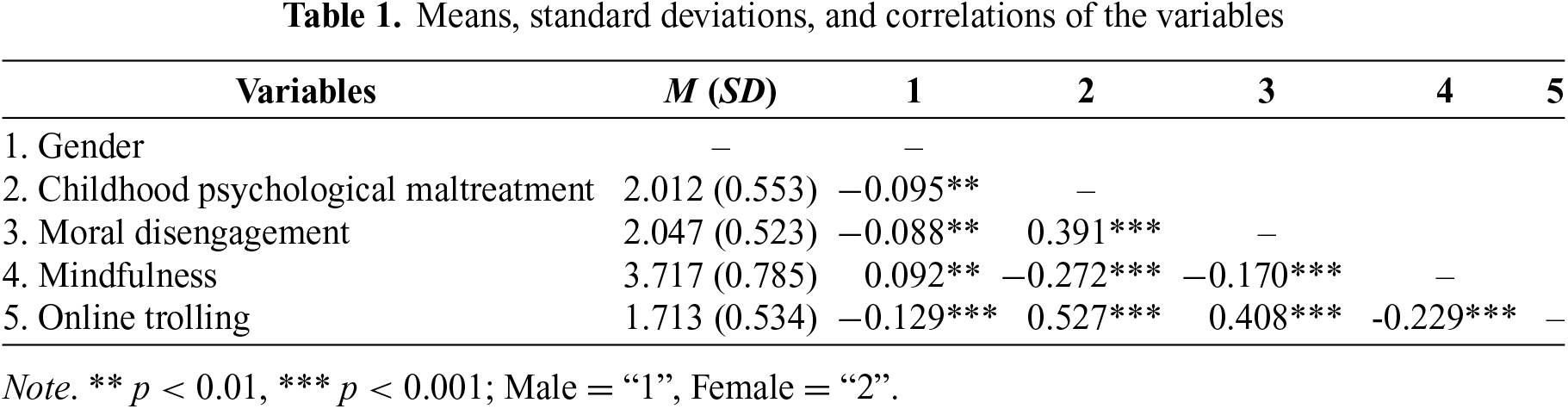
Table 1 displays the means, standard deviations, and correlation coefficients for the study variables. The findings indicated that childhood psychological maltreatment was significantly associated with online trolling (r = 0.527, p < 0.001), thus supporting Hypothesis 1. Moral disengagement also showed a positive association with online trolling (r = 0.408, p < 0.001) but was negatively correlated with mindfulness (r = −0.170, p < 0.001). Mindfulness was negatively linked to online trolling (r = −0.299, p < 0.001). In addition, gender was found to be positively associated with mindfulness (r = 0.092, p < 0.01), yet negatively associated with childhood psychological maltreatment (r = −0.095, p < 0.01), moral disengagement (r = −0.088, p < 0.01) and online trolling (r = −0.129, p < 0.001). Therefore, gender was incorporated as a covariate in the subsequent analysis.
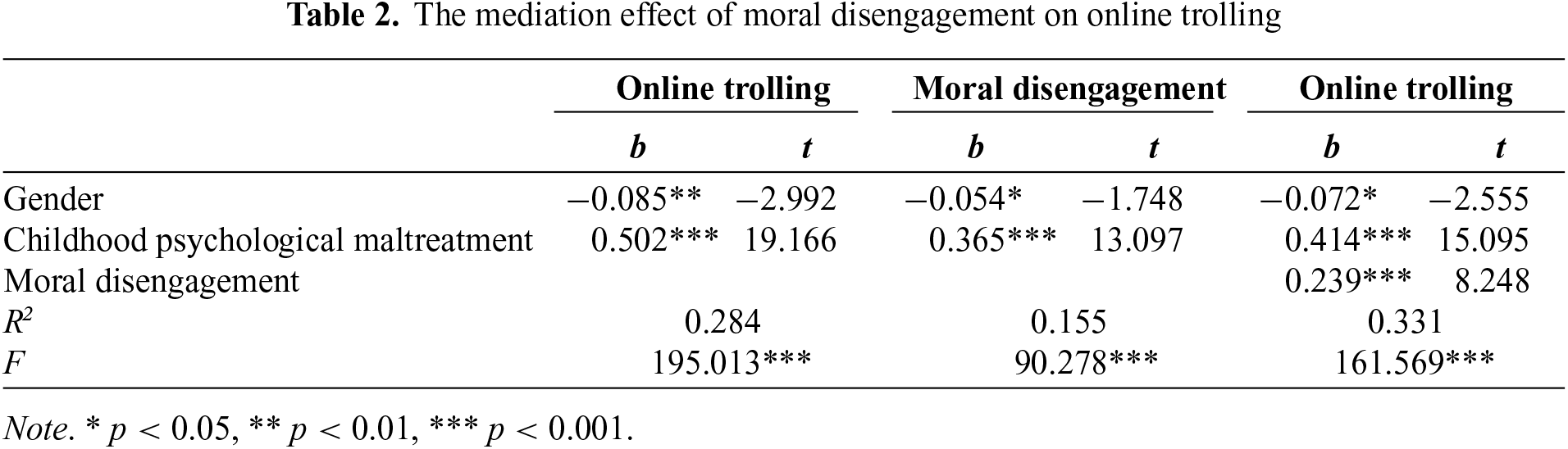
To test for Hypothesis 2, we initially conducted a regression analysis to explore the association between childhood psychological maltreatment and online trolling, after which we employed Hayes’s PROCESS macro (Model 4) to assess the mediating role of moral disengagement. As shown in Table 2, childhood psychological maltreatment was positively associated with moral disengagement and positively associated with online trolling (95% confidence interval did not include 0). The bootstrap results also revealed the significance of the mediating role of moral disengagement in the link between childhood psychological maltreatment and online trolling, the mediating effect was 0.087 (the 95% confidence interval did not contain zero), accounting for 17% of the overall effect. Thus, Hypothesis 2 was validated.
To test Hypotheses 3 and 4, we employed the PROCESS macro Model 15 (Hayes, 2018) to assess the moderating effect of mindfulness. As indicated in Table 3, the interaction between moral disengagement and mindfulness significantly predicted online trolling, with a total effect of −0.091 (the 95% confidence interval did not contain zero). Therefore, Hypothesis 4 was supported. To further elucidate the nature of the interaction between moral disengagement and mindfulness, we divided the sample into high and low mindfulness groups based on one standard deviation above or below the mean. We then conducted a simple slopes analysis and plotted the results. As shown in Figure 2, when the level of mindfulness was low, moral disengagement significantly positively predicted online trolling, b simple = 0.299, p < 0.001; when the level of mindfulness was high, moral disengagement significantly positively predicted online trolling, b simple = 0.157, p < 0.001. The findings suggest that as mindfulness increases, the predictive effect of moral disengagement on online trolling decreased.
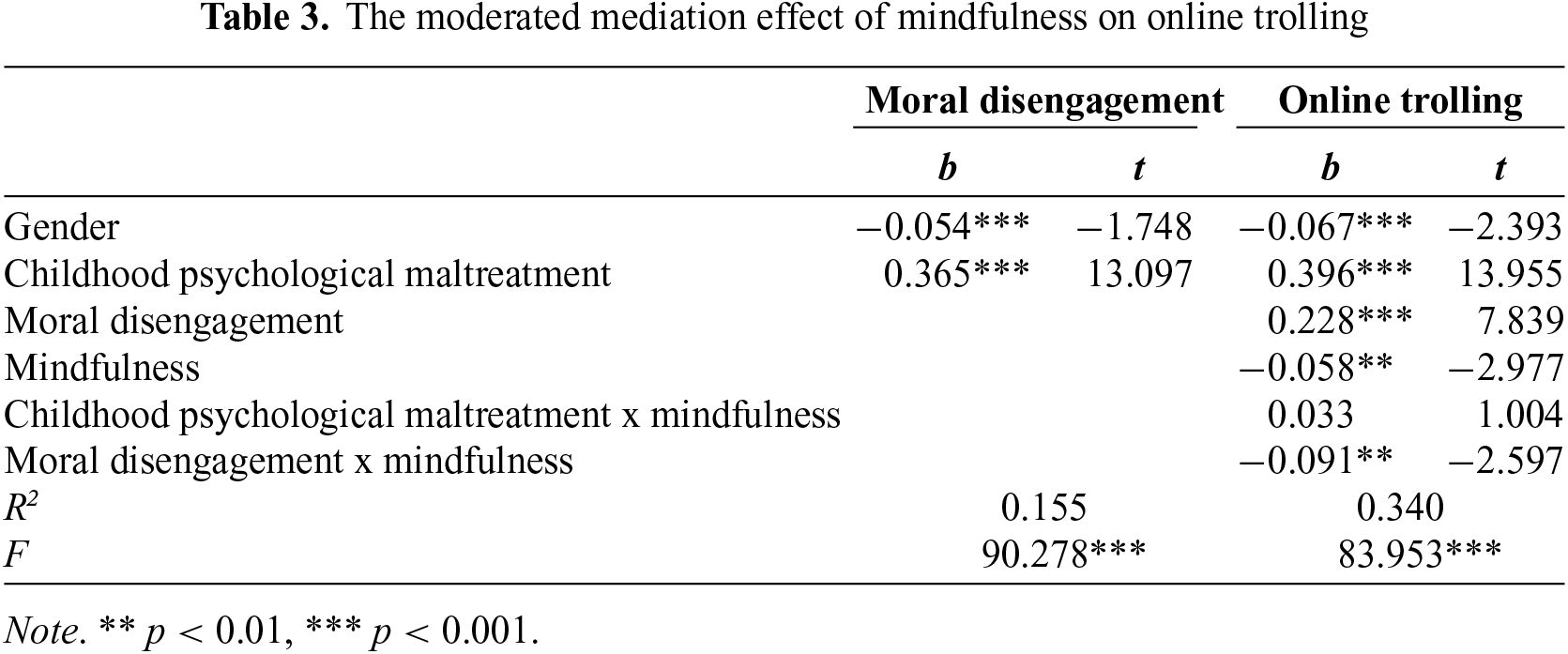
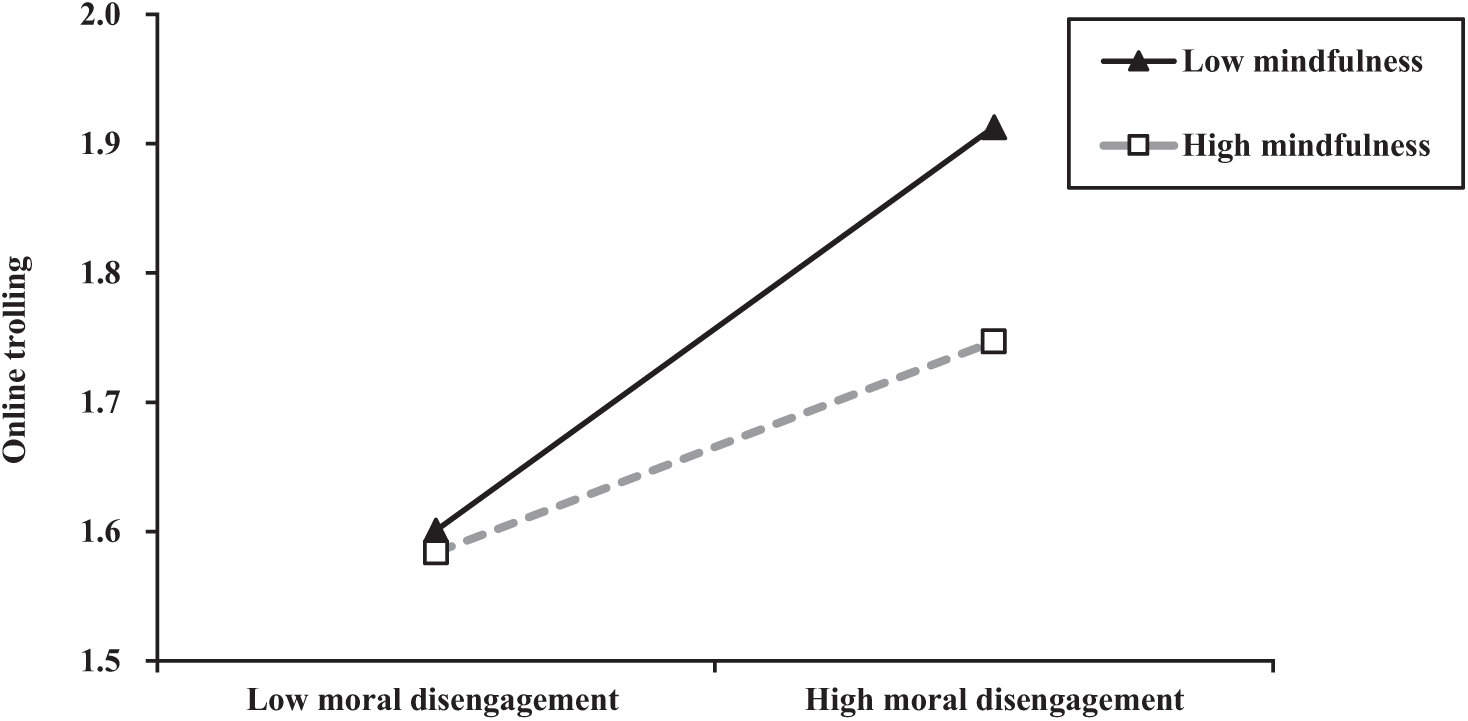
Figure 2: The relationship between moral disengagement and online trolling at different levels of mindfulness
In contrast to our initial hypothesis, mindfulness did not significantly moderate the relationship between childhood psychological maltreatment and online trolling (b = 0.033, p > 0.05).
Consistent with our hypothesis, childhood psychological maltreatment was associated with higher risk for online trolling. This finding is consistent with previous findings on childhood psychological maltreatment being a predictor of online antisocial behaviors such as cyberbullying (Li et al., 2023). Our study also found that children who suffered more psychological maltreatment were more prone to participate in online trolling in adulthood, consistent with the general aggression model (GAM) that environmental factors (childhood psychological maltreatment) would influence aggressive behavior (online trolling) (Allen et al., 2018).
On the one hand, experiences of psychological maltreatment may cause individuals to observe and learn the behaviors to which they are subjected, thus leading to a “cycle of violence” (Wang et al., 2019). Relevant studies have shown that adverse experiences such as childhood psychological maltreatment often leads individuals to exhibit more hostility as well as physical and verbal aggression (Xiang et al., 2020), and these psychological traits may affect individuals’ behavioral performance in social interactions, making them more likely to engage in aggressive and impulsive behaviors. On the other hand, due to the rise of social media, the fact that interactions via such media are not conducted face-to-face and the high accessibility of such media have made it easier and more common to engage in trolling online (Wang et al., 2023). Exposure to psychological maltreatment during childhood can contribute to the emergence of negative psychological conditions, such as anxiety, depression, and low self-esteem, while college students may attack the crowd on social media as a way to alleviate their negative emotions and seek some degree of recognition and satisfaction, ultimately increasing the likelihood of such individuals engaging in online trolling (Geng et al., 2022).
This research identified moral disengagement as a mediator in the link between childhood psychological maltreatment and online trolling. This can be attributed to the early family environment being with moral disengagement. This is in line with previous studies demonstrating that harsh family child-rearing environments can elevate moral disengagement (Wang et al., 2019). Moral disengagement results from social learning, college students who have suffered from high levels of psychological abuse are more likely to exhibit negative attitudes toward moral development, and moral cognition is susceptible to shifts and distortions such as minimization or disengagement of responsibility, thus leading to moral disengagement (Hodgdon, 2009).
This study’s findings suggest that morally disengaged individuals are more inclined to participate in online trolling (Wu et al., 2023). Morally disengaged individuals are prone to reconstruct or rationalize their aggressive behavior and are more likely to create cognitive frameworks that rationalize their antisocial behavior (Hodgdon, 2009), thereby promoting online trolling. That is, highly morally disengaged individuals are more inclined to justify online trolling behavior; therefore, they are also more inclined to participate in such unethical behaviors. In addition, due to the rapid development of information technology, college students are more likely to socialize via the internet, which is relatively anonymous, lacks adequate regulation, and is prone to the diffusion and transfer of responsibility. In such an environment, the process of moral disengagement is more likely to be triggered, thus raising the likelihood of involvement in online trolling.
Finally, this research found that mindfulness to moderate the relationship between moral disengagement and online trolling. Specifically, the impact of moral disengagement on online trolling is weaker when individuals possess greater mindfulness, whereas this impact is amplified when individuals display lesser mindfulness. This result aligns with existing literature, which suggests that mindfulness, as a protective factor, reduces moral disengagement and unethical behaviors and significantly negatively predicts online trolling (Liu et al., 2022). This outcome might be attributed to the fact that mindfulness, as a positive psychological resource, increases people’s self-control and enables them to adhere to their own moral standards, perceive the present moment uncritically, and act more in line with their moral standards, thus leading them to engage in less aggressive behavior (Zhang & Zhang, 2023).
However, contrary to our expectations, mindfulness did not moderate the relationship between childhood psychological maltreatment and online trolling. A plausible explanation for this connection is that childhood psychological maltreatment has long-lasting and profound effects on an individual’s psychological functioning (Mwakanyamale & Yizhen, 2019), which in turn can lead to a cycle of violence in adulthood, such as online trolling. Although mindfulness can help individuals strengthen self-control and emotional regulation, it is difficult to eliminate the impact of the root problem of childhood psychological maltreatment. This finding emphasizes the strong impact of childhood psychological maltreatment on online trolling.
This research offers a number of practical insights. This study contributes to our understanding of how exposure to psychological maltreatment in early childhood predicts an increased risk of engaging in online trolling in adulthood. Specifically, the substantial link between childhood psychological maltreatment and online trolling suggests that parents or other caregivers should recognize that poor parenting as a risk for online trolling in adulthood. As preventive is positive parenting styles, that show more care and concern for children for healthy development.
Children with adverse childhood events should be provided with timely psychological support and assistance to restore their psychological health. Moral engagement education would also be helpful to mindfulness and emotional regulation of individuals who have endured psychological maltreatment, decreasing their risk for online trolling.
Several limitations of the current study should be noted. First, this study employed a cross-sectional design that did not allow causal inferences. In the future, longitudinal studies are needed to test our model. Second, the individuals involved in this study were university students and future to should implement in the general population. Finally, future research could examine other possible mediators of this link (e.g., anger rumination and hostile attributions) with the goal of providing more theoretical guidance on potential interventions targeting online trolling.
Most of the existing studies have explored online trolling from a personality perspective. This research thoroughly explored the link between childhood psychological maltreatment and online trolling, as well as its underlying mechanism. This somewhat extends current research ideas from the perspective of environmental factors. Childhood psychological maltreatment could be a substantial risk factor against college students’ online trolling. Negative childhood events were linked to higher online trolling among university students. Childhood psychological maltreatment may not only directly increase online trolling but also indirectly through increased moral disengagement. Mindfulness moderated the direct connection between moral disengagement and online trolling. Specifically, when compared with individuals with high levels of mindfulness, those with high levels of moral disengagement were more inclined to engage in online trolling when their mindfulness was low. Mindfulness may serve as protective factors against online trolling for students who have experienced childhood maltreatment.
Acknowledgement: We gratefully acknowledge the time and dedication of all individuals who participated in this study.
Funding Statement: This research was supported by the National Social Science Funds of China “A Study of the Psychosocial Mechanisms of Youth Online Trolling” (23BSH143).
Author Contributions: Study conception and design: Xu Tang, Fang Li; data collection: Xu Tang, Fang Li and Biyun Wu; analysis and interpretation of results: Xu Tang, Fang Li; draft manuscript preparation: Xu Tang, Fang Li and Biyun Wu. All authors reviewed the results and approved the final version of the manuscript.
Availability of Data and Materials: The research data collected and examined in this investigation can be obtained by contacting the corresponding author with a justified request.
Ethics Approval: All procedures performed in studies involving human participants were in accordance with the ethical standards of the institutional research committee and with the 1964 Helsinki declaration and its later amendments or comparable ethical standards. Ethical approval for this investigation was granted by Sichuan Normal University’s Ethics Review Committee. The study adhered to institutional ethical requirements, with all subjects providing voluntary participation consent.
Conflicts of Interest: The authors declare no conflicts of interest to report regarding the present study.
References
Allen, J. J., Anderson, C. A., & Bushman, B. J. (2018). The general aggression model. Current Opinion in Psychology, 19, 75–80. [Google Scholar] [PubMed]
Bandura, A., Barbaranelli, C., Caprara, G. V., & Pastorelli, C. (1996). Mechanisms of moral disengagement in the exercise of moral agency. Journal of Personality and Social Psychology, 71(2), 364–374. [Google Scholar]
Brown, K. W., & Ryan, R. M. (2003). The benefits of being present: Mindfulness and its role in psychological well-being. Journal of Personality and Social Psychology, 84(4), 822. [Google Scholar] [PubMed]
Buckels, E. E., Trapnell, P. D., & Paulhus, D. L. (2014). Trolls just want to have fun. Personality and Individual Differences, 67, 97–102. [Google Scholar]
Chen, S. Y., Cui, H., Zhou, R. L., & Jia, Y. Y. (2012). Revision of mindful attention awareness scale (MAAS). Chinese Journal of Clinical Psychology, 20(2), 148–151. [Google Scholar]
Coles, B. A., & West, M. (2016). Trolling the trolls: Online forum users constructions of the nature and properties of trolling. Computers in Human Behavior, 60, 233–244. https://doi.org/10.1016/j.chb.2016.02.070 [Google Scholar] [CrossRef]
Craker, N., & March, E. (2016). The dark side of Facebook®: The dark tetrad, negative social potency, and trolling behaviors. Personality and Individual Differences, 102, 79–84. https://doi.org/10.1016/j.paid.2016.06.043 [Google Scholar] [CrossRef]
Geng, J., Bao, L., Wang, H., Wang, J., Wei, X. et al. (2022). The relationship between childhood maltreatment and adolescents’ cyberbullying victimization: The new phenomenon of a cycle of victimization. Child Abuse & Neglect, 134, 105888. https://doi.org/10.1016/j.chiabu.2022.105888. [Google Scholar] [PubMed] [CrossRef]
Hardaker, C. (2010). Trolling in asynchronous computer-mediated communication: From user discussions to academic definitions. Journal of Politeness Research, 6(2), 215–242. https://doi.org/10.1515/jplr.2010.011 [Google Scholar] [CrossRef]
Hayes, A. F. (2018). Introduction to mediation, moderation, and conditional process analysis: A regression based approach. 2nd ed. New York, NY, USA: Guilford Press. [Google Scholar]
Hodgdon, H. B. (2009). Child maltreatment and aggression: The mediating role of moral disengagement, emotion regulation, and emotional callousness among juvenile offenders. Philadelphia, PA, USA: Temple University. [Google Scholar]
Hong, F. Y., & Cheng, K. T. (2018). Correlation between university students’ online trolling behavior and online trolling victimization forms, current conditions, and personality traits.Telematics and Informatics, 35(2), 397–405. https://doi.org/10.1016/j.tele.2017.12.016 [Google Scholar] [CrossRef]
Jeong, R., Gilbertson, M., Riffle, L. N., & Demaray, M. K. (2022). Participant role behavior in cyberbullying: An examination of moral disengagement among college students. International Journal of Bullying Prevention, 6, 28–40. [Google Scholar]
Li, F., Tang, X., Ge, X., Yu, M., Wang, S. et al. (2024). Is mindfulness associated with lower online trolling among adolescents? Mediating effects of self-esteem and depression and moderating effect of dark personality traits. Journal of Psychology in Africa, 34(3), 293–298. https://doi.org/10.1080/14330237.2024.2363698 [Google Scholar] [CrossRef]
Li, S., Zhao, X., Zhao, F., Liu, H., & Yu, G. (2023). Childhood maltreatment and adolescent cyberbullying perpetration: Roles of individual relative deprivation and deviant peer affiliation. Children and Youth Services Review, 149(4), 106957. https://doi.org/10.1016/j.childyouth.2023.106957 [Google Scholar] [CrossRef]
Liu, C., Yuan, G. F., Fung, H. W., Zhao, J., Shi, W. et al. (2024). Mediating roles of self-esteem and empathy in the relation between mindfulness and cyberbullying perpetration among adolescents: A longitudinal perspective. Journal of School Violence, 23(1), 43–54. https://doi.org/10.1080/15388220.2023.2266800 [Google Scholar] [CrossRef]
Liu, M. F., Wu, B. Y., Li, F., Wang, X. Q., & Geng, F. L. (2022). Does mindfulness reduce trolling? The relationship between trait mindfulness and online trolling: The mediating role of anger rumination and the moderating role of online disinhibition. Journal of Affective Disorders, 301(1), 36–43. https://doi.org/10.1016/j.jad.2022.01.023. [Google Scholar] [PubMed] [CrossRef]
March, E., & Marrington, J. (2019). A qualitative analysis of internet trolling. Cyberpsychology, Behavior, and Social Networking, 22(3192–197. [Google Scholar] [PubMed]
Mwakanyamale, A. A., & Yizhen, Y. Z. (2019). Psychological maltreatment and its relationship with self-esteem and psychological stress among adolescents in Tanzania: A community based, cross-sectional study. BMC Psychiatry, 19(1), 176. https://doi.org/10.1186/s12888-019-2139-y. [Google Scholar] [PubMed] [CrossRef]
Pan, C., Deng, Y. L., Guan, B. Q., & Luo, X. R. (2010). Reliability and validity of child psychological maltreatment scale. Chinese Journal of Clinical Psychology, 18(4), 463–465. [Google Scholar]
Sest, N., & March, E. (2017). Constructing the cyber-troll: Psychopathy, sadism, and empathy. Personality and Individual Differences, 119, 69–72. [Google Scholar]
Shapiro, S. L., Carlson, L. E., Astin, J. A., & Freedman, B. (2006). Mechanisms of mindfulness. Journal of Clinical Psychology, 62(3), 373–386. [Google Scholar] [PubMed]
Wang, X. C., Yang, J. P., Wang, P. C., & Lei, L. (2019). Childhood maltreatment, moral disengagement, and adolescents’ cyberbullying perpetration: Fathers’ and mothers’ moral disengagement as moderators. Computers in Human Behavior, 95(1), 48–57. https://doi.org/10.1016/j.chb.2019.01.031 [Google Scholar] [CrossRef]
Wang, X. C., Yang, L., Gao, L., Yang, J. P., Lei, L. et al. (2017). Childhood maltreatment and Chinese adolescents’ bullying and defending: The mediating role of moral disengagement. Child Abuse & Neglect, 69, 134–144. [Google Scholar]
Wang, X., Dong, W., & Qiao, J. (2023). How is childhood psychological maltreatment related to adolescents’ cyberbullying perpetration? The roles of moral disengagement and empathy. Current Psychology, 42(19), 16484–16494. https://doi.org/10.1007/s12144-021-02495-9 [Google Scholar] [CrossRef]
Wang, X., Wang, W., Qiao, Y., Gao, L., Yang, J. et al. (2022). Parental phubbing and adolescents’ cyberbullying perpetration: A moderated mediation model of moral disengagement and online disinhibition. Journal of Interpersonal Violence, 37(7–8), NP5344–NP5366. https://doi.org/10.1177/0886260520961877. [Google Scholar] [PubMed] [CrossRef]
Wang, X., & Yang, J. (2010). Reliability and validity of moral disengagement scale in Chinese students. Chinese Journal of Clinical Psychology, 18(2), 177–179. [Google Scholar]
Wu, B., Xiao, Y., Zhou, L., Li, F., & Liu, M. (2023). Why individuals with psychopathy and moral disengagement are more likely to engage in online trolling? The online disinhibition effect. Journal of Psychopathology and Behavioral Assessment, 45(2), 322–332. https://doi.org/10.1007/s10862-023-10028-w [Google Scholar] [CrossRef]
Xiang, Q., Wang, M. M., Hu, Q., Liu, Q., Zhang, H. et al. (2020). Psychological abuse and neglect in childhood and aggression of college students: The mediating effects ofrumination and forgiveness. China Journal of Health Psychology, 28(11), 1682–1686. [Google Scholar]
Yang, J. P., Wang, X. C., & Gao, L. (2010). Concept, measurement and related variables of moral disengagement. Advances in Psychological Science, 18(4), 671–678. [Google Scholar]
Yin, T. Z., & Yao, Q. (2021). The effect of psychological maltreatment on externalizing problem behavior of high school students: The chain mediating effect of empathy and moral disengagement. Chinese Journal of Special Education, (10), 70–76. [Google Scholar]
Zhang, A., & Zhang, Q. (2023). How could mindfulness-based intervention reduce aggression in adolescent? Mindfulness, emotion dysregulation and self-control as mediators. Current Psychology, 42(6), 4483–4497. https://doi.org/10.1007/s12144-021-01778-5 [Google Scholar] [CrossRef]
Zhang, S., Li, Y., Cao, M., & Liu, Y. (2023). Does childhood psychological maltreatment encourage you to become a cyberbullying perpetrator? The mediating role of negative affect and the moderating role of meaning in life. Frontiers in Psychology, 14, 1223535. https://doi.org/10.3389/fpsyg.2023.1223535. [Google Scholar] [PubMed] [CrossRef]
Cite This Article
 Copyright © 2025 The Author(s). Published by Tech Science Press.
This work is licensed under a Creative Commons Attribution 4.0 International License , which permits unrestricted use, distribution, and reproduction in any medium, provided the original work is properly cited.
 Downloads
 Citation Tools
