
 Login
Login Register
 Submit a Paper
 Propose a Special lssue
 Open Access
REVIEW

Plant-Based Cellulose Nanopapers with Applications for Packaging, Protective Films and Energy Devices
Instituto de Investigaciones en Ciencia y Tecnología de Materiales (INTEMA), Facultad de Ingeniería, Universidad Nacional de Mar del Plata-CONICET, Mar del Plata, 7600, Argentina
* Corresponding Author: Mirta I. Aranguren. Email:
Journal of Renewable Materials 2025, 13(8), 1491-1519. https://doi.org/10.32604/jrm.2025.02024-0079
Received 28 December 2024; Accepted 23 June 2025; Issue published 22 August 2025
 View Full Text
 Download PDF
Abstract
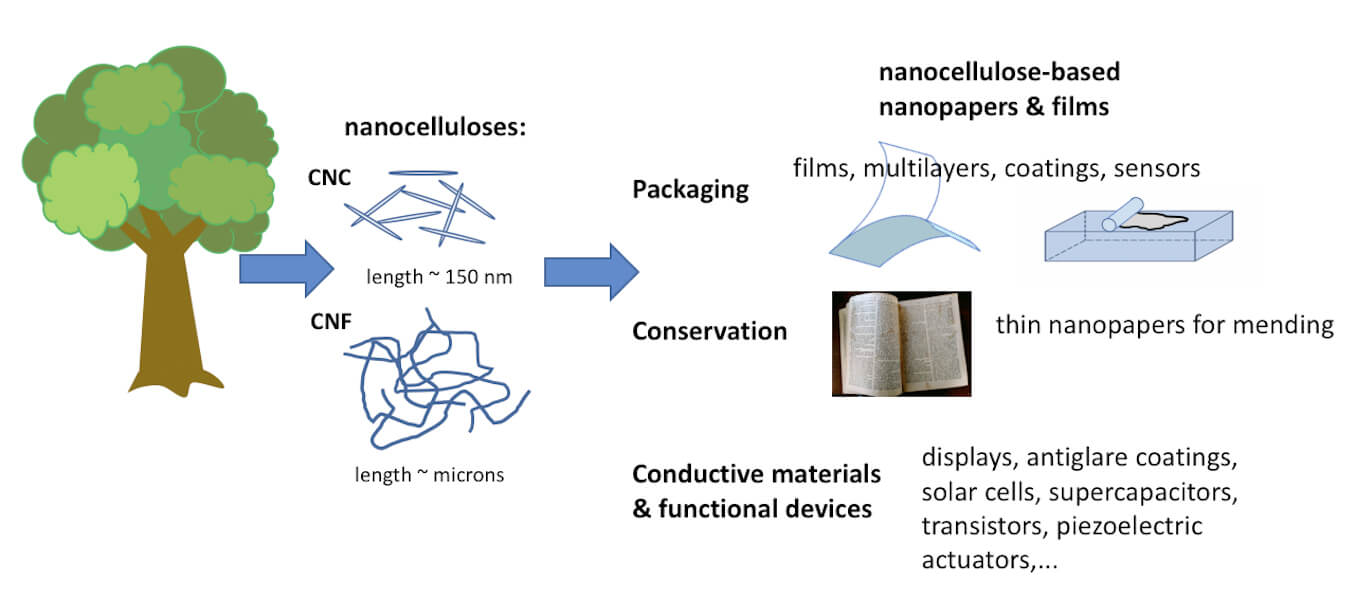
Interest in the use of cellulose nanomaterial’s continues to grow, both in research and industry, not only due to the abundance of raw materials, low toxicity and sustainability, but also due to the attractive physical and chemical properties that make nanocelluloses useful for a wide range of end-use applications. Among the large number of potential uses, and nanocelluloses modification and processing strategies, the chosen topic of this review focuses exclusively on plant-derived cellulose microfibers/nanofibers (CNF) and cellulose nanocrystals (CNC) processed into 2D structures—nanopapers and nanofilms—fabricated as self-standing films or applied as coatings. The end uses considered are: combination with standard papers and cardboards for packaging, mending material for the conservation and protection of cellulosic heritage artifacts, and component-parts of complex designs of functional devices for energy harvesting and storage. In these contexts, nanocelluloses provide high mechanical and ecofriendly properties, transparency and tunable haze, as well as flexibility/bendability in the resulting films. All these characteristics make them extremely attractive to a market seeking for sustainable, light weight and low cost raw materials for the production of goods. General perspectives on the current advantages and disadvantages of using CNF and CNC in the selected areas are also reviewed.Graphic Abstract
Keywords
Nanocellulose; cellulose nanofibers; cellulose nanocrystals; packaging; energy storage; energy harvesting; heritage paper protection
Supplementary Material
Supplementary Material FileCite This Article
APA Style
Mucci, V.L., Aranguren, M.I. (2025). Plant-Based Cellulose Nanopapers with Applications for Packaging, Protective Films and Energy Devices. Journal of Renewable Materials, 13(8), 1491–1519. https://doi.org/10.32604/jrm.2025.02024-0079
Vancouver Style
Mucci VL, Aranguren MI. Plant-Based Cellulose Nanopapers with Applications for Packaging, Protective Films and Energy Devices. J Renew Mater. 2025;13(8):1491–1519. https://doi.org/10.32604/jrm.2025.02024-0079
IEEE Style
V. L. Mucci and M. I. Aranguren, “Plant-Based Cellulose Nanopapers with Applications for Packaging, Protective Films and Energy Devices,” J. Renew. Mater., vol. 13, no. 8, pp. 1491–1519, 2025. https://doi.org/10.32604/jrm.2025.02024-0079
 Copyright © 2025 The Author(s). Published by Tech Science Press.
This work is licensed under a Creative Commons Attribution 4.0 International License , which permits unrestricted use, distribution, and reproduction in any medium, provided the original work is properly cited.
 Downloads
 Citation Tools
