
 Login
Login Register
 Submit a Paper
 Propose a Special lssue
 Open Access
ARTICLE
SFXN3 Serves as a Predictive Biomarker for Cisplatin Response and Survival in Head and Neck Squamous Cell Carcinoma
1 Department of Otorhinolaryngology–Head and Neck Surgery, College of Medicine, Konyang University, Daejeon, Republic of Korea
2 Department of Otorhinolaryngology–Head and Neck Surgery, College of Medicine, Korea University, Seoul, Republic of Korea
3 BK21 FOUR KNU Creative BioResearch Group, Department of Biology, College of Natural Sciences, Kyungpook National University, Daegu, Republic of Korea
4 New Drug Development Center, Osong Medical Innovation Foundation, Cheongju, Republic of Korea
5 Basic Research Laboratory for the Regulation of Microplastic-Mediated Diseases and Anti-Aging Research Center, Dong-eui University, Busan, Republic of Korea
6 Department of Biochemistry, College of Korean Medicine, Dong-eui University, Busan, Republic of Korea
7 Center for Genome Engineering, Institute for Basic Science, Daejeon, Republic of Korea
* Corresponding Author: Eunjeong Kim. Email:
# These authors share first authorship
Oncology Research 2026, 34(6), 22 https://doi.org/10.32604/or.2026.078376
Received 30 December 2025; Accepted 01 April 2026; Issue published 21 May 2026
 View Full Text
 Download PDF
Abstract
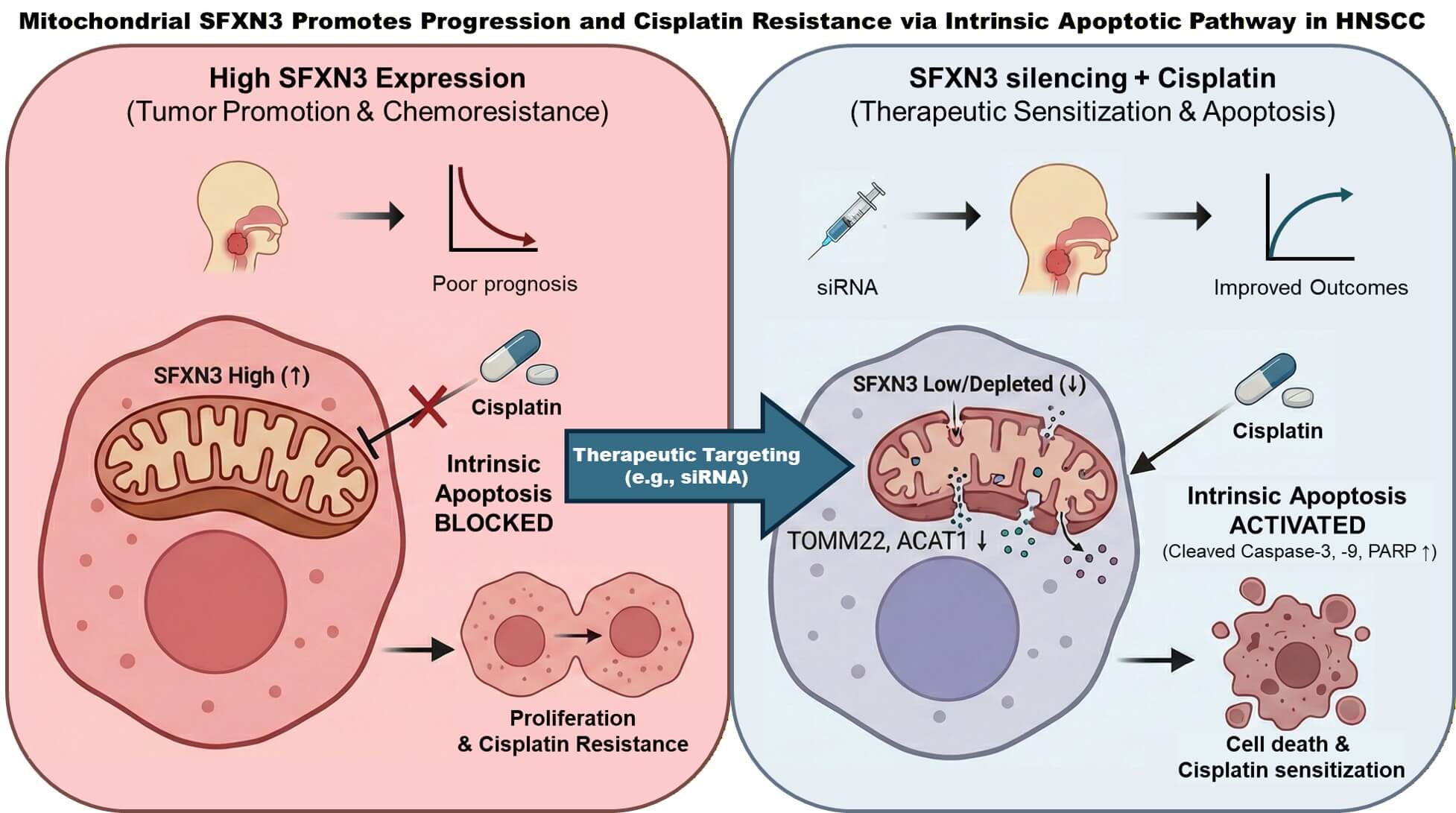
Objective: The systematic evaluation of expansive genomic databases facilitates the discovery of clinically vital biomarkers. While Sideroflexin 3 (SFXN3) consistently displays elevated expression in head and neck squamous cell carcinoma (HNSCC), its specific pathobiological functions and prognostic value remain insufficiently characterized. This study aims to delineate the clinical and functional significance of SFXN3 in HNSCC. Methods: We interrogated SFXN3 expression patterns, patient survival outcomes, and immune cell infiltration characteristics utilizing multiple independent repositories, including the cancer genome atlas (TCGA) and gene expression omnibus (GEO). The prognostic independence of SFXN3 was verified via multivariate Cox regression. These computational findings were subsequently corroborated through targeted in vitro functional assays. Results: SFXN3 expression was significantly augmented in HNSCC, demonstrating strong correlations with advanced disease stages and reduced overall survival. Multivariate models confirmed its status as an independent prognostic indicator. Furthermore, SFXN3 upregulation was closely tied to an immunosuppressive microenvironment. In vitro validations revealed that SFXN3 knockdown substantially impairs cell proliferation while simultaneously sensitizing HNSCC cells to cisplatin-induced apoptosis via intrinsic pathways. Conclusion: Ultimately, SFXN3 represents a robust prognostic indicator and an actionable therapeutic vulnerability to counteract both drug resistance and tumor immune escape in HNSCC.Graphic Abstract
Keywords
Supplementary Material
Supplementary Material FileCite This Article
 Copyright © 2026 The Author(s). Published by Tech Science Press.
This work is licensed under a Creative Commons Attribution 4.0 International License , which permits unrestricted use, distribution, and reproduction in any medium, provided the original work is properly cited.
 Downloads
 Citation Tools
