
 Login
Login Register
 Submit a Paper
 Propose a Special lssue
 Open Access
REVIEW
Cancer-Associated Arterial Thrombosis: Mechanisms and Risk Factors
Laboratory of Biochemistry, Faculty of Chemistry, School of Sciences, University Campus, University of Ioannina, Ioannina, Greece
* Corresponding Author: Despoina Pantazi. Email:
(This article belongs to the Special Issue: Recent Advances in Cancer Pharmacology)
Oncology Research 2026, 34(5), 5 https://doi.org/10.32604/or.2026.074452
Received 11 October 2025; Accepted 02 February 2026; Issue published 22 April 2026
 View Full Text
 Download PDF
Abstract
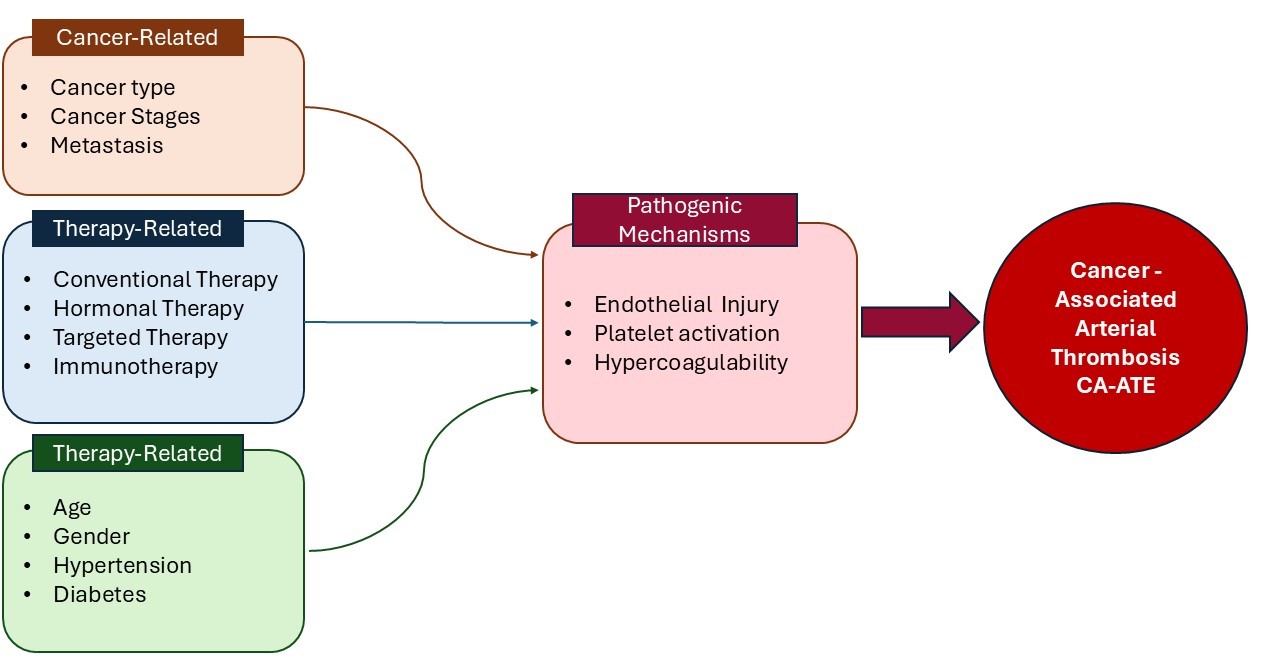
Cancer-associated thrombosis (CAT) is a leading cause of morbidity and mortality among cancer patients. While venous thromboembolic events have been extensively studied due to their higher incidence, arterial thrombosis in cancer patients—referred to as cancer-associated arterial thromboembolism (CA-ATE)—is less well understood but may pose a greater danger. The pathophysiology of CA-ATE involves complex interactions between the tumor microenvironment, cancer cells, patient-related factors, and cancer therapies. Some chemotherapeutic agents, particularly platinum-based compounds (cisplatin, oxaliplatin), gemcitabine, taxanes, and targeted therapies such as tyrosine kinase inhibitors (TKIs), have been associated with an increased risk of arterial thrombosis. In certain patient populations, hormonal therapy and selective estrogen receptor modulators may also contribute to this risk. Additionally, factors such as patient age, cancer type, and stage contribute to an increased risk of arterial thrombosis in this population. Key mechanisms driving CA-ATE include endothelial injury, hypercoagulability, and platelet activation. Certain malignancies, notably lung and pancreatic cancers, are associated with a higher incidence of arterial thrombotic events. The aim of this review is to enhance understanding of the underlying mechanisms of cancer-related arterial thromboembolism and to highlight the various therapeutic, cancer-related, and patient-related factors that contribute to the occurrence of cancer-associated arterial thrombotic events.Graphic Abstract
Keywords
Anticancer drugs; cancer-associated arterial thromboembolism; pathophysiology; risk factors; thrombosis
Cite This Article
APA Style
Lalechou, K., Pantazi, D. (2026). Cancer-Associated Arterial Thrombosis: Mechanisms and Risk Factors. Oncology Research, 34(5), 5. https://doi.org/10.32604/or.2026.074452
Vancouver Style
Lalechou K, Pantazi D. Cancer-Associated Arterial Thrombosis: Mechanisms and Risk Factors. Oncol Res. 2026;34(5):5. https://doi.org/10.32604/or.2026.074452
IEEE Style
K. Lalechou and D. Pantazi, “Cancer-Associated Arterial Thrombosis: Mechanisms and Risk Factors,” Oncol. Res., vol. 34, no. 5, pp. 5, 2026. https://doi.org/10.32604/or.2026.074452
 Copyright © 2026 The Author(s). Published by Tech Science Press.
This work is licensed under a Creative Commons Attribution 4.0 International License , which permits unrestricted use, distribution, and reproduction in any medium, provided the original work is properly cited.
 Downloads
 Citation Tools
