
 Login
Login Register
 Submit a Paper
 Propose a Special lssue
 Open Access
ARTICLE
GPX4 Defines an Immune-Cold Phenotype and Poor Prognosis in Resected Lung Adenocarcinoma
1 Cancer Center, Union Hospital, Tongji Medical College, Huazhong University of Science and Technology, Wuhan, China
2 Department of Infectious Diseases, Union Hospital, Tongji Medical College, Huazhong University of Science and Technology, Wuhan, China
3 Department of Biophysics, Center for Integrative Physiology and Molecular Medicine (CIPMM), School of Medicine, Saarland University, Homburg, Germany
4 Department of Biomedical Sciences, Institute for Health Research and Education, Osnabrück University, Osnabrück, Germany
5 Department of Oncology, People’s Hospital of Huangpi District, Jianghan University, Wuhan, China
6 Department of Oncology, Hubei Aerospace Hospital, Xiaogan, China
* Corresponding Authors: Guangqin Xiao. Email: ; Sijia Zhang. Email:
(This article belongs to the Special Issue: Biomarker Discovery for Personalized Medicine in Oncology)
Oncology Research 2026, 34(8), 26 https://doi.org/10.32604/or.2026.083840
Received 11 April 2026; Accepted 16 June 2026; Issue published 16 July 2026
 View Full Text
 Download PDF
Abstract
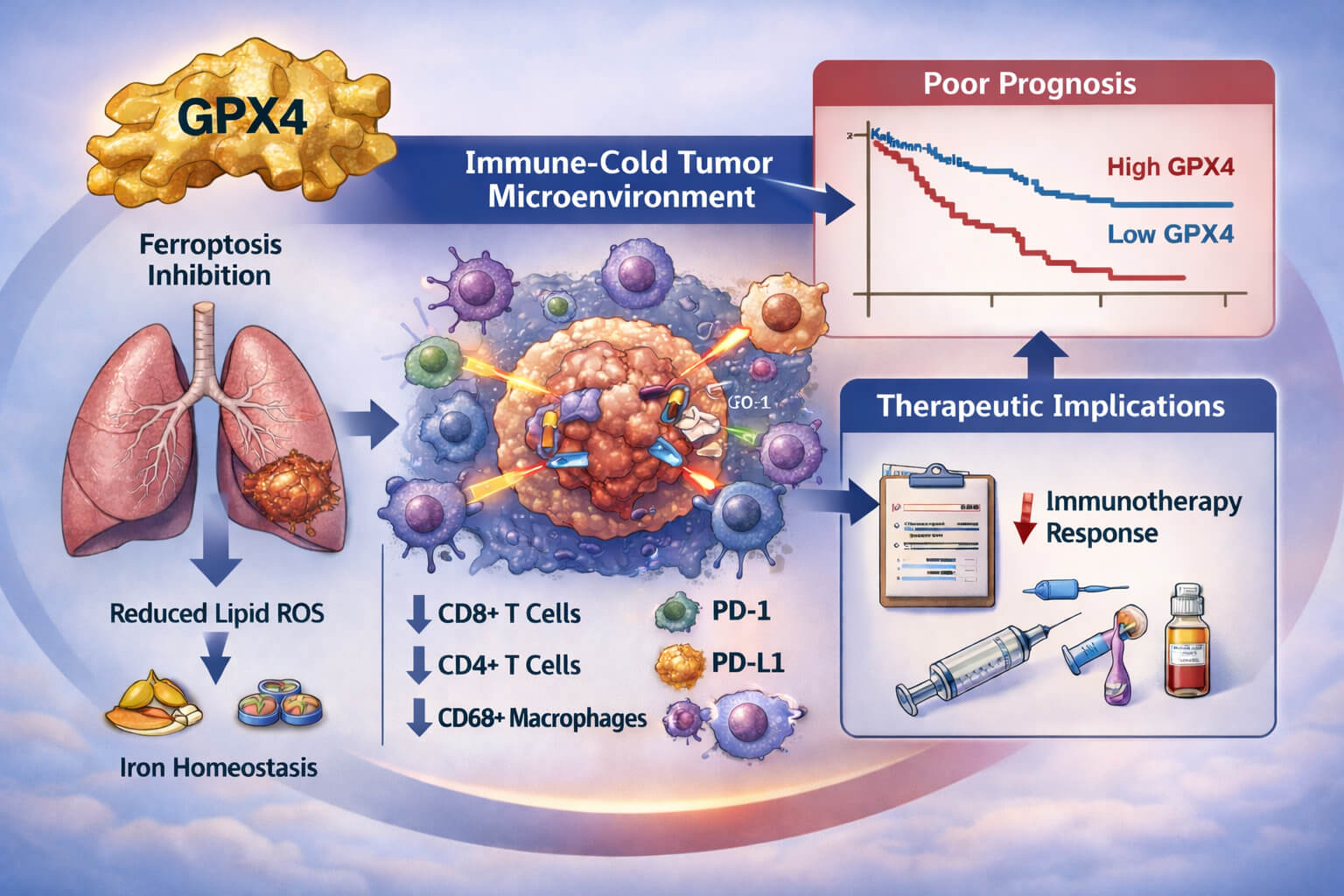
Objectives: Ferroptosis resistance may contribute to tumor progression and immune escape. This study evaluated the prognostic and immunological significance of glutathione peroxidase 4 (GPX4), a core ferroptosis-suppressive enzyme, in surgically resected lung adenocarcinoma. Methods: We retrospectively analyzed 104 patients with primary lung adenocarcinoma who underwent curative resection. GPX4 protein expression was assessed by immunohistochemistry (IHC) using the histological score (H-score), and patients were classified as GPX4-low (n = 54) or GPX4-high (n = 50). Intratumoral immune contexture was quantified using CD3, CD4, CD8, CD68, programmed cell death protein 1 (PD-1), and programmed death-ligand 1 (PD-L1) staining. Disease-free survival (DFS) and overall survival (OS) were analyzed using Cox regression. Cutoff sensitivity analyses, category consolidation, ridge-penalized Cox regression, events-per-variable assessment, bootstrap internal validation, and interobserver reproducibility testing were performed to strengthen statistical robustness. Results: GPX4-high tumors were associated with systemic inflammatory and immune-related features, including elevated fibrinogen (p = 0.015), lower lymphocyte-to-monocyte ratio (p = 0.003), and altered aspartate aminotransferase-to-alanine aminotransferase ratio (p = 0.028). GPX4-high tumors showed reduced intratumoral CD3+, CD4+, CD8+, and CD68+ immune-cell infiltration, together with increased PD-1 and PD-L1 expression, indicating an immune-cold yet checkpoint-enriched phenotype. After category consolidation and ridge-penalized multivariable adjustment, high GPX4 expression remained independently associated with worse DFS (HR, 8.63; 95% CI, 2.99–24.91; p < 0.001) and OS (HR, 6.94; 95% CI, 2.44–19.74; p < 0.001). GPX4-based prognostic models showed bias-corrected C-index values of 0.782 for DFS and 0.826 for OS, with calibration slopes of 0.964 and 0.937, respectively. Conclusions: High GPX4 expression identifies a clinically adverse, ferroptosis-resistant, immune-remodeled phenotype in resected lung adenocarcinoma. Integrating GPX4 with clinicopathological and inflammatory variables may improve postoperative risk stratification.Graphic Abstract
Keywords
Supplementary Material
Supplementary Material FileCite This Article
 Copyright © 2026 The Author(s). Published by Tech Science Press.
This work is licensed under a Creative Commons Attribution 4.0 International License , which permits unrestricted use, distribution, and reproduction in any medium, provided the original work is properly cited.
 Downloads
 Citation Tools
