
 Login
Login Register
 Submit a Paper
 Propose a Special lssue
 Open Access
ARTICLE
Multi-Omics Identification of UBE2C as a Prognostic Biomarker and Therapeutic Target Linked to Topotecan Sensitivity in Cervical Cancer
1 Department of Obstetrics and Gynecology, Kaohsiung Veterans General Hospital, Kaohsiung, Taiwan
2 Institute of BioPharmaceutical Sciences, National Sun Yat-sen University, Kaohsiung, Taiwan
3 National Museum of Marine Biology & Aquarium, Pingtung, Taiwan
4 Center of General Education, Cheng Shiu University, Kaohsiung, Taiwan
5 Center of General Education, Shu-Zen Junior College of Medicine and Management, Kaohsiung, Taiwan
6 Department of Allergy and Immunology, China Medical University Children’s Hospital, Taichung, Taiwan
7 Research Center for Allergy, Immunology, and Microbiome (A.I.M.), China Medical University Hospital, Taichung, Taiwan
8 Department of Marine Biotechnology and Resources, National Sun Yat-sen University, Kaohsiung, Taiwan
9 Department of Medical Education and Research, Kaohsiung Veterans General Hospital, Kaohsiung, Taiwan
* Corresponding Author: An-Jen Chiang. Email:
# These authors contribute equally to this study
(This article belongs to the Special Issue: Precision Oncology: Targeted Therapies and Tumor Microenvironment)
Oncology Research 2026, 34(9), 18 https://doi.org/10.32604/or.2026.079551
Received 23 January 2026; Accepted 10 June 2026; Issue published 13 August 2026
 View Full Text
 Download PDF
Abstract
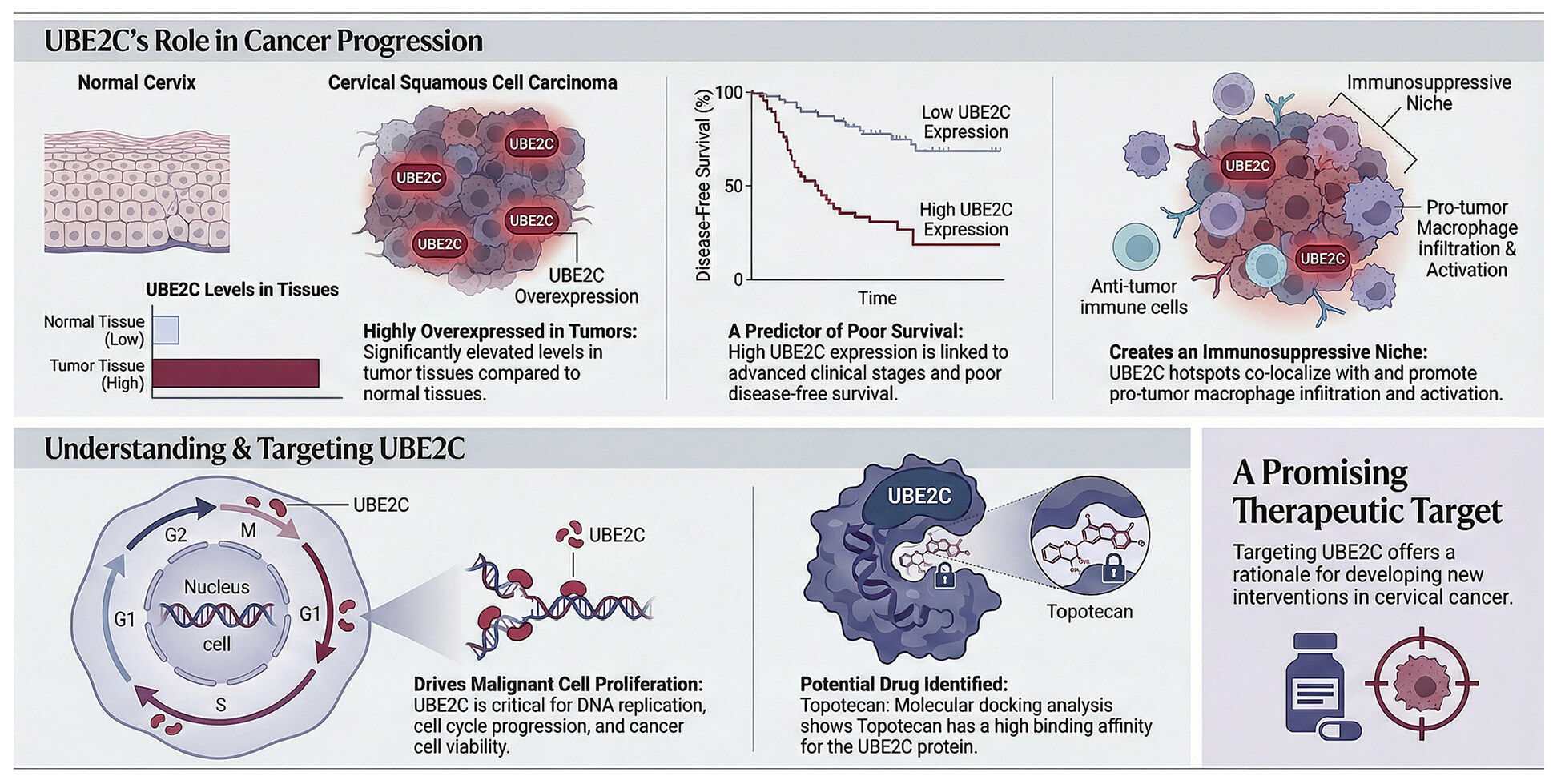
Objectives: Cervical squamous cell carcinoma and endocervical adenocarcinoma (CESC) necessitate the discovery of novel biomarkers for prognostic and therapeutic advancement. This study aims to evaluate the clinical significance of ubiquitin-conjugating enzyme E2C (UBE2C) and its association with the tumor microenvironment (TME) in CESC. Methods: We meticulously sourced CESC data from renowned repositories such as The Cancer Genome Atlas (TCGA), Genotype-Tissue Expression (GTEx), and Gene Expression Omnibus (GEO), leveraging cutting-edge techniques including single-cell RNA sequencing (scRNA-seq), spatial transcriptomics, and pharmacogenomics. Through multifaceted data analysis, we endeavored to unravel the intricate role and potential value of UBE2C in CESC tumorigenesis and progression. Results: Analysis of public datasets confirms UBE2C elevation in CESC tumors, correlating with advanced stages, metastasis, and poor disease-free survival (DFS). Dependency screens and functional enrichment highlight UBE2C’s critical role in cell viability and DNA replication. Notably, multi-omics and spatial transcriptomics reveal a strong link between UBE2C expression and macrophage infiltration (CD63+) in tumor regions. Finally, pharmacogenomic profiling and molecular docking identified Topotecan as a potent therapeutic agent with high UBE2C binding affinity. Conclusion: In conclusion, UBE2C expression is associated with cervical cancer progression and correlates with an immunosuppressive macrophage-enriched microenvironment, making it a promising candidate for further investigation in therapeutic intervention.Graphic Abstract
Keywords
Supplementary Material
Supplementary Material FileCite This Article
 Copyright © 2026 The Author(s). Published by Tech Science Press.
This work is licensed under a Creative Commons Attribution 4.0 International License , which permits unrestricted use, distribution, and reproduction in any medium, provided the original work is properly cited.
 Downloads
 Citation Tools
