
 Login
Login Register
 Submit a Paper
 Propose a Special lssue
 Open Access
REVIEW
Dynamic Metabolic States in TNBC: Orchestrating Spatiotemporal Adaptation and Therapy
1 Department of Oncology, Wuxi Maternal and Child Health Care Hospital, Wuxi Medical Center, Nanjing Medical University, Wuxi, China
2 Department of Oncology, Wuxi Maternity and Child Health Care Hospital, Women’s Hospital of Jiangnan University, Jiangnan University, Wuxi, China
3 Suzhou Medical College, Soochow University, Suzhou, China
* Corresponding Authors: Yanfang Gu. Email: ; Daozhen Chen. Email:
; Yan Zhang. Email:
# These authors contributed equally to this work
Oncology Research 2026, 34(9), 13 https://doi.org/10.32604/or.2026.085967
Received 21 May 2026; Accepted 15 July 2026; Issue published 13 August 2026
 View Full Text
 Download PDF
Abstract
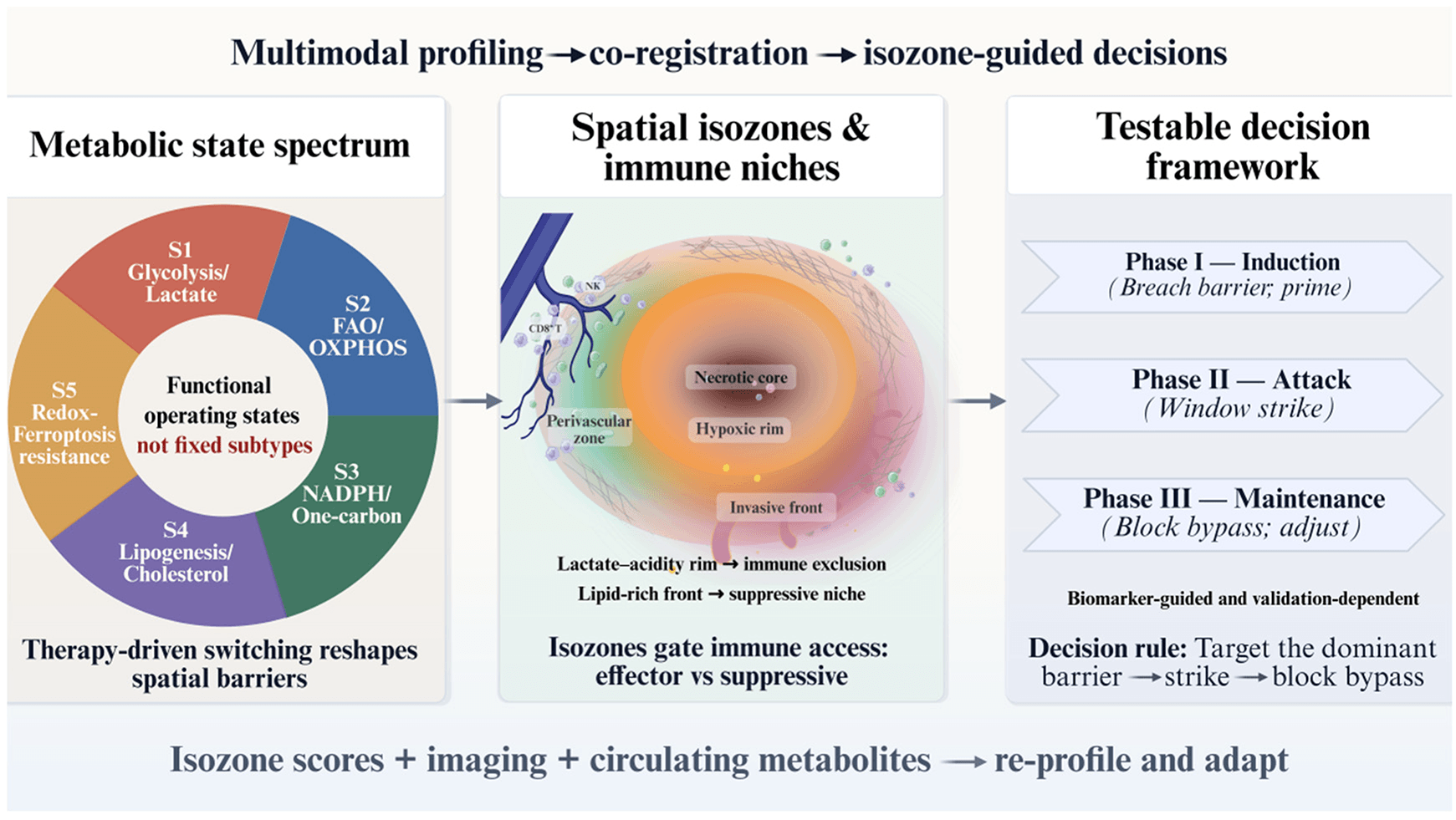
Triple-negative breast cancer (TNBC) is characterized by marked metabolic plasticity, spatial heterogeneity, and therapy-induced adaptive remodeling. However, TNBC metabolism is often discussed as isolated pathways, making it difficult to link metabolic rewiring to immune exclusion, drug-tolerant persister cells, and treatment windows. Here, we propose a functional metabolic operating-state framework to organize recurrent adaptive programs in TNBC. Importantly, the S1–S5 framework is not a clinically validated subtype classification, but a set of coexisting and reversible operating states shaped by microenvironmental and therapeutic pressures. S1 represents a glycolysis–lactate/acidosis barrier; S2 denotes fatty acid oxidation (FAO)/oxidative phosphorylation (OXPHOS)-supported persister-like survival; S3 reflects NADPH and one-carbon metabolism-mediated reductive defense; S4 captures lipogenesis, cholesterol metabolism, and membrane remodeling; and S5 represents a ferroptosis tipping window emerging when redox and lipid-peroxide defenses fail. We further highlight flux-valve nodes that redirect carbon, nitrogen, lipid, and redox allocation, thereby biasing transitions among these states. Integrating evidence from spatial omics, metabolic imaging, tumor immunology, and therapeutic studies, we discuss how metabolic isozones reinforce immune suppression and how staged interventions may exploit state-specific vulnerabilities. This framework is intended to generate monitorable and falsifiable decision hypotheses for biomarker development, combination therapy design, and future prospective validation in TNBC.Graphic Abstract
Keywords
Cite This Article
 Copyright © 2026 The Author(s). Published by Tech Science Press.
This work is licensed under a Creative Commons Attribution 4.0 International License , which permits unrestricted use, distribution, and reproduction in any medium, provided the original work is properly cited.
 Downloads
 Citation Tools
