
 Login
Login Register
 Submit a Paper
 Propose a Special lssue
 Open Access
ARTICLE

Bioactive Potential of Calophyllum inophyllum: Phytochemical Profiles, Biological Activities, and In Silico Pharmacokinetic Predictions
1 Department of General Education, Faculty of Science and Fisheries Technology, Rajamangala University of Technology Srivijaya, Sikao, Trang, 92150, Thailand
2 Department of Marine Sciences and Environment, Faculty of Science and Fisheries Technology, Rajamangala University of Technology Srivijaya, Sikao, Trang, 92150, Thailand
3 Division of Physical Science and Center of Excellence for Innovation in Chemistry, Faculty of Science, Prince of Songkla University, Hat-Yai, Songkhla, 90110, Thailand
* Corresponding Authors: Luksamee Vittaya. Email: ,
Phyton-International Journal of Experimental Botany 2025, 94(12), 4091-4115. https://doi.org/10.32604/phyton.2025.074891
Received 20 October 2025; Accepted 28 November 2025; Issue published 29 December 2025
 View Full Text
 Download PDF
Abstract
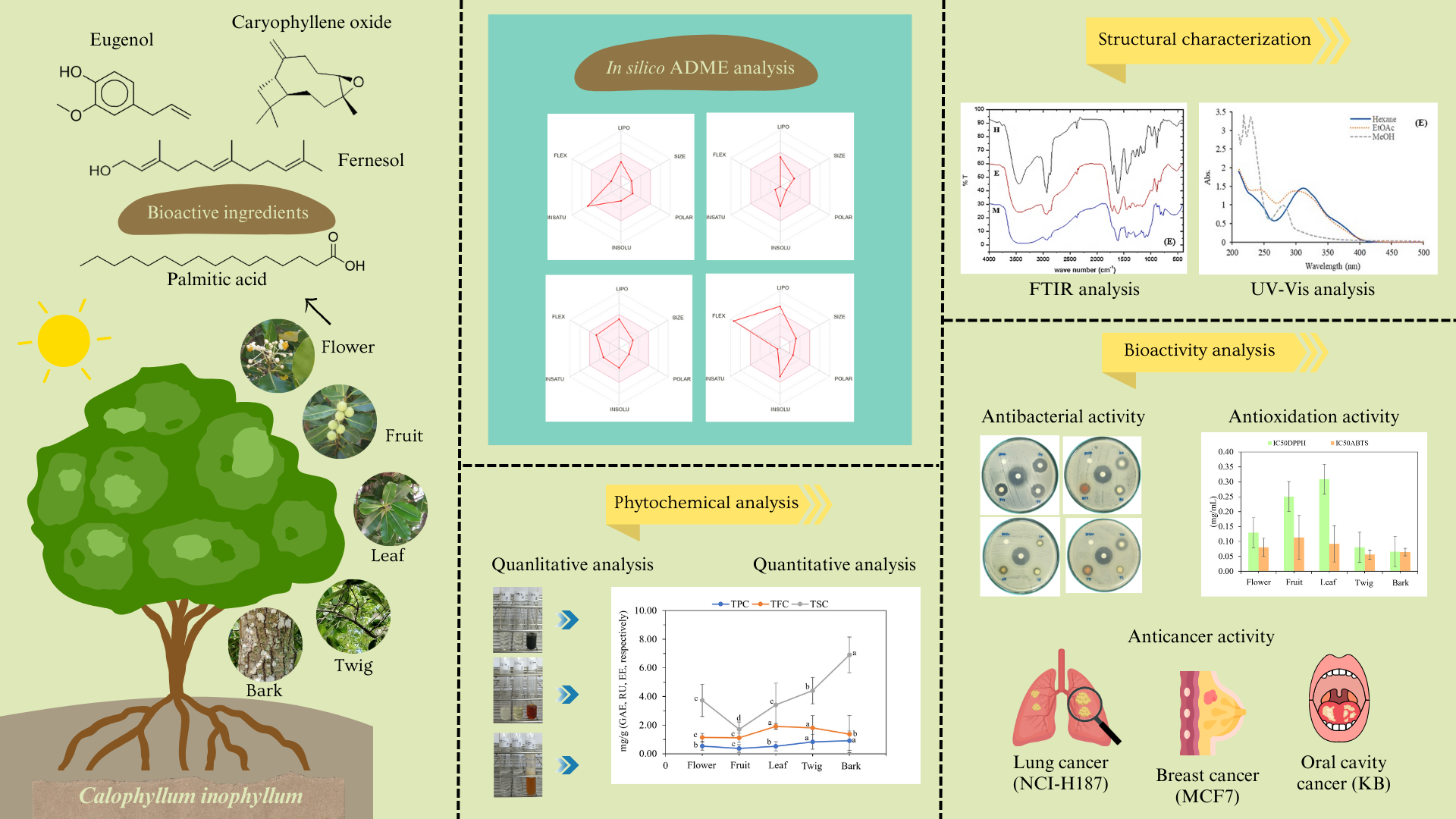
Calophyllum inophyllum is a tropical plant that could have useful medicinal properties for pharmaceutical and cosmetic applications. The present study extracted the flower, fruit, leaf, twig, and bark of the plant by maceration in different organic solvents. The correlation between bioactive compounds and their biological activities was investigated, with emphasis on their therapeutic relevance through in silico pharmacokinetic predictions using SwissADME. Qualitative and quantitative analyses were conducted to determine the total phenolic, flavonoid, and saponin contents of the extracts. Spectral analysis of the extracts revealed –OH, C=O, C=C, and C–H functional groups. The antioxidant activity of the extracts was evaluated by colorimetric DPPH and ABTS assays. Antibacterial activity was also determined, along with cytotoxicity and anticancer potential. The plant part and solvent used for extraction affected the active compounds collected. Methanolic bark extract presented the highest phenolic and flavonoid contents, whereas hexane bark extract presented the highest saponin content. These results correlated with the antioxidant and antibacterial activities of the extracts. The strong correlation between antioxidant activity and total phenolic contents indicated that phenolic compounds were the dominant contributors to antioxidant activity. Methanolic bark extract showed significant DPPH scavenging activity (IC50 = 0.004 mg/mL) while hexane bark extract produced the largest zone of inhibition against Staphylococcus aureus (17.96 ± 0.00 mm). The lowest minimum inhibitory concentration (<0.098 mg/mL) was shown against Bacillus cereus by 11 out of the 15 extracts. Selective cytotoxicity was observed against cancer cells, especially lung cancer cells. In silico ADME analysis of a previously reported flower extract showed favorable pharmacokinetic properties for compounds such as eugenol and caryophyllene oxide. High gastrointestinal absorption and blood-brain barrier permeability suggested good oral bioavailability and central nervous system potential. Most extracted compounds met Lipinski’s Rule with minimal cytochrome P450 inhibition, indicating good drug-likeness. These findings highlight the promise of C. inophyllum as a source of natural antioxidants and antibacterial agents with therapeutic potential.Graphic Abstract
Keywords
Supplementary Material
Supplementary Material FileCite This Article
 Copyright © 2025 The Author(s). Published by Tech Science Press.
This work is licensed under a Creative Commons Attribution 4.0 International License , which permits unrestricted use, distribution, and reproduction in any medium, provided the original work is properly cited.
 Downloads
 Citation Tools
