
 Login
Login Register
 Submit a Paper
 Propose a Special lssue
 Open Access
ARTICLE
Evaluation of the Antifungal Activity of Aqueous Extracts of Corrigiola telephiifolia and Marrubium vulgare against Major Post-Harvest Citrus Diseases
1 Phytopathology Unit, Department of Plant Protection, Ecole Nationale d’Agriculture de Meknès, Km10, Rte Haj Kaddour, Meknes, Morocco
2 Laboratory of Functional Ecology and Environmental Engineering, Sidi Mohamed Ben Abdellah University, Fez, Morocco
3 Laboratory of Biotechnology, Conservation and Valorisation of Bioresources (LBCVBR), Faculty of Sciences, Dhar El Mehraz, Sidi Mohamed Ben Abdallah University, Fez, Morocco
4 Department of Plant and Environment Protection, National School of Agriculture, Ecole Nationale d’Agriculture de Meknes, Route Haj Kaddour, Meknes, Morocco
* Corresponding Author: Rachid Lahlali. Email:
Phyton-International Journal of Experimental Botany 2026, 95(4), 7 https://doi.org/10.32604/phyton.2026.078088
Received 23 December 2025; Accepted 09 March 2026; Issue published 28 April 2026
 View Full Text
 Download PDF
Abstract
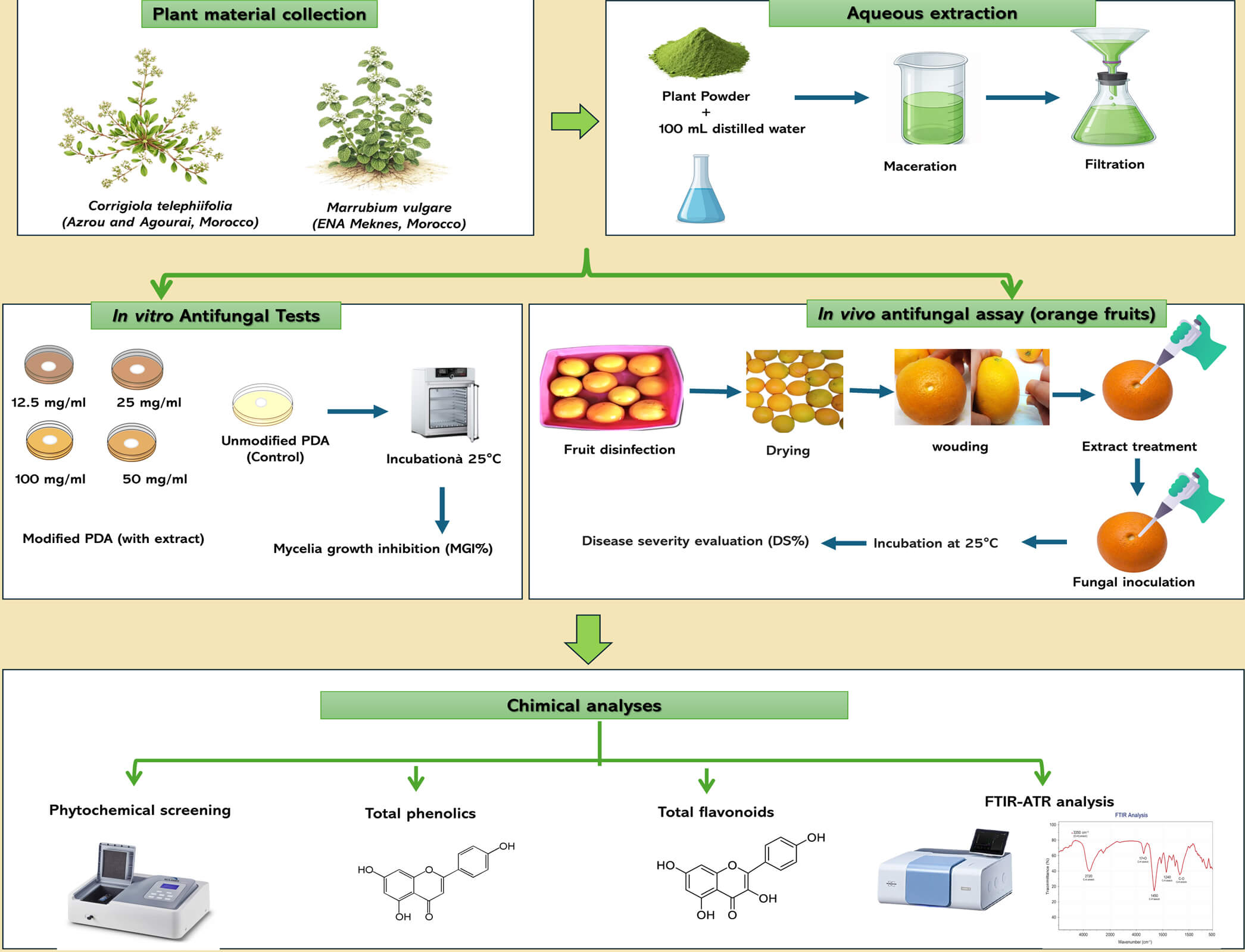
Citrus fruits are highly susceptible to post-harvest diseases such as green rot (Penicillium digitatum), blue rot (P. italicum), and sour rot (Geotrichum citri-aurantii), causing significant economic losses. Due to the risks associated with synthetic fungicides and the emergence of resistant strains, natural alternatives are needed. This study evaluated the antifungal activity of aqueous extracts of Corrigiola telephiifolia and Marrubium vulgare. In vitro tests were conducted using PDA medium with extract concentrations of 12.5–100 mg/mL and in vivo assays were performed on artificially wounded oranges with the same extract concentrations. In vitro tests showed strong inhibition of mycelial growth and spore germination, with C. telephiifolia reducing pathogen growth by over 70–89%. In vivo assays confirmed its effectiveness, completely preventing green rot at 12.5 mg/mL and significantly reducing sour rot. Phytochemical analysis revealed high levels of polyphenols and flavonoids in C. telephiifolia. These findings suggest that aqueous extracts of C. telephiifolia are a safe and sustainable alternative to synthetic fungicides for managing post-harvest citrus diseases.Graphic Abstract
Keywords
Cite This Article
 Copyright © 2026 The Author(s). Published by Tech Science Press.
This work is licensed under a Creative Commons Attribution 4.0 International License , which permits unrestricted use, distribution, and reproduction in any medium, provided the original work is properly cited.
 Downloads
 Citation Tools
