
 Login
Login Register
 Submit a Paper
 Propose a Special lssue
 Open Access
ARTICLE
Integration of Computer Vision and Physicochemical Parameters for Post-Harvest Ripeness Classification of TomEJC Mango
1 Department of Food Science and Technology, Faculty of Agriculture, University of Peradeniya, Peradeniya, Sri Lanka
2 Department of Computer Science, Faculty of Natural Sciences, The Open University of Sri Lanka, Nugegoda, Sri Lanka
3 Department of Computing, Atlantic Technological University, Donegal Campus, Letterkenny, Donegal, Ireland
4 Department of Civil Engineering and Construction, Atlantic Technological University, Sligo, Ireland
* Corresponding Authors: Rasanjali Samarakoon. Email: ; Upaka Rathnayake. Email:
(This article belongs to the Special Issue: Advances in the Physiological, Biochemical and Molecular Mechanisms Regulating Fruit Ripening in Tropical Fruits)
Phyton-International Journal of Experimental Botany 2026, 95(4), 19 https://doi.org/10.32604/phyton.2026.078657
Received 05 January 2026; Accepted 31 March 2026; Issue published 28 April 2026
 View Full Text
 Download PDF
Abstract
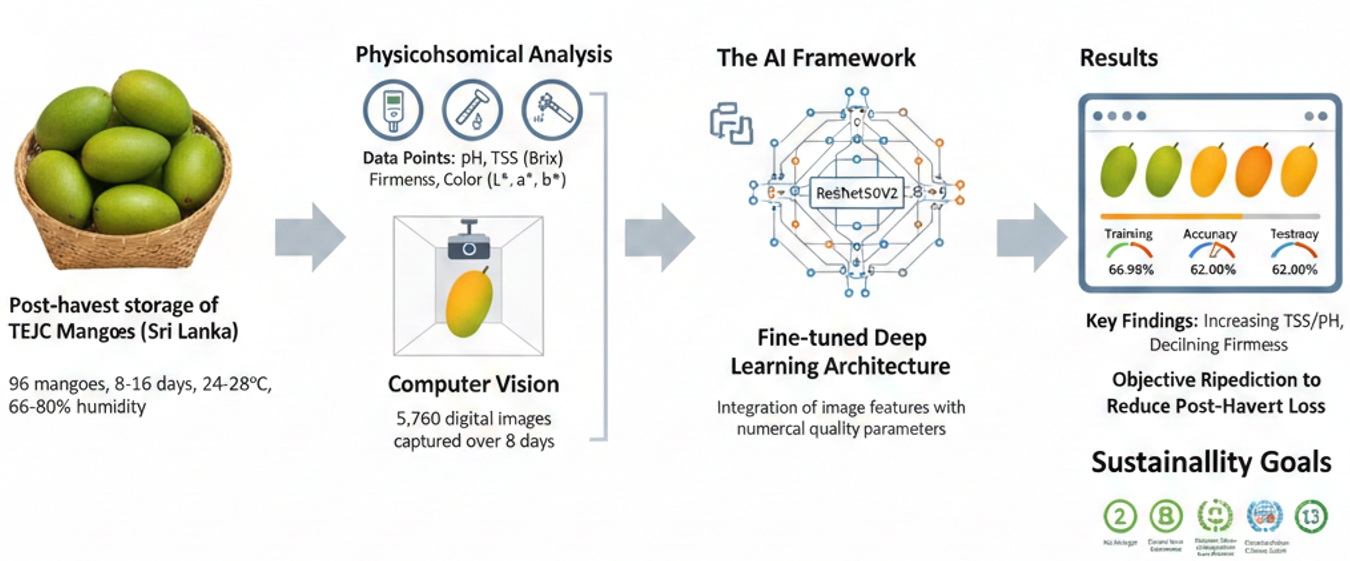
Accurately determining the optimal post-harvest storage period is still a major challenge in mango processing, especially for the Tom EJC (TEJC) variety, due to reliance on subjective visual evaluations, leading to inconsistent product quality and increased post-harvest losses. This study presents an artificial intelligence-based framework combining computer vision and physicochemical analysis to objectively predict the optimal post-harvest storage period of TEJC mango before processing. TEJC mangoes of grade one were stored for eight days at 24–28°C temperature and 66.4–80% relative humidity. Daily measurements of pH, Total Soluble Solids (TSS), firmness, and peel color parameters (L*, a*, b*) were evaluated along with an image dataset of 5760 photos taken under variable lighting. Image data were then combined with numerical quality parameters to train and evaluate a deep learning model based on a fine-tuning architecture of ResNet50V2 for the classification of multi-class ripeness stages. The model achieved 66.96% of training and 62% testing accuracy, demonstrating the feasibility of integrating computer vision and physicochemical parameters for preliminary multi-class ripeness classification under non-uniform real-world conditions. The ripening trends were reflected in increasing TSS and pH values and declining fruit firmness. Among peel colour parameters, a* was strongly associated with ripening advancement. The findings underscore the potential of deep learning tools as non-destructive decision-support systems for post-harvest mango processing. The proposed framework serves as a proof-of-concept demonstrating its potential applicability in real-world scenarios. Nevertheless, the dataset used in this study enabled proof-of-concept evaluation; it represents a potential limitation for deep learning models, which typically benefit from larger and more diverse training sets.Graphic Abstract
Keywords
Cite This Article
 Copyright © 2026 The Author(s). Published by Tech Science Press.
This work is licensed under a Creative Commons Attribution 4.0 International License , which permits unrestricted use, distribution, and reproduction in any medium, provided the original work is properly cited.
 Downloads
 Citation Tools
