
 Login
Login Register
 Submit a Paper
 Propose a Special lssue
 Open Access
ARTICLE
Foliar Application of Boron Nanoparticles to Enhance Productivity, Postharvest Quality and Nutrient Use Efficiency in Summer Tomato (Solanum lycopersicum L.)
1 Horticulture Research Centre, Bangladesh Agricultural Research Institute, Joydebpur, Gazipur, Bangladesh
2 Irrigation and Water Management Division, Bangladesh Agricultural Research Institute, Gazipur, Bangladesh
3 Department of Physics, Jahangirnagar University, Dhaka, Bangladesh
4 Agricultural Research Station, Bangladesh Agricultural Research Institute, Satkhira, Khulna, Bangladesh
5 Oil Seed Research Centre, Bangladesh Agricultural Research Institute, Joydebpur, Gazipur, Bangladesh
6 Soil Science Division, Bangladesh Agricultural Research Institute, Joydebpur, Gazipur, Bangladesh
7 On-Farm Research Division, Bangladesh Agricultural Research Institute, Joydebpur, Gazipur, Bangladesh
8 Department of Physical Sports Sciences, College of Sports Sciences and Physical Activity, Princess Nourah bint Abdulrahman University, Riyadh, Saudi Arabia
9 Department of Biology, Faculty of Science, Taif University, Taif, Saudi Arabia
10 Soil Science Division, Bangladesh Wheat and Maize Research Institute, Dinajpur, Bangladesh
* Corresponding Authors: Md. Abdul Quddus. Email: ; Akbar Hossain. Email:
(This article belongs to the Special Issue: Application of Nanomaterials in Plants)
Phyton-International Journal of Experimental Botany 2026, 95(9), 7 https://doi.org/10.32604/phyton.2026.086296
Received 27 May 2026; Accepted 31 July 2026; Issue published 24 September 2026
 View Full Text
 Download PDF
Abstract
The productivity of summer tomato in subtropical regions is hampered by boron (B) deficiency, an element essential for reproductive development. Conventional soil or foliar applications often suffer from nutrient leaching and inadequate uptake. Nanoboron fertilizers offer a highly efficient and innovative alternative; their small particle size and high surface-to-volume ratio enhance cellular penetration. This study evaluated the efficacy of foliar-applied boron nanoparticles in improving summer tomato productivity, fruit quality, nutrient use efficiency and profitability, while determining the optimal dosage for maximizing yield. A field study was conducted using a randomized complete block design with three replications. The five treatments consisted of four concentrations of nanoboron (0, 0.2, 0.3, and 0.4 g L−1) along with conventional boric acid at 1 g L−1. Treatments were applied as foliar sprays at 20 days after transplanting (DAT) (corresponding to flower initiation), 35 DAT (corresponding to peak flowering and initial fruit set), and 50 DAT (corresponding to late fruit set and early fruit expansion). The application of boron nanoparticles significantly outperformed conventional boric acid in terms of all the measured parameters. The highest results were observed with 0.2 g L−1 nano B fertilizer (T2), which increased the fresh fruit yield (41.2 t ha−1) by 59.7% compared with that in the control treatment and 9.57% compared with that in the conventional boric acid treatment. This increase was attributed to greater individual fruit weight (53.0 g), maximum number of fruits per plant (43.7), and greatest plant height (110 cm). The same treatment (T2) resulted in the highest total soluble solids (TSS) (5.53 °Brix), vitamin C (34.7 mg/100 g) and β-carotene (21.8 μ/g) contents and the highest B uptake (604 g ha−1) and B use efficiency. T2 treatment prominently increased the cost-benefit ratio (5.94). The results suggest that 0.2 g L−1 nanoboron is the optimum dosage for maximizing the yield, quality and profitability of summer tomatoes under experimental condition. Hence, this technique provides a precision-based farming solution to the challenges associated with soil B fixation, leading to higher yields and better fruit quality with less waste.Keywords
The global population is proposed to exceed nine billion by 2050, and a 70% increase in agricultural production is needed to ensure food and nutritional security [1]. Nevertheless, arable land is continuously decreasing through rapid industrialization and urbanization [2]. Consequently, agricultural production is facing unprecedented challenges driven by climate change, soil degradation, and the decreasing efficiency of conventional fertilizers. Moreover, tomato (Solanum lycopersicum L.) is among the most widely cultivated and economically important vegetable crops worldwide, including in Bangladesh [3]. It is consumed fresh or cooked, or processed food by canning or juicing, or it is reduced into pulp, paste, and various sauces. Moreover, the consumption of tomatoes is associated with the prevention of different types of diseases [4]. Tomato cultivation during the summer season is severely hampered by high temperatures and related physiological stress, which negatively affects pollen viability, fruit set, and overall output [5]. Among the essential micronutrients, boron (B) plays a pivotal role in the structural and functional integrity of plant cell walls and membranes [6]. It is specifically indispensable for reproductive development, as it regulates pollen viability, pollen tube growth, and fruit set [6,7,8]. In summer tomato, boron deficiency is a frequent constraint, often leading to increased flower drop, fruit cracking, poor fruit quality and significantly reduced yields [5]. Traditional B fertilizers, such as boric acid or borax, are frequently subject to leaching in soil or poor mobility within the plant when applied via the roots. Consequently, foliar application has emerged as a more direct route to satisfy crop requirements. Nevertheless, the efficacy of bulk B sprays is often limited by low leaf penetration and rapid crystallization on the leaf surface. Addressing these limitations through the precise management of nutrient elements is essential for sustainable agricultural production [9]. Nanotechnology offers an innovative and transformative approach to crop nutrition through the development of boron nanoparticles (B-NPs) [10,11,12]. Owing to their high surface-area-to-volume ratio and minute particle size (typically 1–100 nm) [13], compared with conventional bulk fertilizer, B-NPs exhibit superior adhesion and penetration through stomatal openings and cuticular pores. Recent research suggests that nanostructured micronutrients, particularly B-NPs, increase nutrient use efficiency (NUE) and photosynthetic performance by facilitating the controlled release of ions [10]. Foliar application of nanoboron fertilizers effectively meets the boron requirements of plants. The excessive application of conventional boron fertilizers often leads to severe toxicity, harming plant growth and productivity. However, nanoboron technology can mitigate these risks [14,15]. By improving growth, productivity, and crop quality, B-NPs reduce the need for excessive and costly conventional fertilizers [16]. Furthermore, this targeted delivery minimizes environmental runoff and reduces the metabolic energy expenditure required for nutrient uptake [5]. While the effects of nano-zinc and nanourea are well documented [3,13,17], the specific efficacy of foliar-applied B-NPs in mediating the productivity and fruit quality of tomato, particularly under the physiological stress of the summer season, remains underexplored. Specifically, there is a critical lack of information regarding the practical application of B-NPs for summer tomato production under the physiological stress of tropical environments.
We hypothesize that compared with conventional B sources; the foliar application of boron nanoparticles (B-NPs) significantly enhances the yield and quality of summer tomatoes. In particular, B-NPs are expected to improve nutrient use efficiency (NUE) and stimulate antioxidant metabolic activity, leading to improved fruit set and superior nutritional profiles under high-temperature stress. Thus, the purpose of this study was to assess how foliar-applied B-NPs affect summer tomato productivity, fruit quality, nutrient use efficiency, and the benefit-cost ratio. Furthermore, the optimal dosage of nanoboron fertilizer for maximizing summer tomato yields during the challenging summer season was determined.
2.1 Location of the Experiment
The experiments were carried out at the research field of the Soil and Water Management Section under the Horticulture Research Centre, Bangladesh Agricultural Research Institute (BARI), Gazipur, during the summer seasons of 2024 and 2025. The experimental site is located at 23°59’ N latitude and 90°24’ E longitude, at an elevation of 8.4 m above sea level. The soil is classified under the Chhiata series (Aeric Haplaquepts), which is representative of the Madhupur Tract (AEZ-28) terrace landscape [18]. Physically, the soil is characterized as clay loam, with a particle density of 2.54 g/cm3 and a bulk density of 1.41 g/cm3. The region experiences a subhumid tropical to subtropical continental monsoon climate [19]. During the experimental period of 2024 and 2025, temperatures ranged from 24.9°C to 35.2°C, relative humidity fluctuated between 79.4% and 88.1%, and rainfall varied from 224 to 428 mm (Fig. 1a,b). The 2024 summer season was warmer than that of 2025, with higher average minimum and maximum temperatures. In contrast, significantly higher rainfall is recorded in 2025 (Fig. 1b). Prior to the experiments, soil samples were systematically collected from a depth of 0–20 cm, following the protocol outlined by Zhu et al. [20]. These samples were analysed using standard techniques, and their physicochemical properties are summarized in Table 1.
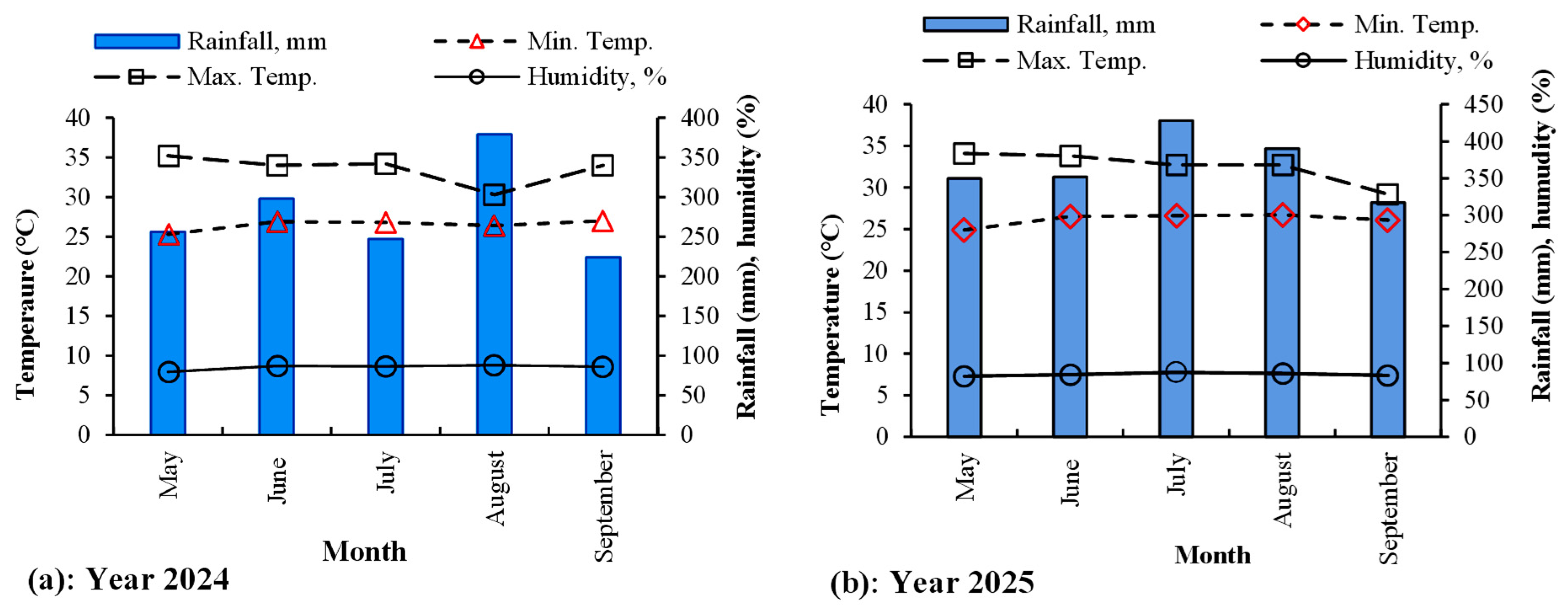
Figure 1: Monthly average minimum and maximum temperatures, monthly average humidity and rainfall during the experimental periods of 2024 (a) and 2025 (b).
Table 1: Physicochemical properties of the initial soil at the experimental site.
| Soil Properties | Soil Test Value | Critical Level | Soil Test Interpretation |
|---|---|---|---|
| Soil Physical Properties | |||
| Sand (%) | 31.5 | - | - |
| Silt (%) | 38.3 | - | - |
| Clay (%) | 30.2 | - | - |
| Textural class | Clay loam | - | - |
| Moisture content (%) | 28.9 | - | |
| Particle density (g/cc) | 2.54 | - | - |
| Bulk density (g/cc) | 1.41 | - | - |
| Porosity (%) | 44.5 | - | - |
| Soil temperature (°C) | 32.1–35.3 | - | - |
| Soil night temperature (°C) | 20.1–25.5 | - | - |
| Soil chemical properties | |||
| pH | 6.3 | 5.5–6.5 | Slightly acidic |
| Soil EC (dS/m) | 0.31 | - | Non saline |
| Organic matter (%) | 1.24 | - | Low |
| Ca (meq/100 g soil) | 4.50 | 2.0 | Optimum |
| Mg (meq/100 g soil) | 1.12 | 0.5 | Medium |
| Total N (%) | 0.065 | 0.12 | Very low |
| Available P (mg/kg) | 12.2 | 7 | Medium |
| K (meq/100 g soil) | 0.13 | 0.12 | Low |
| S (mg/kg) | 12.4 | 10 | Low |
| Zn (mg/kg) | 0.87 | 0.6 | Low |
| B (mg/kg) | 0.17 | 0.2 | Low |
The physical and chemical properties of the soil were determined using established analytical protocols. Soil textural class was identified via the hydrometer method [21]. The particle density and bulk density were assessed using the volumetric flask and core sampler methods, respectively. In situ measurements of soil electrical conductivity (EC) and temperature were recorded using a Groline direct soil meter (HI98331), while soil moisture was quantified using a spot moisture tester (Model DM-15, Tokyo, Japan). Soil pH was determined in a 1:2.5 soil–water suspension using a glass electrode pH meter. Organic carbon (OC) was estimated through the wet oxidation method [20], with total organic matter (OM) subsequently calculated by applying the Van Bemmelen factor (1.73 × %OC). The total N content was determined using the micro-Kjeldahl method [22]. Calcium (Ca) and Mg were extracted with a 1 M NH4OAc solution [23] and quantified via atomic absorption spectrometry (AAS). Exchangeable K was measured using the 1 N NH4OAc extraction method [24]. Available P was determined following the protocol of Bray and Kurtz in 1945 [25], and available S was measured through BaCl2 turbidimetry [26]. The available Zn was extracted using the DTPA method [27], and B was analysed via the azomethine-H method [22].
2.3 Plant Materials and Seedling Growth
The seeds for tomato cv. BARI Hybrid Tomato-8 were sourced from the Olericulture Division of the Horticulture Research Centre (HRC), BARI, Gazipur district in Bangladesh. The seedbeds were meticulously prepared using 4–5 manual spadings and protected by 10 mm thick white polyethylene tunnels. The seeds were sown on 18 May 2024, and 19 May 2025, followed by immediate irrigation. The seedlings were maintained in the seedbed under a plastic-covered shed at temperatures of 25–29°C and 77–82% relative humidity. The developing seedlings were watered twice weekly using a watering can. Disease (specifically damping off) and pest outbreaks were managed using the fungicide Autostin® 50 WDG (a.i. Carbendazim) and the insecticide Sevin® 85 WP (a.i., Carbaryl).
2.4 Land Preparation, Treatment and Layout
During the seedling development period, the main experimental site was prepared by ploughing 3–4 times with a tractor-driven disc plough and subsequently levelling it with a rotavator. Following the removal of weeds and stalks, the area was covered with a white polyethylene sheet (12 mm thick) installed over a permanent iron frame measuring 6 feet in height. The experiment was carried out in a randomized complete block design (RCBD) with three replications. Five treatments were evaluated: T1 (Control), T2 (0.2 g L−1 of Boron Nanofertilizer), T3 (0.3 g L−1 of Boron Nanofertilizer), T4 (0.4 g L−1 of Boron Nanofertilizer) and T5 (1 g L−1 of boric acid). These nano-B fertilizer doses were selected based on the studies outlined by Goswami et al. [28] and García-Locascio et al. [29]. The recommended doses of other fertilizers were N140P40K90S10Mg12Zn3 kg ha−1 and 5 t ha−1 of cow dung [30]. Under tropical conditions, high soil temperatures facilitate the rapid decomposition of manure, making nutrients readily available for plant uptake. Raised beds were manually constructed to a height of approximately 20 cm. Each treatment plot measured 2.0 m × 1.0 m and was separated by a 50 cm gap. Moreover, a 1 m gap was maintained between replicated blocks to facilitate effective drainage. Note that the treatments included three doses of nano-B fertilizer, one dose of conventional B fertilizer (boric acid), and a control (no use of B fertilizer). The elemental B rate for each treatment was calculated in kg ha−1. The details are summarized in Table 2.
Table 2: Application rates of elemental boron (kg ha−1) derived from the nanoboron and boric acid treatments.
| Treatment | Foliar Application Rate (g L−1) | Total Amount of Fresh Water (L ha−1) | Nano-B and Conventional B Fertilizer (kg ha−1) | B (kg ha−1) |
|---|---|---|---|---|
| T1 (Control) | 0 | 3000 | 0.0 | 0 |
| T2 (Nano B-fertilizer) | 0.2 | 3000 | 0.60 | 0.054 |
| T3 (Nano B-fertilizer) | 0.3 | 3000 | 0.90 | 0.081 |
| T4 (Nano B-fertilizer) | 0.4 | 3000 | 1.20 | 0.11 |
| T5 (Boric acid) | 1.0 | 3000 | 3.0 | 0.51 |
2.5 Nanoboron and Other Fertilizer Sources and Application Procedures
The nanochelated boron fertilizer was sourced from a distributor of Nano Crops Ltd., a firm based in Dhaka, Bangladesh. This nanochelated boron fertilizer was developed by the Sodour Ahrar Shargh Knowledge-based Company (SASh Co.) in Tehran, Iran. By utilizing advanced nanotechnology, fertilizer incorporates boron nanoparticles smaller than 100 nm. The manufacturing process involves the initial conversion of borax into boric acid, which is subsequently processed into nanoparticles to produce the final chelated product. The nutrient sources for N, P, K, S, Mg, Zn, and B were urea (46% N), triple superphosphate (20% P, 1.3% S and 14% Ca), muriate of potash (50% K), gypsum (18% S, 20% Ca), magnesium sulfate (12.5% S, 9.5% Mg), zinc sulfate heptahydrate (10.5% S, 21% Zn), nanoboron-chelated fertilizer (9% B) and conventional boric acid (17% B), respectively. Fertilizers were applied manually through basal application and subsequent top dressings. The basal application included half of the decomposed cow dung, half of the triple superphosphate, half of the muriate of potash, and the full amounts of gypsum, zinc sulfate heptahydrate, and magnesium sulfate, all of which were thoroughly incorporated into the soil. The remaining half of the decomposed cow dung was applied directly to the planting pits before transplanting.
2.6 Solution Preparation of Nanoboron Fertilizer
To prepare the colloidal suspensions, precise amounts of commercial nanochelated boron were weighed using an analytical balance to achieve target concentrations of 0.2, 0.3, and 0.4 g L−1. Each measured dose was added to a 1000 mL beaker containing 800 mL of distilled water. The mixtures were subjected to continuous mechanical agitation for 30 min to ensure uniform particle dispersion. Similarly, a measured amount of conventional boric acid to reach a concentration of 1 g L−1 was added to a 1000 mL beaker containing 800 mL of distilled water. The mixture was subjected to continuous mechanical agitation for 30 min to ensure complete dissolution and a uniform mixture. The resulting suspensions were then transferred to 1000 mL volumetric flasks, and the final volume was adjusted to the 1000 mL mark with distilled water. Finally, the solutions were transferred into a manual sprayer for immediate foliar application according to the respective treatment protocols.
2.7 Seedling Transplanting and Agronomic Practices
Thirty-day-old summer tomato plants were transplanted into the experimental plots on 17 June 2024 and 18 June 2025, with a spacing of 50 cm × 50 cm. A single seedling was planted per pit. Immediate irrigation was provided following transplanting, followed by two weekly applications until the third week to ensure successful crop establishment. Afterward, supplemental irrigation was applied via a plastic hose pipe according to the soil moisture conditions and crop water requirements. In terms of treatment, the nanoboron fertilizer and the conventional B fertilizer were applied as a foliar spray at three distinct growth stages: the vegetative stage-corresponding to flower initiation (20 DAT), the flowering stage-corresponding to peak flowering and initial fruit set (35 DAT), and the fruit-bearing stage-corresponding to late fruit set and early fruit expansion (50 DAT). Manual weeding was performed three times: at 20, 35 and 50 DAT. The urea and the remaining half of the muriate of the potash were divided into three equal splits and applied at 20, 35, and 50 DAT. These doses were applied using the ring method under favourable soil moisture conditions and were subsequently incorporated into the soil. Fungal diseases were managed by applying dithane M-45 and ridomil gold at a rate of 2 g L−1. A total of three applications were made at 10-day intervals, beginning at 30 DAT. For insect control, Ripcord and Imitaf were sprayed at rates of 2 mL L−1 and 0.50 mL L−1, respectively. Insecticide applications were carried out three times at 10-day intervals, commencing at the flowering stage. The tomato plants were supported with bamboo stakes to prevent plant lodging. The fruits were harvested at maturity, with the harvesting period extending from the second week of August to the fourth week of September.
2.8 Field and Laboratory Data Collection and Curation
The experimental data were collected in two distinct phases. In the field, three plants were randomly selected and tagged from each plot to record the following parameters: plant height, number of branches per plant, and dates of flowering and harvesting. The number of clusters per plant, number of fruits per cluster, and total fruit count per plant were recorded. Five fruits were randomly selected from each treatment to measure their length, diameter, and individual weight. Ten fruits per treatment were sliced and dried to determine dry fruit yield (converted to kg ha−1). The marketable fresh fruit yield was recorded on a whole-plot basis and converted to t ha−1. The leaf chlorophyll content was determined using a soil-plant analysis development (SPAD) chlorophyll meter (Model SPAD-502 Plus, Konica Minolta, Tokyo, Japan). SPAD readings were taken from the mid-ribs of fully expanded leaves on each tagged plant. Mature tomato fruits were harvested between the first week of August and the last week of September.
In the laboratory, representative fresh tomato fruit samples from each treatment plot were analysed for fruit quality and chemical composition. These samples were preserved by freezing at −30°C. The samples were subsequently thawed to determine the total soluble solids (TSS), vitamin C content, beta-carotene content, firmness, and titratable acidity, total sugars and reducing sugars, and the results were averaged across treatments. The TSS was measured by applying fresh fruit juice to the lens of a digital pocket refractometer (model PAL1, ATAGO™, Tokyo, Japan). The results are expressed in °Brix, following the established method described by Nirupama et al. [31]. The vitamin C (ascorbic acid) content was determined following standard analytical methods [32]. β-Carotene was determined after extraction with diacetone alcohol and petroleum ether, followed by purification with diacetone alcohol, a 5% KOH solution, and distilled water. The resulting solution was filtered by gravity using anhydrous sodium sulfate. The absorbance was then measured using a UV/VIS spectrophotometer (PG Instrument Ltd., model T80, Alma Park, UK) at 451 nm, with petroleum ether used as a blank [33]. Fruit firmness was measured using a universal testing machine (Model 5543, Instron Corp., Norwood, MA, USA) equipped with a 6 mm diameter cylindrical probe. The tests were conducted at a crosshead speed of 20 mm/min, and the data were processed using Instron Merlin software (version M12-13664-EN). Firmness values were recorded in kilogram-force (kgf) for each sample [34]. Finally, the titratable acidity was estimated according to the methodology described by Ranganna [33].
Oven-dried samples of fruits and plants from each treatment were crushed using a Cyclotec™ 1093 sample mill (FOSS, Sweden). For each treatment, 100 g of the resulting powder (100 g each for fruit and plant tissue) was stored in small polyethylene bags (15 cm × 10 cm) for subsequent laboratory analysis. The samples underwent wet digestion using a 5:1 diacid mixture of HNO3-HClO4, as suggested by Piper [35]. Nutrient concentrations were then determined using the following methods: total N was determined via the micro-Kjeldahl method [22]. Phosphorus was measured spectrophotometrically using the vanadomolybdophosphoric acid yellow color (Vanadate-Molybdate) method [36]. K and Zn were determined using an atomic absorption spectrophotometer (AAS; Varian SpectrAA 55B, Sydney, Australia) following the procedures of Gupta [23]. Sulfur was obtained via the BaCl2 turbidity method [26]. Boron was estimated spectrophotometrically by utilizing the azomethine-H method [20]. Nutrient uptake by dry fruits and dry plants of the summer tomato was assessed, along with total nutrient uptake. These values were calculated using the formulas described by Quddus et al. [37].
2.10 Boron Use Efficiency Calculation
The agronomic efficiency of boron (AEB) was calculated based on the method outlined by Quddus et al. [38], who measured the kg of fruit yield produced per gram (g−1) of B applied.
The physiological efficiency of boron (PEB) was determined according to the procedure outlined by Quddus et al. [18]. This metric quantifies the amount of biological production (kg) generated per gram (g−1) of boron absorbed by the plant.
The apparent boron recovery efficiency (ABRE) was derived in accordance with the equations of Quddus et al. [18]. This metric provides a clear understanding of how effectively the plant utilizes applied boron.
2.11 Cost and Return Analysis for Cultivation of Summer Tomato with Nano B fertilizer
The total variable cost (TVC) for summer tomato cultivation across all experimental treatments was calculated on a per-hectare basis. This expenditure included an inclusive range of agronomic procedures, including tillage, nursery management, seedling transplantation, irrigation, tunnel construction, and plant protection measures. In addition, the costs of needed inputs such as seeds, cow dung and inorganic fertilizers were included. General operational costs remained constant across all the treatments, including the control. The costs for nanoboron and conventional boron fertilizers were noted according to their respective treatment applications. Fixed costs, such as land rent, were excluded from this economic analysis. The gross return was determined from the fresh fruit yield, which was converted to kilograms per hectare (kg ha−1) and multiplied by the prevailing local market price. The gross margin was subsequently calculated by subtracting the TVC from the gross return. Finally, the benefit-cost ratio (BCR) was calculated using the formula outlined by Quddus et al. [18].
BCR = Gross Return ÷ Total Variable Cost(6)Statistical analysis was performed using Statistix 10 (Statistix LLC, Tallahassee, FL, USA). Data concerning summer tomato growth, yield attributes, quality traits, profitability, and nutrient dynamics were subjected to two-way analysis of variance (ANOVA). Treatment means were compared using the least significant difference (LSD) test at significance levels of p ≤ 0.05, p ≤ 0.01, or p ≤ 0.001. To ensure the precision and reliability of the experimental data, the standard error of the mean (SEm±) and the coefficient of variation (CV (V (%)) were also calculated. Pearson’s correlation analysis was performed using the “corrplot” package to examine the relationships between variables. Principal component analysis (PCA) and the subsequent PCA biplot were generated using the FactoMineR and factoextra packages, with visualizations enhanced by ggplot2 [39].
3.1 Growth of Summer Tomato as Influenced by Foliar Application of Boron Nanoparticles
The data in Table 3 show that the cultivation year significantly influenced the plant height, number of branches per plant, number of clusters per plant, number of fruits per cluster, number of days to maturity, and SPAD values. On the other hand, the effect on days to 50% flowering was not significant. The performance across all growth parameters was more prominent in the second year than in the first year. Foliar application of nano-B fertilizer significantly increased the growth parameters of summer tomatoes (Table 3). The greatest plant height (110 cm) was achieved with 0.2 g L−1 nano-B (T2), which was statistically similar to that in the T3 treatment; the minimum plant height was recorded in the control (T1). Similarly, the maximum number of branches per plant (9.15) was observed in T2, which was similar to that in T3, while the control (T1) produced the fewest branches. With respect to flowering, the control treatment (T1) took significantly longer to reach 50% flowering (42.8 days). The maximum number of clusters per plant (17.9) and number of fruits per cluster (4.00) were recorded in the T2 treatment, both of which were significantly greater than the values found in the T1 and T5 (conventional B fertilizer at 1 g L−1) treatments. Days to maturity were greatest (61.6 days) in both the T2 and T3 treatments, followed by those in the T4 and T5 treatments, whereas maturity occurred earliest (59.6 days) in the control (T1). Finally, the highest chlorophyll content (52.1 SPAD) was measured in T2, whereas the lowest was observed in the control group (Table 3).
Table 3: Influence of cultivation year and chelated nanoboron fertilizer on the plant height, branches plant−1, days to 50% flowering, clusters plant−1, fruits cluster−1, days to maturity, and SPAD value of summer tomatoes.
| Factors | Plant Height (cm) | Branches Plant−1 (No.) | Days to 50% Flowering | Cluster Plant−1 (No.) | Fruits Cluster−1 (No.) | Days to 1st Maturity | SPAD Value |
|---|---|---|---|---|---|---|---|
| Year (Y) | |||||||
| 2024 | 104 ± 1.31b | 7.37 ± 0.33b | 41.4 ± 0.24a | 14.4 ± 0.55b | 3.68 ± 0.15a | 60.2 ± 0.30b | 48.6 ± 0.57b |
| 2025 | 107 ± 1.29a | 8.57 ± 0.33a | 41.9 ± 0.24a | 16.5 ± 0.55a | 3.88 ± 0.15a | 61.4 ± 0.30a | 49.1 ± 0.56a |
| F test | * | *** | ns | *** | ns | ** | * |
| CV (%) | 3.23 | 6.31 | 2.11 | 4.98 | 10.4 | 1.70 | 1.26 |
| LSD0.05 | 2.60 | 0.39 | 0.67 | 0.59 | 0.30 | 0.79 | 0.47 |
| Treatment (T) | |||||||
| T1 | 98.0 ± 1.32c | 6.10 ± 0.28d | 42.8 ± 0.38a | 12.0 ± 0.57d | 3.10 ± 0.09c | 59.6 ± 0.45b | 45.9 ± 0.25e |
| T2 | 110 ± 1.17a | 9.15 ± 0.45a | 41.4 ± 0.45b | 17.9 ± 0.59a | 4.40 ± 0.26a | 61.6 ± 0.45a | 52.1 ± 0.24a |
| T3 | 107 ± 1.98ab | 9.10 ± 0.29a | 41.4 ± 0.38b | 16.5 ± 0.59b | 4.00 ± 0.07ab | 61.6 ± 0.45a | 49.8 ± 0.18b |
| T4 | 106 ± 0.99b | 8.22 ± 0.27b | 41.3 ± 0.25b | 15.8 ± 0.53bc | 3.80 ± 0.06b | 60.6 ± 0.45ab | 48.8 ± 0.21c |
| T5 | 105 ± 1.28b | 7.30 ± 0.27c | 41.5 ± 0.12b | 15.4 ± 0.48c | 3.60 ± 0.19b | 60.6 ± 0.45ab | 48.0 ± 0.30d |
| F test | *** | *** | * | *** | *** | * | *** |
| CV (%) | 3.23 | 6.31 | 2.11 | 4.98 | 10.4 | 1.70 | 1.26 |
| LSD0.05 | 4.11 | 0.61 | 1.07 | 0.93 | 0.48 | 1.25 | 0.75 |
| Interaction (Y×T) | ns | ns | ns | ns | ns | ns | ns |
3.2 Yield Components and Yields of Summer Tomato as Influenced by Foliar Application of Boron Nanoparticles
The data in Table 4 show that the cultivation year had no significant influence on the number of fruits per plant, fruit length, fruit diameter, dry fruit or dry plant yield. However, it did significantly affect individual fruit weight and fresh fruit yield. Across all yield components and yields, summer tomato performance was markedly greater in the second year than in the first year. The foliar application of boron nanoparticles significantly enhanced summer tomato yield attributes and yields (Table 4). The results of the study revealed that treatment T2 (0.2 g L−1 Nano B) produced the greatest number of fruits per plant (43.7), which was statistically similar to that in T3, whereas the control (T1) produced the fewest. T2 also resulted in the greatest fruit length (3.83 cm) and diameter (4.50 cm), which were comparable to the results of T3, while both were lowest in the control treatment. Treatment T2 produced the heaviest individual fruits (53.0 g). Furthermore, the marketable fresh fruit yield was highest in T2 (41.2 t ha−1), representing a 59.7% increase over the control and a 9.57% increase over conventional B fertilizer. The dry fruit yield (4.27 t ha−1) and dry plant yield (5.30 t ha−1) were also significantly highest in T2, whereas all yield parameters were lowest in the control treatment (T1) (Table 4).
Table 4: Influence of cultivation year and chelated nanoboron fertilizer on the fruits plant−1 (No.), fruit length and diameter, individual fruit weight, fresh fruit yield, dry fruit yield and dry plant yield of summer tomato.
| Factors | Fruits Plant−1 (No.) | Fruit Length (cm) | Fruit Diameter (cm) | Individual Fruit Weight (g) | Fresh Fruit Yield (t ha−1) | Dry Fruit Yield (t ha−1) | Dry Plant Yield (t ha−1) |
|---|---|---|---|---|---|---|---|
| Year (Y) | |||||||
| 2024 | 36.4 ± 1.87a | 3.57 ± 0.07a | 4.28 ± 0.046a | 45.0 ± 1.20b | 35.5 ± 1.45b | 3.70 ± 0.15a | 4.75 ± 0.160a |
| 2025 | 37.5 ± 1.87a | 3.62 ± 0.07a | 4.33 ± 0.047a | 46.2 ± 1.20a | 36.7 ± 1.45a | 3.73 ± 0.15a | 4.78 ± 0.159a |
| F test | ns | ns | ns | ** | ** | ns | ns |
| CV (%) | 4.45 | 4.12 | 2.57 | 1.98 | 2.60 | 3.00 | 2.35 |
| LSD0.05 | 1.26 | 0.11 | 0.08 | 0.69 | 0.72 | 0.09 | 0.09 |
| Treatment (T) | |||||||
| T1 | 24.3 ± 0.44c | 3.19 ± 0.08c | 4.07 ± 0.06d | 39.2 ± 0.43d | 25.8 ± 0.45e | 2.68 ± 0.037d | 3.63 ± 0.038d |
| T2 | 43.7 ± 0.77a | 3.83 ± 0.06a | 4.50 ± 0.04a | 53.0 ± 0.46a | 41.2 ± 0.44a | 4.27 ± 0.039a | 5.30 ± 0.037a |
| T3 | 42.2 ± 0.74a | 3.71 ± 0.03ab | 4.42 ± 0.04ab | 46.6 ± 0.45b | 39.6 ± 0.44b | 4.12 ± 0.048b | 5.14 ± 0.055b |
| T4 | 36.8 ± 0.44b | 3.60 ± 0.04b | 4.22 ± 0.02c | 44.3 ± 0.45c | 36.3 ± 0.45d | 3.70 ± 0.037c | 4.87 ± 0.039c |
| T5 | 37.5 ± 0.63b | 3.65 ± 0.05b | 4.31 ± 0.04bc | 44.9 ± 0.33c | 37.6 ± 0.37c | 3.83 ± 0.039c | 4.90 ± 0.034c |
| F test | *** | *** | *** | *** | *** | *** | *** |
| CV (%) | 4.45 | 4.12 | 2.57 | 1.98 | 2.60 | 3.00 | 2.35 |
| LSD0.05 | 1.99 | 0.18 | 0.13 | 1.10 | 1.14 | 0.14 | 0.14 |
| Interaction (Y×T) | ns | ns | ns | ns | ns | ns | ns |
3.3 Postharvest Quality Attributes of Summer Tomato as Influenced by Foliar Application of Boron Nanoparticles
As shown in Table 5, the year of cultivation had a significant influence on the postharvest quality attributes of summer tomato fruits, including total soluble solids (TSS), vitamin C, beta-carotene, fruit firmness, titratable acidity, protein and both total and reduced sugars. The performance across all quality attributes was superior in the second year than in the first year (Table 5). Foliar application of B nanofertilizer significantly influenced most quality traits of tomato, including TSS, vitamin C content, beta-carotene content, titratable acidity, protein content, and total and reduce sugars. However, its effect on fruit firmness was not significant (Table 5).
Table 5: Influence of cultivation year and foliar application of chelated nanoboron fertilizer on the postharvest quality attributes of tomato fruits.
| Factors | TSS (°Brix) | Vitamin C (mg/100 g) | β-Carotene (μg/g) | Fruit Firmness (kgf) | Titratable Acidity (%) | Protein Content (%) | Total Sugar (%) | Reducing Sugar (%) |
|---|---|---|---|---|---|---|---|---|
| Year (Y) | ||||||||
| 2024 | 4.78 ± 0.069b | 32.0 ± 0.58b | 20.7 ± 0.28b | 0.94 ± 0.020b | 0.29 ± 0.005b | 14.5 ± 0.13b | 3.80 ± 0.11b | 2.65 ± 0.06b |
| 2025 | 5.81 ± 0.068a | 32.9 ± 0.55a | 21.5 ± 0.25a | 1.05 ± 0.021a | 0.36 ± 0.005a | 15.4 ± 0.13a | 3.90 ± 0.11a | 2.74 ± 0.06a |
| F test | *** | *** | * | ** | *** | *** | * | ** |
| CV (%) | 3.88 | 1.85 | 3.92 | 8.65 | 4.10 | 1.61 | 3.21 | 2.60 |
| LSD0.05 | 0.16 | 0.46 | 0.63 | 0.07 | 0.01 | 0.18 | 0.10 | 0.05 |
| Treatment (T) | ||||||||
| T1 | 5.05 ± 0.23c | 28.8 ± 0.53d | 19.7 ± 0.46b | 0.97 ± 0.04a | 0.35 ± 0.019a | 14.2 ± 0.23c | 3.08 ± 0.03c | 2.30 ± 0.04d |
| T2 | 5.53 ± 0.25a | 34.7 ± 0.28a | 21.8 ± 0.22a | 1.05 ± 0.03a | 0.32 ± 0.016cd | 15.5 ± 0.24a | 4.16 ± 0.06a | 2.91 ± 0.04a |
| T3 | 5.51 ± 0.24ab | 33.1 ± 0.20b | 21.4 ± 0.40a | 1.01 ± 0.03a | 0.31 ± 0.016d | 15.0 ± 0.22b | 3.83 ± 0.07b | 2.64 ± 0.03c |
| T4 | 5.28 ± 0.25bc | 32.3 ± 0.17c | 21.2 ± 0.18a | 0.96 ± 0.05a | 0.34 ± 0.016ab | 15.0 ± 0.22b | 4.10 ± 0.02a | 2.79 ± 0.02b |
| T5 | 5.11 ± 0.23c | 33.5 ± 0.42b | 21.3 ± 0.41a | 0.98 ± 0.04a | 0.33 ± 0.016bc | 14.9 ± 0.25b | 4.10 ± 0.05a | 2.84 ± 0.03ab |
| F test | *** | *** | ** | ns | *** | *** | *** | *** |
| CV (%) | 3.88 | 1.85 | 3.92 | 8.65 | 4.10 | 1.61 | 3.21 | 2.56 |
| LSD0.05 | 0.25 | 0.73 | 1.00 | 0.10 | 0.02 | 0.29 | 0.15 | 0.09 |
| Interaction (Y × T) | ns | ns | ns | ns | ns | ns | ns | ns |
In our study, an increase in total soluble solids (TSS) was observed in the T2 treatment (foliar application of B nanoparticles at 0.2 g L−1), reaching 5.53 °Brix. These results were comparable to those of the T3 treatment, whereas the lowest TSS levels were noted in the control (T1). With respect to vitamin C and β-carotene contents, the T2 treatment resulted in the significantly highest concentration of vitamin C (34.7 mg/100 g) and the maximum amount of β-carotene (21.8 μg/g). While the beta-carotene levels in T2 were comparable to those in most other treatments, both parameters were lower in the control treatment. The peak fruit firmness (1.05 kgf) occurred in T2, and the variations among all the treatments were not statistically significant. The highest total sugar (4.16%) and reduced sugar (2.91%) contents were recorded in T2. However, compared with those in the T4 and T5 treatments, the total sugar levels in the T2 treatment did not significantly differ (Table 5).
3.4 Boron Content, Boron Uptake and Boron Use Efficiency of Summer Tomato
The cultivation year significantly influenced both the boron concentration and total B uptake by summer tomatoes. Higher B concentrations and uptake were observed during the second year (2025) than during the first year (2024) (data not presented). The B content in dry fruits and dry plants, as well as the total B uptake of summer tomatoes, was significantly influenced by the foliar application of chelated nanoboron fertilizer (Fig. 2a,b). The highest B content (47.1 mg kg−1 in dry fruit and 76.0 mg kg−1 in dry plants) was observed in the T2 treatment (foliar application of chelated nanoboron fertilizer at 0.2 g L−1), which was comparable with most other treatments, while the lowest was recorded in the control (T1) (Fig. 2a). Similarly, the maximum total B uptake (604 g ha−1) was recorded in T2, which was significantly greater than that in the other treatments. Conversely, the total B uptake was lowest in the control (T1) (Fig. 2b). The cultivation year did not significantly influence the agronomic efficiency of B (AE), physiological efficiency of B (PE), or apparent boron recovery efficiency (ABRE) in summer tomatoes (data not presented). The AE and ABRE of summer tomatoes were significantly influenced by the foliar application of chelated nanoboron fertilizer. However, the physiological efficiency of B was not significantly affected (Fig. 2c,d). The highest agronomic efficiency of B (29.4 kg g−1) and the maximum apparent B recovery efficiency (474%) occurred in the T2 treatment (foliar application of nanochelated boron fertilizer at 0.2 g L−1), which significantly differed from those in the other treatments, while the lowest AE and ABRE were recorded in T5 (Fig. 2c,d). On the other hand, the results for the physiological efficiency of B were not significantly different among the treatments and exhibited an inconsistent trend (Fig. 2c).
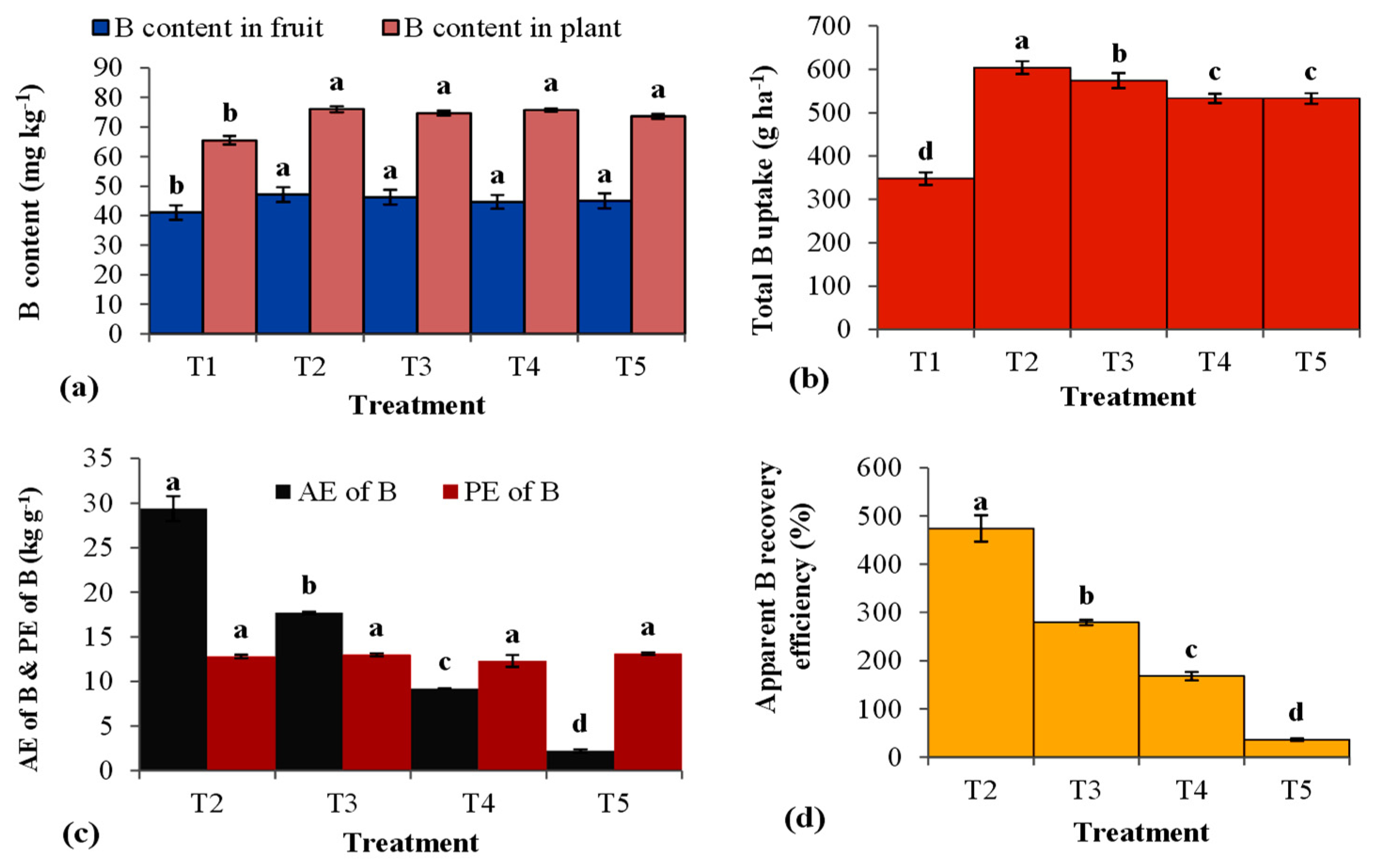
Figure 2: Influence of the foliar application of chelated nanoboron fertilizer on (a) the boron content, (b) total B uptake, (c) agronomic efficiency and physiological efficiency of B and (d) apparent B recovery efficiency in summer tomato. Vertical bars represent the standard error of the mean (n = 3); the mean values indicated by the common letters are not significantly different at the 5% level according to the least significant difference test; T1 (Control), T2 (Boron Nanofertil at 0.2 g L−1), T3 (boron nanofertil at 0.3 g L−1), T4 (Boron Nanofertil at 0.4 g L−1) and T5 (Boric acid at 1 g L−1).
3.5 Pearson’s correlation analysis
Pearson’s correlation analysis confirmed extremely high correlations among the measured yield, yield attributes, growth, and B uptake parameters (Fig. 3).
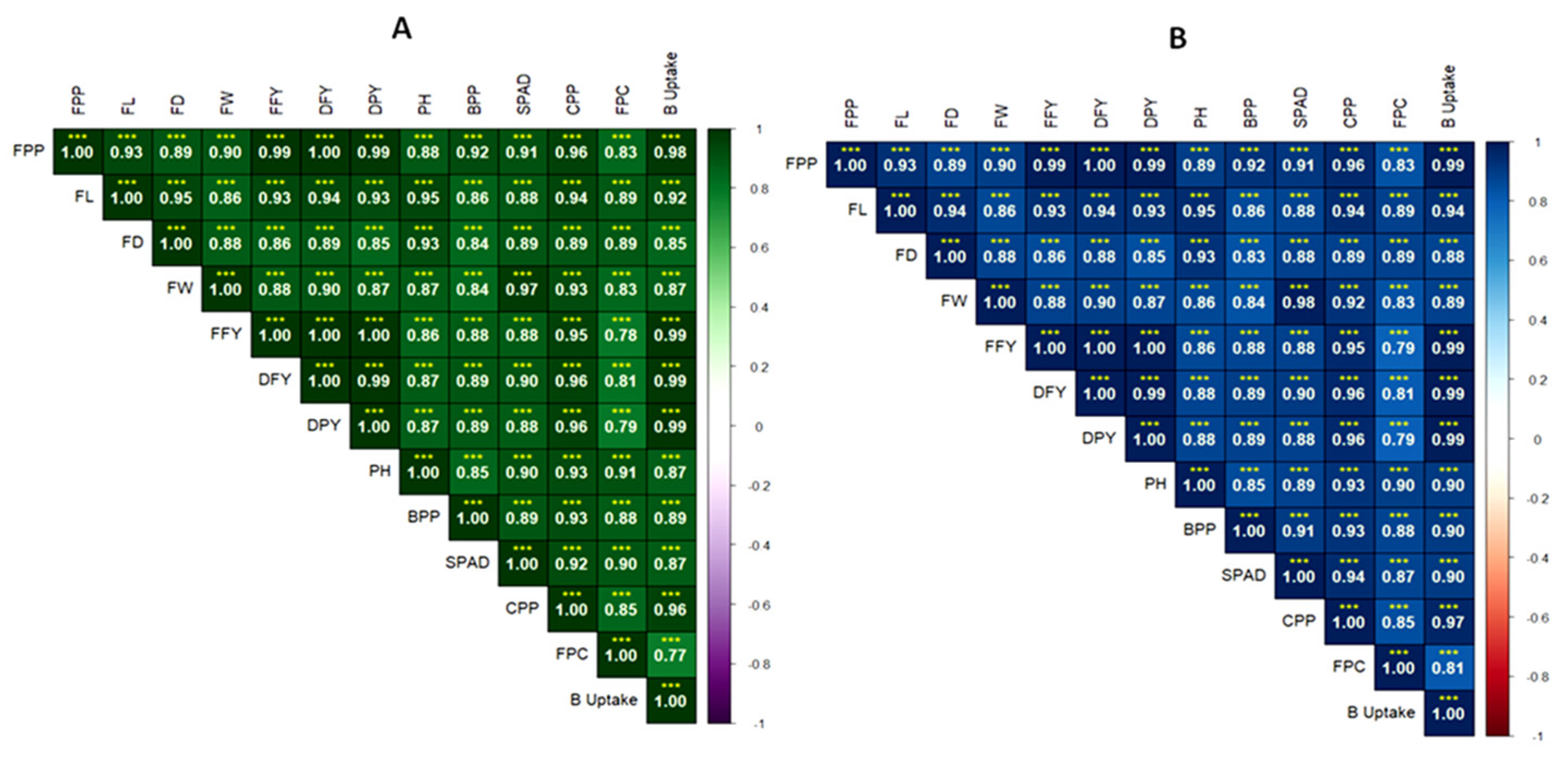
Figure 3: Pearson’s correlation analysis for a correlation matrix (13 × 13) consisting of 7 contributing yield attributes, 5 growth attributes and 1 applied B uptake dynamic from the five treatments in two consecutive years ((A) 2024 and (B) 2025). The color intensity scales indicate the strength and direction of the correlation coefficient. Asterisks indicate statistically significant correlations between traits: *** correspond to significance levels of 0.1% probability, respectively. Correlations that are not statistically significant (p > 0.05) are represented by blank spaces. FPP = Fruits per plan (nos.); FL = Fruit length (cm); FD = Fruit height (cm); FW = fruit weight (gm); FFY = Fresh fruit yield (t ha−1); DFY = Dry fruit yield (t ha−1); DPY = Dry plant yield (t ha−1); FFY = Fresh fruit yield (t ha−1); PH = Plant height (cm); BPP = Branches per plant (nos.); SPAD = SPAD value; CPP = Cluster per plant (nos.); FPC = Fruits per cluster (nos.) and B Uptake = Boron uptake (g ha−1).
All the parameters were significantly positively correlated (p ≤ 0.001). The year-to-year (2024 and 2025) correlation coefficients were highly consistent, although minor variations were observed in the interaction between fruits per cluster (FPC) and boron uptake (r = 0.77 to r = 0.81), SPAD value and boron uptake (r = 0.87 to r = 0.90), and fruit diameter (FD) and boron uptake (r = 0.85 to r = 0.88). The strongest correlation of growth attributes with yield attributes was exhibited by the correlation coefficients for plant height (PH) with fruit length (FL) and fruit diameter (FD), with correlation coefficients of 0.95 and 0.93, respectively. Consecutively, the number of branches per plant (BPP) and the SPAD value were correlated with the number of fruits per plant (FPP) and the weight of the fruit (FW), respectively. Clusters per plant (CPP) strongly correlated with fruits per plant (FPP), fruit length (FL), fruit weight (FW), fresh fruit yield (FFY), dry fruit yield (DFY), and dry plant yield (DPY). However, the boron uptake dynamics were strongly correlated with FPP (r = 0.98), FFY (r = 0.99), DFY (r = 0.99), DPY (r = 0.99), and CPP (r = 0.96) but weakly correlated with FPC (r = 0.77 and 0.81).
3.6 Principal Component Analysis (PCA)
The principal component analysis (PCA) biplot reflected the effects of treatments on growth, yield and B uptake over two consecutive years. The PCA biplot for 2024 and 2025 reflects the multi-trait response of the treatments through two principal components (PC1 and PC2), which together account for a cumulative variance of 98.1% and 98.0% for 2024 and 2025, respectively (Fig. 4).
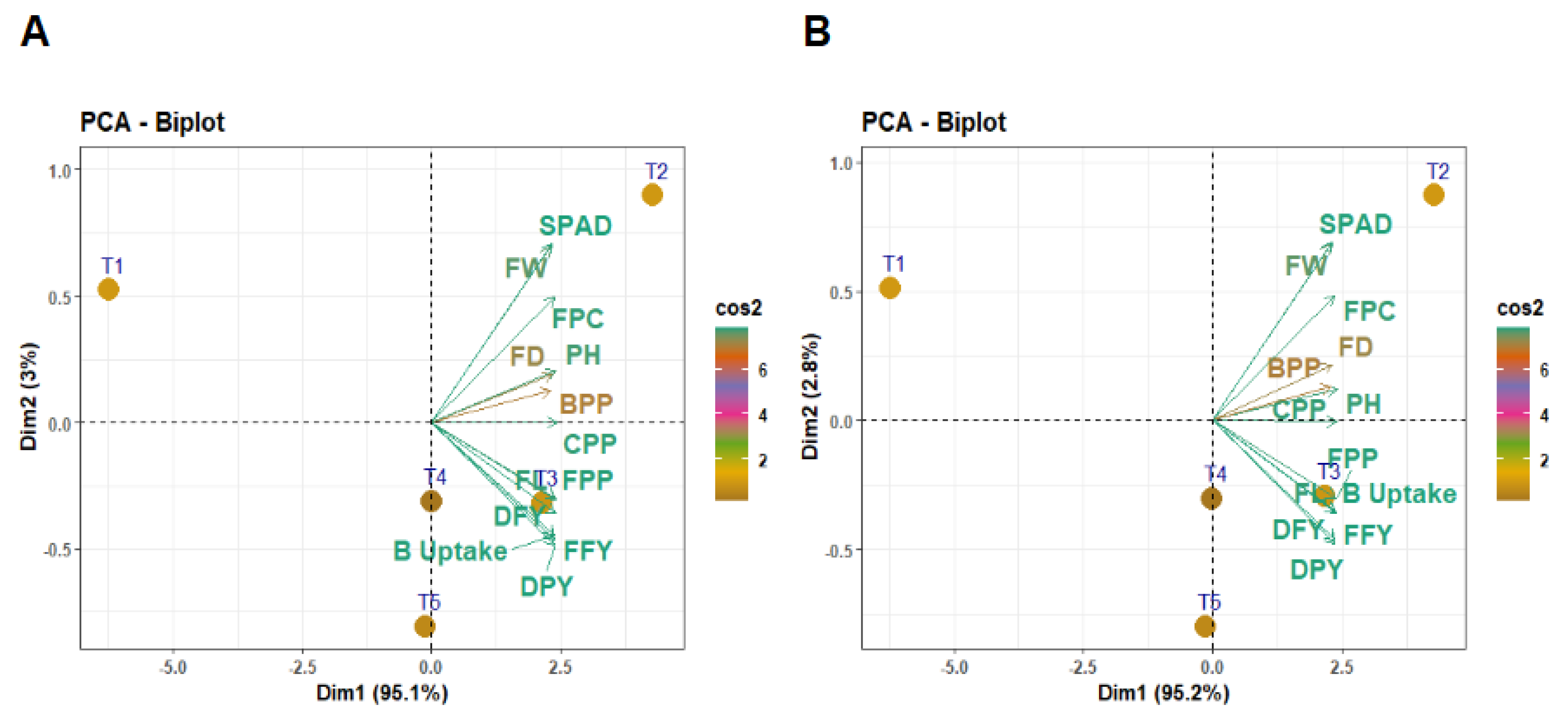
Figure 4: Principal component analysis (PCA)—biplot for five treatments and a total variable of 13 yield, growth, and nutrient attributes over two consecutive years ((A) 2024, (B) 2025). The contribution and intensity of variables in Principal Component 1 (PC1) and Principal Component 2 (PC2) are depicted by individual arrows. FPP = Fruits plan−1 (no.); FL = Fruit length (cm); FD = Fruit diameter (cm); FW = Fruit weight (gm); FFY = Fresh fruit yield (t ha−1); DFY = Dry fruit yield (t ha−1); DPY = Dry plant yield (t ha−1); PH = Plant height (cm); BPP = Branches plant−1 (nos.); SPAD = SPAD value; CPP = Cluster plant−1 (no.); FPC = Fruits cluster−1 (nos.) and B Uptake = Boron uptake (g ha−1).
A strong positive correlation was reflected by the vector direction (Fig. 4A) of fruit length (FL), fruits per plant (FPP), and fresh fruit yield (FFY), dry fruit yield (DFY), dry plant yield (DPY), and boron uptake (B uptake), as all these traits exhibited mostly similar and largest variations in PC1. On the other side, SPAD value, fruit weight (FW) and fruit per cluster (FPC) showed similar vector direction while contributing positive loading for both PC1 and PC2. In contrast to other vector traits, cluster per plant (CPP) independently contributed horizontal loading in PC1. Furthermore, the observation points reflected the treatment effect on the variables, as T2 (nano-B fertilizer at 0.2 g L−1) and T3 (nano-B fertilizer at 0.3 g L−1) covered the maximum traits, which were directly causing the effect. In contrast, observations points of T1 (Control) situated on the opposite coordinates of the all variables comprise a notably weak treatment effect compared to others. The biplot of consecutive two years (Fig. 4B) also exhibited the same trends in all traits, indicating effective responsiveness to treatments.
3.7 Cost and Return of Tomato Farming as Influenced by Foliar Application of Boron Nanoparticles
The year of cultivation significantly influenced the gross return, gross margin, and benefit-cost ratio (BCR) of tomato farming (Table 6).
Table 6: Influence of cultivation year and the foliar application of chelated nanoboron fertilizer on the gross return, gross margin, and benefit-cost ratio (BCR) of summer tomatoes.
| Factors | Gross Return (US$/season) | Gross Margin (US$/season) | Benefit-Cost Ratio |
|---|---|---|---|
| Cultivation Year (Y) | |||
| 2024 | 10,265 ± 421b | 8230 ± 413b | 5.04 ± 0.20b |
| 2025 | 10,612 ± 421a | 8577 ± 413a | 5.21 ± 0.19a |
| F test | ** | ** | ** |
| CV (%) | 2.60 | 3.23 | 2.61 |
| LSD0.05 | 208 | 208 | 0.10 |
| Treatment (T) | |||
| T1 (Control or B0) | 7463 ± 131e | 5517 ± 131e | 3.83 ± 0.067e |
| T2 (Nano B at 0.2 g L−1) | 11,908 ± 127a | 9902 ± 127a | 5.94 ± 0.063a |
| T3 (Nano B at 0.3 g L−1) | 11,445 ± 127b | 9379 ± 127b | 5.54 ± 0.061b |
| T4 (Nano B at 0.4 g L−1) | 10,500 ± 131d | 8374 ± 131d | 4.94 ± 0.062d |
| T5 (Boric acid at 1gL−1) | 10,876 ± 107c | 8847 ± 107c | 5.36 ± 0.053c |
| F test | *** | *** | *** |
| CV (%) | 2.60 | 3.23 | 2.61 |
| LSD0.05 | 329 | 329 | 0.16 |
| Interaction (Y×T) | ns | ns | ns |
The performance of the gross return, gross margin, and BCR in the second year (2025) is significantly better than that in the first year (2024). The total variable cost (TVC) for each experimental treatment was similar across both seasons. Consequently, the mean TVC for each treatment was as: T1 (Control or B0) = US$ 1946 ha−1, T2 (Nano B at 0.2 g L−1) = US$ 2006 ha−1, T3 (Nano B at 0.3 g L−1) = US$ 2066 ha−1, T4 (Nano B at 0.4 g L−1) = US$ 2126 ha−1, and T5 (Boric acid at 1 gL−1) = US$ 2029 ha−1. As detailed in Table 6, the T2 treatment (foliar application of 0.2 g L−1 nano-B fertilizer) resulted in the greatest gross return (US$ 11,908 ha−1) and the greatest gross margin (US$ 9902 ha−1), whereas the lowest values were recorded in the control group (T1). Furthermore, the highest BCR (5.94) occurred in T2, which was significantly greater than that in the other treatments; on the other hand, the minimum BCR occurred in the control (T1) (Table 6).
Summer tomato cultivation is hampered by elevated ambient temperatures, fluctuating moisture regimes, and micronutrient deficiencies, particularly of boron [40]. Heat stress compromises critical physiological, biochemical, and reproductive processes; especially, hyperthermia triggers substantial flower drop, ovule abortion, and high pollen sterility by impairing pollen tube elongation [41]. Furthermore, experimental soils exhibited the deficiency of organic carbon, total nitrogen, available K, Zn and B. While B is critical for structural integrity, fruit setting and development, high temperatures and erratic watering restrict the mass flow of this immobile micronutrient [7]. Under these stress conditions, B also works synergistically with other nutrients, enhancing the uptake of P and Ca to improve overall crop growth, yield and quality [7,40]. Foliar delivery of boron nanoparticles (B-NPs) counteracts these climatic challenges by promoting robust pollen tube growth and minimizing floral abscission, thereby enhancing the fruit-to-flower ratio [7]. Hence, this study evaluates the comparative efficacy of traditional foliar B (boric acid) and B-NPs, focusing on their respective physiological mechanisms.
4.1 Growth Parameters of Tomato as Influenced by Foliar Application of Boron Nanoparticles
The substantial improvement in growth traits of summer tomato, particularly plant height and branching, observed under 0.2 g L−1 Nano B (T2) is primarily attributed to the superior physicochemical properties of the nanoformulation. In contrast to conventional boric acid sprays, which often struggle with high surface tension and restricted cuticular penetration, nanoboron fertilizers exhibit enhanced permeability and more efficient nutrient uptake [42,43]. Boron nanoparticles (BNPs) have a high surface-area-to-volume ratio, increasing their reactivity and affinity for the leaf surface [44]. Physically, they exhibit a lower contact angle, which promotes better wetting and more extensive coverage on tomato leaves. BNPs avoid traditional cuticular barriers through numerous mechanisms. Particles less than 100 nm can penetrate directly through stomatal pores [45]. Additionally, they may utilize transcellular transport via aquaporins or facilitate the formation of “nanoholes” in the cuticle to increase the activity of the vascular system [43]. These pathways permit more rapid, uniform delivery of B within the leaf mesophyll, consistently outperforming the slower diffusion rates of bulk boric acid [46]. The effectiveness of BNPs in stimulating vertical growth and horizontal branching is driven by the targeted, sustained release of nutrients to metabolic sinks [47,48]. By optimizing nutrient use efficiency (NUE), compared with traditional sources, nanoboron formulations support cell wall biosynthesis, meristematic activity, and photosynthesis more effectively. This biological “stay-green” effect allows the fruit to accumulate more photoassimilates and soluble solids, extending the ripening period. In contrast, control plants may reach premature maturity because of nutrient stress [49].
In our study, the significant increase in clusters per plant and fruits per cluster following the application of 0.2 g L−1 Nano B (T2) can be attributed to the critical role of boron in the reproductive development of summer tomatoes. The efficacy of nanoboron is driven by several key physiological and biochemical pathways: Boron is a primary regulator of pollen viability and tube elongation [50]. Finally, by reinforcing cell wall integrity through borate-pectin complexes, boron maintains fruit firmness and delays the rapid breakdown of cellular components [51]. In summer tomatoes, where heat often impairs pollination, nanoboron ensures successful fruit set by stabilizing reproductive tissues and facilitating the cell wall synthesis necessary for pollen tube growth [7,50]. Compared with bulk fertilizers, the ultrasmall particle size and high surface area of nanofertilizers allow better penetration through stomatal openings [3]. This increased absorption efficiency increases photosynthetic rates, providing the photoassimilates required for fruit bulking [3,45]. Nanoboron acts as a catalyst for indole-3-acetic acid (IAA) metabolism. By maintaining optimal auxin levels, it prevents the premature abscission (dropping) of flowers and fruits, ensuring vigorous growth despite the heat stress typical in the summer season in Bangladesh [43]. Beyond structural stability, boron enhances cell membrane enzymatic functions [7]. This promotes the efficient phloem mobility of sugars from the leaves (source) to the developing fruits (sink), directly increasing the fruit count per cluster [7,52]. In this study, the control treatment (T1, no nanoboron fertilizer) significantly delayed the opening of flowering. Conversely, plants treated with 0.2 g L−1 Nano B (T2) required more days to reach maturity, whereas the control (T1) matured the earliest. The delay in flowering observed in T1 twigs is attributed to the vital function of boron in the early stages of reproductive morphogenesis. As an essential regulator of plant growth, a deficiency in boron interferes with the development of reproductive structures and postpones the onset of flowering [53]. In particular, boron supports pollen viability and raceme development, both of which are essential for the timely transition from the vegetative phase to the reproductive phase [54,55]. Moreover, the prolonged time to maturity in T2 indicates enhanced physiological activity rather than poor growth. Foliar application of boron improves carbohydrate transport and overall metabolism, thereby sustaining the fruit-filling stage [7]. Furthermore, boron regulates endogenous phytohormones such as gibberellins and cytokinins, which promote continuous cell expansion and delay fruit senescence [56]. In the present study, the chlorophyll content (SPAD value) of summer tomatoes were greatest in the 0.2 g L−1 nano-B treatment (T2), whereas the lowest values occurred in the unfertilized control group. The superiority of T2 treatment highlights the enhanced bioavailability of nanomaterials; their ultrasmall size and high specific surface area facilitate easier cellular penetration via plasmodesmata and stomata, thereby increasing nutrient uptake and use efficiency [6,57]. Furthermore, its positive interaction with nitrogen assimilation stimulates chlorophyll biosynthesis, stabilizing photosystem performance during high-temperature summer conditions [58]. Conversely, the minimal SPAD values in the control group reflect a typical boron deficiency response, characterized by impaired chloroplast development, altered hormonal balance, and reduced light utilization [59].
4.2 Yield Attributes and Yields of Tomato as Influenced by Foliar Application of Boron Nanoparticles
The application of 0.2 g L−1 Nano B (T2) significantly enhanced the reproductive harvest and physical morphology of summer tomatoes, resulting in the highest fruit count, length, diameter, and individual fruit weight. Conversely, the control group (T1) recorded the minimum values for all the measured parameters. The prominent improvements under the T2 treatment can be attributed to the unique physicochemical attributes of nanoboron and its fundamental role in plant reproductive development [60]. While conventional boron fertilizers often suffer from low mobility and poor utilization efficiency because of environmental leaching, nanofertilizers have exceptionally high surface-area-to-volume ratios and tiny particle sizes (<100 nm) [60,61]. These properties enhance penetration through the leaf cuticle and stomatal pores, ensuring a sustained, controlled release of nutrients directly into metabolic sinks while preventing the temporary toxicity or nutrient deficiencies associated with bulk fertilizers [3,60]. The maximum fruit count observed in the T2 treatment is directly associated with the critical role of boron in plant sexual reproduction, where it drives pollen grain germination and elongates the pollen tube during pollination [62,63]. By maintaining cell membrane integrity and promoting pollen tube growth toward the ovary, nanoboron minimizes flower drop and increases successful fruit set under stressful summer conditions [7,61]. Moreover, substantial increases in fruit size and biomass are governed by the structural role of boron in the plant apoplast [62]. Concurrently, boron regulates hormone metabolism, particularly through interactions with auxins and cytokinin, to stimulate cell division and rapid elongation within the developing tomato pericarp [62,63,64]. It also complexes with sugars to facilitate the phloem-mediated translocation of photoassimilates from source leaves to reproductive sinks [65]. By improving the photosynthetic efficiency and accelerating the carbohydrate distribution to developing fruits, nanoboron effectively increases individual fruit weight [65]. Conversely, the unmitigated nutrient limitation in the control treatment limits cell wall expansion and sugar transport, causing stunted fruit dimensions and poor yield [62,63].
In this study, the marketable fresh fruit yield of summer tomato increased significantly in the T2 treatment (0.2 g L−1 Nano B), representing a 59.7% increase over that in the control treatment (T1) and a 9.57% improvement over that in the conventional B fertilizer treatment. Moreover, the dry fruit yield and dry plant yield were greatest in T2, whereas the lowest values across all the evaluated yields were noted in the control treatment. The flow in marketable fresh fruit yield and dry biomass yield under the T2 treatment (0.2 g L−1 Nano B) can be attributed mainly to the superior physicochemical properties of the nanofertilizers. Compared with conventional boron formulations, nanoparticles have a significantly higher surface-area-to-volume ratio, which considerably enhances their penetration through leaf cuticles or root cellular membranes [3,66]. This nanoscale mobility prevents the rapid fixation and leaching common to traditional boric acid or borax applications [51]. Nanoencapsulated formulations avoid standard vascular bottlenecks, sustaining a continuous and controlled release of B that precisely matches the physiological demands of the tomato plant during critical reproductive phases [66,67]. The significant advancements in dry plant and dry fruit yields reflect the foundational role of boron in structural carbohydrate synthesis. This mechanism is supported by the observations of Álvarez-Herrera et al. [51] and Mahious et al. [62], who reported that boron is physiologically indispensable for cell wall cross-linking. Specifically, it dimerizes with the pectic polysaccharide rhamnogalacturonan II (RG-II) to form stable dRG-II-B complexes, thereby maintaining structural integrity. This maintenance preserves cell wall integrity and regulates cell division and elongation in active meristematic tissues [62]. By providing optimal boron availability, T2 optimized leaf structural development, increased the degree of chlorophyll, and increased the net photosynthetic rate [65]. This enhanced photosynthetic efficiency ultimately resulted in increased photoassimilate accumulation, which translated directly into greater dry vegetative biomass. The remarkable 59.7% increase in marketable fresh fruit yield compared with that of the control strongly emphasizes the importance of reproductive micronutrients. Tomato plants require substantial amounts of B during the anthesis stage; a deficiency of B triggers intense flower drop, bud senescence, and localized tissue cracking [51,62]. Boron drives pollen grain viability, stabilizes stigma receptivity, and accelerates pollen tube elongation toward the ovary [62,63,65]. The fine-tuned bioavailability provided by 0.2 g L−1 Nano-B ensured successful pollination, minimized early fruit abortion, and fostered symmetrical fruit expansion [51]. Furthermore, adequate B management mitigates enzymatic phenolic oxidation and stabilizes plasma membrane ion flows, resulting in healthy, firm epidermis formations that directly increase the yield of marketable fresh fruits while eliminating unmarketable, deformed, or cracked produce [51,62].
4.3 Quality Parameters of Tomato as Influenced by Foliar Application of Boron Nanoparticles
Foliar application of boron nano fertilizer significantly influenced most quality traits of summer tomatoes. In our study, the prominent enhancement of summer tomato quality traits following the foliar application of B nanoparticles T2 (foliar application of B nanoparticles at 0.2 g L−1) can be attributed to the superior absorption, cellular penetration, and distinct biochemical functionalities of nanoscale formations compared with those of conventional fertilizers [3,66]. Mittal et al. [68] supported this view, demonstrating that nanoparticles can easily penetrate leaf cuticles and stomatal pathways more efficiently via symplastic movement. This process avoids the soil-fixation limitations typical of traditional boron application treatments, leading to a direct and highly bioavailable influx of B to developing reproductive sinks. In our study, a significant accumulation of TSS, total sugars, and reducing sugars was observed under the T2 treatment (foliar application of B nanoparticles at 0.2 g L−1). These improvements occur via two mechanisms: upregulation of photosynthesis activity and increased phloem loading. Specifically, boron acts as a primary catalyst for the activation of dehydrogenase enzymes and regulates the metabolic flux of carbohydrates, a view supported by the findings of Goswami et al. [69]. Additionally, nano-B application optimizes chlorophyll biosynthesis and photosynthetic efficiency, increasing dry matter accumulation [70]. Mechanistically, boron binds with sugar molecules to form highly translocatable sugar–borate complexes across plasma membranes, assisting in the rapid translocation of photoassimilates from source leaves into sink fruits [71]. This accelerated transport mechanism directly increases the sugar profile and TSS values of the fruit. The maximum concentrations of vitamin C and β-carotene observed in the T2 treatment underscore the pivotal role of boron in mitigating oxidative stress and triggering secondary metabolism. Foliar application of B reduces fruit degradation by promoting antioxidant enzyme pathways and enhancing the metabolic synthesis of ascorbic acid [51,71]. Furthermore, nanofertilizers ensure a sustained, steady release of nutrients, thereby protecting plants from destructive oxidative reactions during intense summer conditions [3,72]. The application of nano boron at 100 ppm through foliar spray on days 40, 55, and 70 after transplanting (DATP) enhanced the yield and yield characteristics of tomatoes. In contrast, superior quality parameters were observed with the foliar application of nano boron at 200 ppm on the same days, 40, 55, and 70 DATP [69]. Although the T2 treatment resulted in the highest numerical values for fruit firmness in this study, these differences did not reach statistical significance. Mechanistically, boron is indispensable to plant structural integrity through its specific cross-linking with rhamnogalacturonan II (RG-II) chains within pectin, which preserves cell wall architecture and mechanical strength [62,73]. The lack of statistical significance in firmness variation suggests that while B nanoparticles successfully reinforced epidermal cell walls and optimized cellular turgor [51], tomato fruit firmness remains a complex polygenic trait. It is highly buffered by other structural elements, such as calcium (Ca2+), and tightly coordinated by the enzymatic suppression of pectin methylesterase and polygalacturonase during the ripening cascade.
4.4 Boron Uptake and Boron Use Efficiency (BUE)
Foliar application of nanochelated boron fertilizer at 0.2 g L−1 (T2) positively increased both the boron content and total B uptake in summer tomatoes. This increase in boron accumulation within the tomato plants can be attributed to the structural advantages of nanochelated formulations over traditional mineral forms [51,71,74]. Standard water-soluble boron fertilizers are significantly resistant to penetration of the hydrophobic, waxy leaf cuticle of tomato plants [68]. Nanochelated boron effectively resolves this physical limitation in two ways: a high surface-area-to-volume ratio of nanoparticles ensures a wider and more uniform distribution across the foliar surface [65]. Their tiny size allows for direct, efficient infiltration through stomatal pores and hydrophilic cuticular pathways, successfully avoiding the distinctive barriers that hinder larger solute complexes [3,66]. Boron enhances cellular metabolic and structural functions in plants [65]. Foliar application of nano-B enhances chlorophyll synthesis, accelerates photosynthetic rates, and drives the active transport of sugars to reproductive organs [75]. The T2 (0.2 g L−1) treatment likely resulted in superior B uptake through this sharp metabolic and structural increase. Conversely, the minimal B levels recorded in the untreated control plants (T1) reflected a deficiency in standard micronutrients. In the absence of supplemental B, summer tomatoes face limited vascular development and structural cell wall limitations, which drastically suppress their overall nutrient assimilation capacity [58,76].
In the present study, the foliar application of nanochelmented boron fertilizer modulated the agronomic efficiency (AE) of B and the apparent boron recovery efficiency (ABRE) of summer tomatoes. However, the physiological efficiency (PE) of boron remained unaffected by the treatments, generating inconsistent results. The highest AE and maximum ABRE were observed in the T2 treatment (foliar application of nanochelated boron fertilizer at 0.2 g L−1), whereas the lowest values were recorded in T5 (conventional B fertilizer application). These best AE and ABRE values in T2 (0.2 g L−1) indicate that lower concentrations of nanoboron enhance the boron use efficiency (BUE). This lower dose of nano-B likely operates within the “hormetic zone” to stimulate growth [77] and modulates auxin translocation to root tips, stimulating lateral root development and elongation. This structural modification optimizes nutrient foraging, ultimately maximizing agronomic efficiency and apparent recovery efficiency [78,79]. Conversely increasing the application rate of both the nanoboron and conventional B fertilizers decreased the BUE. This aligns with the findings of Guo et al. [74], who reported that the superior efficiency of nanoboron at lower concentrations compared with that of conventional boric acid is driven by several physiological and physicochemical mechanisms. The decrease in BUE (AE and ABRE) at elevated nanoboron concentrations is likely due to the narrow margin between boron deficiency and toxicity. Excess boron can induce the accumulation of reactive oxygen species (ROS) and degrade chlorophyll, a mechanism that aligns with the observations of Agathokleous [77]. High doses may saturate metabolic pathways and reduce nutrient utilization efficiency [74,78].
4.5 Correlation Coefficient Analysis
The highly significant positive correlations (p < 0.001) observed among yield, growth, and B uptake characteristics demonstrate strong phenotypic consistency across consecutive years. However, the slight year-to-year increases in correlation coefficients involving boron uptake suggest that minor environmental fluctuations may influence nutrient assimilation dynamics. In particular, B uptake was more strongly correlated with yield attributes than with growth attributes, despite all the parameters showing highly significant correlations (p < 0.001). The strong relationship between B uptake and dry plant yield aligns with the findings of Noaema et al. [80], highlighting the critical role of boron in biomass accumulation. Furthermore, fresh fruit yield (FFY) and dry fruit yield (DFY) were strongly correlated with both B uptake and clusters per plant (CPP). These findings suggest that increased B uptake supports a greater number of clusters per plant, directly driving fresh fruit yield and consequently resulting in superior dry fruit yield, a developmental sequence supported by Al-Hajjaj and Ayad [81] as well as Giacobbo et al. [82].
4.6 Principal Component Analysis (PCA)
Principal component analysis (PCA) reduces the dimension and complexity and presents the maximum spread of data, as visualized by a PCA biplot. In this study, a PCA biplot was generated to reveal the relationships among yield, growth, and B uptake attributes over two consecutive years (2024 and 2025). The strong, positive loadings of fruit length (FL), fruit weight (FW), number of clusters per plant (CPP), number of branches per plant (BPP), number of fruits per plant (FPP), and the SPAD value along the primary axis (PC1) reveal a highly synchronized physiological response driven by specific treatments. This clustering highlights the direct channel between vegetative capacity and sinks strength: higher SPAD values reflect increased chlorophyll density and photosynthetic capacity, which directly fuels structural branching (BPP) and robust reproductive sinks (CPP, FPP, FL, and FW). This strongly combined relationship between source efficiency and yield building aligns with structural dependency frameworks previously observed by Ullah et al. [83], Rahman et al. [84] and Shireen et al. [6]. The dissimilar spatial clustering of treatments T2 (0.2 g L−1 nano-B fertilizer) and T3 (0.3 g L−1 nano-B fertilizer) along the positive vector of PC1 highlights their fundamental role in upregulating these attributes. This behavior is primarily tied to boron uptake; boron is biochemically indispensable for cell wall synthesis, pollen tube elongation, and carbohydrate transport from source leaves to developing reproductive sinks. Consequently, enhanced boron assimilation under T2 and T3 directly enhanced cell division in developing fruits (demonstrating increased FL and FW) and reduced flower abortion (producing higher CPP and FPP). On the other hand, treatment T1 clustered heavily in the negative quadrants of PC1, indicating a restrictive environment likely due to nutrient deficiency or imbalance that suppressed chlorophyll synthesis and decreased metabolic translocation, leading to stunted growth and compromised yield components. This inhibitory pattern reflects the metabolic constraints documented by Quddus et al. [85] and Xu et al. [65]. The variable vector, excluding the horizontal axes, represents uncorrelated variables, such as fruits per cluster (FPC), which predominantly influence PC2. This observation aligns with the findings of Haleema et al. [86]. Furthermore, Quddus et al. [18] emphasized the complex nature of yield and growth components and their varied responses to different treatments.
4.7 Cost-Effectiveness and Seasonal Variation
From an economic perspective, the foliar application of 0.2 g L−1 boron nanofertilizer (T2) proved to be the most profitable intervention, generating a benefit-cost ratio (BCR) that was 55.1% greater than that of the control and 10.8% greater than that of conventional boron applications. This pronounced monetary increase is directly related to the superior nutrient use efficiency (NUE) inherent to nanoscale delivery systems. While conventional boron treatments frequently suffer from poor mobility and rapid chemical fixation, nanoformulation ensures rapid cellular uptake. Consequently, the T2 treatment reduced the decrease in the number of physiological flowers and increased reproductive viability. It converts lower input costs into a significantly elevated marketable fruit yield. These observations confirm the enhanced productivity and nutrient assimilation dynamics reported by Gayathri et al. [87] and Kumar et al. [88].
In the present study, the variations observed in the growth, yield, and quality attributes of summer tomatoes between the two experimental years can be directly attributed to differences in environmental constraints, microclimate stability, and soil fertility dynamics. Tomato is a highly thermosensitive crop [89]; consequently, off-season summer cultivation is exceptionally susceptible to climatic variations, where minor fluctuations in ambient temperature and relative humidity can alter key physiological transitions [90]. Meteorological data indicated that the ambient air temperature during the first year (2024) was considerably higher than that during the second year (2025). Conversely, the precipitation records revealed greater rainfall during the second season. When summer temperatures align closely with the crop’s biological optimum, tomatoes exhibit a shorter distance between the apical meristem and the inflorescence, thereby maximizing early reproductive growth, flower retention, and total fruit-set numbers [89,90]. Ultimately, these variations in microclimate, seasonal precipitation, and residual soil nutrients explain the enhanced productivity, improved fruit quality, and accelerated nutrient assimilation dynamics that led to better overall crop performance during the second year, a view supported by Gayathri et al. [87] and Kumar et al. [88].
In this study, compared with traditional boron practices, under heat-stressed summer conditions, foliar treatment with 0.2 g L−1 nanoboron greatly improved the growth, production, cost ratio, and quality of summer tomatoes. Foliar application of 0.2 g L−1 nanoboron fertilizer effectively improved the fruit set, fruit size and weight and overall yield. This treatment markedly enhanced the nutritional quality of the fruit, increasing total soluble solids (TSS), ascorbic acid (vitamin C), and protein content. Compared with bulk boron sources, 0.2 g L−1 nanoboron fertilizer facilitated superior nutrient uptake and translocation, leading to a substantial increase in nutrient use efficiency (NUE). However, the foliar management of 0.2 g L−1 nanoboron is highly efficient and economic and represents a sustainable approach for maximizing tomato productivity under heat-stressed conditions. This technique offers a scientific solution for precise nutrient delivery together with obvious economic benefits by reducing the overall amount of fertilizer needed to achieve ideal harvests. In future, the long-term ecological footprint, residual accumulation in intensive multi-cropping systems and comprehensive economic processing costs of nano-chelated B formulations versus traditional bulk inputs should be evaluated across multi-location trials before widespread commercial adoption can be recommended.
Acknowledgement:
Funding Statement: The study was financially supported by Bangladesh Agricultural Research Institute (BARI), Joydebpur, Gazipur, Bangladesh. This study was also funded by Princess Nourah bint Abdulrahman University Researchers Supporting Project number (PNURSP2026R951), Princess Nourah bint Abdulrahman University, Riyadh, Saudi Arabia.
Author Contributions: Conceptualization, Md. Abdul Quddus, Khokan Kumer Sarker and Akbar Hossain; methodology, Md. Abdul Quddus, Khokan Kumer Sarker, Zoheb Hasan Fahad, Shafkat Tashzi, Shimul Mondal, Nazneen Ara Sultana, Rabeka Sultana Smriti, Md. Anarul Islam, Md. Ruhul Amin and Akbar Hossain; software, Md. Abdul Quddus, Khokan Kumer Sarker, Hela Znazen, Ahmed Gaber and Akbar Hossain; validation, Md. Abdul Quddus, Khokan Kumer Sarker, Zoheb Hasan Fahad, Shafkat Tashzi, Shimul Mondal, Nazneen Ara Sultana, Rabeka Sultana Smriti, Md. Anarul Islam, Md. Ruhul Amin and Akbar Hossain; formal analysis, Md. Abdul Quddus, Khokan Kumer Sarker and Akbar Hossain; investigation, Md. Abdul Quddus, Khokan Kumer Sarker, Zoheb Hasan Fahad, Shafkat Tashzi, Shimul Mondal, Nazneen Ara Sultana, Rabeka Sultana Smriti, Md. Anarul Islam, Md. Ruhul Amin and Akbar Hossain; resources, Md. Abdul Quddus, Khokan Kumer Sarker and Akbar Hossain; data curation, Md. Abdul Quddus, Khokan Kumer Sarker, Hela Znazen, Ahmed Gaber and Akbar Hossain; writing—original draft preparation, Md. Abdul Quddus, Zoheb Hasan Fahad, Shafkat Tashzi, Shimul Mondal, Nazneen Ara Sultana, Rabeka Sultana Smriti, Md. Anarul Islam, Md. Ruhul Amin; writing—review and editing, Md. Abdul Quddus, Khokan Kumer Sarker, Hela Znazen, Ahmed Gaber and Akbar Hossain; visualization, Md. Abdul Quddus, Khokan Kumer Sarker and Akbar Hossain; supervision, Md. Abdul Quddus, Khokan Kumer Sarker, Hela Znazen, Ahmed Gaber and Akbar Hossain; project administration, Md. Abdul Quddus, Khokan Kumer Sarker, Hela Znazen, Ahmed Gaber and Akbar Hossain; funding acquisition, Md. Abdul Quddus, Khokan Kumer Sarker, Hela Znazen, Ahmed Gaber and Akbar Hossain. All authors reviewed and approved the final version of the manuscript.
Availability of Data and Materials: The data that supports the findings of this study are available from the corresponding authors upon reasonable request.
Ethics Approval: Not applicable.
Conflicts of Interest: The authors declare no conflicts of interest.
References
1. Meier S , Moore F , Morales A , González ME , Seguel A , Meriño-Gergichevich C , et al. Synthesis of calcium borate nanoparticles and its use as a potential foliar fertilizer in lettuce (Lactuca sativa) and zucchini (Cucurbita pepo). Plant Physiol Biochem. 2020; 151: 673– 80. doi:10.1016/j.plaphy.2020.04.025. [Google Scholar] [CrossRef]
2. Arifeen HM , Phoungthong K , Mostafaeipour A , Yuangyai N , Yuangyai C , Techato K , et al. Determine the land-use land-cover changes, urban expansion and their driving factors for sustainable development in gazipur Bangladesh. Atmosphere. 2021; 12( 10): 1353. doi:10.3390/atmos12101353. [Google Scholar] [CrossRef]
3. Ahmed R , Uddin MK , Quddus MA , Samad MYA , Hossain MAM , Haque ANA . Impact of foliar application of zinc and zinc oxide nanoparticles on growth, yield, nutrient uptake and quality of tomato. Horticulturae. 2023; 9( 2): 162. doi:10.3390/horticulturae9020162. [Google Scholar] [CrossRef]
4. Collins EJ , Bowyer C , Tsouza A , Chopra M . Tomatoes: An extensive review of the associated health impacts of tomatoes and factors that can affect their cultivation. Biology. 2022; 11( 2): 239. doi:10.3390/biology11020239. [Google Scholar] [CrossRef]
5. Dasgan HY , Dere S , Akhoundnejad Y , Arpaci BB . Effects of high-temperature stress during plant cultivation on tomato (Solanum lycopersicum L.) fruit nutrient content. J Food Qual. 2021; 2021: 7994417. doi:10.1155/2021/7994417. [Google Scholar] [CrossRef]
6. Shireen F , Nawaz MA , Chen C , Zhang Q , Zheng Z , Sohail H , et al. Boron: Functions and approaches to enhance its availability in plants for sustainable agriculture. Int J Mol Sci. 2018; 19( 7): 1856. doi:10.3390/ijms19071856. [Google Scholar] [CrossRef]
7. Alila P . Boron nutrition in horticultural crops: Constraint diagnosis and their management. Aydin M , editor. London, UK: IntechOpen; 2023. doi:10.5772/intechopen.113367. [Google Scholar] [CrossRef]
8. Batabyal K , Sarkar D , Mandal B . Critical levels of boron in soils for cauliflower (Brassica oleracea Var. Botrytis). J Plant Nutr. 2015; 38( 12): 1822– 35. doi:10.1080/01904167.2015.1042166. [Google Scholar] [CrossRef]
9. Davarpanah S , Tehranifar A , Davarynejad G , Abadía J , Khorasani R . Effects of foliar applications of zinc and boron nano-fertilizers on pomegranate (Punica granatum cv. Ardestani) fruit yield and quality. Sci Hortic. 2016; 210: 57– 64. doi:10.1016/j.scienta.2016.07.003. [Google Scholar] [CrossRef]
10. Sutulienė R , Brazaitytė A , Małek S , Jasik M , Samuolienė G . Response of oxidative stress and antioxidant system in pea plants exposed to drought and boron nanoparticles. Antioxidants. 2023; 12( 2): 528. doi:10.3390/antiox12020528. [Google Scholar] [CrossRef]
11. Irshad MK , Ansari JR , Noman A , Javed W , Lee JC , Aqeel M , et al. Seed priming with Fe3O4-SiO2 nanocomposites simultaneously mitigate Cd and Cr stress in spinach (Spinacia oleracea L.): A way forward for sustainable environmental management. Ecotoxicol Environ Saf. 2024; 286: 117195. doi:10.1016/j.ecoenv.2024.117195. [Google Scholar] [CrossRef]
12. Alotaibi NM , Irshad MK , Saleem S , Ansari JR , Noman A , Alzuaibr FM , et al. Harnessing nano-engineered iron-silicon nanoparticles to modulate cadmium uptake and strengthen detoxification in rice (Oryza sativa L.). Int J Phytoremediat. 2026: 1– 17. doi:10.1080/15226514.2026.2687592. [Google Scholar] [CrossRef]
13. Goyal A , Chavan SS , Mohite RA , Shaikh IA , Chendake Y , Mohite DD . Emerging trends and perspectives on nano-fertilizers for sustainable agriculture. Discov Nano. 2025; 20( 1): 97. doi:10.1186/s11671-025-04286-8. [Google Scholar] [CrossRef]
14. Kumar N , Samota SR , Venkatesh K , Tripathi SC . Global trends in use of nano-fertilizers for crop production: Advantages and constraints–A review. Soil Till Res. 2023; 228: 105645. doi:10.1016/j.still.2023.105645. [Google Scholar] [CrossRef]
15. Liu R , Lal R . Potentials of engineered nanoparticles as fertilizers for increasing agronomic productions. Sci Total Environ. 2015; 514: 131– 9. doi:10.1016/j.scitotenv.2015.01.104. [Google Scholar] [CrossRef]
16. Muñoz-Márquez E , Soto-Parra JM , Noperi-Mosqueda LC , Sánchez E . Application of molybdenum nanofertilizer on the nitrogen use efficiency, growth and yield in green beans. Agronomy. 2022; 12( 12): 3163. doi:10.3390/agronomy12123163. [Google Scholar] [CrossRef]
17. Verma KK , Song XP , Degu HD , Guo DJ , Joshi A , Huang HR , et al. Recent advances in nitrogen and nano-nitrogen fertilizers for sustainable crop production: A mini-review. Chem Biol Technol Agric. 2023; 10( 1): 111. doi:10.1186/s40538-023-00488-3. [Google Scholar] [CrossRef]
18. Quddus A , Ahmed R , Khan SU , Purnota SJ , Islam T , Sultana NA , et al. Sustainable garden pea cultivation: A comprehensive evaluation of organic, inorganic, and bio-fertilizer impacts on productivity, quality and nutrient dynamics. Int J Plant Prod. 2026; 20( 1): 22. doi:10.1007/s42106-025-00398-4. [Google Scholar] [CrossRef]
19. Huq SMI , Shoaib JUM . The Soils of Bangladesh. Dordrecht, The Netherlands: Springer; 2013. 165 p. doi:10.1007/978-94-007-1128-0. [Google Scholar] [CrossRef]
20. Zhu G , Yong L , Zhao X , Liu Y , Zhang Z , Xu Y , et al. Evaporation, infiltration and storage of soil water in different vegetation zones in the Qilian Mountains: A stable isotope perspective. Hydrol Earth Syst Sci. 2022; 26( 14): 3771– 84. doi:10.5194/hess-26-3771-2022. [Google Scholar] [CrossRef]
21. Black CA . Methods of soil analysis: Part 1, physical and mineralogical properties. Madison, WI, USA: American Society of Agronomy; 1965, p. 1572. doi:10.2134/AGRONMONOGR9.1. [Google Scholar] [CrossRef]
22. Page AL , Miller RH and Keeney DR . Methods of soil analysis. Part 2. chemical and microbiological properties. Madison, WI, USA: American Society of Agronomy, Soil Science Society of America; 1982. p. 1159. [Google Scholar]
23. Gupta . Soil, plant, water and fertilizer analysis. Rajasthan, India: Department of Agricultural Chemistry and Soil Science, Maharana Pratap University of Agriculture and Technology; 2004. [Google Scholar]
24. Jackson ML . Soil chemical analysis. New Delhi, India: Prentice Hall of India Pvt. Ltd.; 1973. [Google Scholar]
25. Bray RH , Kurtz LT . Determination of total, organic, and available forms of phosphorus in soils. Soil Sci. 1945; 59( 1): 39– 46. doi:10.1097/00010694-194501000-00006. [Google Scholar] [CrossRef]
26. Fox RL , Olson RA , Rhoades HF . Evaluating the sulfur status of soils by plant and soil tests. Soil Sci Soc Amer J. 1964; 28( 2): 243– 6. doi:10.2136/sssaj1964.03615995002800020034x. [Google Scholar] [CrossRef]
27. Lindsay WL , Norvell WA . Development of a DTPA soil test for zinc, iron, Manganese, and copper. Soil Sci Soc Am J. 1978; 42( 3): 421– 8. doi:10.2136/sssaj1978.03615995004200030009x. [Google Scholar] [CrossRef]
28. Goswami PB , Satodiya BN , Raval CH , Baria VK . Effect of nano boron and conventional boron sources on growth, yield and leaf boron content of Toma to cv. anand Roma. J Adv Biol Biotechnol. 2025; 28( 10): 1– 9. doi:10.9734/jabb/2025/v28i103031. [Google Scholar] [CrossRef]
29. García-Locascio E , Cervantes-Avilés P . Seed priming with boron-based nanoparticles mitigates tomato losses in hyperthermia stress. BIO Web Conf. 2025; 205: 01010. doi:10.1051/bioconf/202520501010. [Google Scholar] [CrossRef]
30. Ahmmed S , Jahiruddin M , Razia S , Begum RA , Biswas JC , Rahman ASMM , et al. Fertilizer recommendation guide-2018. Dhaka, Bangladesh: Bangladesh Agricultural Research Council (BARC); 2018. 223 p. [Google Scholar]
31. Nirupama P , Gol NB , Rao TVR . Effect of postharvest treatments on physicochemical characteristics and storage life of tomato (Lycopersicon esculentum Mill.) fruits during storage. Am-Eurasian J Agric Environ Sci. 2010; 9: 470– 9. [Google Scholar]
32. AOAC. Official methods of analysis. Washington, DC, USA: Association of Official Agricultural Chemists; 1994. [Google Scholar]
33. Ranganna S . Handbook of analysis and quality control for fruit and vegetable products. 2nd ed. New Delhi, India: Tata McGraw Hill Pub. Co., Ltd.; 1986. [Google Scholar]
34. Kumah P , Olympio N . Sensitivity of three toma to (Lycopersicon esculentum) cultivars—Akoma, Pectomech and power- to chilling injury. Agric Biol J N Am. 2011; 2( 5): 799– 805. doi:10.5251/abjna.2011.2.5.799.805. [Google Scholar] [CrossRef]
35. Piper CS . Soil and plant analysis. Adelaide University ed. Adelaide, Australia: Hassel Press; 1950. 368 p. [Google Scholar]
36. Kitson RE , Mellon MG . Colorimetric determination of phosphorus as molybdivanadophosphoric acid. Ind Eng Chem Anal Ed. 1944; 16( 6): 379– 83. doi:10.1021/i560130a017. [Google Scholar] [CrossRef]
37. Quddus A , Rahman A , Tashzi S , Ahmed B , Islam M , Arfin S , et al. Improvement of productivity, quality and nutrient use efficiency of Indian spinach (Basella alba L.) by organic and inorganic nutrition. J Soil Sci Plant Nutr. 2024; 24( 4): 8174– 91. doi:10.1007/s42729-024-02105-0. [Google Scholar] [CrossRef]
38. Quddus MA , Ahmed R , Islam MS , Siddiky MA , Rahman MA . Evaluation of potassium nutrition in productivity, quality and potassium use efficiency of garden pea in terrace soils. Bangladesh J Agric Res. 2026; 48( 3): 307– 23. doi:10.3329/bjar.v48i3.91714. [Google Scholar] [CrossRef]
39. Khan MSU , Rahman MM , Basak AR , Angon PB , Ritu SA , Kobir M , et al. Evaluation of different sesame varieties cultivated under saline conditions in the southwestern coastal region of Bangladesh. Crop Des. 2025; 4( 1): 100093. doi:10.1016/j.cropd.2024.100093. [Google Scholar] [CrossRef]
40. Rajani D , Padma M , Kumar MR , Kiran A , Vijaya M , Padmaja G . The effect of foliar spraying of nano boron on qualitative parameters of tomato grown in polybags. Int J Environ Clim Change. 2022; 12: 1171– 7. doi:10.9734/IJECC/2022/v12i1131094. [Google Scholar] [CrossRef]
41. Ali MM , Shafique MW , Gull S , Naveed WA , Javed T , Yousef AF , et al. Alleviation of heat stress in tomato by exogenous application of sulfur. Horticulturae. 2021; 7( 2): 21. doi:10.3390/horticulturae7020021. [Google Scholar] [CrossRef]
42. Madlala NC , Khanyile N , Masenya A . Examining the correlation between the inorganic nano-fertilizer physical properties and their impact on crop performance and nutrient uptake efficiency. Nanomaterials. 2024; 14( 15): 1263. doi:10.3390/nano14151263. [Google Scholar] [CrossRef]
43. Ding Y , Zhao W , Zhu G , Wang Q , Zhang P , Rui Y . Recent trends in foliar nanofertilizers: A review. Nanomaterials. 2023; 13( 21): 2906. doi:10.3390/nano13212906. [Google Scholar] [CrossRef]
44. Hassim MFN , Chuen NL , Ghazali MSM , Ahmad A . Nanotechnology: Recent progress in agriculture and effects on physiology of plants. J Trop Plant Physiol. 2023; 13( 2): 14. doi:10.56999/jtpp.2021.13.2.17. [Google Scholar] [CrossRef]
45. Semenova NA , Burmistrov DE , Shumeyko SA , Gudkov SV . Fertilizers based on nanoparticles as sources of macro- and microelements for plant crop growth: A review. Agronomy. 2024; 14( 8): 1646. doi:10.3390/agronomy14081646. [Google Scholar] [CrossRef]
46. Wang X , Xie H , Wang P , Yin H . Nanoparticles in plants: Uptake, transport and physiological activity in leaf and root. Materials. 2023; 16( 8): 3097. doi:10.3390/ma16083097. [Google Scholar] [CrossRef]
47. Khanm H , Vaishnavi BA , Shankar AG . Raise of nano-fertilizer era: Effect of nano scale zinc oxide particles on the germination, growth and yield of tomato (Solanum lycopersicum). Int J Curr Microbiol Appl Sci. 2018; 7( 5): 1861– 71. doi:10.20546/ijcmas.2018.705.219. [Google Scholar] [CrossRef]
48. Elsayed GI , Mohamed Hamed LM , Elsayed EMSA , Magdy SR , Nader HR . Fostering sustainable potato prod: Enhancing quality and yield via potassium and boron applications. Int J Agric Nat Resour. 2024; 51( 3): 189– 203. doi:10.7764/ijanr.v51i3.2581. [Google Scholar] [CrossRef]
49. Franco-Lagos CL , Sánchez E , Palacio-Márquez A , Pérez-Álvarez S , Terrazas-Gómez M , Villalobos-Cano O , et al. Efficacy of the application of boron nanofertilizer on biomass, yield, nitrogen assimilation and photosynthetic activity in green beans. Not Bot Horti Agrobo. 2023; 51( 1): 12795. doi:10.15835/nbha51112795. [Google Scholar] [CrossRef]
50. Quddus MA , Anwar MB , Naser HM , Siddiky MA , Hussain MJ , Aktar S , et al. Impact of zinc, boron and molybdenum addition in soil on mungbean productivity, nutrient uptake and economics. J Agric Sci. 2020; 12( 9): 115. doi:10.5539/jas.v12n9p115. [Google Scholar] [CrossRef]
51. Álvarez-Herrera JG , Jaime-Guerrero M , Fischer G . The effect of boron on fruit quality: A review. Horticulturae. 2025; 11( 8): 992. doi:10.3390/horticulturae11080992. [Google Scholar] [CrossRef]
52. Harris KD , Mathuma V . Effect of foliar application of boron and zinc on growth and yield of tomato (Lycopersicon esculentum MILL.). Asian J Pharm Sci Technol. 2015; 5( 2): 74– 8. [Google Scholar]
53. Archana , Verma P , Pandey N . Impact of boron nutrition on pollen stigma interaction and seed quality. In: Aftab T , Landi M. Papadakis IE , Araniti F , Brown PH , editors. Boron in plants and agriculture. Cambridge, MA, USA: Academic Press; 2022. p. 311– 25. doi:10.1016/b978-0-323-90857-3.00002-3. [Google Scholar] [CrossRef]
54. Pandey N , Gupta B . The impact of foliar boron sprays on reproductive biology and seed quality of black gram. J Trace Elem Med Biol. 2013; 27( 1): 58– 64. doi:10.1016/j.jtemb.2012.07.003. [Google Scholar] [CrossRef]
55. Gracia JM , Elayaraja D , Kamalakannan P , Kamaleshwaran R . Effect of boron fertilization and boron enriched organic manures on yield boron use efficiency and nutrient uptake by Toma to in coastal soil. Int J Plant Soil Sci. 2024; 36( 6): 50– 61. doi:10.9734/ijpss/2024/v36i64605. [Google Scholar] [CrossRef]
56. Chen J , Li Y , Wei J , Zhang X , Guo Z , Lu X . Comprehensive analysis of boron-induced changes in cell expansion and phytohormone during early ovary development in pear (Pyrus sinkiangensis Yu). Plants. 2025; 14( 23): 3619. doi:10.3390/plants14233619. [Google Scholar] [CrossRef]
57. Lata S , Yadav A , Kumar P , Joshi AK . Nanofertilizers for sustainable crop production under changing climate: A global perspective. In: Smart Technologies in Sustainable Agriculture. New York, NY, USA: Apple Academic Press; 2025. p. 23– 62. doi:10.1201/9781003493402-4. [Google Scholar] [CrossRef]
58. Vera-Maldonado P , Aquea F , Reyes-Díaz M , Cárcamo-Fincheira P , Soto-Cerda B , Nunes-Nesi A , et al. Role of boron and its interaction with other elements in plants. Front Plant Sci. 2024; 15: 1332459. doi:10.3389/fpls.2024.1332459. [Google Scholar] [CrossRef]
59. Csima F , Hoffmann R , Kazinczi G , Jócsák I . Dose-dependent effects of boron on photosynthetic and oxidative processes in young sugar beet (Beta vulgaris L.) plants. Stresses. 2025; 5( 4): 61. doi:10.3390/stresses5040061. [Google Scholar] [CrossRef]
60. Yadav A , Yadav K , Abd-Elsalam K . Nanofertilizers: Types, delivery and advantages in agricultural sustainability. Agrochemicals. 2023; 2( 2): 296– 336. doi:10.3390/agrochemicals2020019. [Google Scholar] [CrossRef]
61. Astaneh N , Bazrafshan F , Zare M , Amiri B , Bahrani A . Nano-fertilizer prevents environmental pollution and improves physiological traits of wheat grown under drought stress conditions. Sci Agropecu. 2021; 12( 1): 41– 7. doi:10.17268/sci.agropecu.2021.005. [Google Scholar] [CrossRef]
62. Mahious R , Halvaci E , Sen F . Boron in plant growth and development: Roles, nutrient interaction and implications for sustainable agriculture. Int J Boron Sci Nanotechnol. 2025; 3: 1– 14. [Google Scholar]
63. Quddus MA , Hossain MA , Naser HM , Anwar B , Aktar S , Nazimuddin M . Effect of zinc and boron application on productivity, quality and nutrient uptake of fieldpea (Pisum sativum L.) grown in calcareous soils. J Agric Sci Pract. 2018; 3( 6): 132– 43. doi:10.31248/jasp2018.114. [Google Scholar] [CrossRef]
64. Ahmad MA , Agha BS , Alabade AIY , Ibraheem FFR , Alalaf AH , Alalam ATS , et al. Synergistic effects of boron and zinc foliar applications on growth and post-harvest storage attributes of potato (Solanum tuberosum L.) cultivar Argana. BMC Plant Biol. 2025; 25( 1): 1623. doi:10.1186/s12870-025-07723-z. [Google Scholar] [CrossRef]
65. Xu W , Wang P , Yuan L , Chen X , Hu X . Effects of application methods of boron on Toma to growth, fruit quality and flavor. Horticulturae. 2021; 7( 8): 223. doi:10.3390/horticulturae7080223. [Google Scholar] [CrossRef]
66. Swain S , Sukla LB , Krishna Samal DPK . Revolutionizing agroecosystems through next-generation bio-nanofertilizers: An overview toward sustainable agriculture. Nanoscale Adv. 2026; 8( 7): 2138– 58. doi:10.1039/d6na00006a. [Google Scholar] [CrossRef]
67. Rios JJ , Lopez-Zaplana A , Bárzana G , Martinez-Alonso A , Carvajal M . Foliar application of boron nanoencapsulated in almond trees allows B movement within tree and implements water uptake and transport involving aquaporins. Front Plant Sci. 2021; 12: 752648. doi:10.3389/fpls.2021.752648. [Google Scholar] [CrossRef]
68. Mittal D , Kaur G , Singh P , Yadav K , Ali SA . Nanoparticle-based sustainable agriculture and food science: Recent advances and future outlook. Front Nanotechnol. 2020; 2: 579954. doi:10.3389/fnano.2020.579954. [Google Scholar] [CrossRef]
69. Goswami PB , Satodiya BN , Sabhaya NB . Impact of Different Sources of Boron on Yield and Quality of Tomato cv. Anand Roma. Int J Plant Soil Sci. 2025; 37( 9): 955– 60. doi:10.9734/ijpss/2025/v37i95752. [Google Scholar] [CrossRef]
70. Mosa WFA , Al-Saif AM , Sas-Paszt L , Górnik K , Eladly RM . Effect of the combined application of compost with the spraying of some nano fertilizers on the performance of mango. Sustainability. 2024; 16( 23): 10239. doi:10.3390/su162310239. [Google Scholar] [CrossRef]
71. Vishekaii ZR , Soleimani A , Fallahi E , Ghasemnezhad M , Hasani A . The impact of foliar application of boron nano-chelated fertilizer and boric acid on fruit yield, oil content, and quality attributes in olive (Olea europaea L.). Sci Hortic. 2019; 257: 108689. doi:10.1016/j.scienta.2019.108689. [Google Scholar] [CrossRef]
72. El-Hoseiny HM , Helaly MN , Elsheery NI , Alam-Eldein SM . Humic acid and boron to minimize the incidence of alternate bearing and improve the productivity and fruit quality of mango trees. HortScience. 2020; 55( 7): 1026– 37. doi:10.21273/hortsci15053-20. [Google Scholar] [CrossRef]
73. Funakawa H , Miwa K . Synthesis of borate cross-linked rhamnogalacturonan II. Front Plant Sci. 2015; 6: 223. doi:10.3389/fpls.2015.00223. [Google Scholar] [CrossRef]
74. Guo H , White JC , Wang Z , Xing B . Nano-enabled fertilizers to control the release and use efficiency of nutrients. Curr Opin Environ Sci Health. 2018; 6: 77– 83. doi:10.1016/j.coesh.2018.07.009. [Google Scholar] [CrossRef]
75. Melo RO , Martinez HP , Carneiro AP . Production and quality of Sweet Grape tomato in response to foliar fertilization with boron. Hortic Bras. 2019; 37( 3): 338– 42. doi:10.1590/s0102-053620190313. [Google Scholar] [CrossRef]
76. Davis JM , Sanders DC , Nelson PV , Lengnick L , Sperry WJ . Boron improves growth, yield, quality, and nutrient content of tomato. Jashs. 2003; 128( 3): 441– 6. doi:10.21273/jashs.128.3.0441. [Google Scholar] [CrossRef]
77. Agathokleous E . The rise and fall of photosynthesis: Hormetic dose response in plants. J For Res. 2021; 32( 2): 889– 98. doi:10.1007/s11676-020-01252-1. [Google Scholar] [CrossRef]
78. Erofeeva EA . Plant hormesis: The energy aspect of low and high-dose stresses. Plant Stress. 2024; 14: 100628. doi:10.1016/j.stress.2024.100628. [Google Scholar] [CrossRef]
79. Kekeli MA , Wang Q , Rui Y . The role of nano-fertilizers in sustainable agriculture: Boosting crop yields and enhancing quality. Plants. 2025; 14( 4): 554. doi:10.3390/plants14040554. [Google Scholar] [CrossRef]
80. Noaema AH , Alhasany ARK , Altai DSK , Sawicka BH . Effect of nano-boron spraying on the concentration of some nutrients in leaves and dry matter of two Vicia faba L. (Partim) cultivars. Agron Sci. 2020; 74( 4): 33– 45. doi:10.24326/as.2019.4.2. [Google Scholar] [CrossRef]
81. Al-hajjaj HS , Ayad JY . Effect of foliar boron applications on yield and quality of Medjool date palm. J Appl Hortic. 2018; 20( 3): 182– 9. doi:10.37855/jah.2018.v20i03.32. [Google Scholar] [CrossRef]
82. Giacobbo CL , Picolotto L , Pasa MS , Fachinello JC . Boron foliar application, branch girdling and plant growth regulators on yield and fruit quality of ‘Garber’ pear trees. An Acad Bras Cienc. 2018; 90( 2): 1815– 22. doi:10.1590/0001-3765201820170106. [Google Scholar] [CrossRef]
83. Ullah R , Ayub G , Ilyas M , Ahmad M , Umar M , Mukhtar S , et al. Growth and yield of tomato (Lycopersicon esculentum L.) as influenced by different levels of zinc and boron as foliar application. Am-Eurasian J Agric Environ Sci. 2015; 15( 12): 2495– 8. doi:10.5829/idosi.aejaes.2015.15.12.12820. [Google Scholar] [CrossRef]
84. Rahman MS , Hossain MR , Hossain A , Khan MI . Impact of foliar boron application on the growth and yield of summer tomato. J Agrofor Environ. 2023; 16: 58– 63. doi:10.55706/jae1608. [Google Scholar] [CrossRef]
85. Quddus MA , Rashid MM , Siddiky MA , Islam MA , Rahman MA . Response of mungbean varieties to boron in calcareous soils of Bangladesh. Bangladesh J Agric Res. 2023; 47( 1): 105– 18. doi:10.3329/bjar.v47i1.64884. [Google Scholar] [CrossRef]
86. Haleema B , Shah ST , Basit A , Hikal WM , Arif M , Khan W , et al. Comparative effects of calcium, boron, and zinc inhibiting physiological disorders, improving yield and quality of Solanum lycopersicum. Biology. 2024; 13( 10): 766. doi:10.3390/biology13100766. [Google Scholar] [CrossRef]
87. Gayathri U , Rao KD , Kadiri L , Sadarunnisa S . Impact of nano fertilizers on yield and economics of cauliflower. Int J Adv Biochem Res. 2025; 9( 10S): 140– 3. doi:10.33545/26174693.2025.v9.i10sb.5827. [Google Scholar] [CrossRef]
88. Kumar Y , Tiwari KN , Nayak RK , Rai A , Singh SP , Singh AN , et al. Nanofertilizers for increasing nutrient use efficiency, yield and economic returns in important winter season crops of Uttar Pradesh. Indian J Fertil. 2020; 16( 8): 772– 86. [Google Scholar]
89. Alsamir M , Mahmood T , Trethowan R , Ahmad N . An overview of heat stress in tomato (Solanum lycopersicum L.). Saudi J Biol Sci. 2021; 28( 3): 1654– 63. doi:10.1016/j.sjbs.2020.11.088. [Google Scholar] [CrossRef]
90. Bae HJ , Kim SH , Jeong Y , Park S , Ochar K , Hong Y , et al. Optimal planting time for summer tomatoes (Lycopersicon esculentum Mill.) cropping in Korea: Growth, yield, and photosynthetic efficiency in a semi-closed greenhouse. Plants. 2024; 13( 15): 2116. doi:10.3390/plants13152116. [Google Scholar] [CrossRef]
Cite This Article
 Copyright © 2026 The Author(s). Published by Tech Science Press.
This work is licensed under a Creative Commons Attribution 4.0 International License , which permits unrestricted use, distribution, and reproduction in any medium, provided the original work is properly cited.
 Downloads
 Citation Tools
