
 Login
Login Register
 Submit a Paper
 Propose a Special lssue
 Open Access
REVIEW
Allelochemicals in the Invasive Success of Specific Alien Plant Species
Department of Applied Biological Science, Faculty of Agriculture, Kagawa University, Miki, Kagawa, Japan
* Corresponding Author: Hisashi Kato-Noguchi. Email:
(This article belongs to the Special Issue: Integrative Plant Biology: From Metabolism and Gene Function to Environmental Stress, Ecology, and Medicinal Innovations)
Phyton-International Journal of Experimental Botany 2026, 95(9), 1 https://doi.org/10.32604/phyton.2026.087465
Received 17 June 2026; Accepted 08 September 2026; Issue published 24 September 2026
 View Full Text
 Download PDF
Abstract
This review investigates the allelopathic characteristics of seven highly invasive plant species: Lantana camara, Reynoutria japonica, Leucaena leucocephala, Bidens pilosa, Tithonia diversifolia, Arundo donax, and Pueraria montana var. lobata. A thorough literature search was conducted using five databases. These plants employ allelopathy, releasing specific chemicals called allelochemicals that suppress the germination and growth of neighboring vegetation. Each species produces a distinct profile of allelochemicals, including cinnamic acid derivatives, benzoic acid derivatives, monoterpenes, sesquiterpenes, sesquiterpene lactones, pentacyclic triterpenoids, flavonoids, a non-protein amino acid, indole alkaloids, and anthraquinones. These allelochemicals are released into the environment through their roots, leaves, and decaying matter, giving the plants a competitive edge over native flora. This chemical suppression enables the plants to rapidly colonize and adapt to local habitats, indicating that allelopathy may contribute to their invasive success.Keywords
The plant invasion process comprises introduction, naturalization, and invasion phases. During the introduction phase, species are transported beyond their native range through intentional or accidental human activity. The naturalization phase involves environmental adaptation and successful reproduction. The invasion phase involves rapid population proliferation and geographic expansion [1,2,3]. During this process, species encounter environmental constraints that impede the establishment of self-sustaining populations and expansion [4,5,6]. Through environmental filtering, only a fraction of introduced species successfully become naturalized, and an even smaller subset becomes invasive [4,5,6]. The success of an invasion depends on several key factors, including the presence of empty niches, life history traits, and interactions with other organisms. Life history traits include the ability to adapt to climatic and edaphic conditions through phenotypic plasticity, along with successful growth and reproduction, and interactions with other organisms. These interactions include forming symbiotic relationships with microorganisms, defending against natural enemies, such as pathogens and herbivores, and competing with native plant communities [7,8,9,10]. Studies indicate that many invasive plants thrive due to their high adaptability, rapid growth, and prolific reproduction. These plants often form symbiotic relationships with soil microorganisms, including endophytes, arbuscular mycorrhizal fungi, and rhizobia. These plants have strong defenses against natural enemies and use allelopathy against native plant communities [11,12,13].
Allelopathy is the biological process by which host plants release chemicals called allelochemicals that affect the germination and growth of neighboring plants. Host plants synthesize and store these allelochemicals within their tissues [14,15,16]. Depending on the conditions, these allelochemicals are released into the environment, including the rhizosphere, through root exudation, volatilization, and the degradation of plant residues in the soil [14,15,16]. This process gives host plants a competitive advantage by suppressing the germination and growth of neighboring vegetation. Plants compete intensely with neighboring vegetation for limited environmental niches and resources, including sunlight, nutrients, and moisture. A superior competitive advantage increases the likelihood of survival [17,18,19].
Allelochemicals are released into the environment, but identifying them is highly challenging due to their low concentration caused by adsorption into soil and degradation by microorganisms, oxidation, and photolysis. However, suitable solvents can be used to isolate allelochemicals stored in plant tissues. Many allelochemicals have been isolated and identified in the tissues of invasive plant species. These species use allelopathy to suppress competitive plants and secure a larger share of vital resources [20,21,22]. This review examines the allelopathic properties of seven notorious invasive plant species: Lantana camara, Reynoutria japonica, Leucaena leucocephala, Bidens pilosa, Tithonia diversifolia, Arundo donax, and Pueraria montana var. lobata. The primary objective is to clarify the mechanisms behind plant invasion, focusing on the role of allelopathy.
A thorough literature search was conducted using the Scopus, PubMed, Biological Abstracts, ScienceDirect, and Google Scholar databases. The search focused on terms related to invasive plant species, allelopathy, allelopathic substance, allelochemical, decomposition, exudation, inhibition, phytotoxicity, rhizosphere, and volatilization. A total of 284 publications were identified, comprising 57 for L. camara, 42 for R. japonica, 72 for L. leucocephala, 34 for B. pilosa, 29 for T. diversifolia, 27 for A. donax, and 23 for P. montana var. lobata. Every effort was made to include all relevant research papers in the analysis. To ensure broad coverage, no restriction was placed on the search period; however, a total of 41 studies were excluded due to a lack of clear methodologies, statistical analysis or because they were non-English papers without English abstracts. We included allelochemicals found in these species, but excluded compounds for which allelopathic activity in the respective species was not confirmed.
3 Allelopathy and Allelochemicals of Lantana camara
Lantana camara L. is a sprawling, perennial shrub in the Verbenaceae family. It is commonly known as lantana or shrub verbena. It can grow up to 4 m tall and form monospecific stands in various habitats, including forest edges, sparse forests, grasslands, coastal plains, and riparian zones. It also grows in disturbed areas, such as agricultural fields, orchards, forestry plantations, railroad tracks, roadsides, and abandoned land [23,24,25,26,27]. Originally from Mexico and tropical America, this plant was widely introduced for ornamental purposes. It has since become highly invasive, spreading across warm temperate, subtropical, and tropical regions in North and South America, Europe, Asia, Africa, and Oceania [23,24,25,26,28,29,30,31]. A random forest analysis indicated that L. camara is present in 114 countries. Areas between latitudes 35° N and 35° S exhibit a high invasion risk and include an additional 27 countries [32]. Lantana camara has been reported to have significant negative impacts on agriculture and natural ecosystems [27,33,34]. The International Union for Conservation of Nature and Natural Resources has listed it among the world’s 100 worst alien invasive species [35] (Fig. 1).
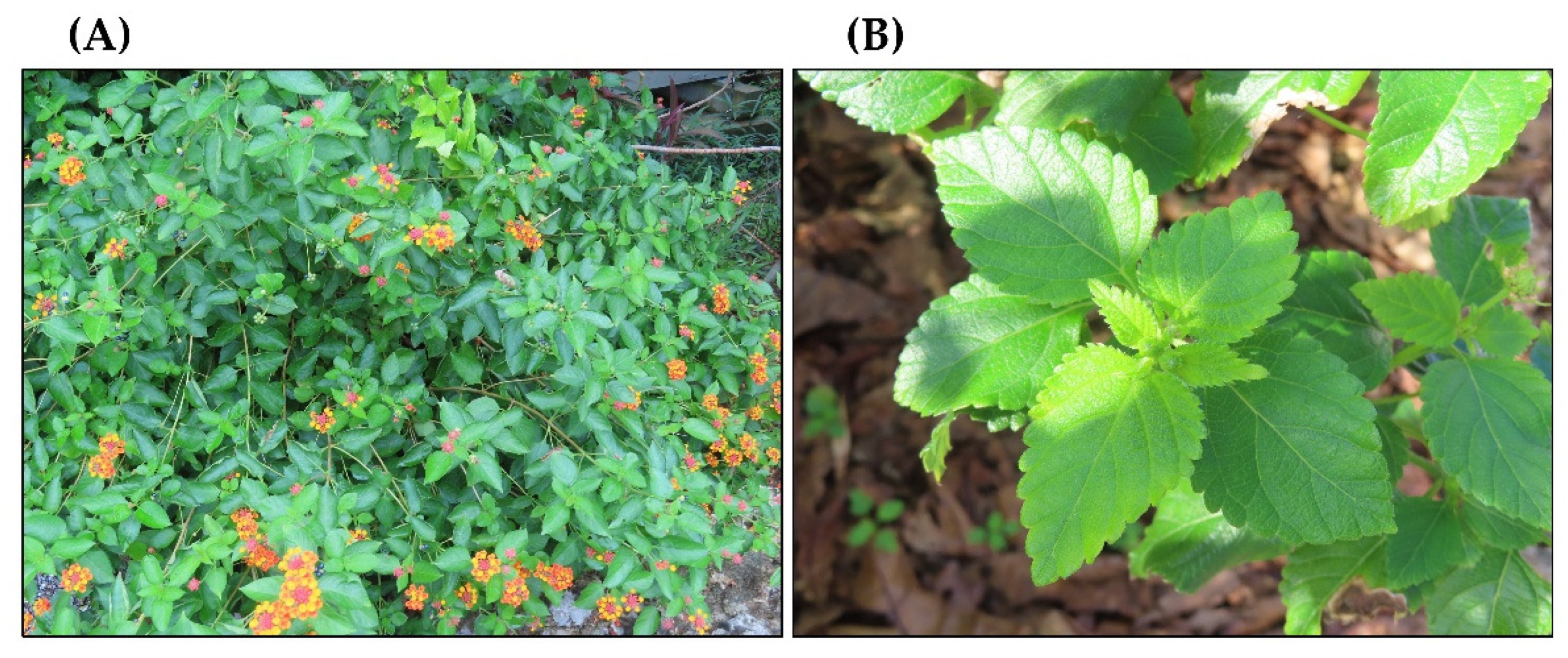
Figure 1: Lantana camara. (A): its monospecific stand. (B): its opposite leaves.
The rhizosphere soil of L. camara inhibited the germination and/or growth of Albizia lebbeck, Achyranthes aspera, Cicer arietinum, Avena sativa, Triticum aestivum, and Hordeum vulgare [36,37]. Residues from the shoots, leaves, and roots of L. camara also inhibited the growth of Bidens bipinnata, B. pilosa, Urena lobata, and Morrenia odorata [38,39]. A mixture of sand and chopped L. camara shoots inhibited the growth of Abutilon theophrasti, Lepidium virginicum, and T. aestivum [40]. Leachates from L. camara roots inhibited the germination of T. aestivum [41,42], and the growth of Cucurbita pepo, Lycopersicon esculentum, and Phaseolus vulgaris [43]. Leachates from L. camara leaves also inhibited the germination and growth of Mimosa pudica [44]. Additionally, soaking water from L. camara shoots was toxic to Eichhornia crassipes, ultimately killing it [45,46]. These findings suggest that L. camara contains allelochemicals that are released into rhizosphere soil through plant decomposition and leaching from plant parts by water.
Three cinnamic acid derivatives, including p-coumaric acid (1), caffeic acid (2), ferulic acid (3), and six benzoic acid derivatives, including salicylic acid (5), p-hydroxybenzoic acid (6), gentisic acid (7), α-resorcylic acid (8), β-resorcylic acid (9), and vanillic acid (12), were identified in the aqueous leaf extracts of L. camara [47] (Fig. 2). Cinnamic acid derivatives are synthesized from phenylalanine through the phenylpropanoid pathway in the cytoplasm of plant cells. The first intermediate in this pathway is cinnamic acid. The enzyme cinnamate 4-hydroxylase converts cinnamic acid into p-coumaric acid, which is then enzymatically converted into caffeic acid and ferulic acid [48,49,50,51]. Benzoic acid is produced from cinnamic acid via either a peroxisomal β-oxidative pathway or a mitochondrial non-β-oxidative pathway. Benzoic acid derivatives are typically synthesized by altering the aromatic ring or transforming functional groups on the existing benzoic acid skeleton [52].
These cinnamic acid and benzoic acid derivatives have been identified in various plant extracts [53,54]. Their involvement in plant allelopathy and modes of action have been investigated in many other plant species [55,56,57]. These compounds modify the protein and lipid profiles of the plasma membranes of target plant cells [52,56]. Consequently, the transmembrane electrochemical potential dissipates, leading to depolarization of the plasma membrane. This depolarization triggers indiscriminate leakage of various ions, including magnesium, potassium, phosphate, and nitrate, and alters cellular water homeostasis. These compounds also impair various enzymes involved in photosynthesis, protein synthesis, phytohormone synthesis, and secondary metabolism. Ultimately, this retards the proliferation and normal growth of plant cells [57,58,59]. Thus, the presence of these compounds in L. camara can alter the structural integrity of plasma membranes, disrupt the transmembrane electrochemical balance, and inhibit key metabolic enzymes in target plants.
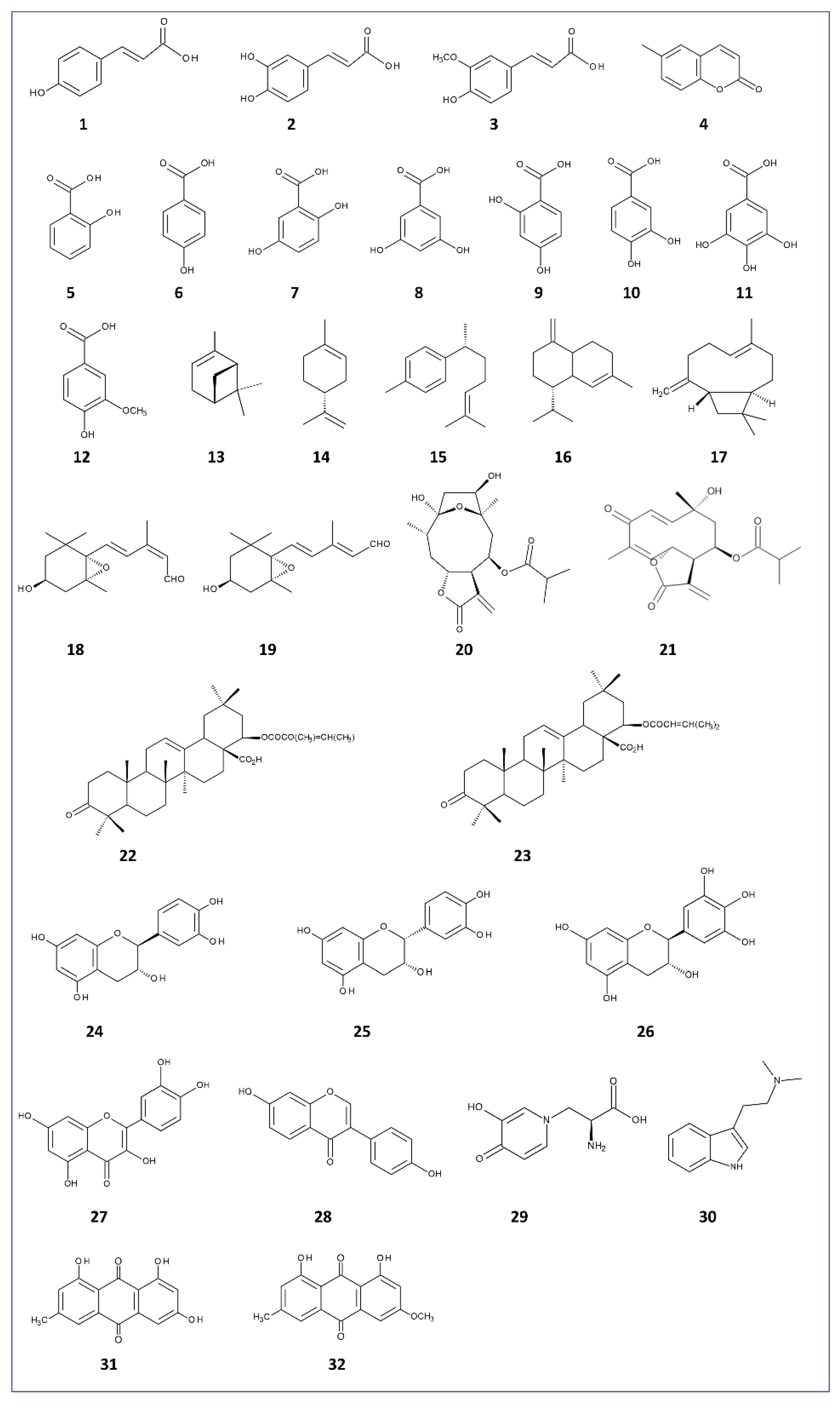
Figure 2: Allelochemicals identified in the invasive plants. Cinnamic acid derivatives; 1: p-coumaric acid, 2: caffeic acid, 3: ferulic acid, 4: methyl coumarin. Benzoic acid derivatives; 5: salicylic acid, 6: p-hydroxybenzoic acid, 7: gentisic acid, 8: α-resorcylic acid, 9: β-resorcylic acid, 10: protocatechuic acid. 11: gallic acid, 12: vanillic acid. Monoterpenes; 13: α-pinene, 14: limonene. Sesquiterpenes; 15: α-curcumene, 16: γ-muurolene, 17: β-caryophyllene, 18: cis,trans-xanthoxin, 19: trans,trans-xanthoxin. Sesquiterpene lactones; 20: tagitinin A, 21: tagitinin C. Pentacyclic triterpenoids; 22: lantadene A, 23: lantadene B. Flavonoids; 24: catechin, 25: epicatechin, 26: gallocatechin, 27: quercetin, 28: daidzein. Non-protein amino acid; 29: mimosine. Indole alkaloid; 30: gramine. Anthraquinones; 31: emodin, 32: physcion.
Research demonstrates that the essential oil from L. camara leaves suppresses the growth of Portulaca oleracea. This effect is primarily caused by three sesquiterpenes: α-curcumene (15), γ-muurolene (16), and β-caryophyllene (17) [60,61,62] (Fig. 2). As volatile agents, β-caryophyllene and α-humulene induce membrane damage in target plants, resulting in electrolyte leakage [63,64]. Additionally, β-caryophyllene has been reported to induce oxidative stress [65], and disrupt photosynthesis and water potential in target plants [66,67,68].
Two pentacyclic triterpenoids, lantadene A (22) and lantadene B (23) (Fig. 2), were identified in the leaves and rhizosphere soil of L. camara. Both compounds inhibited the growth of Eichhornia crassipes [69]. Lantadene A and lantadene B have been reported to act as defensive compounds against herbivores, causing cholestasis, hepatic necrosis, nephrosis, and jaundice [70]. However, the modes of action of lantadene A and lantadene B in allelopathy remain unknown.
These findings suggest that L. camara exhibits allelopathic properties by releasing allelochemicals, including cinnamic acid and benzoic acid derivatives, sesquiterpenes, and pentacyclic triterpenoids, into the rhizosphere and atmosphere through decomposition, leaching, and volatilization.
4 Allelopathy and Allelochemicals of Reynoutria japonica
Reynoutria japonica Houtt. (syn. Polygonum cuspidatum Siebold & Zucc.; Fallopia japonica (Houtt.) Ronse Decr.), is a bushy, perennial herb belonging to the Polygonaceae family. It is commonly known as Asian knotweed or Japanese knotweed and grows up to 3 m in height [71,72,73]. It branches well and forms monospecific stands [74]. The species is found in areas altered by human activity, including riverbanks, grasslands, pastures, forest margins, agricultural fields, roadsides, and other disturbed areas [74,75,76]. Originally from East Asia, it was widely introduced as an ornamental plant. This invasive species has spread to temperate regions of South Asia, North America, and Europe. It threatens native plant communities in these areas [73,74,77,78,79]. It has been listed among the world’s 100 worst invasive alien species [35] (Fig. 3).
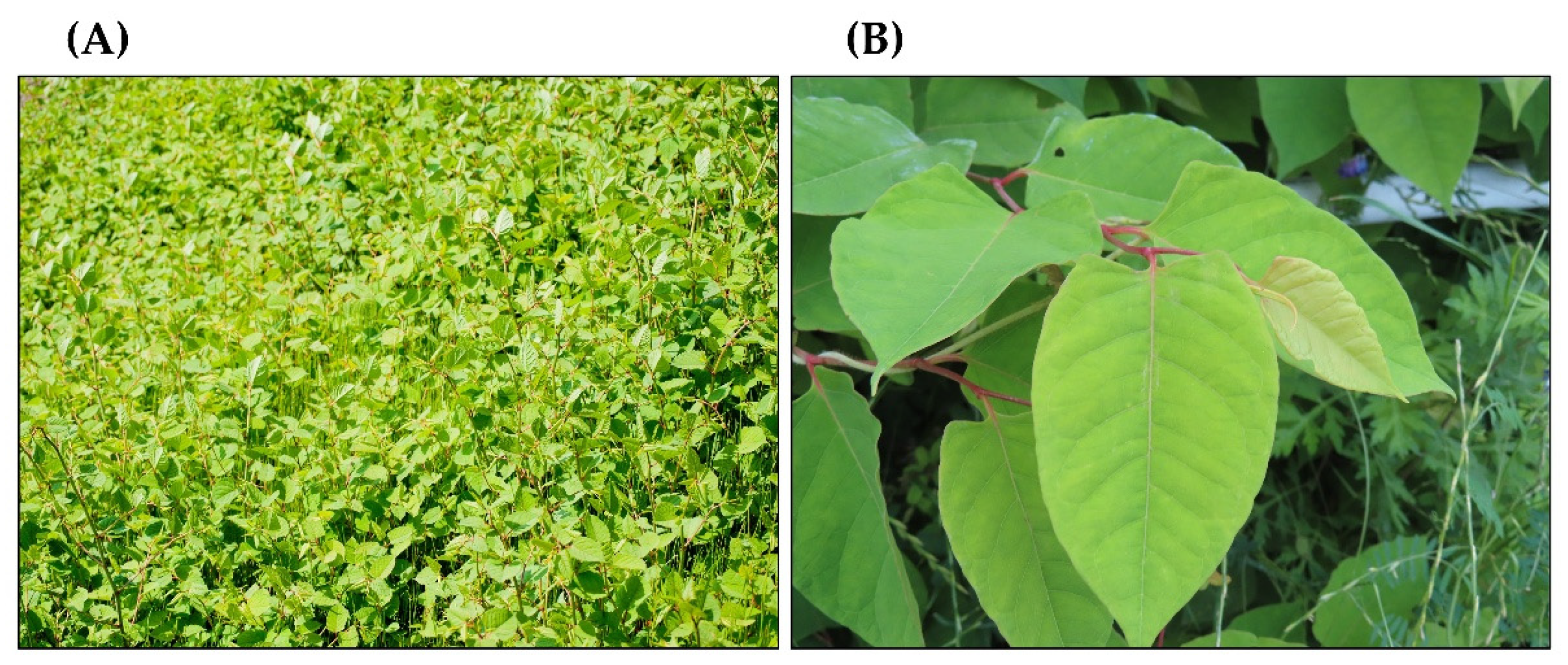
Figure 3: Reynoutria japonica. (A): its monospecific stand. (B): its alternate leaves.
Allelopathic property of R. japonica was confirmed using a donor-receiver bioassay. Test plants (Salix atrocinerea, S. viminalis, and Populus nigra) were irrigated with a mixture of nutrient solution and drain solution from R. japonica, and grown for four months. The growth of all the test plants was suppressed by the mixture solution [80]. The irrigated solution contained nutrients. Therefore, the inhibition may have been caused by allelochemicals in the drain solution from R. japonica. Considering this bioassay method, these allelochemicals may also be released through root exudation from R. japonica.
Reynoutria japonica is a perennial, but its above-ground parts die back in the winter [73]. These parts decay to form a litter layer. During the decomposition process, secondary metabolites are released into the rhizosphere soil where they act as allelochemicals [81,82,83]. Soil mixed with R. japonica leaves inhibited the germination of Brassica napus and Sinapis alba [84]. Soaking water from the senescent above-ground parts of R. japonica suppressed the germination of Triticum aestivum and Sinapis arvensis [85], suggesting that the water leachates contain allelochemicals. Aqueous extracts from the above-ground parts of R. japonica suppressed the germination of Calamagrostis epigejos, Urtica dioica, and Lactuca sativa [86], and the growth of Helianthus annuus, Avena sativa, and Brassica napus [87]. These findings suggest that R. japonica may contain allelochemicals that are released into the rhizosphere through decomposition and leaching.
Two flavonoids, catechin (24) and epicatechin (25) (Fig. 2), were identified in the roots and shoots of R. japonica [88,89,90]. These compounds have been found in various plants and are linked to allelopathic interactions [91,92,93,94]. Flavonoids regulate plant physiology by controlling auxin transport, driving shoot and root morphogenesis, and balancing reactive oxygen species. In allelopathic interactions, flavonoids significantly alter target root growth by suppressing ATP synthesis and interfering auxin pathways [95]. Plants also release certain flavonoids into the rhizosphere to modulate microbial dynamics [96]. The application of catechin and epicatechin initiated programmed cell death, which expanded from the root periphery to the stele. This propagation is likely driven by a calcium wave elicited by reactive oxygen species that disturbs ionic homeostasis and leads to cellular acidification [97,98,99].
Two anthraquinones, emodin (31) and physcion (32) (Fig. 2), were identified in the rhizosphere soil of R. japonica at concentrations of 55 and 30 mg per kg of dry soil, respectively. These compounds inhibited the growth of Lactuca sativa, Phleum pratense, and Amaranthus spp. at concentrations greater than 50–100 ppm in a laboratory setting [100]. While the pharmacological properties of these compounds are well-established, the mechanisms underlying their allelopathic effects remain unclear [101,102]. Furthermore, the activity of these compounds should be evaluated under field conditions with native plant species.
Reynoutria japonica is allelopathic and produces allelochemicals, such as catechin, epicatechin, emodin and physcion. These allelochemicals are released into the rhizosphere soil through decomposition, leaching, and root exudation.
5 Allelopathy and Allelochemicals of Leucaena leucocephala
Leucaena leucocephala (Lam.) de Wit is a small tree in the Fabaceae family. It is commonly known as white lead tree. It grows to a height of 3–20 m and has high biomass production. It reaches reproductive maturity within 4–12 months after germination and produces numerous viable seeds [103,104,105,106,107]. Originally from Mexico and Central America, it has been introduced to many subtropical and tropical regions for paper pulp and biochar production [108,109]. It is also used as a shade tree [110,111], as livestock fodder [112], and for erosion control [113,114,115]. However, L. leucocephala can easily spread to unintended areas. It forms monospecific stands in riparian zones, grasslands, forest edges, hillsides, and disturbed areas, including agricultural fields, abandoned land, and roadsides [116,117,118]. This species has spread to over 130 countries in warm temperate, subtropical, and tropical regions of South America, Southern Europe, South and East Asia, Africa, Australia, and the islands in the Caribbean, Indian, and Pacific Oceans [103,104,105,116]. Leucaena leucocephala negatively impacts native plant communities by reducing abundance and richness in infested areas [119,120]. Consequently, it is classified among the world’s 100 worst invasive alien species [35] (Fig. 4).
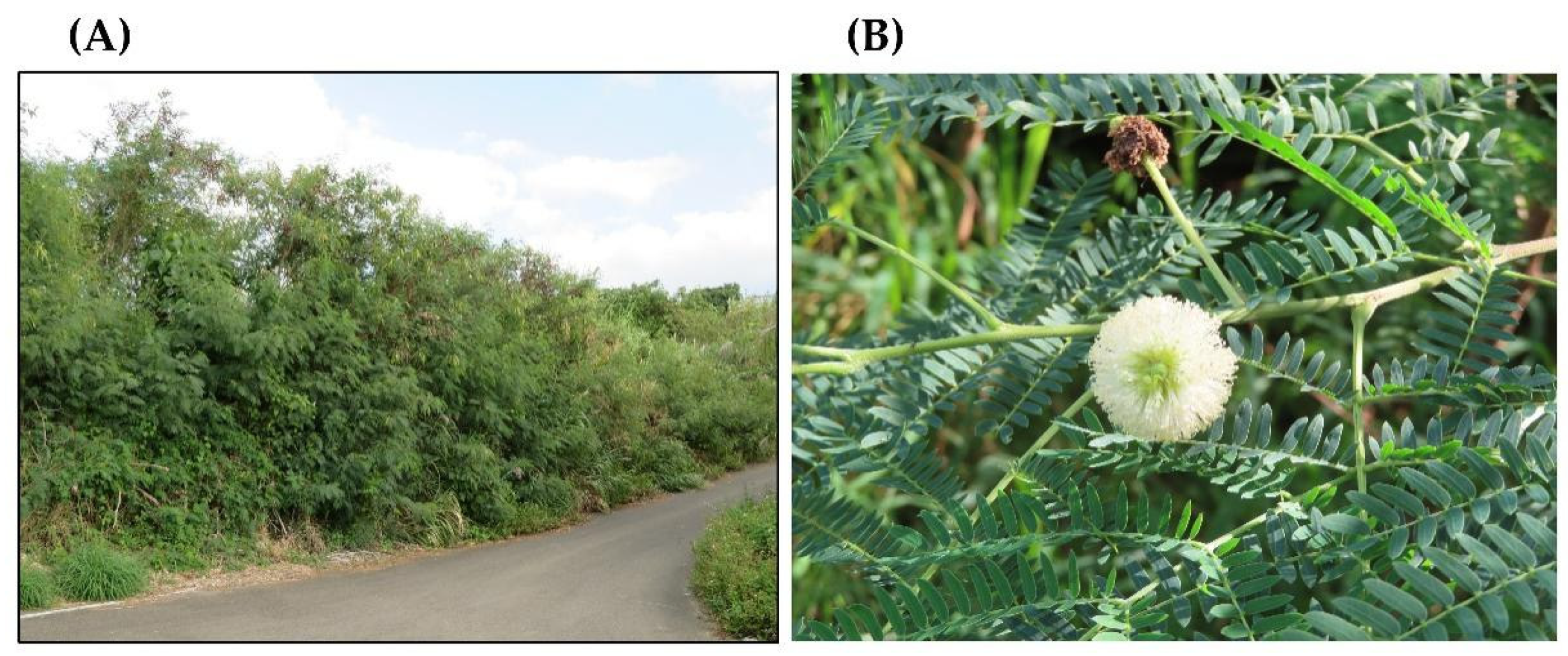
Figure 4: Leucaena leucocephala. (A): its monospecific stand along roadside. (B): its capitulum and alternate, bipinnate leaves.
Under controlled field conditions, the presence of L. leucocephala was observed to stunt the growth and survival of the woody plant species, Erythrina velutina [120]. Since typical resource competition was ruled out in the experimental setup, the finding suggests that allelopathy limits the growth and survival of E. velutina.
Soil samples taken beneath the L. leucocephala canopy and its leaf litter extracts significantly reduced the germination and early growth of Tridax procumbens, Emilia sonchifolia, and Ageratum conyzoides [121,122]. Incorporating its leaves and decomposed leaf litter into the soil inhibited the seedling growth of several tree species, including Albizia procera, Liquidambar formosana, Mimosa pudica, Acacia confusa, Casuarina glauca, and Alnus formosana [121,123]. Root exudates from L. leucocephala also inhibited the germination and growth of T. procumbens, E. sonchifolia, and A. conyzoides [122]. These findings suggest that allelochemicals likely enter the rhizosphere soil through root exudation and litter decomposition. Additionally, aqueous extracts from the aerial parts of L. leucocephala inhibited the growth of Bidens pilosa, Amaranthus hybridus, T. procumbens, E. sonchifolia, and A. conyzoides in both laboratory and greenhouse settings [124,125,126]. Thus, these extracts may contain allelochemicals.
Mimosine (29) (Fig. 2), a non-protein amino acid, is recognized as an allelochemical in L. leucocephala due to its ability to suppress the growth of various plants [121,127,128]. At a concentration of 100 ppm, mimosine suppressed the growth of Mimosa pudica, Bidens pilosa, Lolium multiflorum, Brassica rapa, and Phaseolus vulgaris by 31–93% for their shoots and 40–95% for their roots, respectively [129]. Mimosine also suppressed the growth of the shoots and roots of Sesbania herbacea and Senna obtusifolia [130], and T. procumbens, E. sonchifolia, and A. conyzoides [131]. Mimosine inhibits plant growth by disrupting cell division. This is evidenced by its suppression of rooting in Allium cepa [132], cell arrest between the G1 and S phases in Petunia hybrida protoplasts [133], and its effect on the phytoplankton Rhodomonas salina [134]. However, exogenously applied mimosine has been reported not to significantly inhibit the growth of L. leucocephala [129]. Leucaena leucocephala contains mimosinase, an enzyme responsible for mimosine degradation, which exhibits significantly high gene expression [135,136,137]. Consequently, mimosinase-driven degradation of mimosine could mitigate its toxicity to the host plant.
Aqueous extracts of L. leucocephala aerial parts stimulated the activity of peroxidase in Zea mays roots [126]. Similarly, its aqueous leaf extracts induced the activity of key antioxidant enzymes, ascorbate peroxidase and catalase, in Eichhornia crassipes leaves, while promoting electrolyte leakage from cell membranes [138]. These enzymes are known to be upregulated in plants subjected to oxidative stress. Oxidative stress alters the physiological and structural processes of plant cells, particularly those of the plasma membrane [139,140,141,142,143]. Mimosine triggered necrotic cell death and caused structural damage to cytoplasmic organelles in the root meristem of Allium cepa. Mimosine also increased superoxide dismutase and catalase activities, as well as malondialdehyde levels in root cells [132], suggesting that it may induce oxidative stress in root cells. This results in abnormal cytoplasmic organelles and necrosis [144,145,146]. Consequently, mimosine can trigger oxidative stress in target plants, disrupting their physiology and cellular structures.
Mimosine is highly concentrated throughout L. leucocephala plants. On a dry-weight basis, concentrations ranged from 2.4–13.6% (mature seeds), 0.47–8.6% (leaves), 1.2–2.7% (flowers), 0.15–0.68% (stems), and 0.16–0.66% (roots) [129,147,148]. Mimosine levels increased during germination and seedling development. Levels started at 3.9% in seeds and increased to 6.9% in six-day-old seedlings. Levels then reached 15.2% in two-week-old seedlings [148,149]. This progressive accumulation provides clear evidence that mimosine is synthesized de novo during these early developmental stages. In L. leucocephala, mimosine is synthesized by mimosine synthase from 3-hydroxy-4-pyridone and O-acetyl-L-serine [150,151]. O-acetyl-L-serine is catalyzed by serine acetyltransferase from serine and acetyl-CoA [150,151,152,153]. However, the biosynthesis pathway of 3-hydroxy-4-pryridone in L. leucocephala remains unknown.
Seedlings of L. leucocephala secreted mimosine into the growth medium at a daily rate of 1–5 μg per g of dry plant weight [154]. Mimosine accumulated in the soil at a concentration of 7.4 μg per g of dry soil weight [155]. These findings suggest that L. leucocephala releases mimosine into its rhizosphere soil. As previously mentioned, L. leucocephala tissues are rich in mimosine. It is also likely released into the soil through the decomposition of plant residues, resulting in its buildup. However, the concentration of mimosine in the soil, along with its specific activity, may not fully explain the allelopathic activity of L. leucocephala. Therefore, other compounds may be involved in the allelopathy of L. leucocephala.
The application of jasmonic acid and ethylene promotes mimosine biosynthesis in L. leucocephala seedlings [156]. Salicylic acid, UV irradiation, physical wounding, and sodium chloride (NaCl) stress also increase mimosine accumulation in these seedlings [148,156,157]. Jasmonic acid, ethylene, and salicylic acid are plant hormones that act as stress signaling molecules, triggering the transcription of stress-responsive genes [158,159,160,161,162]. These findings suggest that stress signaling molecules and environmental stressors, such as UV irradiation, physical wounding, and NaCl, may promote mimosine synthesis in L. leucocephala. Therefore, stress conditions caused by competition with neighboring plants may also increase the production of mimosine, enhancing the allelopathic activity and competitive ability of L. leucocephala against these plant species.
Gallocatechin (26) (Fig. 2), a flavonoid and the primary active agent in the methanol extracts of L. leucocephala roots, has been shown to suppress soil nitrification [163]. Nitrification is an essential mechanism that drives nitrogen cycling in ecosystems [164,165]. The exact mechanism is unclear, but gallocatechin from L. leucocephala may interfere with nitrification by inhibiting bacterial activity. Reduced nitrification decreases soil nitrate levels, thereby suppressing the growth of neighboring vegetation. Conversely, L. leucocephala stands have been shown to enrich soil nitrogen pools through symbiotic nitrogen fixation [166,167]. Future studies should assess the amount of available nitrogen in the soil under the L. leucocephala canopy.
Three cinnamic acid derivatives, such as p-coumaric acid (1), caffeic acid (2), and ferulic acid (3), and four benzoic acid derivatives, such as p-hydroxybenzoic acid (6), protocatechuic acid (10), gallic acid (11), and vanillic acid (12) (Fig. 2), have been identified in L. leucocephala leaves [121]. As described in the section on L. camara, these compounds function as allelochemicals.
A review of the literature revealed that L. leucocephala exhibits allelopathic effects due to the presence of allelochemicals, including mimosine, gallocatechin, and cinnamic acid and benzoic acid derivatives. The plant releases mimosine into rhizosphere soil through root exudation. Additionally, the decomposition of its plant residues contributes to its accumulation in the soil. Gallocatechin suppresses nitrification in soil. Cinnamic acid and benzoic acid derivatives suppress the growth of neighboring plants. Consequently, L. leucocephala outcompetes other species for resources, which boosts its growth and population size.
6 Allelopathy and Allelochemicals of Bidens pilosa
Bidens pilosa L. is an annual herb in the Asteraceae family. It grows to a height of 20–180 cm and forms thick, monospecific stands [168,169,170,171,172]. It can grow in various habitats, including secondary forests, forest edges, grasslands, wetlands, streams, coastal areas, agricultural fields, pastures, railway lines, and roadsides [168,169,170,173,174]. Originally from subtropical and tropical America, this plant was widely introduced for ornamental purposes. Since then, it has become highly invasive, spreading across warm temperate, subtropical and tropical regions in Europe, Asia, North and South America, Australia, and Africa. Bidens pilosa has significant negative impacts on agriculture and natural ecosystems [169,170,171,172,173,174,175,176]. It is listed as an invasive plant that threatens the environment in over 40 countries [169,170,173,174,175] (Fig. 5).
The growth of Cyperus rotundus was inhibited by field soils obtained under B. pilosa stands [177], suggesting the presence of allelochemicals in the soil. Incorporating the chopped leaves and above-ground parts of B. pilosa into the soil inhibited the germination and growth of several spontaneous weed species and C. rotundus under field and greenhouse conditions [177,178,179]. Root exudates from B. pilosa suppressed the growth of Leucaena leucocephala, Echinochloa crus-galli, and several crop species, including Medicago sativa, Lactuca sativa, Oryza sativa, Zea mays, and Sorghum bicolor [180,181]. Its root exudates also inhibited the spore germination, growth, and photosynthesis of the fern Pteris multifida [182,183]. However, adding activated carbon to the soil significantly reduced growth inhibition [177]. Activated carbon can absorb various compounds, including allelochemicals, which renders them ineffective [184,185]. These findings suggest that allelochemicals are released into the soil from B. pilosa through root exudation and plant decomposition. Additionally, aqueous extracts from various parts of B. pilosa, such as the stems, leaves, and roots inhibited the germination and growth of several weeds, including Amarantus dubius [186], Ageratum conyzoides [187], E. crus-galli, E. coloa, Ludwigia chinensis, L. hyssopifolia, Sphenoclea zaylania, Cyperus iria, Fimbristylis dichotoma, and Fimbristylis milacea [179,188]. These results suggest that the allelochemicals in B. pilosa are extractable.
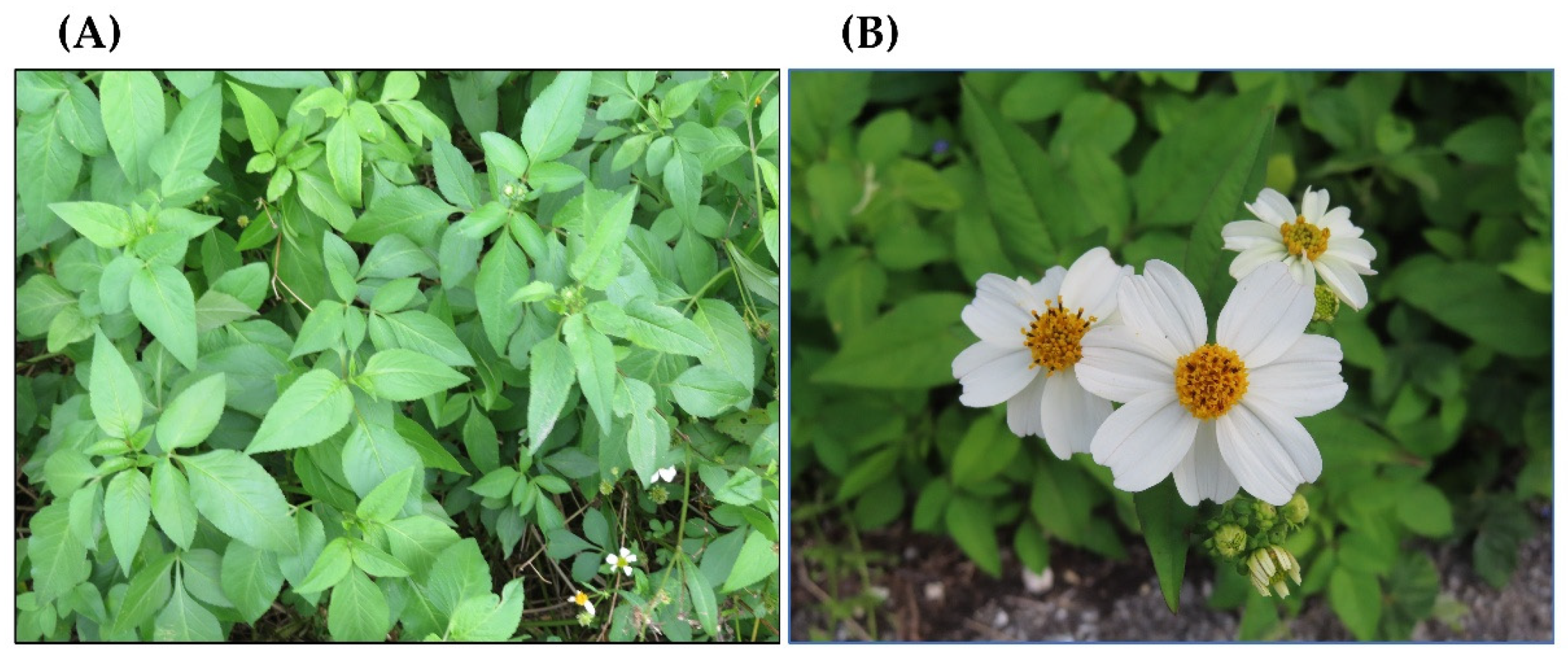
Figure 5: Bidens pilosa. (A): its monospecific stand. (B): its capitula.
Cinnamic acid derivatives, p-coumaric acid (1), caffeic acid (2), and ferulic acid (3), and benzoic acid derivatives, salicylic acid (5), p-hydroxybenzoic acid (6), and vanillic acid (12) were identified in the boiling water extracts of the stems, leaves, and roots of B. pilosa [189]. A flavonoid, quercetin (27) (Fig. 2), was identified from B. pilosa leaf extracts [190]. Quercetin inhibits growth and mitochondrial function in several plant species as an allelochemical [191,192]. Several monoterpenes were identified in the essential oil of B. pilosa [193]. Among these monoterpenes, α-pinene (13) and limonene (14) were reported to exhibit allelopathic activity as volatile agents [194]. These monoterpenes reduce chlorophyll levels and cellular respiration in target plants, indicating that they disrupt photosynthesis and energy metabolism [195,196].
Bidens pilosa is allelopathic, releasing allelochemicals, such as cinnamic acid and benzoic acid derivatives, quercetin, α-pinene, and limonene into the rhizosphere and atmosphere through decomposition, leaching, and volatilization. These allelochemicals may contribute to B. pilosa infestation by suppressing the germination and growth of neighboring plant species within its introduced ranges.
7 Allelopathy and Allelochemicals of Tithonia diversifolia
Tithonia diversifolia (Hemsl.) A. Gray is a bushy, perennial herb belonging to the Asteraceae family. It is commonly known as Mexican sunflower, Nitobe chrysanthemum, or tree marigold. It can grow up to 4 m in height and branches well. It often forms high-density, monospecific stands of 8–20 plants/m2 in grasslands, forest edges, riverbanks, and other disturbed areas, including pastures, agricultural fields, abandoned places, and roadsides [197,198,199,200,201,202,203]. Originally from Mexico and Central America, it was introduced for landscaping, green manure, and as an incidental contaminant in agricultural seeds [203,204]. This highly invasive species has spread across warm temperate, subtropical, and tropical regions globally, including South America, Southeast Asia, Africa, Australia, and various islands in the Indian and Pacific Oceans [197,198,199,200,201,202,203]. Tithonia diversifolia infestation negatively impacts the abundance and diversity of native plant communities [198,199,200,201,204,205] (Fig. 6).
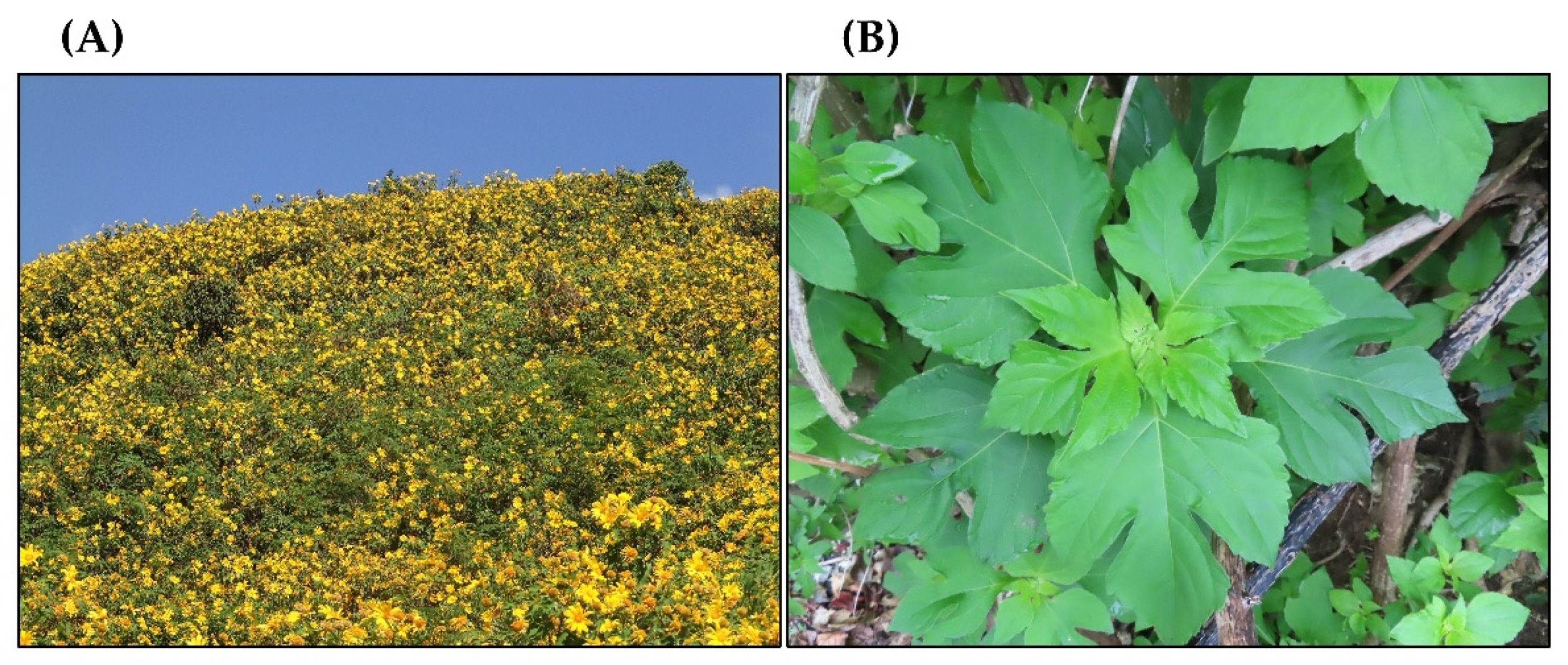
Figure 6: Tithonia diversifolia. (A): its monospecific stand. (B): its alternate lobe leaves.
Field soil obtained from under T. diversifolia stands inhibited the germination of Bidens pilosa, Euphorbia heterophylla, Acanthospermum hispidum, Pennisetum polysachyum, and Panicum maximum [206] and the growth of Amaranthus viridis, Cyperus iria, and Digitaria ciliaris [207]. Aqueous extracts of T. diversifolia soil also inhibited the growth of A. viridis, C. iria, and D. ciliaris [208]. Soil mixed with T. diversifolia leaves suppressed the germination and growth of Abelmoschus esculentus [209]. Root exudates from T. diversifolia suppressed the germination and growth of Amaranthus dubius [210]. These findings suggest that T. diversifolia releases allelochemicals into the soil through root exudation and decomposition.
Aqueous extracts of T. diversifolia shoots have been shown to inhibit the germination and growth of Tridax procumbens [211], Amaranthus cruentus [212], and B. pilosa [213]. These extracts have also been found to hinder the growth and leaf development of the woody plants; Monodora tenuifolia, Dialium guineense, and Hildegardia barteri, under field conditions [214]. Aqueous methanol extracts of T. diversifolia leaves inhibited the growth of Phleum pratense, Lolium multiflorum, and Echinochloa crus-galli [215]. These findings suggest that allelochemicals in T. diversifolia can be extracted from its shoots and leaves using water or methanol.
To identify allelochemicals in T. diversifolia, the leaves were extracted with an aqueous methanol and subjected to a bioassay-guided separation process. The allelopathic activity of each chromatography fraction was determined during this process. The most active fraction the proceeded to the next chromatographic step. This process resulted in the isolation of a sesquiterpene lactone, tagitinin C, which inhibited the growth of P. pratense, L. multiflorum, and E. crus-galli. These test plants required 0.35–0.83 mM of tagitinin C to inhibit growth by 50% [215]. Tagitinin A (20) and tagitinin C (21) (Fig. 2) were identified as primary sesquiterpene lactones in T. diversifolia. These compounds inhibited the growth of Lactuca sativa, Lepidium sativum, Solanum lycopersicum, and Allium cepa in a concentration-dependent manner [216,217]. Tagitinins, especially tagitinin C, disrupt cell division and induce programmed cell death in several cancer cell lines [218,219]. However, the mode of action of tagitinins on plants remains unclear.
Tithonia diversifolia releases allelochemicals into the soil under its stands through root exudation and decomposition. Two sesquiterpenes, tagitinin A and tagitinin C, have been identified in T. diversifolia as allelochemicals. These allelochemicals give T. diversifolia a competitive advantage as an invasive plant species. However, it is unclear whether T. diversifolia produces other allelochemicals.
8 Allelopathy and Allelochemicals of Arundo donax
Arundo donax L. is a perennial grass in the Poaceae family that resembles bamboo. It is commonly known as giant cane or giant reed. Originally from the Middle East and East Asia [220,221,222,223], this species has been cultivated in the Mediterranean region since ancient times for woodwind reeds and various household and construction items [224,225]. However, genetic analyses have identified it as an invasive archaeophyte in the Mediterranean region [226,227,228]. The species grows in large, monospecific stands in riparian zones including floodplains, riverbanks, and streams. It can switch from aerobic respiration to alternate anaerobic respiration. This process produces supplemental energy [229,230,231,232,233]. It also grows on hillsides, in agricultural fields, and along roadsides [224,225]. This invasive species has spread to over 100 countries in warm temperate, subtropical, and tropical regions across Europe, North and South America, Oceania, and Africa. It threatens native plant communities in these areas [231,232,233]. Due to the severe threat it poses to native plant ecosystems, this species is included on the list of the world’s 100 worst invasive alien species [35] (Fig. 7).
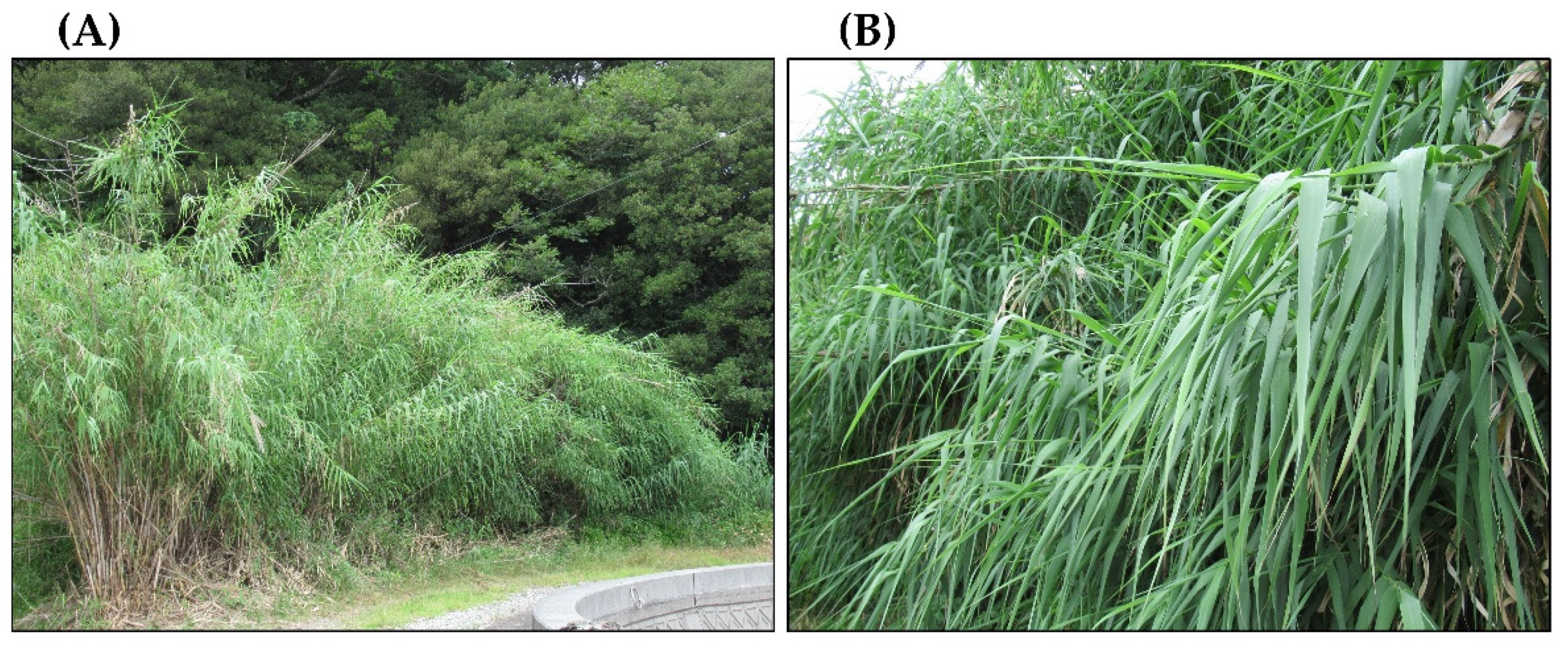
Figure 7: Arundo donax. (A): its monospecific stand. (B): its distichous phyllotaxis leaves.
The allelopathic properties of A. donax have been determined in its various extracts. Aqueous extracts of its leaves and/or rhizomes have been shown to inhibit the growth of the crop plant Lens culinaris, the forage grass Megathyrsus maximus, and the woody plants Guazuma ulmifolia, Handroanthus impetiginosus, Eriotheca pubescens, Parkia platycephala, and Pseudobombax tomentosum [234,235].
An indole alkaloid, gramine (30) (Fig. 2), has been identified in methanol extracts of A. donax as an inhibitory substance against the growth of the flagellated alga, Prymnesium parvum [236]. Gramine has been identified in several other plant species and has been reported to act as a defensive compound against insect herbivores and fungal pathogens [237]. Various alkaloids, including bufotenidine and 2,2,4,4-tetramethyl-N,N-bis(2,6-dimethylphenyl)-cyclobutane-1,3-diamine, have also been identified in A. donax. These compounds also act as defense mechanisms against insect herbivores and fungal pathogens [238,239]. As described above, A. donax exhibits allelopathic effects against crops, a forage grass, and woody plants. However, the specific allelochemicals responsible for inhibiting terrestrial plants have not yet been identified. Therefore, identifying these allelochemicals is crucial to understanding its allelopathic mechanisms.
9 Allelopathy and Allelochemicals of Pueraria montana var. lobata
Pueraria montana var. lobata (Willd.) Maesen & S.M.Almeida ex Sanjappa & Predeep (hereafter, Pueraria montana) is a perennial vine in the Fabaceae family. It is commonly known as kudzu vine or East Asian arrowroot. It can exceed 20 m in length, branch extensively, and overgrow other vegetation [240,241,242,243,244]. This highly adaptable species is commonly found in shrubby terrain, slopes, ecotones, riparian zones, transportation corridors, agricultural fields, and various disturbed ecosystems [241,242,243,244,245]. Originally from East Asia, it was widely introduced for ornamental purposes, soil erosion control, manufacturing, and as a high-nitrogen forage [246,247,248]. This invasive species has spread to temperate and subtropical regions in Europe, South Asia, Oceania, North and South America, and Africa. It threatens native plant communities in these areas [240,241,242,244,249]. Due to its negative impact on native plant communities, it has been listed among the world’s 100 worst invasive alien species [35] (Fig. 8).
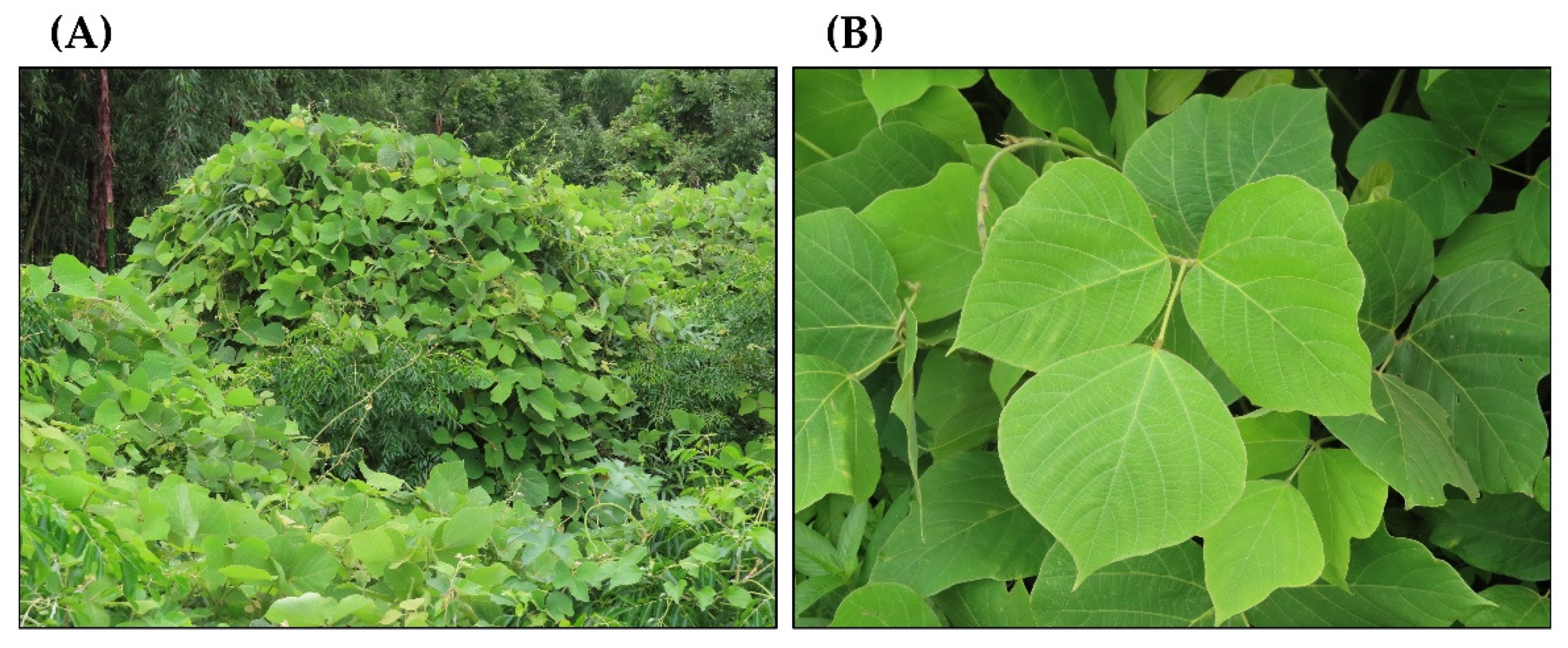
Figure 8: Pueraria montana var. lobata. (A): claiming on the other vegetation. (B): its trifoliate leaves.
The rhizosphere soil of P. montana inhibited the growth of Lolium perenne and Raphanus sativa. Soil mixed with aqueous extracts of P. montana residue also inhibited the germination of L. perenne and Bidens pilosa [250,251]. A mixture of sand and leaf powder of P. montana inhibited the germination and growth of Phleum pratense and Lolium multiflorum [252]. Two sesquiterpenes, cis,trans-Xanthoxin (18) and trans,trans-xanthoxin (19) (Fig. 2), have been identified as allelochemicals in P. montana leaves [253]. cis,trans-Xanthoxin has been reported to metabolize into the plant hormone, abscisic acid, in cell-free systems and in some plants. However, this has not been observed for trans,trans-xanthoxin [254,255,256]. cis,trans-Xanthoxin and trans,trans-xanthoxin have been reported to inhibit the growth of several plant species [257,258], suggesting that both xanthoxins may act as allelochemicals. p-Coumaric acid (1) and caffeic acid (2) (Fig. 2) have been identified in P. montana roots [259]. As described in the section on L. camara, caffeic acid and p-coumaric acid have been reported to act as allelochemicals [260].
The growth of Lactuca sativa protoplasts was significantly suppressed by incubation with P. montana protoplasts [260]. Daidzein (28) (Fig. 2), the primary flavonoid found in P. montana leaves, disrupts cell division and cell wall formation in L. sativa protoplasts [260,261]. Therefore, daidzein from P. montana suppresses the growth of L. sativa protoplasts.
Pueraria montana exhibits allelopathic properties by exuding allelochemicals, including xanthoxins, daidzein and cinnamic acid derivatives. These compounds are released into its rhizosphere soil through decomposition. These allelochemicals may contribute to the invasive nature of P. montana.
Alien plants must engage in competition with native plant species for limited ecological niches and essential resources: sunlight, nutrients, and moisture. An elevated competitive edge improves their chances of survival [8,9,10,11]. Allelopathy confers a significant competitive advantage in interspecific interactions [15,16,17,18,19,20]. To study the invasiveness of plants through the lens of allelopathic strategies, we examined seven prominent invasive species: L. camara (Verbenaceae), R. japonica (Polygonaceae), L. leucocephala (Fabaceae), B. pilosa (Asteraceae), T. diversifolia (Asteraceae), A. donax (Poaceae), and P. montana var. lobata (Fabaceae). Each plant species produces a unique set of allelochemicals, including cinnamic acid derivatives, benzoic acid derivatives, monoterpenes, sesquiterpenes, sesquiterpene lactones, pentacyclic triterpenoids, flavonoids, a non-protein amino acid, indole alkaloids, and anthraquinones (Table 1).
Table 1: Allelochemicals identified in invasive plant species and their release routes and concentrations in soil.
| Species (Family) | Native Range | Identified Allelochemicals (Compound No. in Fig. 2) | Release Routes | Allelochemicalsi n Soil |
|---|---|---|---|---|
| Lantana camara (Verbenaceae) | Mexico, tropical America | Cinnamic acid derivatives; p-coumaric acid (1), caffeic acid (2), ferulic acid (3). Benzoic acid derivatives; salicylic acid (5), p-hydroxybenzoic acid (6), gentisic acid (7), α-resorcylic acid (8), β-resorcylic acid (9), vanillic acid (12). Sesquiterpenes; α-curcumene (15), γ-muurolene (16), β-caryophyllene (17). Pentacyclic triterpenoids; lantadene A (22), lantadene B (23). | Decomposition, leaching, volatilization. | Not available |
| Reynoutria japonica (Polygonaceae) | East Asia | Flavonoids; catechin (24), epicatechin (25). Anthraquinones; emodin (31), physcion (32). | Decomposition, leaching, root exudation. | Emodin: 55 mg/kg dry soil. Physcion: 30 mg/kg dry soil. |
| Leucaena leucocephala (Fabaceae) | Mexico, Central America | Cinnamic acid derivatives; p-coumaric acid (1), caffeic acid (2), ferulic acid (3). Benzoic acid derivatives; p-hydroxybenzoic acid (6), protocatechuic acid (10), gallic acid (11), vanillic acid (12). Flavonoid; gallocatechin (26). Non-protein amino acid; mimosine (29). | Decomposition, root exudation. | Mimosine: 7.4 μg/g dry soil. Its root exudation: 1–5 μg/g dry plant/day. |
| Bidens pilosa (Asteraceae) | Sub- & tropical America | Cinnamic acid derivatives; p-coumaric acid (1), caffeic acid (2), ferulic acid (3). Benzoic acid derivatives; salicylic acid (5), p-hydroxybenzoic acid (6), vanillic acid (12). Monoterpenes; α-pinene (13), limonene (14). Flavonoid; quercetin (27). | Decomposition, leaching, volatilization. | Not available |
| Tithonia diversifolia (Asteraceae) | Mexico, Central America | Sesquiterpene lactones; tagitinin A (20), tagitinin C (21). | Decomposition, root exudation. | Not available |
| Arundo donax (Poaceae) | Middle East, East Asia | Indole alkaloid; gramine (30). Allelochemicals against terrestrial plants have not yet been identified. | Not available | Not available |
| Pueraria montana var. lobata (Fabaceae) | East Asia | Cinnamic acid derivatives; p-coumaric acid (1), caffeic acid (2). Sesquiterpenes; cis,trans-xanthoxin (18), trans,trans-xanthoxin (19). Flavonoid; daidzein (28). | Decomposition | Not available |
These allelochemicals demonstrate allelopathic capabilities and enter the surrounding environment, including the rhizosphere, through root exudation, decomposition, leaching, and volatilization. Cinnamic acid and benzoic acid derivatives alter the protein and lipid profiles of the plasma membranes of target plant cells [52,56] and impair enzymes involved in photosynthesis, protein synthesis, phytohormone synthesis, and secondary metabolism [57,58,59]. Sesquiterpenes, such as α-curcumene, γ-muurolene, and β-caryophyllene, cause electrolyte leakage in cell membranes [63,64], and disrupt photosynthesis and water potential in target plants [66,67,68]. Flavonoids significantly alter target root growth by suppressing ATP synthesis and interfering with auxin pathways [95]. Among flavonoids, catechin and epicatechin initiate programmed cell death [97,98,99] and gallocatechin suppresses soil nitrification [163]. Monoterpenes, such as α-pinene and limonene reduce chlorophyll levels and cellular respiration in target plants, indicating that they disrupt photosynthesis and energy metabolism [195,196]. Mimosine inhibits plant growth by disrupting cell division between the G1 and S phases [133] (Table 1).
Allelochemicals cannot stunt the growth of target plants unless they are released into the environment, including the rhizosphere, and reach certain concentrations [262,263,264,265]. Otherwise, these allelochemicals are unable to suppress the germination and growth of target plants in a natural environment [266,267,268]. Many allelochemicals have been isolated and identified in the tissues of invasive plant species. The exact release rates and concentrations of most of these allelochemicals in ecosystems remain unclear. The concentrations in the soil were determined to be 55 and 30 mg per kg of dry soil for emodin and physcion, respectively [100], and 7.4 μg per g of dry soil weight for mimosine [155]. However, the allelopathic activity of emodin and physcion was determined only under laboratory conditions (Table 1). Considering the inhibitory activity, mimosine alone cannot explain the allelopathic activity of L. leucocephala. Additionally, allelochemicals are often only tested for their effects on the germination and growth of crop plants in a laboratory setting rather than in a field setting with native plant species. To fully understand allelopathic interactions between invasive and native plant species in introduced ecosystems, future research must investigate the release rates and concentrations of allelochemicals in the environment, including the rhizosphere, as well as the fate of these chemicals in the environment. Allelopathy refers to the chemical interactions through a donor plant species affects the germination and growth of neighboring plants. Many allelopathy studies, however, have not adequately addressed competition for resources in their experimental designs. Because competitive interactions also affect the germination and growth of neighboring plants [269,270,271], future research must strictly distinguish the effects of chemical interactions from resource competition in both laboratory and field studies.
Additionally, high extract concentrations alter the osmotic potential and pH of the bioassay solutions, thus, plant extract bioassays conducted at high concentrations often carry potentially confounding osmotic and pH effects that can independently suppress growth. However, separating controls (such as activated carbon or osmotic adjustments) have been reported in only a minority of the cited studies [184,185]. Furthermore, a clear dose-response structure is largely absent across the literature, with tagitinin C being the sole compound for which an IC50 value is provided [215]. Consequently, there is currently no established threshold against which field concentrations can be reliably evaluated to confirm actual chemical interference in natural ecosystems.
Phytochemical analyses and pharmacological studies have revealed that these invasive plant species contain various secondary metabolites, including terpenoids, benzenoids, flavonoids, polyphenols, steroids, alkaloids, and quinones. Many of these compounds are responsible for their diverse pharmacological properties, including anti-inflammatory, anticarcinogenic, antiviral, antidiabetic, and antipyretic activities [272,273,274,275,276,277]. While the majority of these compounds have not yet been linked to the allelopathy of the respective species, some may play a role in this chemical interference.
The novel weapon hypothesis, states that alien plants gain a competitive advantage in new environments because their allelochemicals suppress native species more effectively than in their home environments. Plants in their home environments often develop tolerance to local allelochemicals through long-term coevolution. However, native species in newly invaded ecosystems lack this historical exposure. Consequently, they miss the opportunity to acquire these defensive traits, leaving them highly vulnerable to these allelochemicals [278,279,280]. The invasive plant species discussed in this review may gain a competitive advantage in their introduced environments by releasing allelochemicals that suppress the germination and growth of competing plant species. However, it is necessary to evaluate the activity of these allelochemicals in both the native and introduced ranges of these invasive plants.
All invasive species exhibit significant allelopathic capabilities and produce unique sets of allelochemicals, which include cinnamic acid derivatives, benzoic acid derivatives, monoterpenes, sesquiterpenes, sesquiterpene lactones, pentacyclic triterpenoids, flavonoids, a non-protein amino acid, indole alkaloids, and anthraquinones. These compounds can be released into the surrounding environment, including the rhizosphere, through root exudation, decomposition, leaching, and volatilization. Through this process, these invasive plant species may gain a competitive advantage over native vegetation in their introduced ranges, allowing them to propagate and adapt to non-native ecosystems. However, soil concentrations have only been determined for emodin and physcion (from R. japonica) and mimosine (from L. leucocephala). The concentrations of other allelochemicals must be determined to evaluate their specific contributions to plant invasion mechanisms.
Acknowledgement:
Funding Statement: The authors received no specific funding for this study.
Author Contributions: Midori Kato and Hisashi Kato-Noguchi: conception and design of the review, screening of papers. Midori Kato: writing original draft preparation. Hisashi Kato-Noguchi: review and editing. All authors reviewed and approved the final version of the manuscript.
Availability of Data and Materials: Not applicable.
Ethics Approval: Not applicable.
Conflicts of Interest: The authors declare that they have no conflicts of interest.
References
1. Richardson DM , Pyšek P . Plant invasions: Merging the concepts of species invasiveness and community invasibility. Progr Phys Geogr. 2006; 30( 3): 409– 31. doi:10.1191/0309133306PP490PR. [Google Scholar] [CrossRef]
2. Briski E , Chan FT , Darling JA , Lauringson V , MacIsaac HJ , Zhan A , et al. Beyond propagule pressure: Importance of selection during the transport stage of biological invasions. Front Ecol Environ. 2018; 16( 6): 345– 53. doi:10.1002/FEE.1820. [Google Scholar] [CrossRef]
3. Simberloff D . The role of propagule pressure in biological invasions. Annu Rev Ecol Evol Syst. 2009; 40( 6): 81– 102. doi:10.1146/ANNUREV.ECOLSYS.110308.120304. [Google Scholar] [CrossRef]
4. Richardson DM , Pyšek P . Naturalization of introduced plants: Ecological drivers of biogeographical patterns. New Phytol. 2012; 196( 2): 383– 96. doi:10.1111/J.1469-8137.2012.04292.X. [Google Scholar] [CrossRef]
5. Williamson M , Fitter A . The varying success of invaders. Ecology. 1996; 77( 6): 1661– 6. doi:10.2307/2265769. [Google Scholar] [CrossRef]
6. Blackburn TM , Pyšek P , Bacher S , Carlton JT , Duncan RP , Jarošík V , et al. A proposed unified framework for biological invasions. Trends Ecol Evol. 2011; 26( 7): 333– 9. doi:10.1016/J.TREE.2011.03.023. [Google Scholar] [CrossRef]
7. Barrett SC , Colautti RI , Eckert CG . Plant reproductive systems and evolution during biological invasion. Mol Ecol. 2008; 17( 1): 373– 83. doi:10.1111/J.1365-294X.2007.03503.X. [Google Scholar] [CrossRef]
8. Gioria M , Hulme PE , Richardson DM , Pyšek P . Why are invasive plants successful? Annu Rev Plant Biol. 2023; 74( 1): 635– 70. doi:10.1146/ANNUREV-ARPLANT-070522-071021. [Google Scholar] [CrossRef]
9. Cappuccino N , Arnason JT . Novel chemistry of invasive exotic plants. Biol Lett. 2006; 2( 2): 189– 93. doi:10.1098/RSBL.2005.0433. [Google Scholar] [CrossRef]
10. Chengxu W , Mingxing Z , Xuhui C , Bo Q . Review on allelopathy of exotic invasive plants. Procedia Eng. 2011; 18: 240– 6. doi:10.1016/J.PROENG.2011.11.038. [Google Scholar] [CrossRef]
11. Meiners SJ , Kong CH , Ladwig LM , Pisula NL , Lang KA . Developing an ecological context for allelopathy. Plant Ecol. 2012; 213( 8): 1861– 7. doi:10.1007/S11258-012-0121-6. [Google Scholar] [CrossRef]
12. Clements DR , Kato-Noguchi H . Defensive mechanisms of Mikania micrantha likely enhance its invasiveness as one of the world’s worst alien species. Plants. 2025; 14( 2): 269. doi:10.3390/PLANTS14020269. [Google Scholar] [CrossRef]
13. Kato-Noguchi H , Kato M . Defense molecules of the invasive plant species Ageratum conyzoides. Molecules. 2024; 29( 19): 4673. doi:10.3390/MOLECULES29194673. [Google Scholar] [CrossRef]
14. Kato-Noguchi H , Kato M . Invasive characteristics and impacts of Ambrosia trifida. Agronomy. 2024; 14( 12): 2868. doi:10.3390/AGRONOMY14122868. [Google Scholar] [CrossRef]
15. Bais HP , Weir TL , Perry LG , Gilroy S , Vivanco JM . The role of root exudates in rhizosphere interactions with plants and other organisms. Annu Rev Plant Biol. 2006; 57( 1): 233– 66. doi:10.1146/ANNUREV.ARPLANT.57.032905.105159. [Google Scholar] [CrossRef]
16. Belz RG . Allelopathy in crop/weed interactions—An update. Pest Manag Sci. 2007; 63( 4): 308– 26. doi:10.1002/PS.1320. [Google Scholar] [CrossRef]
17. Bonanomi G , Sicurezza MG , Caporaso S , Esposito A , Mazzoleni S . Phytotoxicity dynamics of decaying plant materials. New Phytol. 2006; 169( 3): 571– 8. doi:10.1111/J.1469-8137.2005.01611.X. [Google Scholar] [CrossRef]
18. Kato-Noguchi H . Defensive molecules momilactones A and B: Function, biosynthesis, induction and occurrence. Toxins. 2023; 15( 4): 241. doi:10.3390/TOXINS15040241. [Google Scholar] [CrossRef]
19. Kato-Noguchi H , Tanaka Y , Murakami T , Yamamura S , Fujihara S . Isolation and identification of an allelopathic substance from peel of Citrus junos. Phytochemistry. 2002; 61( 7): 849– 53. doi:10.1016/s0031-9422(02)00382-5. [Google Scholar] [CrossRef]
20. Macías FA , Molinillo JM , Varela RM , Galindo JC . Allelopathy—A natural alternative for weed control. Pest Manag Sci. 2007; 63( 4): 327– 48. doi:10.1002/PS.1342. [Google Scholar] [CrossRef]
21. Kato-Noguchi H , Kato M . The impact of life history traits and defensive abilities on the invasiveness of Ulex europaeus L. Diversity. 2025; 17( 11): 805. doi:10.3390/D17110805. [Google Scholar] [CrossRef]
22. Kato-Noguchi H , Kato M . The mechanisms of Sphagneticola trilobata invasion as one of the most aggressive invasive plant species. Diversity. 2025; 17( 10): 698. doi:10.3390/D17100698. [Google Scholar] [CrossRef]
23. Kew royal botanical gardens kew, Lantana camara L. [cited 2026 May 28]. Available from: https://powo.science.kew.org/taxon/325686-2. [Google Scholar]
24. CABI compendium, Lantana camara (lantana). [cited 2026 May 28]. Available from: https://www.cabidigitallibrary.org/doi/abs/10.1079/cabicompendium.29771. doi:10.1079/CABICOMPENDIUM.29771. [Google Scholar] [CrossRef]
25. Global invasive species database. Species profile: Lantana camara. [cited 2026 May 28]. Available from: http://www.iucngisd.org/gisd/species.php?sc=56. [Google Scholar]
26. Weeds Australia—Profiles Lantana camara L. [cited 2026 May 28]. Available from: https://weeds.org.au/profiles/lantana-common-kamara/. doi:10.1071/978064310420446.334.346.2012.46. [Google Scholar] [CrossRef]
27. Sharma GP , Raghubanshi AS , Singh JS . Lantana invasion: An overview. Weed Biol Manag. 2005; 5( 4): 157– 65. doi:10.1111/J.1445-6664.2005.00178.X. [Google Scholar] [CrossRef]
28. Gooden B , French K , Turner PJ . Invasion and management of a woody plant, Lantana camara L., alters vegetation diversity within wet sclerophyll forest in southeastern Australia. For Ecol Manag. 2009; 257( 3): 960– 7. doi:10.1016/J.FORECO.2008.10.040. [Google Scholar] [CrossRef]
29. Paudel CK , Tiwari A , Baniya CB , Shrestha BB , Jha PK . High impacts of invasive weed Lantana camara on plant community and soil physicochemical properties across habitat types in Central Nepal. Forests. 2024; 15( 8): 1427. doi:10.3390/F15081427. [Google Scholar] [CrossRef]
30. Raphela TD , Duffy K . The Impact of Lantana camara on Invertebrates and plant species of the Groenkloof Nature Reserve, South Africa. Zool Stud. 2002; 61: 33. [Google Scholar]
31. Day MD , Zalucki MP . Lantana camara Linn. (Verbenaceae). In: Reeder MM , editor. Biological control of tropical weeds using arthropods. Cambridge, UK: Cambridge University Press; 2009. p. 211– 46. doi:10.1017/cbo9780511576348.012. [Google Scholar] [CrossRef]
32. Adhikari P , Lee YH , Adhikari P , Poudel A , Choi SH , Yun JY , et al. Global invasion risk assessment of Lantana camara, a highly invasive weed, under future environmental change. Glob Ecol Conserv. 2024; 55: e03212. doi:10.1016/J.GECCO.2024.E03212. [Google Scholar] [CrossRef]
33. Vardien W , Richardson DM , Foxcroft LC , Thompson GD , Wilson JRU , Le Roux JJ . Invasion dynamics of Lantana camara L. (sensu lato) in South Africa. S Afr J Bot. 2012; 81: 81– 94. doi:10.1016/J.SAJB.2012.06.002. [Google Scholar] [CrossRef]
34. Kato-Noguchi H , Kato M . Compounds involved in the invasive characteristics of Lantana camara. Molecules. 2025; 30( 2): 411. doi:10.3390/MOLECULES30020411. [Google Scholar] [CrossRef]
35. IUCN, 100 of the world’s worst invasive alien species. [cited 2026 May 28]. Available from: https://portals.iucn.org/library/sites/library/files/documents/2000-126.pdf. [Google Scholar]
36. Singh HP , Batish DR , Dogra KS , Kaur S , Kohli RK , Negi A . Negative effect of litter of invasive weed Lantana camara on structure and composition of vegetation in the lower Siwalik Hills, northern India. Environ Monit Assess. 2014; 186( 6): 3379– 89. doi:10.1007/S10661-014-3624-X. [Google Scholar] [CrossRef]
37. Hayyat MS , Safdar ME , Asif M , Tanveer A , Ali L , Qamar R , et al. Allelopathic effect of waste-land weeds on germination and growth of winter crops. Planta Daninha. 2020; 38: e020173626. doi:10.1590/S0100-83582020380100076. [Google Scholar] [CrossRef]
38. Achhireddy NR , Singh M . Allelopathic effects of lantana (Lantana camara) on milkweedvine (Morrenia odorata). Weed Sci. 1984; 32( 6): 757– 61. doi:10.1017/S0043174500059944. [Google Scholar] [CrossRef]
39. Wang R , Kang X , Quan G , Zhang J . Influence of Lantana camara on soil II. Effects of Lantana camara leaf litter on plants and soil properties. Allelopath J. 2015; 35( 2): 207– 16. [Google Scholar]
40. Mersie W , Singh M . Allelopathic effect of lantana on some agronomic crops and weeds. Plant Soil. 1987; 98( 1): 25– 30. doi:10.1007/BF02381724. [Google Scholar] [CrossRef]
41. Oudhia P . Allelopathic effects of root leachates of some obnoxious weeds on germination and seedling vigour of wheat. Ecol Environ Conserv. 2001; 7( 1): 111– 3. [Google Scholar]
42. Joshi V , Joshi C , Bargali SS , Bargali K . Effects of aqueous leachates from above ground parts of Lantana camara on seed germination, growth and yield of wheat crop. Ecol Front. 2024; 44( 6): 1241– 50. doi:10.1016/J.ECOFRO.2024.07.006. [Google Scholar] [CrossRef]
43. Romero-Romero T , Anaya AL , Cruz-Ortega R . Screening for effects of phytochemical variability on cytoplasmic protein synthesis pattern of crop plants. J Chem Ecol. 2002; 28( 3): 617– 29. doi:10.1023/A:1014504531418. [Google Scholar] [CrossRef]
44. Maiti PP , Bhakat RK , Bhattacharjee A . Allelopathic effects of Lantana camara on physio-biochemical parameters of Mimosa pudica seeds. Allelopath J. 2008; 22( 1): 59– 67. [Google Scholar]
45. Saxena MK . Aqueous leachate of Lantana camara kills water hyacinth. J Chem Ecol. 2000; 26( 10): 2435– 47. doi:10.1023/A:1005539230307. [Google Scholar] [CrossRef]
46. Motwani G , Golani N , Solanki H . Allelopathic effects of aqueous leaf leachates of Lantana camara on Eichhorina crassipes. Life Sci Leafl. 2013; 1: 83– 90. [Google Scholar]
47. Singh M , Tamma RV , Nigg HN . HPLC identification of allelopathic compounds from Lantana camara. J Chem Ecol. 1989; 15( 1): 81– 9. doi:10.1007/bf02027775. [Google Scholar] [CrossRef]
48. Dixon RA , Achnine L , Kota P , Liu CJ , Reddy MS , Wang L . The phenylpropanoid pathway and plant defence—A genomics perspective. Mol Plant Pathol. 2002; 3( 5): 371– 90. doi:10.1046/J.1364-3703.2002.00131.X. [Google Scholar] [CrossRef]
49. Vogt T . Phenylpropanoid biosynthesis. Mol Plant. 2010; 3( 1): 2– 20. doi:10.1093/MP/SSP106. [Google Scholar] [CrossRef]
50. Marchiosi R , dos Santos WD , Constantin RP , de Lima RB , Soares AR , Finger-Teixeira A , et al. Biosynthesis and metabolic actions of simple phenolic acids in plants. Phytochem Rev. 2020; 19( 4): 865– 906. doi:10.1007/S11101-020-09689-2. [Google Scholar] [CrossRef]
51. Yu J , Xie J , Sun M , Xiong S , Xu C , Zhang Z , et al. Plant-derived caffeic acid and its derivatives: An overview of their NMR data and biosynthetic pathways. Molecules. 2024; 29( 7): 1625. doi:10.3390/MOLECULES29071625. [Google Scholar] [CrossRef]
52. Widhalm JR , Dudareva N . A familiar ring to it: Biosynthesis of plant benzoic acids. Mol Plant. 2015; 8( 1): 83– 97. doi:10.1016/J.MOLP.2014.12.001. [Google Scholar] [CrossRef]
53. Da Silva APG , Sganzerla WG , John OD , Marchiosi R . A comprehensive review of the classification, sources, biosynthesis, and biological properties of hydroxybenzoic and hydroxycinnamic acids. Phytochem Rev. 2025; 24( 2): 1061– 90. doi:10.1007/S11101-023-09891-Y. [Google Scholar] [CrossRef]
54. Hussain MI , Danish S , Sánchez-Moreiras AM , Vicente Ó , Jabran K , Chaudhry UK , et al. Unraveling sorghum allelopathy in agriculture: Concepts and implications. Plants. 2021; 10( 9): 1795. doi:10.3390/PLANTS10091795. [Google Scholar] [CrossRef]
55. Barkosky RR , Einhellig FA , Butler JL . Caffeic acid-induced changes in plant-water relationships and photosynthesis in leafy spurge Euphorbia esula. J Chem Ecol. 2000; 26( 9): 2095– 109. doi:10.1023/A:1005564315131. [Google Scholar] [CrossRef]
56. Li ZH , Wang Q , Ruan X , Pan CD , Jiang DA . Phenolics and plant allelopathy. Molecules. 2010; 15( 12): 8933– 952. doi:10.3390/MOLECULES15128933. [Google Scholar] [CrossRef]
57. Ruwizhi N , Aderibigbe BA . Cinnamic acid derivatives and their biological efficacy. Int J Mol Sci. 2020; 21( 16): 5712. doi:10.3390/IJMS21165712. [Google Scholar] [CrossRef]
58. Manuja R , Sachdeva S , Jain A , Chaudhary J . A comprehensive review on biological activities of p-hydroxy benzoic acid and its derivatives. Int J Pharm Sci Rev Res. 2013; 22( 2): 109– 15. [Google Scholar]
59. Einhellig FA . Mode of action of allelochemical action of phenolic compounds, In: Macías FA , Galindo JCG , Molino JMG , Cutler HG , editors. Chemistry and mode of action of allelochemicals. Boca Raton, FL, USA: CRC Press; 2004, p. 217– 38. doi:10.1201/9780203492789.ch11. [Google Scholar] [CrossRef]
60. Verdeguer M , Blázquez MA , Boira H . Phytotoxic effects of Lantana camara, Eucalyptus camaldulensis and Eriocephalus africanus essential oils in weeds of Mediterranean summer crops. Biochem Syst Ecol. 2009; 37( 4): 362– 9. doi:10.1016/J.BSE.2009.06.003. [Google Scholar] [CrossRef]
61. Chauhan N , Haider SZ , Lohani H , Godbole S , Gwari G , Bhandari U . Chemical composition and antifungal activity of essential oil of Cymbopogon distans (Nees ex Steud.) W. Watson, Eupatorium adenophorum Spreng and Lantana camara L. grown in Uttarakhand (India). J Biol Act Prod Nat. 2015; 5( 3): 234– 40. doi:10.1080/22311866.2015.1100524. [Google Scholar] [CrossRef]
62. Passos JL , Barbosa LCA , Demuner AJ , Alvarenga ES , da Silva CM , Barreto RW . Chemical characterization of volatile compounds of Lantana camara L. and L. radula Sw. and their antifungal activity. Molecules. 2012; 17( 10): 11447– 55. doi:10.3390/MOLECULES171011447. [Google Scholar] [CrossRef]
63. Stokłosa A , Matraszek R , Isman MB , Upadhyaya MK . Phytotoxic activity of clove oil, its constituents, and its modification by light intensity in broccoli and common lambsquarters (Chenopodium album). Weed Sci. 2012; 60( 4): 607– 11. doi:10.1614/WS-D-11-00210.1. [Google Scholar] [CrossRef]
64. Ghaffari Z , Rahimmalek M , Sabzalian MR , Arzani A , Kiani R , Gharibi S , et al. Chemical composition, physiological and morphological variations in Salvia subg. Perovskia populations in response to different salinity levels. Int J Mol Sci. 2024; 25( 23): 12566. doi:10.3390/IJMS252312566. [Google Scholar] [CrossRef]
65. Wang R , Peng SL , Zeng RS , Ding LW , Xu ZF . Cloning, expression and wounding induction of β-caryophyllene synthase gene from Mikania micrantha HBK and allelopathic potential of β-caryophyllene. Allelopath J. 2009; 24( 1): 35– 44. [Google Scholar]
66. Mahdavi A , Moradi P , Mastinu A . Variation in terpene profiles of Thymus vulgaris in water deficit stress response. Molecules. 2020; 25( 5): 1091. doi:10.3390/MOLECULES25051091. [Google Scholar] [CrossRef]
67. Vasconcelos LC , Mendes LA , dos Santos Bergamin A , Martins GS , da Silva KF , Scotá MB , et al. Bioherbicidal and cytogenotoxic potential of nanoemulsions containing essential oils from Piper amalago and Piper dilatatum. Sci Rep. 2025; 15( 1): 32327. doi:10.1038/S41598-025-18224-2. [Google Scholar] [CrossRef]
68. Sánchez AF , Moreiras AM , Graña E , Reigosa MJ , Abenavoli MR . Terpenoid trans-caryophyllene inhibits weed germination and induces plant water status alteration and oxidative damage in adult Arabidopsis. Plant Biol. 2017; 19( 1): 79– 89. doi:10.1111/PLB.12471. [Google Scholar] [CrossRef]
69. Kong CH , Wang P , Zhang CX , Zhang MX , Hu F . Herbicidal potential of allelochemicals from Lantana camara against Eichhornia crassipes and the alga Microcystis aeruginosa. Weed Res. 2006; 46( 4): 290– 5. doi:10.1111/j.1365-3180.2006.00509.x. [Google Scholar] [CrossRef]
70. Machado M , Oliveira LG , Schild CO , Boabaid F , Lucas M , Buroni F , et al. Lantana camara poisoning in cattle that took refuge during a storm in a forest invaded by this plant. Toxicon. 2023; 229( 4): 107124. doi:10.1016/j.toxicon.2023.107124. [Google Scholar] [CrossRef]
71. Plants of the World. Royal botanical gardens Kew, Reynoutria japonica Houtt. [cited 2026 May 28]. Available from: https://powo.science.kew.org/taxon/urn:lsid:ipni.org:names:435655-1. [Google Scholar]
72. Global invasive species database. Reynoutria japonica Houtt. [cited 2026 May 28]. Available from: https://www.gbif.org/species/113596072. [Google Scholar]
73. CABI compendium, Fallopia japonica (Japanese knotweed). [cited 2026 May 28]. Available from: https://www.cabidigitallibrary.org/doi/abs/10.1079/cabicompendium.23875. doi:10.1079/CABICOMPENDIUM.23875. [Google Scholar] [CrossRef]
74. Sukopp H , Starfinger U . Reynoutria Sachalinensis in Europe and in the Far East: A Comparison of the Species Ecology in its Native and Adventive Distribution Range. In: Pyšek P , Prach K , Rejmánek M , Wade M , editors. Plant invasions—General aspects and special problems. Amsterdam, The Netherlands: SPB Academic; 1995. p. 151– 9. [Google Scholar]
75. Bailey JP , Bímová K , Mandák B . Asexual spread versus sexual reproduction and evolution in Japanese knotweed s.l. sets the stage for the “Battle of the Clones”. Biol Invasions. 2009; 11( 5): 1189– 203. doi:10.1007/S10530-008-9381-4. [Google Scholar] [CrossRef]
76. Drazan D , Smith AG , Anderson NO , Becker R , Clark M . History of knotweed (Fallopia spp.) invasiveness. Weed Sci. 2021; 69( 6): 617– 23. doi:10.1017/WSC.2021.62. [Google Scholar] [CrossRef]
77. Kato-Noguchi H . Allelopathy of knotweeds as invasive plants. Plants. 2021; 11( 1): 3. doi:10.3390/PLANTS11010003. [Google Scholar] [CrossRef]
78. Peng W , Qin R , Li X , Zhou H . Botany, phytochemistry, pharmacology, and potential application of Polygonum cuspidatum Sieb.et Zucc.: A review. J Ethnopharmacol. 2013; 148( 3): 729– 45. doi:10.1016/J.JEP.2013.05.007. [Google Scholar] [CrossRef]
79. Cybill S , Soraya R , Jean-Nicolas B , Laurent H , Nicolas P , Isabelle C . Ecological implications of the replacement of native plant species in riparian systems: Unexpected effects of Reynoutria japonica Houtt. leaf litter. Biol Invasions. 2020; 22( 6): 1917– 30. doi:10.1007/S10530-020-02231-7. [Google Scholar] [CrossRef]
80. Dommanget F , Evette A , Spiegelberger T , Gallet C , Pacé M , Imbert M , et al. Differential allelopathic effects of Japanese knotweed on willow and cottonwood cuttings used in riverbank restoration techniques. J Environ Manag. 2014; 132: 71– 8. doi:10.1016/J.JENVMAN.2013.10.024. [Google Scholar] [CrossRef]
81. Kato-Noguchi H , Kato M . Invasive characteristics of Robinia pseudoacacia and its impacts on species diversity. Diversity. 2024; 16( 12): 773. doi:10.3390/D16120773. [Google Scholar] [CrossRef]
82. Kato-Noguchi H . Invasive mechanisms of one of the world’s worst alien plant species Mimosa pigra and its management. Plants. 2023; 12( 10): 1960. doi:10.3390/PLANTS12101960. [Google Scholar] [CrossRef]
83. Kato-Noguchi H , Kato M . Mechanisms and impact of Acacia mearnsii invasion. Diversity. 2025; 17( 8): 553. doi:10.3390/D17080553. [Google Scholar] [CrossRef]
84. Šerá B . Effects of soil substrate contaminated by knotweed leaves on seed development. Pol J Environ Stud. 2012; 21( 3): 713– 7. [Google Scholar]
85. Heděnec P , Novotný D , Ust’ak S , Honzík R , Kovářová M , Šimáčková H , et al. Allelopathic effect of new introduced biofuel crops on the soil biota: A comparative study. Eur J Soil Biol. 2014; 63: 14– 20. doi:10.1016/j.ejsobi.2014.05.002. [Google Scholar] [CrossRef]
86. Moravcová L , Pyšek P , Jarošík V , Zákravský P . Potential phytotoxic and shading effects of invasive Fallopia (Polygonaceae) taxa on the germination of dominant native species. NeoBiota. 2011; 9: 31– 47. [Google Scholar]
87. Novak N , Novak M , Barić K , Šćepanović M , Ivić D . Allelopathic potential of segetal and ruderal invasive alien plants. J Cent Eur Agric. 2018; 19( 2): 408– 22. doi:10.5513/JCEA01/19.2.2116. [Google Scholar] [CrossRef]
88. Fan P , Hostettmann K , Lou H . Allelochemicals of the invasive neophyte Polygonum cuspidatum Sieb, and Zucc. (Polygonaceae). Chemoecology. 2010; 20( 3): 223– 7. doi:10.1007/S00049-010-0052-4. [Google Scholar] [CrossRef]
89. Piola F , Bellvert F , Meiffren G , Rouifed S , Walker V , Comte G , et al. Invasive Fallopia × bohemica interspecific hybrids display different patterns in secondary metabolites. Écoscience. 2013; 20( 3): 230– 9. doi:10.2980/20-3-3597. [Google Scholar] [CrossRef]
90. Vrchotová N , Šerá B , Tříska J . The stilbene and catechin content of the spring sprouts of Reynoutria species. Acta Chromatogr. 2007; 19: 21– 8. [Google Scholar]
91. Kalinova J , Vrchotova N . Level of catechin, myricetin, quercetin and isoquercitrin in buckwheat (Fagopyrum esculentum Moench), changes of their levels during vegetation and their effect on the growth of selected weeds. J Agric Food Chem. 2009; 57( 7): 2719– 25. doi:10.1021/JF803633F. [Google Scholar] [CrossRef]
92. Fernández-Aparicio M , Masi M , Cimmino A , Vilariño S , Evidente A . Allelopathic effect of quercetin, a flavonoid from Fagopyrum esculentum roots in the radicle growth of Phelipanche ramosa: Quercetin natural and semisynthetic analogues were used for a structure-activity relationship investigation. Plants. 2021; 10( 3): 543. [Google Scholar]
93. Sheng Z , Bunthara LR , Yamada H , Nehira T , Wasaki J . (-)-Catechin mediates both allelopathy and phosphorus mobilization via leaf litter and root exudates in low-phosphorus granite soils. Plant Soil. 2026; 523( 1): 293– 313. doi:10.1007/S11104-026-08604-6. [Google Scholar] [CrossRef]
94. Okada S , Iwasaki A , Kataoka I , Suenaga K , Kato-Noguchi H . Phytotoxic activity of kiwifruit leaves and isolation of a phytotoxic substance. Sci Hortic. 2019; 250: 243– 8. doi:10.1016/J.SCIENTA.2019.02.029. [Google Scholar] [CrossRef]
95. Šoln K , Dolenc Koce J . Allelopathic root inhibition and its mechanisms. Allelopath J. 2021; 52( 2): 181– 98. doi:10.26651/ALLELO.J/2021-52-2-1262. [Google Scholar] [CrossRef]
96. Ghitti E , Rolli E , Crotti E , Borin S . Flavonoids are intra-and inter-kingdom modulator signals. Microorganisms. 2022; 10( 12): 2479. doi:10.3390/MICROORGANISMS10122479. [Google Scholar] [CrossRef]
97. Bais HP , Kaushik S . Catechin secretion & phytotoxicity: Fact not fiction. Commun Integr Biol. 2010; 3( 5): 468– 70. doi:10.4161/CIB.3.5.12559. [Google Scholar] [CrossRef]
98. Anh LH , Quan NV , Nghia LT , Xuan TD . (2021). Phenolic allelochemicals: Achievements, limitations, and prospective approaches in weed management. Weed Biol Manag. 2021; 21( 2): 37– 67. doi:10.1111/WBM.12230. [Google Scholar] [CrossRef]
99. Lal N , Biswas AK . Allelopathic interaction and eco-physiological mechanisms in agri-horticultural systems: A review. Erwerbs-Obstbau. 2023; 65( 5): 1861– 72. doi:10.1007/S10341-023-00864-1. [Google Scholar] [CrossRef]
100. Inoue M , Nishimura H , Li HH . Mizutani, J. Allelochemicals from Polygonum sachalinense Fr. Schm. (Polygonaceae). J Chem Ecol. 1992; 18( 10): 1833– 40. doi:10.1007/BF02751107. [Google Scholar] [CrossRef]
101. Zheng Q , Li S , Li X , Liu R . Advances in the study of emodin: An update on pharmacological properties and mechanistic basis. Chin Med. 2021; 16( 1): 102. doi:10.1186/S13020-021-00509-Z. [Google Scholar] [CrossRef]
102. Muhammad M , Azhar R , Ghulam H , Muhammad AS , Iqra S , Bushra N . et al. Physcion and physcion 8-O-β-D-glucopyranoside: Natural anthraquinones with potential anticancer activities. Curr Drug Targets. 2021; 22( 5): 488– 504. [Google Scholar]
103. Plants of the World. Royal botanical gardens Kew, Leucaena leucocephala. [cited 2026 May 28]. Available from: https://powo.science.kew.org/taxon/urn:lsid:ipni.org:names:138955-2. [Google Scholar]
104. Global invasive species database, species profile: Leucaena leucocephala. [cited 2026 May 28]. Available from: https://www.iucngisd.org/gisd/species.php?sc=23. [Google Scholar]
105. Invasive species compendium, Leucaena leucocephala (Leucaena). [cited 2026 May 28]. Available from: https://www.cabidigitallibrary.org/doi/abs/10.1079/cabicompendium.31634. doi:10.1079/CABICOMPENDIUM.31634. [Google Scholar] [CrossRef]
106. Walton C . The biology of Australian weeds. 42. Leucaena leucocephala (Lamark) de Wit. Plant Prot Quart. 2003; 18( 3): 90– 8. [Google Scholar]
107. Sharma P , Kaur A , Batish DR , Kaur S . Chauhan S. Critical insights into the ecological and invasive attributes of Leucaena leucocephala, a tropical agroforestry species. Front Agron. 2022; 4: 890992. doi:10.3389/FAGRO.2022.890992. [Google Scholar] [CrossRef]
108. Khanna NK , Shukla OP , Gogate MG , Narkhede SL . Leucaena for paper industry in Gujarat, India: Case study. Trop Grassl-Forrajes Trop. 2019; 7( 2): 200– 9. doi:10.17138/TGFT(7)200-209. [Google Scholar] [CrossRef]
109. Bageel A , Honda MD , Carrillo JT , Borthakur D . Giant leucaena (Leucaena leucocephala subsp. glabrata): A versatile tree-legume for sustainable agroforestry. Agrofor Syst. 2020; 94( 1): 251– 68. doi:10.1007/S10457-019-00392-6. [Google Scholar] [CrossRef]
110. Nguyen MP , Vaast P , Pagella T , Sinclair F . Local knowledge about ecosystem services provided by trees in coffee agroforestry practices in northwest Vietnam. Land. 2020; 9( 12): 486. doi:10.3390/LAND9120486. [Google Scholar] [CrossRef]
111. Oliveira CD , Melo AC , Durigan G . Thinning enhances success of enrichment planting with selected tree species under a pure stand of Leucaena leucocephala. Restor Ecol. 2024; 32( 1): e13985. doi:10.1111/REC.13985. [Google Scholar] [CrossRef]
112. Durango SG , Barahona R , Bolívar D , Chirinda N , Arango J . Feeding strategies to increase nitrogen retention and improve rumen fermentation and rumen microbial population in beef steers fed with tropical forages. Sustainability. 2021; 13( 18): 10312. doi:10.3390/SU131810312. [Google Scholar] [CrossRef]
113. Verdecia DM , Herrera RS , Ramírez JL , Leonard I , Bodas R , Andrés S , et al. Effect of age of regrowth, chemical composition and secondary metabolites on the digestibility of Leucaena leucocephala in the Cauto Valley, Cuba. Agrofor Syst. 2020; 94( 4): 1247– 53. doi:10.1007/S10457-018-0339-Y. [Google Scholar] [CrossRef]
114. Adhikary PP , Hombegowda HC , Barman D , Jakhar P , Madhu M . Soil erosion control and carbon sequestration in shifting cultivated degraded highlands of eastern India: Performance of two contour hedgerow systems. Agrofor Syst. 2017; 91( 4): 757– 71. doi:10.1007/S10457-016-9958-3. [Google Scholar] [CrossRef]
115. Ishihara KL , Honda MDH , Bageel A , Borthakur D . Leucaena leucocephala: A leguminous tree suitable for eroded habitats of Hawaiian Islands. In: Dagar J , Singh A , editors. Ravine lands: Greening for livelihood and environmental security. Singapore: Springer; 2018. p. 413– 31. doi:10.1007/978-981-10-8043-2_18. [Google Scholar] [CrossRef]
116. Campbell S , Vogler W , Brazier D , Vitelli J , Brooks S . Weed leucaena and its significance, implications and control. Trop Grassl-Forrajes Trop. 2019; 7( 4): 280– 89. doi:10.17138/TGFT(7)280-289. [Google Scholar] [CrossRef]
117. Badalamenti E , Pasta S , Sala G , Catania V , Quatrini P , La Mantia T . The paradox of the alien plant Leucaena leucocephala subsp. glabrata (Rose) S. Zárate in Sicily: Another threat for the native flora or a valuable resource? Int J Plant Biol. 2020; 11( 1): 8637. doi:10.4081/pb.2020.8637. [Google Scholar] [CrossRef]
118. Iqbal IM , Balzter H , Firdaus-e-Bareen , Shabbir A . Mapping Lantana camara and Leucaena leucocephala in protected areas of Pakistan: A geo-spatial approach. Remote Sens. 2023; 15( 4): 1020. doi:10.3390/RS15041020. [Google Scholar] [CrossRef]
119. Kato-Noguchi H , Kato M . Evolution of the defense compounds against biotic stressors in the invasive plant species Leucaena leucocephala. Molecules. 2025; 30( 11): 2453. doi:10.3390/MOLECULES30112453. [Google Scholar] [CrossRef]
120. Mello TJ , Oliveira AA . Making a bad situation worse: An invasive species altering the balance of interactions between local species. PLoS ONE. 2016; 11( 3): e0152070. doi:10.1371/JOURNAL.PONE.0152070. [Google Scholar] [CrossRef]
121. Chou CH , Kuo YL . Allelopathic research of subtropical vegetation in Taiwan: III. Allelopathic exclusion of understory by Leucaena leucocephala (Lam.) de Wit. J Chem Ecol. 1986; 12( 6): 1431– 48. doi:10.1007/BF01012362. [Google Scholar] [CrossRef]
122. Ishak MS , Ismail BS , Yusoff N . Allelopathic potential of Leucaena leucocephala (Lam.) de Wit on the germination and seedling growth of Ageratum conyzoides L., Tridax procumbens L. and Emilia sonchifolia (L.) DC. Allelopathy J. 2016; 37( 1): 109– 22. [Google Scholar]
123. Ahmed T , Hoque ATMR , Hossain MK . Allelopathic effects of Leucaena leucocephala leaf litter on some forest and agricultural crops grown in nursery. J For Res. 2008; 19( 4): 298– 302. doi:10.1007/S11676-008-0053-0. [Google Scholar] [CrossRef]
124. Ishak MS , Sahid I . Allelopathic effects of the aqueous extract of the leaf and seed of Leucaena leucocephala on three selected weed species. AIP Conf Proc. 2014; 614: 659– 64. doi:10.1063/1.4895280. [Google Scholar] [CrossRef]
125. Alvim S , Boöhm FML , Pastorin LH . Allelopathic potential of Leucaena leucocephala (Lam.) de Wit leaf extracts on native species. Braz J Biol. 2023; 83: e272274. doi:10.1590/1519-6984.272274. [Google Scholar] [CrossRef]
126. Pires NM , Prates HT , Filho IAP , de Oliveira RS Jr , de Faria TCL . Atividade alelopática da leucena sobre espécies de plantas daninhas. Sci Agric. 2001; 58( 1): 61– 5. (In Portuguese). doi:10.1590/S0103-90162001000100011. [Google Scholar] [CrossRef]
127. John J , Narwal SS . Allelopathic plants. 9. Leucaena leucocephala (Lam.) de Wit. Allelopath J. 2003; 12( 1): 13– 36. [Google Scholar]
128. Hussain MI , Gonzalez-Rodriguez L , Roger MR . Germination and growth response of four plant species to different allelochemicals and herbicides. Allelopath J. 2008; 22( 1): 101– 10. [Google Scholar]
129. Xuan TD , Elzaawely AA , Deba F , Tawata S . Mimosine in Leucaena as a potent bio-herbicide. Agron Sustain Dev. 2006; 26( 2): 89– 97. doi:10.1051/AGRO:2006001. [Google Scholar] [CrossRef]
130. Williams RD , Hoagland RE . Phytotoxicity of mimosine and albizziine on seed germination and seedling growth of crops and weeds. Allelopath J. 2007; 19( 2): 423– 30. [Google Scholar]
131. Sahid I , Ishak SM , Bajrai FS , Jansar KM , Yusoff N . Quantification and herbicidal activity of mimosine from Leucaena leucocephala (Lam.) de Wit. Trans Sci Technol. 2017; 4( 2): 62– 7. [Google Scholar]
132. Çavuşoğlu D , Çavuşoğlu K . Effect of exogenous application of L-mimosine on physiological, cytogenetic, biochemical and anatomical characteristics of Allium cepa L. S Afr J Bot. 2024; 175: 744– 54. doi:10.1016/J.SAJB.2024.10.058. [Google Scholar] [CrossRef]
133. Perennes C , Qin LX , Glab N , Bergounioux C . Petunia p34cdc2 protein kinase activity in G2/M cells obtained with a reversible cell cycle inhibitor, mimosine. FEBS Lett. 1993; 333( 1–2): 141– 5. doi:10.1016/0014-5793(93)80392-8. [Google Scholar] [CrossRef]
134. Yeung PK , Wong FT , Wong JT . Mimosine, the allelochemical from the leguminous tree Leucaena leucocephala, selectively enhances cell proliferation in dinoflagellates. Appl Environ Mcrobiol. 2002; 68( 10): 5160– 63. doi:10.1128/AEM.68.10.5160-5163.2002. [Google Scholar] [CrossRef]
135. Wee KL , Wang S . Effect of post-harvest treatment on the degradation of mimosine in Leucaena leucocephala leaves. J Sci Food Agric. 1987; 39( 3): 195– 201. doi:10.1002/JSFA.2740390302. [Google Scholar] [CrossRef]
136. Negi VS , Borthakur D . Heterologous expression and characterization of mimosinase from Leucaena leucocephala. In: Fett-Neto A , editor. Biotechnology of plant secondary metabolism: Methods and protocols, Methods in molecular biology. New York, NY, USA: Humana Press; 2016. p. 59– 77. doi:10.1007/978-1-4939-3393-8_7. [Google Scholar] [CrossRef]
137. Honda MDH , Ishihara LL , Pham DT , Borthakur D . Highly expressed genes in the foliage of giant Leucaena (Leucaena leucocephala subsp. glabrata), a nutritious fodder legume in the tropics. Plant Biosyst. 2020; 154( 1): 107– 16. doi:10.1080/11263504.2019.1578283. [Google Scholar] [CrossRef]
138. Chai TT , Ooh KF , Ooi PW , Chue PS , Wong FC . Leucaena leucocephala leachate compromised membrane integrity, respiration and antioxidative defence of water hyacinth leaf tissues. Bot Stud. 2013; 54( 1): 8. doi:10.1186/1999-3110-54-8. [Google Scholar] [CrossRef]
139. Møller IM . Plant mitochondria and oxidative stress: Electron transport, NADPH turnover, and metabolism of reactive oxygen species. Annu. Rev. Plant Biol. 2001; 52( 1): 561– 91. doi:10.1146/ANNUREV.ARPLANT.52.1.561. [Google Scholar] [CrossRef]
140. Arora A , Sairam RK , Srivastava GC . Oxidative stress and antioxidative system in plants. Curr Sci. 2002; 82( 10): 1227– 38. [Google Scholar]
141. Demidchik V . Mechanisms of oxidative stress in plants: From classical chemistry to cell biology. Environ Exp Bot. 2015; 109: 212– 28. doi:10.1016/J.ENVEXPBOT.2014.06.021. [Google Scholar] [CrossRef]
142. Alscher RG , Erturk N , Heath LS . Role of superoxide dismutases (SODs) in controlling oxidative stress in plants. J Exp Bot. 2002; 53( 372): 1331– 41. doi:10.1093/JEXBOT/53.372.1331. [Google Scholar] [CrossRef]
143. Itri R , Junqueira HC , Mertins O , Baptista MS . Membrane changes under oxidative stress: The impact of oxidized lipids. Biophys Rev. 2014; 6( 1): 47– 61. doi:10.1007/S12551-013-0128-9. [Google Scholar] [CrossRef]
144. Miao L , Clair DKS . Regulation of superoxide dismutase genes: Implications in disease. Free Radic Biol Med. 2009; 47( 4): 344– 56. doi:10.1016/J.FREERADBIOMED.2009.05.018. [Google Scholar] [CrossRef]
145. Heck DE , Shakarjian M , Kim HD , Laskin JD , Vetrano AM . Mechanisms of oxidant generation by catalase. Ann N Y Acad Sci. 2010; 1203( 1): 120– 5. doi:10.1111/J.1749-6632.2010.05603.X. [Google Scholar] [CrossRef]
146. Perry JJP , Shin DS , Getzoff ED , Tainer JA . The structural biochemistry of the superoxide dismutases. Biochim Biophys Acta. 2010; 1804( 2): 245– 62. doi:10.1016/J.BBAPAP.2009.11.004. [Google Scholar] [CrossRef]
147. Soedarjo M , Borthakur D . Mimosine produced by the tree-legume Leucaena provides growth advantages to some Rhizobium strains that utilize it as a source of carbon and nitrogen. Plant Soil. 1996; 186( 1): 87– 92. doi:10.1007/BF00035060. [Google Scholar] [CrossRef]
148. Honda MDH , Borthakur D . Mimosine concentration in Leucaena leucocephala under various environmental conditions. Trop Grassl-Forrajes Trop. 2019; 7( 2): 164– 72. [Google Scholar]
149. Honda M , Borthakur D . Mimosine concentration in giant leucaena (Leucaena leucocephala subsp. glabrata) fluctuates with age and plant part: Mimosine concentration in giant leucaena. Trop Grassl-Forrajes Trop. 2024; 12( 1): 11– 23. doi:10.17138/tgft(12)11-23. [Google Scholar] [CrossRef]
150. Ikegami F , Mizuno M , Kihara M , Murakoshi I . Enzymatic synthesis of the thyrotoxic amino acid mimosine by cysteine synthase. Phytochemistry. 1990; 29( 11): 3461– 5. doi:10.1016/0031-9422(90)85258-H. [Google Scholar] [CrossRef]
151. Harun-Ur-Rashid M , Iwasaki H , Parveen S , Oogai S , Fukuta M , Hossain MA , et al. Cytosolic cysteine synthase switch cysteine and mimosine production in Leucaena leucocephala. Appl Biochem Biotechnol. 2018; 186( 3): 613– 32. doi:10.1007/S12010-018-2745-Z. [Google Scholar] [CrossRef]
152. Murakoshi I , Ikegami F , Hinuma Y , Hanma Y . Purification and characterization of L-mimosine synthase from Leucaena leucocephala. Phytochemistry. 1984; 23( 9): 1905– 8. doi:10.1016/S0031-9422(00)84938-9. [Google Scholar] [CrossRef]
153. Nguyen BCQ , Tawata S . The chemistry and biological activities of mimosine: A review. Phytother Res. 2016; 30( 8): 1230– 42. doi:10.1002/PTR.5636. [Google Scholar] [CrossRef]
154. Soedarjo M , Borthakur D . Mimosine, a toxin produced by the tree-legume Leucaena provides a nodulation competition advantage to mimosine-degrading Rhizobium strains. Soil Biol Biochem. 1998; 30( 12): 1605– 13. doi:10.1016/S0038-0717(97)00180-6. [Google Scholar] [CrossRef]
155. Honda MDH , Borthakur D . Mimosine is a stress-response molecule that serves as both an antioxidant and osmolyte in giant leucaena (Leucaena leucocephala subsp. glabrata) during environmental stress conditions. Plant Stress. 2021; 2: 100015. doi:10.1016/j.stress.2021.100015. [Google Scholar] [CrossRef]
156. Rodrigues-Corrêa KCDS , Honda MDH , Borthakur D , Fett-Neto AG . Mimosine accumulation in Leucaena leucocephala in response to stress signaling molecules and acute UV exposure. Plant Physiol Biochem. 2019; 135: 432– 40. doi:10.1016/J.PLAPHY.2018.11.018. [Google Scholar] [CrossRef]
157. Vestena S , Fett-Neto AG , Duarte RC , Ferreira A . Regulation of mimosine accumulation in Leucaena leucocephala seedlings. Plant Sci. 2001; 161( 3): 597– 604. doi:10.1016/S0168-9452(01)00448-4. [Google Scholar] [CrossRef]
158. Khan MIR , Fatma M , Per TS , Anjum NA , Khan NA . Salicylic acid-induced abiotic stress tolerance and underlying mechanisms in plants. Front Plant Sci. 2015; 6: 462. doi:10.3389/FPLS.2015.00462. [Google Scholar] [CrossRef]
159. Wang J , Song L , Gong X , Xu J , Li M . Functions of jasmonic acid in plant regulation and response to abiotic stress. Int J Mol Sci. 2020; 21( 4): 1446. doi:10.3390/IJMS21041446. [Google Scholar] [CrossRef]
160. Rehman M , Saeed MS , Fan X , Salam A , Munir R , Yasin MU , et al. The multifaceted role of jasmonic acid in plant stress mitigation: An overview. Plants. 2023; 12( 23): 3982. doi:10.3390/PLANTS12233982. [Google Scholar] [CrossRef]
161. Wang X , Wen H , Suprun A , Zhu H . Ethylene signaling in regulating plant growth, development, and stress responses. Plants. 2025; 14( 3): 309. doi:10.3390/PLANTS14030309. [Google Scholar] [CrossRef]
162. Wasternack C , Strnad M . Jasmonate signaling in plant stress responses and development—Active and inactive compounds. New Biotechnol. 2016; 33( 5): 604– 13. doi:10.1016/J.NBT.2015.11.001. [Google Scholar] [CrossRef]
163. Erickson AJ , Ramsewak RS , Smucker AJ , Nair MG . Nitrification Inhibitors from the roots of Leucaena leucocephala. J Agric Food Chem. 2000; 48( 12): 6174– 7. doi:10.1021/jf991382z. [Google Scholar] [CrossRef]
164. Gujer W . Nitrification and me—A subjective review. Water Res. 2010; 44( 1): 1– 19. doi:10.1016/J.WATRES.2009.08.038. [Google Scholar] [CrossRef]
165. Hiatt WC , Grady CL . An updated process model for carbon oxidation, nitrification, and denitrification. Water Environ Res. 2008; 80( 11): 2145– 56. doi:10.2175/106143008X304776. [Google Scholar] [CrossRef]
166. Sandhu J , Sinha M , Ambasht RS . Nitrogen release from decomposing litter of Leucaena leucocephala in the dry tropics. Soil Biol Biochem. 1990; 22( 6): 859– 63. doi:10.1016/0038-0717(90)90168-Y. [Google Scholar] [CrossRef]
167. Valiente CA . The invasion ecology of Leucaena leucocephala on Moorea, French Polynesia. Biol Geomorphol Trop Islands. 2010; 19: 65– 72. [Google Scholar]
168. Plants of the World. Royal botanical gardens Kew, Bidens pilosa. [cited 2026 May 28]. Available from: https://powo.science.kew.org/taxon/urn:lsid:ipni.org:names:32564-2. [Google Scholar]
169. Global invasive species database, Bidens pilosa. [cited 2026 May 28]. Available from: http://www.iucngisd.org/gisd/speciesname/Bidens+pilosa. doi:10.1079/PWKB.20167800569. [Google Scholar] [CrossRef]
170. Invasive species compendium, Bidens pilosa. [cited 2026 May 28]. Available from: https://www.cabidigitallibrary.org/doi/full/10.1079/cabicompendium.9148. [Google Scholar]
171. Huang YL , Shiang-Jiuun CHEN , Wen-Yuan KAO . Floral biology of Bidens pilosa var. radiata, an invasive plant in Taiwan. Bot Stud. 2012; 53( 4): 501– 7. [Google Scholar]
172. Budumajji U , Raju AJS . Pollination ecology of Bidens pilosa L. (Asteraceae). Taiwania. 2018; 63( 2): 89– 100. [Google Scholar]
173. Davidse G , Sousa-Sánchez M , Knapp S , Chiang F , Ulloa UC , Pruski JF . Flora Mesoamericana. Vol. 5, Part 2: Asteraceae. St. Louis, MO, USA: Missouri Botanical Garden Press; 2018. (In Spanish). [Google Scholar]
174. Queensland Government, Weeds of Australia, Biosecurity Queensland Edition. Bidens pilosa L. Brisbane, QLD, Australia: Queensland Government. [cited 2026 May 28]. Available from: https://keyserver.lucidcentral.org/weeds/data/media/Html/bidens_pilosa.htm. [Google Scholar]
175. Pacific islands ecosystems at risk. University of Hawaii. [cited 2026 May 28]. Available from: http://www.hear.org/pier/index.html. [Google Scholar]
176. Kato-Noguchi H , Kurniadie D . The invasive mechanisms of the noxious alien plant species Bidens pilosa. Plants. 2024; 13( 3): 356. doi:10.3390/PLANTS13030356. [Google Scholar] [CrossRef]
177. Hsueh MT , Fan C , Chang WL . Allelopathic effects of Bidens pilosa L. var. radiata Sch. Bip. on the tuber sprouting and seedling growth of Cyperus rotundus L. Plants. 2020; 9( 6): 742. doi:10.3390/plants9060742. [Google Scholar] [CrossRef]
178. Hong NH , Xuan TD , Eiji T , Khanh TD . Paddy weed control by higher plants from Southeast Asia. Crop Prot. 2004; 23( 3): 255– 61. doi:10.1016/J.CROPRO.2003.08.008. [Google Scholar] [CrossRef]
179. Krumsri R , Suwunnamek U , Homhaul W , Laosinwattana C , Poonpaiboonpipattana T . Allelopathic effects of Bidens pilosa var. radiata and its preliminary utilization to control weeds in rice. J Agric Technol. 2015; 11( 8): 1875– 86. [Google Scholar]
180. Stevens Jr GA , Tang CS . Inhibition of seedling growth of crop species by recirculating root exudates of Bidens pilosa L. J Chem Ecol. 1985; 11( 10): 1411– 25. doi:10.1007/BF01012141. [Google Scholar] [CrossRef]
181. Khanh TD , Cong LC , Xuan TD , Uezato Y , Deba F , Toyama T , et al. Allelopathic plants: 20. Hairy beggarticks (Bidens pilosa L.). Allelopath J. 2009; 24( 1): 243– 59. [Google Scholar]
182. Zhang KM , Shen Y , Zhou XQ , Fang YM , Liu Y , Ma LQ . Photosynthetic electron-transfer reactions in the gametophyte of Pteris multifida reveal the presence of allelopathic interference from the invasive plant species Bidens pilosa. J Photochem Photobiol B Biol. 2016; 158: 81– 8. doi:10.1016/J.JPHOTOBIOL.2016.02.026. [Google Scholar] [CrossRef]
183. Zhang KM , Shen Y , Yang J , Miu X , Bhowmik PC , Zhou X . et al. The defense system for Bidens pilosa root exudate treatments in Pteris multifida gametophyte. Ecotoxicol Environ Saf. 2019; 173: 203– 13. doi:10.1016/J.ECOENV.2019.01.097. [Google Scholar] [CrossRef]
184. Chen Q , Lan P , Wu M , Lu M , Pan B , Xing B . Biochar mitigates allelopathy through regulating allelochemical generation from plants and accumulation in soil. Carbon Res. 2022; 1( 1): 6. doi:10.1007/S44246-022-00003-7. [Google Scholar] [CrossRef]
185. Bao L , Zhao X , Kang G , Suzuki K , Ismail T , Fujii Y , et al. Assessment of the allelopathic activity of various parts of platycodon (Platycodon grandiflorus) and its mitigation by activated carbon. Agronomy. 2024; 14( 2): 385. doi:10.3390/AGRONOMY14020385. [Google Scholar] [CrossRef]
186. Khasabulli BD , Musyimi DM , George O , Gichuhi MN . Allelopathic effect of Bidens pilosa on seed germination and growth of Amaranthus dubius. J Asian Sci Res. 2018; 8( 3): 103– 12. doi:10.18488/JOURNAL.2.2018.83.103.112. [Google Scholar] [CrossRef]
187. Hsu HM , Kao WY . Contrasting effects of aqueous tissue extracts from an invasive plant, Bidens pilosa L. var. radiata, on the performance of its sympatric plant species. Taiwania. 2009; 54( 3): 255– 60. [Google Scholar]
188. Poonpaiboonpipat T , Poolkum S . Utilization of Bidens pilosa var. radiata (Sch. Bip.) Sherff integrated with water irrigation for paddy weed control and rice yield production. Weed Biol Manag. 2019; 19( 2): 31– 8. doi:10.1111/wbm.12173. [Google Scholar] [CrossRef]
189. Deba F , Xuan TD , Yasuda M , Tawata S . Herbicidal and fungicidal activities and identification of potential phytotoxins from Bidens pilosa L. var. radiata Scherff. Weed Biol Manag. 2007; 7( 2): 77– 83. doi:10.1111/j.1445-6664.2007.00239.x. [Google Scholar] [CrossRef]
190. Muhsinah AB , Alsayari A , Thajudeen KY , Asiri YI , Nanjaian M . Simultaneous estimation of rutin and quercetin in Bidens pilosa, Convolvulus arvensis and Neurada procumbens by RP-HPLC. Res J Pharm Technol. 2020; 13( 7): 3305– 10. doi:10.5958/0974-360X.2020.00586.7. [Google Scholar] [CrossRef]
191. Parvez MMK , Yokotani T , Fujii Y , Konishi T , Iwashina T . Effects of quercetin and its seven derivatives on the growth of Arabidopsis thaliana and Neurospora crassa. Biochem Syst Ecol. 2004; 32( 7): 631– 5. doi:10.1016/j.bse.2003.12.002. [Google Scholar] [CrossRef]
192. Okada S , Iwasaki A , Kataoka I , Suenaga K , Kato-Noguchi H . Isolation and identification of a phytotoxic substance in kiwifruit leaves. Acta Hortic. 2018; 1218: 207– 12. doi:10.17660/ACTAHORTIC.2018.1218.28. [Google Scholar] [CrossRef]
193. Priestap HA , Bennett BC , Quirke JME . Investigation of the essential oils of Bidens pilosa var. minor, Bidens alba and Flaveria linearis. J Essent Oil Res. 2008; 20( 5): 396– 402. doi:10.1080/10412905.2008.9700039. [Google Scholar] [CrossRef]
194. Macías FA , Mejías FJ , Molinillo JM . Recent advances in allelopathy for weed control: From knowledge to applications. Pest Manag Sci. 2019; 75( 9): 2413– 36. doi:10.1002/PS.5355. [Google Scholar] [CrossRef]
195. Batish DR , Setia N , Singh HP , Kohli RK . Phytotoxicity of lemon-scented eucalypt oil and its potential use as a bioherbicide. Crop Prot. 2004; 23( 12): 1209– 14. doi:10.1016/J.CROPRO.2004.05.009. [Google Scholar] [CrossRef]
196. Verdeguer M , Sánchez-Moreiras AM , Araniti F . Phytotoxic effects and mechanism of action of essential oils and terpenoids. Plants. 2020; 9( 11): 1571. doi:10.3390/PLANTS9111571. [Google Scholar] [CrossRef]
197. Royal botanical gardens, kew, Tithonia diversifolia (Hemsl.) A. Gray. [cited 2026 May 28]. Available from: https://powo.science.kew.org/taxon/urn:lsid:ipni.org:names:255747-1. [Google Scholar]
198. CABI compendium, Tithonia diversifolia (Mexican sunflower). [cited 2026 May 28]. Available from: https://www.cabidigitallibrary.org/doi/full/10.1079/cabicompendium.54020. [Google Scholar]
199. Global invasive species database, Tithonia diversifolia. [cited 2026 May 28]. Available from: https://www.iucngisd.org/gisd/species.php?sc=1320. [Google Scholar]
200. Queensland Government, Weeds of Australia. Tithonia diversifolia. [cited 2026 May 28]. Available from: https://www.publications.qld.gov.au/dataset/invasive-plant-weed/resource/f2fe6efd-0a6b-4c57-8079-0d9626088a06. [Google Scholar]
201. Pacific island ecosystems at risk (PIER), Tithonia diversifolia. [cited 2026 May 28]. Available from: http://www.hear.org/pier/imagepages/singles/tidivp41.htm. [Google Scholar]
202. Obiakara MC , Fourcade Y . Climatic niche and potential distribution of Tithonia diversifolia (Hemsl.) A. Gray in Africa. PLoS One. 2018; 13( 9): e020242. doi:10.1371/JOURNAL.PONE.0202421. [Google Scholar] [CrossRef]
203. Witt ABR , Shackleton RT , Beale T , Nunda W , Van Wilgen BW . Distribution of invasive alien Tithonia (Asteraceae) species in eastern and southern Africa and the socio-ecological impacts of T. diversifolia in Zambia. Bothalia. 2019; 49( 1): a2356. doi:10.4102/ABC.V49I1.2356. [Google Scholar] [CrossRef]
204. Muoghalu JI . Growth, reproduction and resource allocation of Tithonia diversifolia and Tithonia rotundifolia. Weed Res. 2008; 48( 2): 157– 62. doi:10.1111/J.1365-3180.2007.00613.X. [Google Scholar] [CrossRef]
205. Kato-Noguchi H , Kato M . Defensive compounds involved in the invasiveness of Tithonia diversifolia. Molecules. 2025; 30( 9): 1946. doi:10.3390/molecules30091946. [Google Scholar] [CrossRef]
206. Adesina AO . Does soil under natural Tithonia diversifolia vegetation inhibit seed germination of weed species? Am J Plant Sci. 2013; 4( 11): 2165– 73. [Google Scholar]
207. Tongma S , Kobayashi K , Usui K . Allelopathic activity of Mexican sunflower (Tithonia diversifolia (Hemsl.) A. Gray) in soil under natural field conditions and different moisture conditions. Weed Biol Manag. 2001; 1( 2): 115– 9. doi:10.1046/J.1445-6664.2001.00020.X. [Google Scholar] [CrossRef]
208. Tongma S , Kobayashi K , Usui K . Allelopathic activity of Mexican sunflower (Tithonia diversifolia) in soil. Weed Sci. 1998; 46( 4): 432– 7. doi:10.1017/S0043174500090858. [Google Scholar] [CrossRef]
209. Ademiluyi BO . Effect of Tithonia diversifolia (Hemsl) A. Gray on the growth and yield of okra (Abelmuscus esculentus). J Agric Sci Technol. 2012; 2( 2B): 219– 22. [Google Scholar]
210. Otusanya OO , Sokan-Adeaga AA , Ilori OJ . Allelopathic effect of the root exudates of Tithonia diversifolia on the germination, growth and chlorophyll accumulation of Amaranthus dubius L. and Solanum melongena L. Res J Bot. 2014; 9( 2): 13– 23. doi:10.3923/RJB.2014.13.23. [Google Scholar] [CrossRef]
211. Ademiluyi BO . Investigation on the allelopathic effect of Tithonia diversifolia (Hemsl) (Mexican Sunflower) on Tridax procumbens (L). Caribb J Sci Technol. 2013; 1( 1): 224– 7. [Google Scholar]
212. Otusanya OO , Ilori OJ . Phytochemical screening and the phytotoxic effects of aqueous extracts of Tithonia diversifolia (Hemsl) A. Gray. Int J Biol. 2012; 4( 3): 97– 101. doi:10.5539/IJB.V4N3P97. [Google Scholar] [CrossRef]
213. Alves LL , Oliveira PVA , França SC , Alves PLC , Pereira PS . Allelopathic activity of aqueous extracts of medicinal plants on the germination of Lactuca sativa L. and Bidens pilosa L. Rev Bras Plantas Med. 2011; 13( 3): 328– 36. (In Portuguese). [Google Scholar]
214. Oke SO , Awowoyin AV , Osein SR , Adediwura EL . Effects of aqueous shoot extract of Tithonia diversifolia on the growth of seedlings of Monodora tenuifolia (Benth.), Dialium guineense (Willd.) and Hildegardia barteri (Mast.) Kosterm. Not Sci Biol. 2011; 3( 2): 64– 70. doi:10.15835/NSB326040. [Google Scholar] [CrossRef]
215. Suzuki M , Iwasaki A , Suenaga K , Kato-Noguchi H . Phytotoxic property of the invasive plant Tithonia diversifolia and a phytotoxic substance. Acta Biol Hung. 2017; 68( 2): 187– 95. doi:10.1556/018.68.2017.2.6. [Google Scholar] [CrossRef]
216. Baruah NC , Sarma JC , Barua NC , Sarma S , Sharma RP . Germination and growth inhibitory sesquiterpene lactones and a flavone from Tithonia diversifolia. Phytochemistry. 1994; 36( 1): 29– 36. doi:10.1016/S0031-9422(00)97006-7. [Google Scholar] [CrossRef]
217. Miranda MAFM , Varela RM , Torres A , Molinillo JMG , Gualtieri SCJ , Macías FA . Phytotoxins from Tithonia diversifolia. J Nat Prod. 2015; 78( 5): 1083– 92. doi:10.1021/acs.jnatprod.5b00040. [Google Scholar] [CrossRef]
218. Wicaksana AY , Nugrahaningsih DAA , Wahyuningsih MSH . Effect of tagitinin C isolated from kembang bulan [Tithonia diversifolia (hemsley) A. Gray] leaves on VEGF and TNF-α expressions of keloid fibroblast. J Med Sci. 2020; 52( 4): 292– 9. doi:10.19106/JMEDSCI005204202001. [Google Scholar] [CrossRef]
219. Wei R , Zhao Y , Wang J , Yang X , Li S , Wang Y . et al. Tagitinin C induces ferroptosis through PERK-Nrf2-HO-1 signaling pathway in colorectal cancer cells. Int J Biol Sci. 2021; 17( 11): 2703. doi:10.7150/IJBS.59404. [Google Scholar] [CrossRef]
220. Royal botanic garden kew, Arundo donax L. [cited 2026 May 28]. Available from: https://powo.science.kew.org/taxon/urn:lsid:ipni.org:names:390837-1. [Google Scholar]
221. CABI compendium Arundo donax (giant reed). [cited 2026 May 28]. Available from: https://www.cabidigitallibrary.org/doi/full/10.1079/cabicompendium.1940. doi:10.1079/CABICOMPENDIUM.1940. [Google Scholar] [CrossRef]
222. Global invasive species database, Arundo donax. [cited 2026 May 28]. Available from: https://www.iucngisd.org/gisd/speciesname/Arundo+donax. [Google Scholar]
223. Pacific island ecosystems at risk (PIER) Arundo donax. [cited 2026 May 28]. Available from: http://www.hear.org/pier/species/arundo_donax.htm. [Google Scholar]
224. Jiménez-Ruiz J , Hardion L , Del Monte JP , Vila B , Santín-Montanyá MI . Monographs on invasive plants in Europe, No. 4: Arundo donax L. Bot Lett. 2021; 168( 1): 131– 51. doi:10.1080/23818107.2020.1864470. [Google Scholar] [CrossRef]
225. Goolsby JA , Moran PJ , Jiménez MM , Yang C , Canavan K , Paynter Q , et al. Biology of invasive plants 4. Arundo donax L. Invasive Plant Sci Manag. 2023; 16( 2): 81– 109. doi:10.1017/inp.2023.17. [Google Scholar] [CrossRef]
226. Pilu R , Cassani E , Landoni M , Badone FC , Passera A , Cantaluppi E , et al. Genetic characterization of an Italian giant reed (Arundo donax L.) clone collection: Exploiting clonal selection. Euphytica. 2014; 196( 2): 169– 81. doi:10.1007/S10681-013-1022-Z. [Google Scholar] [CrossRef]
227. Hardion L , Verlaque R , Saltonstall K , Leriche A , Vila B . Origin of the invasive Arundo donax (Poaceae): A trans-Asian expedition in herbaria. Ann Bot. 2014; 114( 3): 455– 62. doi:10.1093/AOB/MCU143. [Google Scholar] [CrossRef]
228. Danelli T , Laura M , Savona M , Landoni M , Adani F , Pilu R . Genetic improvement of Arundo donax L.: Opportunities and challenges. Plants. 2020; 9( 11): 1584. doi:10.3390/PLANTS9111584. [Google Scholar] [CrossRef]
229. Pompeiano A , Reyes HT , Moles TM , Guglielminetti L , Scartazza A . Photosynthetic and growth responses of Arundo donax L. plantlets under different oxygen deficiency stresses and re-oxygenation. Front Plant Sci. 2019; 10: 408. doi:10.3389/FPLS.2019.00408. [Google Scholar] [CrossRef]
230. Kato-Noguchi H . Pyruvate metabolism in rice coleoptiles under anaerobiosis. Plant Growth Regul. 2006; 50( 1): 41– 6. doi:10.1007/S10725-006-9124-4. [Google Scholar] [CrossRef]
231. Armstrong W , Beckett PM , Colmer TD , Setter TL , Greenway H . Tolerance of roots to low oxygen: ‘Anoxic’ cores, the phytoglobin nitric oxide cycle and energy or oxygen sensing. J Plant Physiol. 2019; 239: 92– 108. doi:10.1016/J.JPLPH.2019.04.010. [Google Scholar] [CrossRef]
232. Banti V , Giuntoli B , Gonzali S , Loreti E , Magneschi L , Novi G , et al. Low oxygen response mechanisms in green organisms. Int J Mol Sci. 2013; 14( 3): 4734– 61. doi:10.3390/IJMS14034734. [Google Scholar] [CrossRef]
233. Kato-Noguchi H , Kato M . The invasive mechanism and impact of Arundo donax, one of the world’s 100 worst invasive alien species. Plants. 2025; 14( 14): 2175. doi:10.3390/PLANTS14142175. [Google Scholar] [CrossRef]
234. Abu-Romman S , Ammari T . Allelopathic effect of Arundo donax, a Mediterranean invasive grass. Plant Omics. 2015; 8( 4): 287– 91. [Google Scholar]
235. Girotto L , Franco AC , Nunez CV , Oliveira SC , De Souza MCS , Fachin-Espinar MT , et al. Phytotoxicity and allelopathic potential of extracts from rhizomes and leaves of Arundo donax, an invasive grass in neotropical savannas. Not Bot Horti Agrobot Cluj Napoca. 2021; 49( 3): 12440. doi:10.15835/NBHA49312440. [Google Scholar] [CrossRef]
236. Patiño R , Rashel RH , Rubio A , Longing S . Growth-suppressing and algicidal properties of an extract from Arundo donax, an invasive riparian plant, against Prymnesium parvum, an invasive harmful alga. Harmful Algae. 2018; 71: 1– 9. doi:10.1016/J.HAL.2017.11.005. [Google Scholar] [CrossRef]
237. Zhang J , Jia Q , Li N , Gu L , Dan W , Dai J . Recent developments of gramine: Chemistry and biological activity. Molecules. 2023; 28( 15): 5695. doi:10.3390/MOLECULES28155695. [Google Scholar] [CrossRef]
238. Al-Snafi AE . The constituents and biological effects of Arundo donax. A review. Int J Phytopharm Res. 2015; 6( 1): 34– 40. [Google Scholar]
239. Kumar P , Singh S , Sharma A , Kaur G , Kaur R , Singh AN . Arundo donax L.: An overview on its traditional and ethnomedicinal importance, phytochemistry, and pharmacological aspects. J HerbMed Pharmacol. 2021; 10( 3): 269– 80. doi:10.34172/JHP.2021.31. [Google Scholar] [CrossRef]
240. Plants of the World. Royal botanical gardens kew, Pueraria montana cv. lobata. (Willd.) Maesen & S.M.Almeida ex Sanjappa & Predeep. [cited 2026 May 28]. Available from: https://powo.science.kew.org/taxon/urn:lsid:ipni.org:names:967441-1. [Google Scholar]
241. CABI compendium, Pueraria montana var. lobata. [cited 2026 May 28]. Available from: https://www.cabidigitallibrary.org/doi/abs/10.1079/cabicompendium.45903. [Google Scholar]
242. Global Invasive Species Database. Pueraria montana var. lobata. [cited 2026 May 28]. Available from: https://www.iucngisd.org/gisd/species.php?sc=81. [Google Scholar]
243. Forseth IN Jr , Innis AF . Kudzu (Pueraria montana): History, physiology, and ecology combine to make a major ecosystem threat. Crit Rev Plant Sci. 2004; 23( 5): 401– 13. doi:10.1080/07352680490505150. [Google Scholar] [CrossRef]
244. Lindgren CJ , Castro KL , Coiner HA , Nurse RE , Darbyshire SJ . The biology of invasive alien plants in Canada. 12. Pueraria montana var. lobata (Willd.) Sanjappa & Predeep. Can J Plant Sci. 2013; 93( 1): 71– 95. doi:10.4141/cjps2012-128. [Google Scholar] [CrossRef]
245. EPPO global database, Pueraria montana. [cited 2026 May 28]. Available from: https://gd.eppo.int/taxon/PUEMO. [Google Scholar]
246. Corley RN , Woldeghebriel A , Murphy MR . Evaluation of the nutritive value of kudzu (Pueraria lobata) as a feed for ruminants. Anim Feed Sci Technol. 1997; 68( 1–2): 183– 8. doi:10.1016/S0377-8401(97)00038-2. [Google Scholar] [CrossRef]
247. Mitich LW . Intriguing World of Weeds: Kudzu [Pueraria lobata (Willd.) Ohwi]. Weed Technol. 2000; 14( 1): 231– 5. doi:10.1614/0890-037X(2000)014[0231:KPLWO]2.0.CO;2. [Google Scholar] [CrossRef]
248. Eskridge AE , Alderman DH . Alien invaders, plant thugs, and the southern curse: Framing kudzu as environmental other through discourses of fear. Southeast Geogr. 2010; 50( 1): 110– 29. doi:10.1353/SGO.0.0073. [Google Scholar] [CrossRef]
249. Kato-Noguchi H . The impact and invasive mechanisms of Pueraria montana var. lobata, one of the world’s worst alien species. Plants. 2023; 12( 17): 3066. doi:10.3390/plants12173066. [Google Scholar] [CrossRef]
250. Rashid MH , Asaeda T , Uddin MN . The allelopathic potential of kudzu (Pueraria montana). Weed Sci. 2010; 58( 1): 47– 55. doi:10.1614/WS-09-106.1. [Google Scholar] [CrossRef]
251. Rashid MH , Asaeda T , Uddin MN . Litter-mediated allelopathic effects of kudzu (Pueraria montana) on Bidens pilosa and Lolium perenne and its persistence in soil. Weed Biol Manag. 2010; 10( 1): 48– 56. doi:10.1111/J.1445-6664.2010.00366.X. [Google Scholar] [CrossRef]
252. Kato-Noguchi H . Allelopathic potential of Pueraria thunbergiana. Biol Plant. 2003; 46( 3): 471– 3. doi:10.1023/B:BIOP.0000023899.52362.F3. [Google Scholar] [CrossRef]
253. Kato-Noguchi H . Allelopathic substances in Pueraria thunbergiana. Phytochemistry. 2003; 63( 5): 577– 80. doi:10.1016/S0031-9422(03)00195-X. [Google Scholar] [CrossRef]
254. Cowan AK , Richardson GR . Carotenogenic and abscisic acid biosynthesizing activity in a cell-free system. Physiol Plant. 1997; 99( 3): 371– 8. doi:10.1034/J.1399-3054.1997.990303.X. [Google Scholar] [CrossRef]
255. Seo M , Koshiba T . Complex regulation of ABA biosynthesis in plants. Trends Plant Sci. 2002; 7( 1): 41– 8. doi:10.1016/S1360-1385(01)02187-2. [Google Scholar] [CrossRef]
256. Jia KP , Mi J , Ali S , Ohyanagi H , Moreno JC , Ablazov A , et al. An alternative, zeaxanthin epoxidase-independent abscisic acid biosynthetic pathway in plants. Mol Plant. 2022; 15( 1): 151– 66. doi:10.1016/J.MOLP.2021.09.008. [Google Scholar] [CrossRef]
257. Parry AD , Neill SJ , Horgan R . Measurement of xanthoxin in higher plant tissues using 13C labelled internal standards. Phytochemistry. 1990; 29( 4): 1033– 9. doi:10.1016/0031-9422(90)85398-Y. [Google Scholar] [CrossRef]
258. Taylor HF , Burden RS . Xanthoxin, a recently discovered plant growth inhibitor. Proc R Soc Lond Biol Sci. 1972; 180( 1060): 317– 46. doi:10.1098/RSPB.1972.0020. [Google Scholar] [CrossRef]
259. Shang X , Huang D , Wang Y , Xiao L , Ming R , Zeng W , et al. Identification of nutritional ingredients and medicinal components of Pueraria lobata and its varieties using UPLC-MS/MS-based metabolomics. Molecules. 2021; 26( 21): 6587. doi:10.3390/MOLECULES26216587. [Google Scholar] [CrossRef]
260. Kobayashi K , Sasamoto H , Sasamoto Y , Sugiyama A , Fujii Y . Evaluation of isoflavones as allelochemicals with strong allelopathic activities of kudzu using protoplast co-culture method with digital image analysis. Am J Plant Sci. 2021; 12: 376– 93. doi:10.4236/AJPS.2021.123024. [Google Scholar] [CrossRef]
261. Aboushanab SA , Shevyrin VA , Melekhin VV , Andreeva EI , Makeev OG , Kovaleva EG . Cytotoxic activity and phytochemical screening of eco-friendly extracted flavonoids from Pueraria montana var. lobata (Willd.) Sanjappa & Pradeep and Trifolium pratense L. flowers using HPLC-DAD-MS/HRMS. Appl Chem. 2023; 3( 1): 119– 40. doi:10.3390/appliedchem3010009. [Google Scholar] [CrossRef]
262. Kato-Noguchi H , Kato M . Pesticidal activity of citrus fruits for the development of sustainable fruit-processing waste management and agricultural production. Plants. 2025; 14( 5): 754. doi:10.3390/PLANTS14050754. [Google Scholar] [CrossRef]
263. Kato-Noguchi H , Kato M . Evolution of the secondary metabolites in invasive plant species Chromolaena odorata for the defense and allelopathic functions. Plants. 2023; 12( 3): 521. doi:10.3390/PLANTS12030521. [Google Scholar] [CrossRef]
264. Kato-Noguchi H , Kato M . Allelopathy and allelochemicals of Solidago canadensis L. and S. altissima L. for their naturalization. Plants. 2022; 11( 23): 3235. doi:10.3390/PLANTS11233235. [Google Scholar] [CrossRef]
265. Kato-Noguchi H , Ota K , Ino T . Release of momilactone A and B from rice plants into the rhizosphere and its bioactivities. Allelopath J. 2008; 22( 2): 321– 8. [Google Scholar]
266. Kato-Noguchi H . Allelopathy and allelochemicals of Imperata cylindrica as an invasive plant species. Plants. 2022; 11( 19): 2551. doi:10.3390/PLANTS11192551. [Google Scholar] [CrossRef]
267. Kato-Noguchi H . Bioactive compounds involved in the formation of the sparse understory vegetation in pine forests. Curr Org Chem. 2021; 25( 15): 1731– 8. doi:10.2174/1385272825666210526092443. [Google Scholar] [CrossRef]
268. Kato-Noguchi H . Phytotoxic substances involved in teak allelopathy and agroforestry. Appl Sci. 2021; 11( 8): 3314. doi:10.3390/APP11083314. [Google Scholar] [CrossRef]
269. Weidenhamer JD . Distinguishing resource competition and chemical interference: Overcoming the methodological impasse. Agron J. 1996; 88( 6): 866– 75. doi:10.2134/AGRONJ1996.00021962003600060005X. [Google Scholar] [CrossRef]
270. Yuan L , Li JM , Yu FH , Oduor AM , van Kleunen M . Allelopathic and competitive interactions between native and alien plants. Biol Invasions. 2021; 23( 10): 3077– 90. doi:10.1007/S10530-021-02565-W. [Google Scholar] [CrossRef]
271. Reiss A , Fomsgaard IS , Mathiassen SK , Stuart RM , Kudsk P . Weed suppression by winter cereals: Relative contribution of competition for resources and allelopathy. Chemoecology. 2018; 28( 4): 109– 21. doi:10.1007/S00049-018-0262-8. [Google Scholar] [CrossRef]
272. Liu S , Zhang R , Zhang X , Zhu S , Liu S , Yang J , et al. The invasive species Reynoutria japonica Houtt. as a promising natural agent for cardiovascular and digestive system illness. Front Pharmacol. 2022; 13: 863707. doi:10.3389/FPHAR.2022.863707. [Google Scholar] [CrossRef]
273. Chaubey S , Rastogi N , Srivastava M . Exploring the medicinal potential of Lantana camara: A comprehensive review of phytochemicals and therapeutic application. Phytochem Rev. 2026; 25( 1): 23– 53. doi:10.1007/S11101-025-10118-5. [Google Scholar] [CrossRef]
274. Elbanoby NE , El-Settawy AA , Mohamed AA , Salem MZ . Phytochemicals derived from Leucaena leucocephala (Lam.) de Wit (Fabaceae) biomass and their antimicrobial and antioxidant activities: HPLC analysis of extracts. Biomass Convers Biorefinery. 2024; 14( 13): 14593– 609. doi:10.1007/S13399-022-03420-1. [Google Scholar] [CrossRef]
275. Etukudo EM , Usman IM , Oviosun A , Ojiakor VO , Jama IA , Makena W , et al. Exploring the phytochemical profile, antioxidant and anti-inflammatory potential of Bidens pilosa: A systematic review. Front Pharmacol. 2025; 16: 1569527. doi:10.3389/FPHAR.2025.1569527. [Google Scholar] [CrossRef]
276. Etukudo EM , Usman IM , Oviosun A , Ojiakor VO , Jama IA , Makena W , et al. Bioactive potential of Tithonia diversifolia: Phytochemical profiling and multifunctional activities. Chem Biodivers. 2026; 23( 2): e02969. [Google Scholar]
277. Tang S , Wei K , Xu Y , Xu R , Wan W , Sun Y , et al. Network pharmacology combines cellular experiments to investigate the anti-inflammatory phytochemicals of vine of Pueraria montana var. lobata and their mechanism. J Ethnopharmacol. 2025; 345: 119592. doi:10.1016/j.jep.2025.119592. [Google Scholar] [CrossRef]
278. Colautti RI , Antunes PM . A critical reassessment of the novel weapons hypothesis and allelopathy as an adaptive strategy that facilitates plant invasion. New Phytol. 2025; 248( 2): 507– 16. doi:10.1111/NPH.70415. [Google Scholar] [CrossRef]
279. Inderjit , Simberloff D , Kaur H , Kalisz S , Bezemer TM . Novel chemicals engender myriad invasion mechanisms. New Phytol. 2021; 232( 3): 1184– 200. doi:10.1111/NPH.17685. [Google Scholar] [CrossRef]
280. Callaway RM , Ridenour WM . Novel weapons: Invasive success and the evolution of increased competitive ability. Front Ecol Environ. 2004; 2( 8): 436– 43. doi:10.2307/3868432. [Google Scholar] [CrossRef]
Cite This Article
 Copyright © 2026 The Author(s). Published by Tech Science Press.
This work is licensed under a Creative Commons Attribution 4.0 International License , which permits unrestricted use, distribution, and reproduction in any medium, provided the original work is properly cited.
 Downloads
 Citation Tools
