 Open Access
CASE REPORT
Haojie Zhang#, Caiqing Deng#, Xintian Liu, Feng Li, Menghuan Yan, Xuan Zheng*, Gangcheng Zhang*
Structural and Congenital Heart Disease, DOI:10.32604/schd.2026.079571
Abstract Background: Adult congenital coronary artery fistulas (CAFs) are rare cardiac structural abnormalities that present with diverse clinical manifestations and complex anatomical features. Cases primarily presenting with arrhythmia are exceptionally rare. Percutaneous intervention or surgical correction offers effective strategies for mitigating patients’ symptoms. Case Description: We report a 57-year-old male with CAFs who presented with palpitations as the initial symptom. Both transthoracic echocardiography (TTE) and cardiac computed tomography angiography (CTA) confirmed a right coronary artery-right atrial fistula complicated by a giant aneurysm. Following transcatheter interventional closure of the CAFs, the patient remained in sinus rhythm during the 2-year More >
Open Access
REVIEW
Li Wang#, Hongzhao Li#, Ling Liu, Yanchao Qi, Dahong Zhang, Yanchun Zhi, Runyu Wang, Gairong Jin, Shunda Liu, Huilian Tan*, Jun Liu*
Structural and Congenital Heart Disease, DOI:10.32604/schd.2026.084716
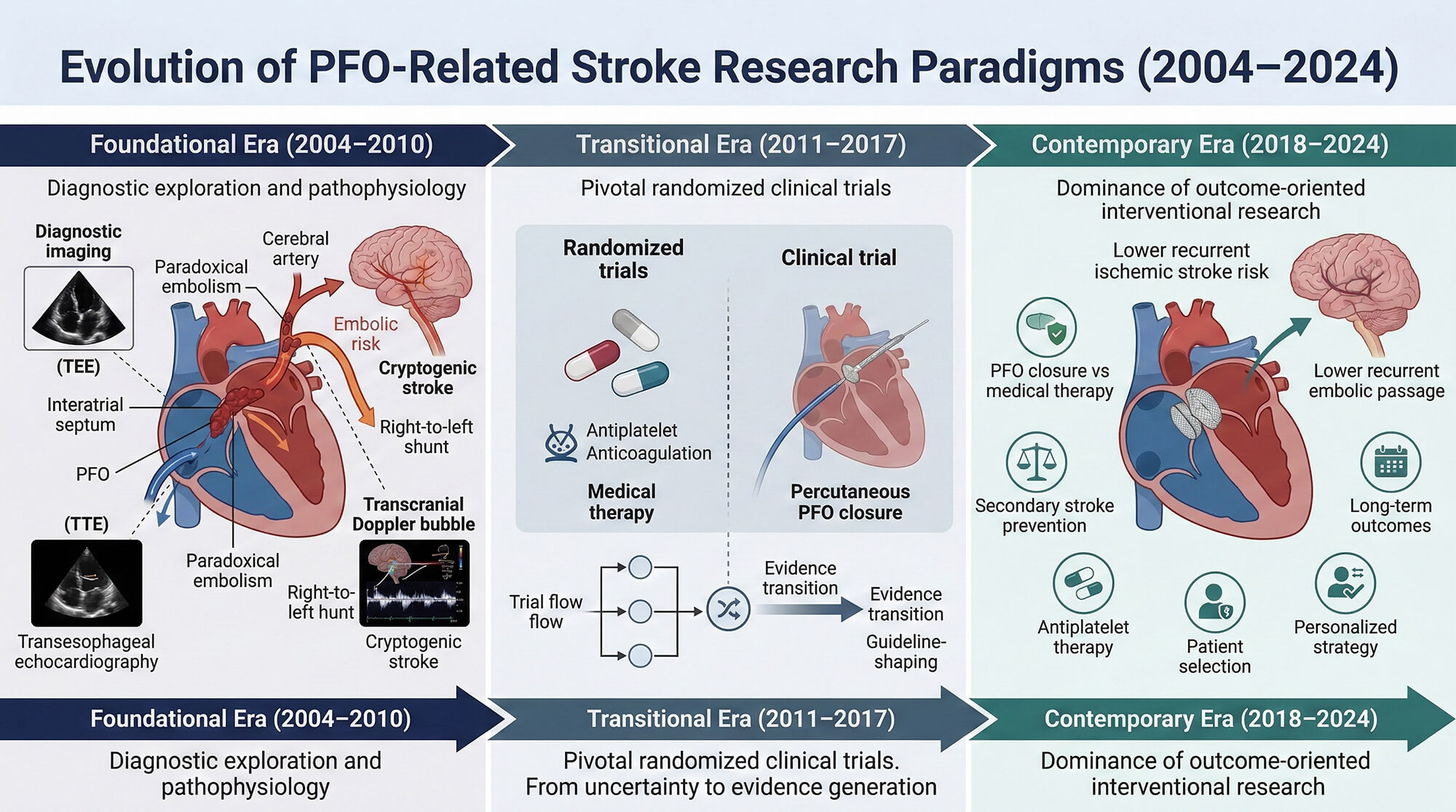
Abstract Background: Patent foramen ovale (PFO) is the most prevalent congenital cardiac anomaly and a key structural heart disease enabling paradoxical embolism, a leading mechanism of cryptogenic stroke. Over the past two decades, the management of PFO-associated stroke has evolved substantially from antithrombotic therapy alone to include percutaneous PFO closure. This systematic review aims to delineate the evolution of therapeutic strategies and clinical evidence in PFO-related stroke research, with particular emphasis on interventional and antithrombotic approaches. Methods: We performed a preferred reporting items for systematic reviews and meta-Analyses (PRISMA)-informed bibliometric systematic review of literature published from 2004… More >
Graphic Abstract
Open Access
ARTICLE
Xiang Liu1,2,#, Linjiang Han1,2,#, Zirui Huang1,2, Jiazichao Tu1,2, Ruyue Zhang1,2, Jimei Chen1,2,*
Structural and Congenital Heart Disease, DOI:10.32604/schd.2026.083722
Abstract Background: This study aimed to evaluate the long-term prognosis and influencing factors in patients who underwent Fontan palliation. We specifically investigated the impact of demographic characteristics, preoperative clinical conditions, surgical techniques, and postoperative variables-particularly liver dysfunction markers such as the Model for End-Stage Liver Disease excluding the international normalized ratio (MELD-XI) score-on survival outcomes. Methods: We conducted a retrospective cohort study involving 322 patients who underwent the Fontan procedure. Comprehensive data on demographics, perioperative parameters, and long-term outcomes were collected. Kaplan-Meier survival analysis was performed to estimate 1-, 5-, 10-, and 15-year survival rates, with subgroup… More >
Open Access
ARTICLE
Dan Li, Rongyuan Zhang, Yuzi Zhou, Yazhou Jiang, Xu Wang, Xia Li*
Structural and Congenital Heart Disease, DOI:10.32604/schd.2026.081407
Abstract Background: Infants undergoing surgery for congenital heart disease (CHD) are at high risk of developing gastrointestinal dysfunction (GID). Although abdominal near-infrared spectroscopy (NIRS) for monitoring tissue oxygen saturation (StO2) has shown clinical promise, its prognostic value remains to be fully elucidated. This study aimed to identify the risk factors associated with postoperative declines in abdominal StO2 and to evaluate its correlation with clinical outcomes. Methods: A total of 439 infants undergoing cardiac surgery with cardiopulmonary bypass between January 2024 and January 2025 were retrospectively enrolled. Continuous postoperative NIRS monitoring was performed during the first 72 h of… More >
Open Access
ARTICLE
Dehua Wu*, Yanxuan Shi, Weixing Wang, Jiawen Tang, Tao Zhu, Guoqing Ding
Structural and Congenital Heart Disease, DOI:10.32604/schd.2026.070946
Abstract Objective: The correlation between intraoperative blood pressure thresholds and outcomes in elderly patients undergoing noncardiac surgery remains inadequately characterized. This study aims to assess the association between intraoperative hypotension (IOH) parameters—specifically blood pressure thresholds and duration—and severe adverse outcomes in elderly patients with or without structural or congenital heart disease. Methods: A retrospective evaluation was performed on 846 elderly patients who underwent non-cardiac surgical procedures at Shanghai Songjiang District Hospital in China, from 01 January 2020, to 31 December 2021. Forty-one patients meetin
Open Access
ARTICLE
Meryem Beyazal*, Merter Keceli, Emine Gulsah Torun, Ibrahim Ece
Structural and Congenital Heart Disease, DOI:10.32604/schd.2026.080538
Abstract Background: Cardiac magnetic resonance (CMR) imaging following transcatheter pulmonary valve replacement (TPVR) allows for the assessment of right ventricular (RV) volume. This study aimed to evaluate early- to mid-term findings after the procedure. Methods: A total of 21 patients with repaired tetralogy of Fallot who underwent TPVR were enrolled in the study. CMR data before and after the procedure were compared. The median interval between the procedure and the post-TPVR CMR was 9 months (range: 6–18 months). Results: RV volumes and RV end-diastolic volume indices were significantly lower after TPVR compared to before the procedure. RV volume… More >
Open Access
ARTICLE
Yanan Pan1,2, Weize Xu2,3,4,*, Zhiwei Zhang4, Mengmeng Su4, Xiaohua Pan4, Jingjing Ye1,2,4, Jin Yu1,2,4,*
Structural and Congenital Heart Disease, DOI:10.32604/schd.2026.079240
Abstract Background: Congenital heart disease (CHD) is characterized by a high incidence and low detection rate. The shortage of pediatric echocardiologists limits the routine ultrasound screening for CHD in many institutions. Deep learning has emerged as a promising tool to enhance the CHD diagnosis. This study aims to develop and evaluate a two-branch, two-stage intelligent algorithm (OBICnet) based on echocardiographic images to predict and classify common CHD in pediatric patients. Methods: A total of 8543 static color Doppler images from 3134 children were analyzed, with each child contributing 1 to 7 standard sectional views. The dataset was… More >
Open Access
CASE REPORT
Yee-Tat Lee1,2, Hay-Son Robin Chen3, Ka-Lam Calvin Leung1,2, Chun-Ka Wong1,2, Ho-On Alston Chiu1,2, Chi-Wai Stephen Cheung4, Yuen-Hei Mak4, Ka-Chun Un1,2,*
Structural and Congenital Heart Disease, DOI:10.32604/schd.2026.078486
Abstract Background: Hypoattenuating leaflet thickening (HALT) is a reported complication following percutaneous pulmonary valve implantation (PPVI) Case description: A 32-year-old man with a history of repaired Tetralogy of Fallot (TOF) underwent PPVI for symptomatic severe pulmonary regurgitation (PR). The postoperative course was complicated by HALT diagnosed by computed tomography (CT) within 24 h of the procedure. Anticoagulation therapy was administered, and reassessment CT at 4 months showed resolution of HALT. Conclusion: HALT following PPVI is managed with anticoagulation yet consensus for optimal management strategy is lacking. More >

 Login
Login Register
 Submit a Paper
 Propose a Special lssue