Patent Foramen Ovale in Cryptogenic Stroke: A 20-Year Systematic Review of Evolving Interventional and Antithrombotic Strategies
Li Wang#, Hongzhao Li#, Ling Liu, Yanchao Qi, Dahong Zhang, Yanchun Zhi, Runyu Wang, Gairong Jin, Shunda Liu, Huilian Tan*, Jun Liu*
Department of Cardiology, The First Hospital of Hebei Medical University, Hebei Medical University, Shijiazhuang, China
* Corresponding Author: Huilian Tan. Email:  ; Jun Liu. Email:
# Li Wang and Hongzhao Li contributed equally to this work and share first authorship
Structural and Congenital Heart Disease https://doi.org/10.32604/schd.2026.084716
Received 28 April 2026; Accepted 11 August 2026; Published online 17 August 2026
Abstract
Background: Patent foramen ovale (PFO) is the most prevalent congenital cardiac anomaly and a key structural heart disease enabling paradoxical embolism, a leading mechanism of cryptogenic stroke. Over the past two decades, the management of PFO-associated stroke has evolved substantially from antithrombotic therapy alone to include percutaneous PFO closure. This systematic review aims to delineate the evolution of therapeutic strategies and clinical evidence in PFO-related stroke research, with particular emphasis on interventional and antithrombotic approaches.
Methods: We performed a preferred reporting items for systematic reviews and meta-Analyses (PRISMA)-informed bibliometric systematic review of literature published from 2004 to 2024. The primary bibliometric dataset was retrieved from the Web of Science Core Collection, and PubMed was used as a sensitivity source to evaluate retrieval coverage. Using CiteSpace, VOSviewer, and Microsoft Excel, we analyzed 1178 articles and reviews to map research trends, identify key contributors, and synthesize major clinical findings in structural and congenital heart disease.
Results: The United States emerged as the most productive country (367 publications; 12,342 citations), while European nations—Germany, Switzerland, and Italy—formed a strong collaborative network. PubMed sensitivity retrieval identified 3497 potentially relevant records, confirming that database selection materially affects retrieval sensitivity. Analysis revealed a paradigm shift from early diagnostic approaches to therapeutic comparisons between PFO closure and medical therapy. Landmark randomized controlled trials (RESPECT, REDUCE, DEFENSE-PFO) demonstrated that percutaneous PFO closure combined with antiplatelet therapy significantly reduces recurrent ischemic stroke compared with medical therapy alone in appropriately selected patients aged 18–60 years. Current guidelines recommend PFO closure for PFO-attributable cryptogenic stroke, often identified using the RoPE score and high-risk anatomical features. Key remaining challenges include management of post-procedural atrial fibrillation, older patients, primary prevention, and integrated risk stratification.
Conclusions: This systematic bibliometric review documents the maturation of PFO-stroke research from mechanistic exploration to evidence-based interventional management within the field of structural and congenital heart disease. Optimal secondary prevention requires a personalized approach balancing closure efficacy against procedural risks. As structural heart interventions continue to evolve, ongoing interdisciplinary collaboration between cardiologists and neurologists remains essential for advancing PFO-related stroke care.
Graphical Abstract
Keywords
Bibliometrics; patent foramen ovale; cryptogenic stroke; research trends; PFO closure; therapeutic intervention
 Open Access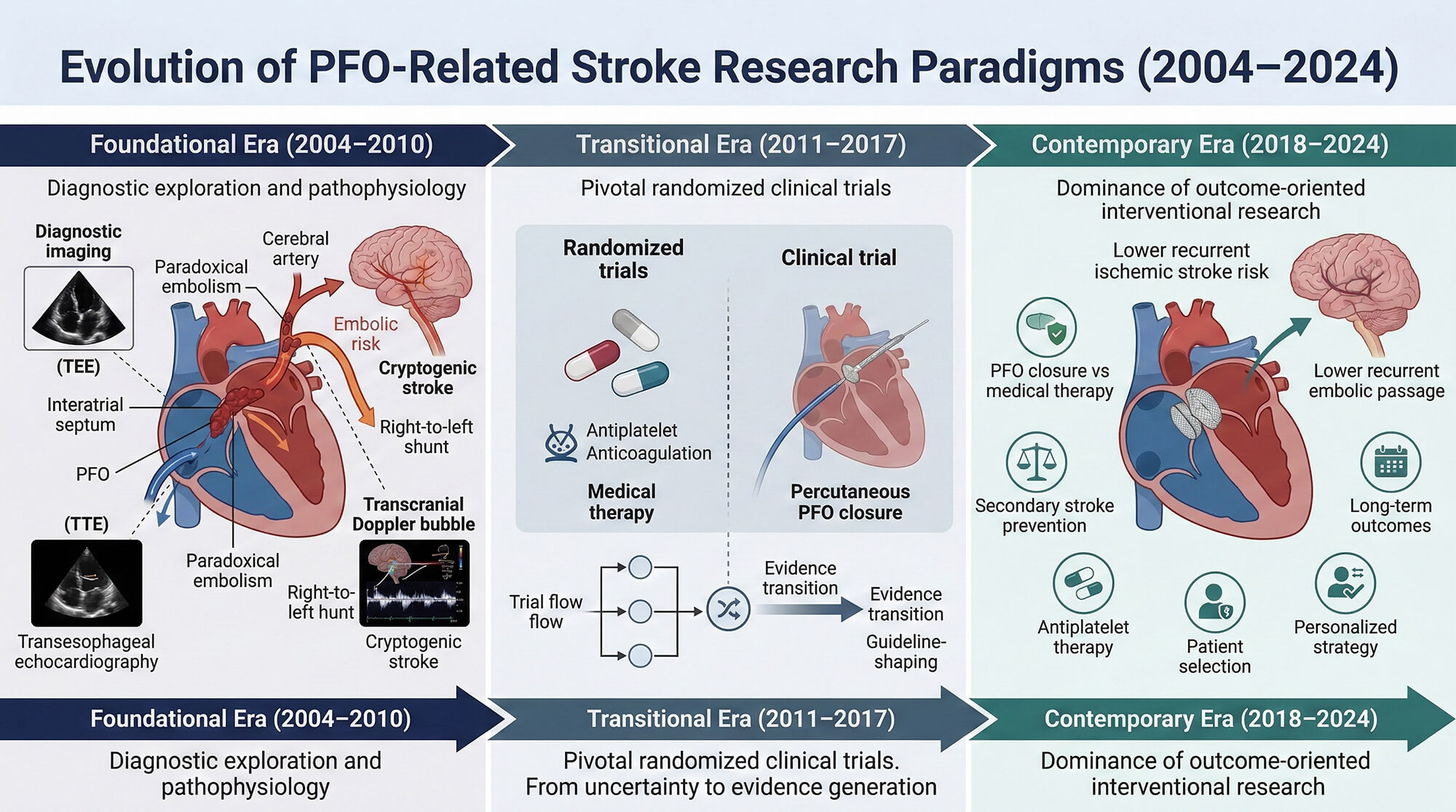

 Login
Login Register
 Submit a Paper
 Propose a Special lssue
 Download PDF
 Supplementary Material File
 Downloads
 Citation Tools
