
 Login
Login Register
 Submit a Paper
 Propose a Special lssue
 Open Access
ARTICLE
Zn Vacancy-Regulated Zn0.4Cd0.6S for Enhanced Charge Separation and Boosted Photocatalytic H2O2 Generation
School of Physics and Electronic Engineering, Jiangsu University, Zhenjiang, 212013, China
* Corresponding Author: Jing Xu. Email:
(This article belongs to the Special Issue: Chalcogenide Materials for Sustainable Environment)
Chalcogenide Letters 2026, 23(5), 6 https://doi.org/10.32604/cl.2026.082986
Received 26 March 2026; Accepted 20 May 2026; Issue published 02 June 2026
 View Full Text
 Download PDF
Abstract
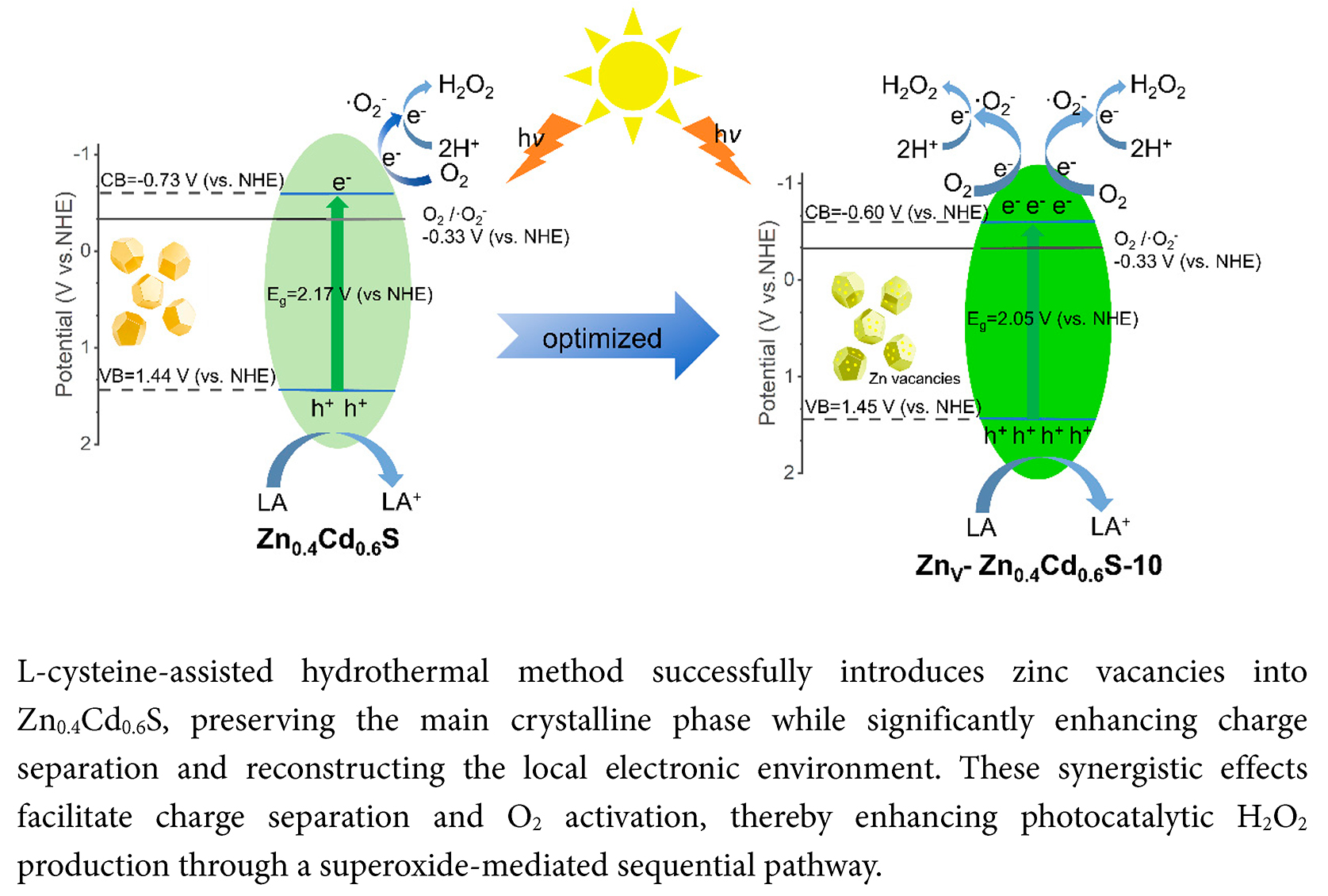
Photocatalytic H2O2 synthesis from O2 is a green and environmentally friendly route. However, due to the limitations of quick recombination of photogenerated electrons and limited O2 activation ability, photocatalytic reactions often exhibit low efficiency. In this study, Zn vacancy-engineered Zn0.4Cd0.6S (ZnV-ZCS) photocatalysts were successfully constructed via a hydrothermal strategy using L-cysteine as a coordination agent. The optimized ZnV-ZCS-10 catalyst achieves an impressive H2O2 production rate of 44.39 mmol/g within 1 h under 425 nm irradiation, approximately 2.3 times higher than that of pristine Zn0.4Cd0.6S (ZCS). Structural characterization and cycling performance tests confirm that the introduction of Zn vacancies does not alter the pristine hexagonal crystal phase of the material, demonstrating good stability. Photoelectrochemical and spectroscopic analyses reveal that Zn vacancies effectively enhance charge carrier separation and reduce charge transfer resistance. Meanwhile, the presence of cation vacancies reconstructs the local electronic environment, promoting the activity of the Zn0.4Cd0.6S catalyst for H2O2 production via the superoxide radical (·O2−)-mediated pathway. This work highlights the crucial role of cation vacancies in modulating carrier dynamics in sulfide semiconductors for efficient photocatalytic H2O2 production.Graphic Abstract
Keywords
Zn0.4Cd0.6S; cation vacancies; Zn vacancies; photocatalytic H2O2 production
Supplementary Material
Supplementary Material FileCite This Article
APA Style
Zhang, Y., Gu, Y., Lan, Y., Wang, Z., Yan, W. et al. (2026). Zn Vacancy-Regulated Zn0.4Cd0.6S for Enhanced Charge Separation and Boosted Photocatalytic H2O2 Generation. Chalcogenide Letters, 23(5), 6. https://doi.org/10.32604/cl.2026.082986
Vancouver Style
Zhang Y, Gu Y, Lan Y, Wang Z, Yan W, Wei Y, et al. Zn Vacancy-Regulated Zn0.4Cd0.6S for Enhanced Charge Separation and Boosted Photocatalytic H2O2 Generation. Chalcogenide Letters. 2026;23(5):6. https://doi.org/10.32604/cl.2026.082986
IEEE Style
Y. Zhang et al., “Zn Vacancy-Regulated Zn0.4Cd0.6S for Enhanced Charge Separation and Boosted Photocatalytic H2O2 Generation,” Chalcogenide Letters, vol. 23, no. 5, pp. 6, 2026. https://doi.org/10.32604/cl.2026.082986
 Copyright © 2026 The Author(s). Published by Tech Science Press.
This work is licensed under a Creative Commons Attribution 4.0 International License , which permits unrestricted use, distribution, and reproduction in any medium, provided the original work is properly cited.
 Downloads
 Citation Tools
