
 Login
Login Register
 Submit a Paper
 Propose a Special lssue
 Open Access
ARTICLE
Zn Vacancy-Regulated Zn0.4Cd0.6S for Enhanced Charge Separation and Boosted Photocatalytic H2O2 Generation
School of Physics and Electronic Engineering, Jiangsu University, Zhenjiang, 212013, China
* Corresponding Author: Jing Xu. Email:
(This article belongs to the Special Issue: Chalcogenide Materials for Sustainable Environment)
Chalcogenide Letters 2026, 23(5), 6 https://doi.org/10.32604/cl.2026.082986
Received 26 March 2026; Accepted 20 May 2026; Issue published 02 June 2026
 View Full Text
 Download PDF
Abstract
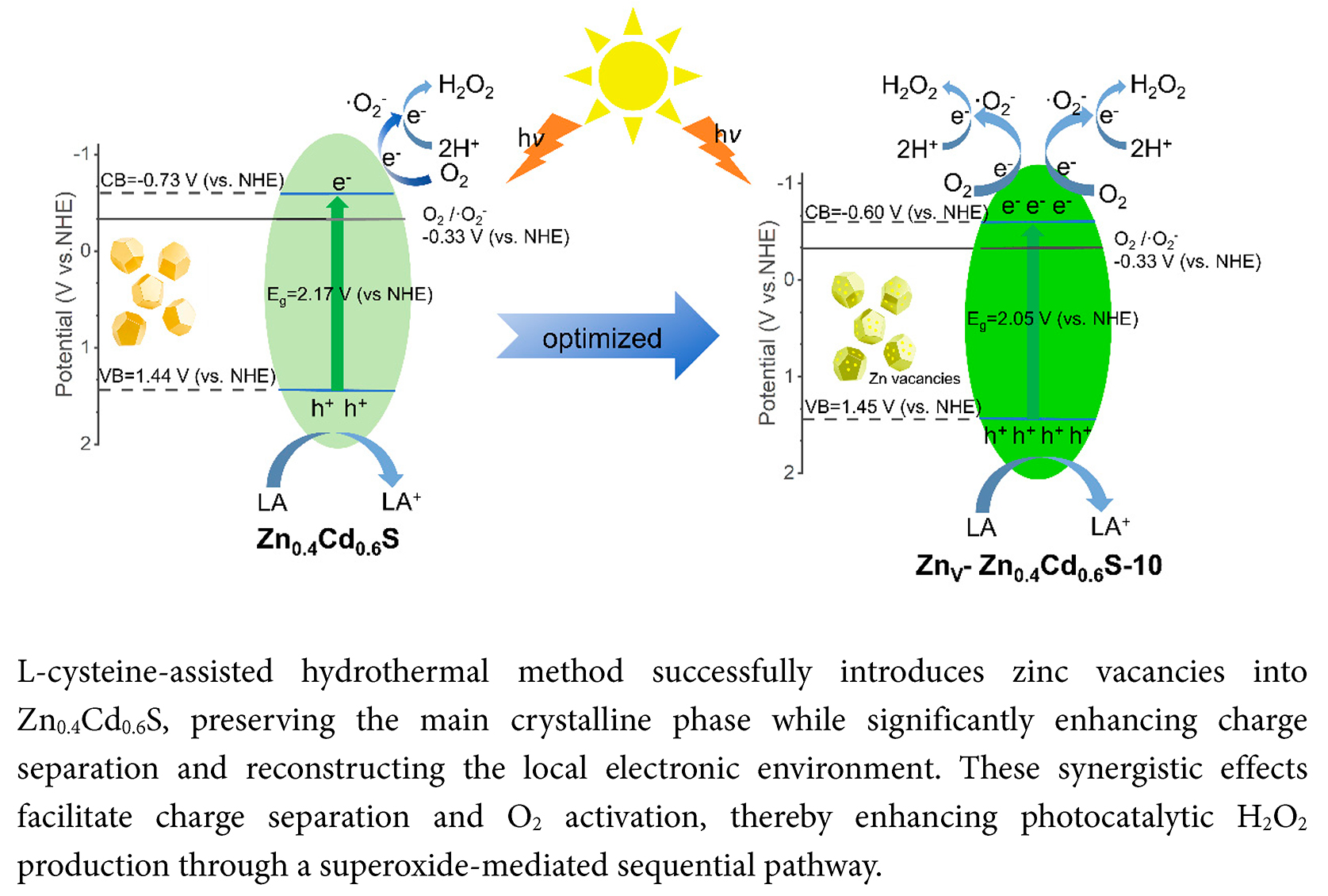
Photocatalytic H2O2 synthesis from O2 is a green and environmentally friendly route. However, due to the limitations of quick recombination of photogenerated electrons and limited O2 activation ability, photocatalytic reactions often exhibit low efficiency. In this study, Zn vacancy-engineered Zn0.4Cd0.6S (ZnV-ZCS) photocatalysts were successfully constructed via a hydrothermal strategy using L-cysteine as a coordination agent. The optimized ZnV-ZCS-10 catalyst achieves an impressive H2O2 production rate of 44.39 mmol/g within 1 h under 425 nm irradiation, approximately 2.3 times higher than that of pristine Zn0.4Cd0.6S (ZCS). Structural characterization and cycling performance tests confirm that the introduction of Zn vacancies does not alter the pristine hexagonal crystal phase of the material, demonstrating good stability. Photoelectrochemical and spectroscopic analyses reveal that Zn vacancies effectively enhance charge carrier separation and reduce charge transfer resistance. Meanwhile, the presence of cation vacancies reconstructs the local electronic environment, promoting the activity of the Zn0.4Cd0.6S catalyst for H2O2 production via the superoxide radical (·O2−)-mediated pathway. This work highlights the crucial role of cation vacancies in modulating carrier dynamics in sulfide semiconductors for efficient photocatalytic H2O2 production.Graphic Abstract
Keywords
Supplementary Material
Supplementary Material FileHydrogen peroxide (H2O2) is a recognized environment-friendly selective oxidant, which has a large number of applications in the fields of environmental remediation and organic synthesis [1], and is also widely used in pollutant degradation and scenarios such as bacterial inactivation [2,3,4,5,6]. Under mild reaction conditions, the use of semiconductor materials for the photocatalytic H2O2 yield is always regarded as a green solution to replace the anthraquinone process [7,8,9,10], but under visible light illumination, the swift recombination of photoinduced charges and the insufficient O2 activation capability and inefficient interfacial reduction kinetics limit the rate of photocatalytic generation of H2O2. Therefore, it is difficult to improve selectivity [11,12,13,14,15].
Benefiting from an adjustable electronic energy band configuration and excellent visible-light responsiveness, ZnxCd1−xS solid solution has received extensive attention in the study of photocatalytic production of H2O2 [16,17,18,19,20]. However, due to the limitations in O2 adsorption/activation, ZnxCd1−xS photocatalysts still face challenges in achieving higher H2O2 yield and selectivity [21,22,23,24]. Introducing cation vacancies such as Zn vacancies into the lattice is an effective way to reshape the local electronic environment and optimize interfacial charge behavior [25,26,27,28,29,30], as it can reconstruct local electron density and alter adsorption/activation properties. Ding et al. systematically reviewed the regulatory mechanisms of cation vacancies (e.g., Zn and In vacancies) in photocatalysis and electrocatalysis, highlighting that they can modulate reaction kinetics by reconstructing local electron density and optimizing adsorption configurations [31]. Yu et al. further summarized the roles of cation vacancies in regulating catalytic processes through electronic structure reconstruction and adsorption optimization [32]. Wang et al. comprehensively outlined the influence of defect engineering, ranging from atomic-scale vacancies to macroscopic structural regulation, on electronic band structure alignment and recombination kinetics of carriers [33]. Therefore, tailoring the carrier kinetics in ZCS and enhancing the selectivity towards the key intermediate ·O2− by constructing cationic Zn vacancies is an effective approach to promote the two-step single-electron reduction pathway for H2O2 production.
In this work, Zn vacancies (ZnV) are added into the Zn0.4Cd0.6S (ZCS) lattice by a hydrothermal method. This process is based on the strong coordination interaction between Zn2+ and the thiol (-SH) group of L-cysteine. The optimized ZnV-ZCS-10 sample exhibits significantly enhanced photocatalytic performance for H2O2 production. Its activity is markedly higher than that of the pristine sample, showing over 2.3-fold improvement. In addition, the catalyst demonstrates good stability, retaining most of its initial activity after repeated cycling tests. Adding Zn vacancies still keeps the main crystal phase of the material. At the same time, it facilitates charge-carrier separation and changes the band structure. EPR results, radical trapping tests, and atmosphere tests demonstrate that ZnV-Zn0.4Cd0.6S-10 undergoes the oxygen reduction reaction proceeding via a two-step single-electron reduction. The superoxide radical (·O2−) serves as a key intermediate in this reaction. This work gives a simple way to design sulfide photocatalysts with cation vacancies for H2O2 synthesis.
2.1 Catalyst Structural Analysis
The synthesis process of ZnV-ZCS is shown in Fig. 1a. We use zinc acetate dihydrate, cadmium acetate dihydrate and L-cysteine as raw materials, ZnV-ZCS samples were synthesized in hydrothermal environment with the strong coordination of Zn and L-cysteine mercapto (-SH). Scanning electron microscope (SEM) images (Fig. S1) show that both pure ZCS and ZnV-ZCS-10 are granular morphology; Transmission electron microscope (TEM) (Fig. 1b) further observed that, ZnV-ZCS-10 consists of numerous nanoparticles exhibiting amorphous-shaped morphology and dimensions of several tens of nanometers. Compared with pure ZCS (Fig. S2), the overall morphology has no obvious change, this shows that the introduction of vacancy does not cause large-scale structural damage to particles. High-Resolution Transmission Electron Microscopy (HRTEM) (Fig. 1c) clearly exhibits well-resolved lattice fringes showing an interplanar distance of approximately 0.33 nm, this matches the (002) crystallographic plane of Zn0.4Cd0.6S, indicating that the overall crystallinity is largely preserved. High-Angle Annular Dark-Field Scanning Transmission Electron Microscopy (HAADF-STEM) was used to characterize the morphology, while elemental mapping was applied to reveal the spatial distribution of elements (Fig. 1d). They illustrate that S, Zn, and Cd are homogeneously distributed throughout the particles, implying that the detected defects are predominantly atomic-scale point defects. X-ray Diffraction (XRD) (Fig. 1e) demonstrates that ZCS and ZnV-ZCS-10 possess the same hexagonal phase (PDF#40-0836). The diffraction peaks of ZnV-ZCS-10 become slightly wider and weaker. This suggests a small decrease in crystallinity. This change is due to the presence of Zn vacancies in ZnV-ZCS-10. In the EPR spectrum, ZnV-ZCS-10 exhibits a distinct signal at g = 2.004, whereas pristine ZCS shows a negligible response at this position. This signal is reasonably attributed to unpaired electrons associated with defect centers related to Zn vacancies [34,35,36]. ICP analysis indicates that the concentration of Zn vacancies in ZnV-ZCS-10 is approximately 4.1226 wt%.

Figure 1: (a) Schematic diagram of the preparation of ZnV-ZCS-10; (b) TEM image of ZnV-ZCS-10; (c) HRTEM images of ZnV-ZCS-10; (d) HAADF-STEM image and elemental mapping of ZnV-ZCS-10; (e) XRD patterns of ZCS and ZnV-ZCS-10; (f) EPR spectra of ZCS and ZnV-ZCS-10.
XPS measurements were conducted to elucidate the surface chemical environments of the samples (Fig. 2a–d). As shown in Fig. 2a, the survey spectrum reveals the existence of S, Zn, Cd, C and O. For the high-resolution S 2p spectrum (Fig. 2b), the peaks at 161.27 eV and 162.50 eV can be assigned to S 2p3/2 and S 2p1/2, respectively, indicating the typical sulfide S2− state. In Fig. 2c, the Zn 2p peaks centered at 1021.73 eV and 1044.71 eV are attributed to Zn 2p3/2 and Zn 2p1/2, confirming the Zn2+ state. Meanwhile, the Cd 3d spectrum in Fig. 2d shows two peaks at 404.83 eV and 411.58 eV, corresponding to Cd 3d5/2 and Cd 3d3/2, which suggests that Cd mainly exists as Cd2+. Overall, the XPS results demonstrate that the chemical states of the elements in the sample remain essentially unchanged. The C 1s peak mainly arises from adventitious carbon and was used for binding-energy calibration, whereas the O 1s signal can be attributed to surface-adsorbed oxygen-containing species, such as hydroxyl groups or adsorbed water [37,38,39]. From the XPS results, it can be seen that the Zn 2p and Cd 3d peaks in ZnV-ZCS-10 shift toward higher binding energy compared to those in ZCS, while the S 2p peak shifts toward lower binding energy. This indicates that Zn vacancies modulate the surface electronic structure of ZnV-ZCS-10, leading to electron enrichment on the S atoms. The surface element content table (Table S3) obtained from XPS analysis shows that the Zn content in ZnV-ZCS-10 is lower than that in ZCS, confirming the introduction of Zn vacancies in ZnV-ZCS-10.

Figure 2: XPS characterization of ZCS and ZnV-ZCS-10: (a) survey spectra; (b) high-resolution S 2p spectra; (c) high-resolution Zn 2p spectra; (d) high-resolution Cd 3d spectra.
2.2 Photocatalytic H2O2 Production Performance
Quantitative evaluation of photocatalytic H2O2 production was carried out according to the calibration curve provided in Fig. S5. Under the identical experimental conditions, in one hour, the production amount of H2O2 in pure ZCS sample was 19.25 mmol/g, while the production amount of ZnV-ZCS-10 reached 44.39 mmol/g, which is about 2.31 times that of pure ZCS (Fig. 3a). Compared with previously reported sulfide-based photocatalysts for H2O2 production, our as-prepared ZnV-ZCS-10 exhibits excellent photocatalytic performance for H2O2 generation (Table S2). The enhanced activity suggests that introducing Zn vacancies effectively promotes H2O2 photosynthesis over ZCS. Fig. 3b shows the average H2O2 yields of the ZnV-ZCS-X (where X represents the amount of L-cysteine used) samples after 1 h of irradiation, with error bars representing the standard deviation of three independent experiments. The results indicate that the optimal performance, reaching 44.39 mmol/g, is achieved when the amount of L-cysteine is 10 mmol. Fig. 3c shows the H2O2 production performance of ZnV-ZCS-10 in different atmospheres. The H2O2 production can hardly be detected under an argon atmosphere, however, obvious catalytic activity can be observed in air and pure oxygen atmosphere, and the production amount in pure oxygen atmosphere is higher, which further demonstrates that O2 is the dominant feedstock involved in photocatalytic H2O2 production. The AQY experiment (The specific methods can be found in the Supplementary Files) results (Fig. 3d) further reveal the wavelength-dependent photocatalytic performance of ZnV-ZCS-10. The AQY increases from 6.31% at 365 nm to 10.33% at 425 nm, indicating that ZnV-ZCS-10 exhibits the highest quantum efficiency in the 365–425 nm wavelength range. When the wavelength further increases to 520 and 920 nm, the AQY sharply decreases to 0.62% and 0.006%, suggesting that long-wavelength light contributes negligibly to the photocatalytic reaction. After five cycles, ZnV-ZCS-10 still retains more than 78% of its initial activity, indicating acceptable photocatalytic stability (Fig. 3e). Additionally, we measured the XRD patterns and SEM images (Fig. S1) of the ZnV-ZCS-10 samples before and after cycling. No significant changes can be observed from the results, indicating that the as-prepared catalyst possesses good structural stability.

Figure 3: (a) Time-dependent photocatalytic H2O2 production over ZCS and ZnV-ZCS-10 (the error bars represent the standard deviation of three independent experiments); (b) Photocatalytic H2O2 production over ZnV-ZCS-X samples with different amounts of L-cysteine (The error bars represent the standard deviation of three independent experiments); (c) Photocatalytic H2O2 production over ZnV-ZCS-10 under different atmospheres (Ar, Air, O2); (d) Photocatalytic H2O2 production and AQY over ZnV-ZCS-10 at different irradiation wavelengths; (e) Performance of ZnV-ZCS-10 for photocatalytic H2O2 production in five successive runs.
To study how Zn vacancies affect the optical properties of ZCS, solid-state UV-Vis diffuse reflectance spectroscopy (UV-Vis DRS) was used to test ZCS and ZnV-ZCS-10. The UV–vis DRS spectra (Fig. 4a) indicate that both samples possess pronounced light-harvesting capability in the visible region, while ZnV-ZCS-10 shows overall stronger absorption in the 400–800 nm range, suggesting that the engineering of Zn vacancies enhances the ZCS light-harvesting capability. According to the Kubelka-Munk transformation and the Tauc plot fitting (inset of Fig. 4a), the ZCS optical band gap is about 2.17 eV. The band gap value for ZnV-ZCS-10 is about 2.05 eV. The conduction band potential of ZnV-ZCS-10 is about −0.60 V (vs. NHE), which is slightly more positive than that of ZCS (−0.73 V). Nevertheless, it remains more negative than the redox potential of O2/·O2− (−0.33 V vs. NHE), indicating that the photogenerated electrons still have sufficient thermodynamic driving force to reduce O2 to ·O2−. Therefore, the enhanced photocatalytic H2O2 production of ZnV-ZCS-10 should not be simply attributed to a more negative CB position, but rather to the combined effects of improved charge separation, increased carrier concentration, reduced interfacial charge-transfer resistance, and facilitated O2 activation induced by Zn vacancies. The Mott-Schottky plots (Fig. 4c) show positive slopes. This shows both samples are n-type semiconductors. Under the same conditions, ZnV-ZCS-10 has a much smaller slope than ZCS. From the Mott-Schottky equation, the slope of the 1/C2-V curve is inversely related to the donor density (ND) [40]. A smaller slope means a higher carrier concentration in ZnV-ZCS-10. The electrical properties were tested with an electrochemical workstation. The transient photocurrent curves (Fig. 4d) show ZnV-ZCS-10 gives a higher and more stable photocurrent under on-off 425 nm light. Electrochemical impedance spectroscopy (EIS) results (Fig. 4e) show that ZnV-ZCS-10 presents a markedly reduced Nyquist semicircle compared with ZCS. This indicates that the interfacial charge transfer resistance is lower. Linear sweep voltammetry (LSV, Fig. S3c) under light shows ZnV-ZCS-10 has higher photocurrent densities in the tested potential range. In the dark, both samples show very low current. This indicates that the process is mainly driven by light. The photocurrent trend is similar to the photocatalytic activity. Photoluminescence (PL) spectra (Fig. 4f) show ZnV-ZCS-10 has much lower emission intensity than ZCS. The presence of Zn vacancies is beneficial for inhibiting charge-carrier recombination while enhancing charge separation. The optical and electrochemical results show that ZnV-ZCS-10 has a smaller band gap, a higher carrier concentration, and lower interfacial charge transfer resistance. This contributes to enhancing the photocatalytic H2O2 production.

Figure 4: (a) UV-Vis diffuse reflectance spectra of the synthesized ZCS and ZnV-ZCS-10; (b) Band structures of ZCS and ZnV-ZCS-10; (c) Mott–Schottky plots of ZCS and ZnV-ZCS-10; (d) Transient photocurrent spectra of ZCS and ZnV-ZCS-10; (e) Electrochemical impedance spectroscopy spectra (EIS); (f) Photoluminescence (PL) spectra of ZCS and ZnV-ZCS-10 (excitation wavelength: 525 nm).
2.4 Mechanistic Investigation of Photocatalytic H2O2 Production
To elucidate the photocatalytic H2O2 generation mechanism over ZnV-ZCS-10, radical trapping and EPR experiments were performed. As shown in Fig. 5a, the H2O2 yield decreased sharply from 44.39 to 3.05 mmol/g after adding p-benzoquinone (p-BQ), demonstrating that ·O2− is the dominant intermediate. By contrast, tert-butanol and β-carotene only caused slight inhibition, suggesting that ·OH and 1O2 are not the major reactive species. In addition, the decreased H2O2 yield in the presence of KPS, an electron scavenger, confirms that photogenerated electrons are indispensable for O2 reduction and subsequent ·O2− formation [41]. The time-dependent EPR spectra further show gradually enhanced DMPO-·O2− signals under irradiation, directly verifying the continuous generation of ·O2−. Based on these results, the H2O2 generation over ZnV-ZCS-10 primarily proceeds through a ·O2−-mediated two-step single-electron oxygen reduction pathway, as illustrated in Fig. 5c. After introducing Zn vacancies into ZCS, although the conduction band position is lowered, it still satisfies the thermodynamic requirement for O2 to obtain electrons and be reduced to ·O2−. Upon light irradiation, electrons in the valence band of ZnV-ZCS-10 are excited to the conduction band. Photocurrent and PL results indicate that the presence of Zn vacancies endows ZnV-ZCS-10 with higher charge carrier separation efficiency than pristine ZCS, thereby generating more photogenerated electrons. Furthermore, XPS analysis reveals that the Zn vacancies on the surface of ZnV-ZCS-10 can modulate the electronic structure of the active S sites, thereby accelerating the rate of H2O2 production via the two-step single-electron O2 reduction pathway. Meanwhile, the photogenerated holes left in the valence band are effectively consumed by the sacrificial agent.

Figure 5: (a) Photocatalytic H2O2 production over ZnV-ZCS-10 with different radical scavengers; (b) EPR spectra of DMPO-·O2− adducts over ZnV-ZCS-10 at different irradiation times; (c) Proposed photocatalytic mechanism for H2O2 production over ZnV-ZCS-10.
In this work, Zn vacancy-engineered Zn0.4Cd0.6S photocatalysts (ZnV-ZCS) were successfully prepared through a hydrothermal strategy by utilizing the coordination interaction between Zn2+ ions and the thiol group of L-cysteine. The optimized ZnV-ZCS-10 sample delivered an H2O2 production yield of 44.39 mmol/g within 1 h, showing a 2.31-fold enhancement relative to pristine ZCS. Zn-vacancy engineering did not disrupt the crystal structure of ZCS, but it markedly improved charge behavior by promoting electron separation, increasing electron availability, and decreasing interfacial transfer resistance, ultimately leading to more efficient use of photogenerated electrons. More importantly, adding Zn vacancies changes the local electronic structure of the catalyst. This change facilitates the catalyst convert O2 into superoxide radicals (·O2−). The ·O2− then reacts with H+ to form H2O2. This work demonstrates that creating cation vacancies is an effective strategy to control charge carrier behavior. It also provides a simple strategy for designing sulfide photocatalysts with better performance for photocatalytic H2O2 production.
Acknowledgement:
Funding Statement: This work was supported by the Jiangsu Provincial College Students’ Innovation and Entrepreneurship Training Program (202510299084).
Author Contributions: The authors confirm contribution to the paper as follows: Conceptualization, Yuanyi Zhang and Jing Xu; methodology, Yuanyi Zhang and Zhenyu Wang; validation, Yuanyi Zhang, Yang Gu and Yuxin Lan; formal analysis, Yuanyi Zhang and Wei Yan; resources, Jing Xu; data curation, Yuanyi Zhang; writing—original draft preparation, Yuanyi Zhang; writing—review and editing, Jing Xu and Yingcong Wei; visualization, Yuanyi Zhang and Yang Gu; supervision, Jing Xu; project administration, Jing Xu; funding acquisition, Jing Xu. All authors reviewed and approved the final version of the manuscript.
Availability of Data and Materials: The datasets generated during and/or analyzed during the current study are available from the corresponding author on reasonable request.
Ethics Approval: Not applicable.
Conflicts of Interest: The authors declare no conflicts of interest.
Supplementary Materials: The supplementary material is available online at https://www.techscience.com/doi/10.32604/cl.2026.082986/s1.
References
1. Jiang Z , Li C , Qi F , Wang Z , Liu Y , Li F , et al. A review on photocatalytic hydrogen peroxide production from oxygen: material design, mechanisms, and applications. ACS Appl Mater Interfaces. 2025; 17( 1): 42– 66. doi:10.1021/acsami.4c14902. [Google Scholar] [CrossRef]
2. Wang W , Gu W , Li G , Xie H , Wong PK , An T . Few-layered tungsten selenide as a co-catalyst for visible-light-driven photocatalytic production of hydrogen peroxide for bacterial inactivation. Environ Sci Nano. 2020; 7( 12): 3877– 87. doi:10.1039/D0EN00801J. [Google Scholar] [CrossRef]
3. Wen C , Zhang J , Feng Y , Duan Y , Ma H , Zhang H . Purification and identification of novel antioxidant peptides from watermelon seed protein hydrolysates and their cytoprotective effects on H2O2-induced oxidative stress. Food Chem. 2020; 327: 127059. doi:10.1016/j.foodchem.2020.127059. [Google Scholar] [CrossRef]
4. Abdelshafy AM , Neetoo H , Al-Asmari F . Antimicrobial activity of hydrogen peroxide for application in food safety and COVID-19 mitigation: an updated review. J Food Prot. 2024; 87( 7): 100306. doi:10.1016/j.jfp.2024.100306. [Google Scholar] [CrossRef]
5. Lin YJ , Khan I , Saha S , Wu CC , Barman SR , Kao FC , et al. Thermocatalytic hydrogen peroxide generation and environmental disinfection by Bi2Te3 nanoplates. Nat Commun. 2021; 12( 1): 180. doi:10.1038/s41467-020-20445-0. [Google Scholar] [CrossRef]
6. Li X , Wu K , Chen S , Yuan B , Wang J , Tang C , et al. Hydrogen peroxide-mediated tandem catalysis for electrifying chemical synthesis. Chem Catal. 2024; 4( 8): 100997. doi:10.1016/j.checat.2024.100997. [Google Scholar] [CrossRef]
7. Chen Z , Yao D , Chu C , Mao S . Photocatalytic H2O2 production Systems: design strategies and environmental applications. Chem Eng J. 2023; 451: 138489. doi:10.1016/j.cej.2022.138489. [Google Scholar] [CrossRef]
8. Wang X , Shao Y , Pan J , Jiang D , Cong Y , Lv SW . Exploring the green technique based on photocatalysis to produce hydrogen peroxide: progress and challenge. Chem Eng J. 2024; 490: 151923. doi:10.1016/j.cej.2024.151923. [Google Scholar] [CrossRef]
9. Ding L , Pan Z , Wang Q . 2D photocatalysts for hydrogen peroxide synthesis. Chin Chem Lett. 2024; 35( 12): 110125. doi:10.1016/j.cclet.2024.110125. [Google Scholar] [CrossRef]
10. Freese T , Meijer JT , Feringa BL , Beil SB . An organic perspective on photocatalytic production of hydrogen peroxide. Nat Catal. 2023; 6( 7): 553– 8. doi:10.1038/s41929-023-00980-x. [Google Scholar] [CrossRef]
11. Wang Y , Xu T , Zhang Z , Wang Y , Huang J , Xue P , et al. Photocatalytic synthesis of hydrogen peroxide: recent advances, challenges, and future perspectives. Nanoscale. 2025; 17( 30): 17443– 79. doi:10.1039/D5NR02034D. [Google Scholar] [CrossRef]
12. Yang Z , Wang J . Highly efficient photocatalytic H2O2 production over a Zn0.3Cd0.7S/MXene photocatalyst for degradation of emerging pollutants under visible-light irradiation. Langmuir. 2024; 40( 6): 3168– 80. doi:10.1021/acs.langmuir.3c03607. [Google Scholar] [CrossRef]
13. Zhou W , Zhang Y , Li B , Jiang J , Liu Q . Advances in constructing efficient photocatalytic systems for hydrogen peroxide production: insights from synchrotron radiation research. Artif Photosynth. 2025; 1( 4): 156– 73. doi:10.1021/aps.4c00025. [Google Scholar] [CrossRef]
14. Nosaka Y , Nosaka AY . Generation and detection of reactive oxygen species in photocatalysis. Chem Rev. 2017; 117( 17): 11302– 36. doi:10.1021/acs.chemrev.7b00161. [Google Scholar] [CrossRef]
15. Hamdan S , Al-Ali K , Vega LF , Muscetta M , Yusuf AO , Palmisano G . Zinc cadmium sulphide (ZnxCd1−xS)-based photocatalysts for hydrogen production from seawater and wastewater. J Environ Chem Eng. 2024; 12( 5): 113937. doi:10.1016/j.jece.2024.113937. [Google Scholar] [CrossRef]
16. Li Q , Meng H , Zhou P , Zheng Y , Wang J , Yu J , et al. Zn1–xCdxS solid solutions with controlled bandgap and enhanced visible-light photocatalytic H2-production activity. ACS Catal. 2013; 3( 5): 882– 9. doi:10.1021/cs4000975. [Google Scholar] [CrossRef]
17. Li K , Chen R , Li SL , Xie SL , Dong LZ , Kang ZH , et al. Engineering Zn1−xCdxS/CdS heterostructures with enhanced photocatalytic activity. ACS Appl Mater Interfaces. 2016; 8( 23): 14535– 41. doi:10.1021/acsami.6b02765. [Google Scholar] [CrossRef]
18. Kudo A , Miseki Y . Heterogeneous photocatalyst materials for water splitting. Chem Soc Rev. 2009; 38( 1): 253– 78. doi:10.1039/B800489G. [Google Scholar] [CrossRef]
19. Chen M , Hou W , Chen C , Wang Y , Xu Y . Wavelength-dependent photoactivity of ZnxCd1−x S and ZnCo2O4/Zn x Cd1−x S for H2 and H2O2 production. Int J Hydrogen Energy. 2022; 47( 39): 17241– 51. doi:10.1016/j.ijhydene.2022.03.220. [Google Scholar] [CrossRef]
20. Feng C , Zhang L . Microdroplet assisted hollow ZnCdS@PDA nanocages’ synergistic confinement effect for promoting photocatalytic H2O2 production. Mater Horiz. 2024; 11( 6): 1515– 27. doi:10.1039/D3MH01915B. [Google Scholar] [CrossRef]
21. Wang Z , Lu D , Kondamareddy KK , He Y , Gu W , Li J , et al. Recent advances and insights in designing ZnxCd1−xS-based photocatalysts for hydrogen production and synergistic selective oxidation to value-added chemical production. ACS Appl Mater Interfaces. 2024; 16( 37): 48895– 926. doi:10.1021/acsami.4c09599. [Google Scholar] [CrossRef]
22. Wang X , Liu B , Ma S , Zhang Y , Wang L , Zhu G , et al. Induced dipole moments in amorphous ZnCdS catalysts facilitate photocatalytic H2 evolution. Nat Commun. 2024; 15: 2600. doi:10.1038/s41467-024-47022-z. [Google Scholar] [CrossRef]
23. Zhang J , Zhang J , Sun C , Yu H , Yu J , Fedin MV , et al. An efficient S-scheme Tb-BPY COF/ZnCdS heterojunction for visible-light H2O2 production. Chem Commun. 2025; 61( 85): 16608– 11. doi:10.1039/D5CC04204F. [Google Scholar] [CrossRef]
24. Wang Y , Gao S , Yang J , Xiong K , Guo M , Lu T , et al. Construction of ZnCdS/C3N4S-scheme heterojunction for superior photocatalytic H2O2Production and benzylamine coupling. Adv Funct Mater. 2026; 36( 7): e17495. doi:10.1002/adfm.202517495. [Google Scholar] [CrossRef]
25. Khan S , Qaiser MA , Ahmad Qureshi W , Haider SN , Yu X , Wang W , et al. Photocatalytic hydrogen peroxide production: advances, mechanistic insights, and emerging challenges. J Environ Chem Eng. 2024; 12( 5): 114143. doi:10.1016/j.jece.2024.114143. [Google Scholar] [CrossRef]
26. Kim S , Lee S , Gu M . Efficient photocatalytic H2O2 generation utilizing surface functional duality in carbon dots-polydopamine heterojunctions. J Mater Chem A. 2025; 13( 35): 29404– 14. doi:10.1039/D5TA02843D. [Google Scholar] [CrossRef]
27. Zhu Q , Su J , Lin G , Li G , Zhuo Z , Wang W , et al. Surface indium vacancies promote photocatalytic H2O2 production over In2S3. Nat Commun. 2025; 16: 10501. doi:10.1038/s41467-025-65538-w. [Google Scholar] [CrossRef]
28. Chen G , Lin C , Han F , Zhang H , Zhou S , Yang F , et al. Recent advances in photocatalytic H2O2 production: modification strategies of 2D materials and in situ application of H2O2. Mater Horiz. 2025; 12( 15): 5492– 512. doi:10.1039/D5MH00295H. [Google Scholar] [CrossRef]
29. Hao X , Wang Y , Zhou J , Cui Z , Wang Y , Zou Z . Zinc vacancy-promoted photocatalytic activity and photostability of ZnS for efficient visible-light-driven hydrogen evolution. Appl Catal B Environ. 2018; 221: 302– 11. doi:10.1016/j.apcatb.2017.09.006. [Google Scholar] [CrossRef]
30. Chen C , Wang C , Zhang Y , Sun H , Xu J , Zhang Y , et al. Enhancing photocatalytic H2O2 production through the improvement of water oxidation via a novel lattice-oxygen-involved pathway. Appl Catal B Environ Energy. 2024; 348: 123854. doi:10.1016/j.apcatb.2024.123854. [Google Scholar] [CrossRef]
31. Ding W , Yuan S , Yang Y , Li X , Luo M . Defect engineering: the role of cationic vacancies in photocatalysis and electrocatalysis. J Mater Chem A. 2023; 11( 44): 23653– 82. doi:10.1039/D3TA04947G. [Google Scholar] [CrossRef]
32. Yu K , Huang HB , Wang JT , Liu GF , Zhong Z , Li YF , et al. Engineering cation defect-mediated Z-scheme photocatalysts for a highly efficient and stable photocatalytic hydrogen production. J Mater Chem A. 2021; 9( 12): 7759– 66. doi:10.1039/D0TA12269F. [Google Scholar] [CrossRef]
33. Wang Z , Xiao M , You J , Liu G , Wang L . Defect engineering in photocatalysts and photoelectrodes: from small to big. Acc Mater Res. 2022; 3( 11): 1127– 36. doi:10.1021/accountsmr.1c00201. [Google Scholar] [CrossRef]
34. Nie Y , Bo T , Zhou W , Hu H , Huang X , Wang H , et al. Understanding the role of Zn vacancy induced by sulfhydryl coordination for photocatalytic CO2 reduction on ZnIn2S4. J Mater Chem A. 2023; 11( 4): 1793– 800. doi:10.1039/D2TA08336A. [Google Scholar] [CrossRef]
35. Xin X , Li Y , Zhang Y , Wang Y , Chi X , Wei Y , et al. Large electronegativity differences between adjacent atomic sites activate and stabilize ZnIn2S4 for efficient photocatalytic overall water splitting. Nat Commun. 2024; 15( 1): 337. doi:10.1038/s41467-024-44725-1. [Google Scholar] [CrossRef]
36. Lai J , Ding L , Fan C , Wei J , Qian J , Wang K . Zinc vacancy mediated electron–hole separation in ZnO nanorod arrays for high-sensitivity organic photoelectrochemical transistor aptasensor. Chem Commun. 2023; 59( 1): 75– 8. doi:10.1039/D2CC05735B. [Google Scholar] [CrossRef]
37. Idriss H . On the wrong assignment of the XPS O1s signal at 531–532 eV attributed to oxygen vacancies in photo- and electro-catalysts for water splitting and other materials applications. Surf Sci. 2021; 712: 121894. doi:10.1016/j.susc.2021.121894. [Google Scholar] [CrossRef]
38. Krishnan P , Liu M , Itty PA , Liu Z , Rheinheimer V , Zhang MH , et al. Characterization of photocatalytic TiO2 powder under varied environments using near ambient pressure X-ray photoelectron spectroscopy. Sci Rep. 2017; 7: 43298. doi:10.1038/srep43298. [Google Scholar] [CrossRef]
39. Chen Z , Kronawitter CX , Waluyo I , Koel BE . Investigation of water dissociation and surface hydroxyl stability on pure and Ni-modified CoOOH by ambient pressure photoelectron spectroscopy. J Phys Chem B. 2018; 122( 2): 810– 7. doi:10.1021/acs.jpcb.7b06960. [Google Scholar] [CrossRef]
40. Wang X , Maeda K , Thomas A , Takanabe K , Xin G , Carlsson JM , et al. A metal-free polymeric photocatalyst for hydrogen production from water under visible light. Nat Mater. 2009; 8( 1): 76– 80. doi:10.1038/nmat2317. [Google Scholar] [CrossRef]
41. Li J , Huang J , Zeng G , Zhang C , Yu H , Wan Q , et al. Efficient photosynthesis of H2O2 via two-electron oxygen reduction reaction by defective g-C3N4 with terminal cyano groups and nitrogen vacancies. Chem Eng J. 2023; 463: 142512. doi:10.1016/j.cej.2023.142512. [Google Scholar] [CrossRef]
Cite This Article
 Copyright © 2026 The Author(s). Published by Tech Science Press.
This work is licensed under a Creative Commons Attribution 4.0 International License , which permits unrestricted use, distribution, and reproduction in any medium, provided the original work is properly cited.
 Downloads
 Citation Tools
