
 Login
Login Register
 Submit a Paper
 Propose a Special lssue
 Open Access
ARTICLE

Bearing Fault Diagnosis with Hybrid CNN-RNN: A Unified-Loop Hyperparameter Optimization Framework via Surrogate-Based Bayesian Optimization
1 Gyeongnam Aerospace & Defense Institute of Science and Technology, Gyeongsang National University, Jinju, Republic of Korea
2 School of Mechanical Engineering, Gyeongsang National University, Jinju, Republic of Korea
* Corresponding Author: Junghwan Kook. Email:
(This article belongs to the Special Issue: Machine Learning, Data-Driven and Novel Approaches in Computational Mechanics)
Computer Modeling in Engineering & Sciences 2026, 147(3), 11 https://doi.org/10.32604/cmes.2026.080930
Received 18 February 2026; Accepted 06 May 2026; Issue published 30 June 2026
 View Full Text
 Download PDF
Abstract
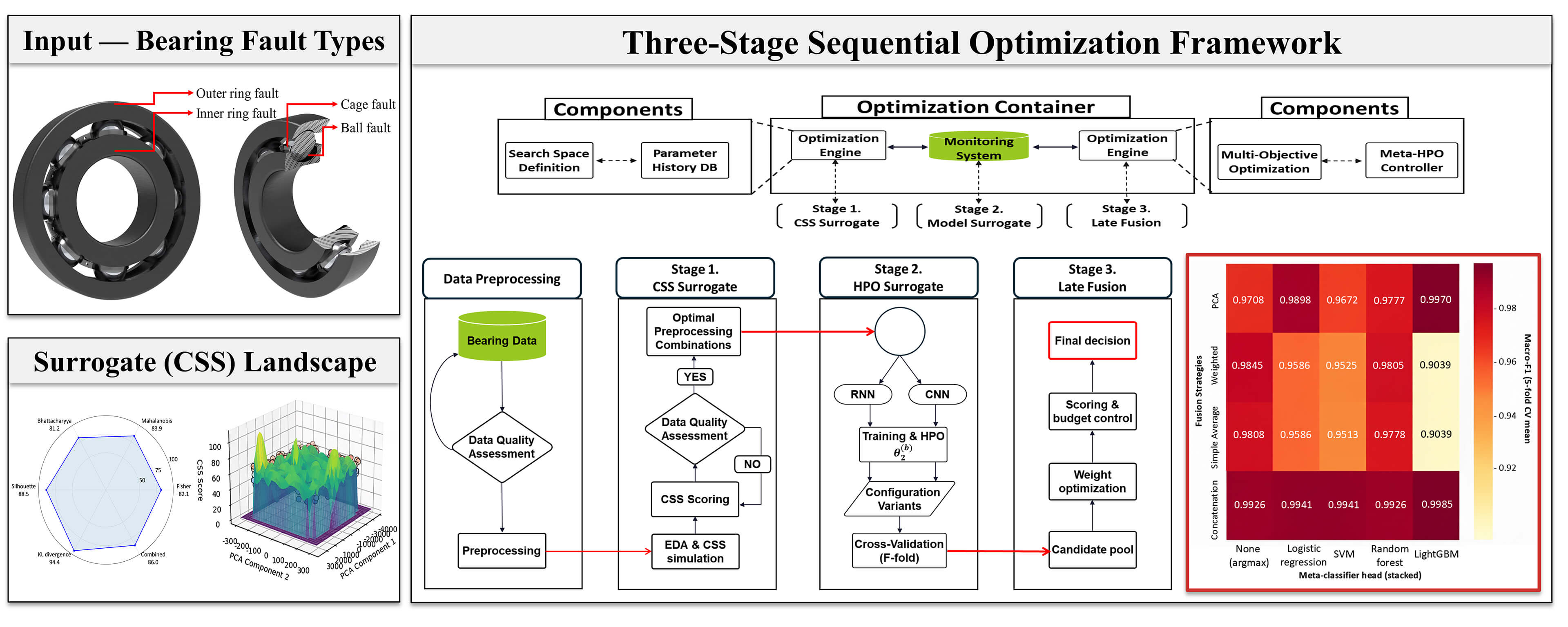
In bearing fault diagnosis for Prognostics and Health Management (PHM), the overall performance of data-driven models is strongly influenced by the coupled effects of preprocessing, model configuration, and decision fusion. However, these components are often optimized independently, resulting in fragmented workflows that limit global optimality, reproducibility, and computational efficiency of the model. This study presents a computationally unified three-stage sequential optimization framework that systematically coordinates the preprocessing selection, model hyperparameter optimization, and decision-level fusion within a consistent surrogate-based optimization architecture. In the first stage, candidate preprocessing schemes reflecting physical fault mechanisms—outer race, inner race, rolling element, and cage faults—are evaluated using a training-free Class Separability Score (CSS), which enables efficient screening without introducing model bias. In the second stage, the hyperparameters of two complementary architectures—an EfficientNetV2-based Convolutional Neural Network (CNN) operating in the time–frequency domain and a Gated Recurrent Unit (GRU)-based Recurrent Neural Network (RNN) operating in the time domain—are optimized independently by maximizing the cross-validated performance. In the third stage, a stacking-based late fusion model is constructed using out-of-fold posterior probabilities to learn the optimal decision rules that exploit cross-model complementarity. All stages are governed by a unified optimization container integrating Latin Hypercube Sampling (LHS), Kriging surrogate modeling with expected improvement, and Bayesian Optimization with Hyperband (BOHB), enabling surrogate-assisted exploration under multi-fidelity computational budgets. Numerical experiments on benchmark datasets, including Case Western Reserve University (CWRU) and MAFAULDA, demonstrate the stable convergence behavior of the sequential optimization process and consistent performance gains over single-model baselines. Reproducibility is ensured through fixed data partitions, random seeds, and normalization boundaries across all stages. The proposed framework provides a structured and reproducible computational modeling approach for bearing fault diagnosis, highlighting how coordinated optimization across multiple stages can improve the robustness and efficiency of complex PHM workflows.Graphic Abstract
Keywords
Cite This Article
 Copyright © 2026 The Author(s). Published by Tech Science Press.
This work is licensed under a Creative Commons Attribution 4.0 International License , which permits unrestricted use, distribution, and reproduction in any medium, provided the original work is properly cited.
 Downloads
 Citation Tools
