
 Login
Login Register
 Submit a Paper
 Propose a Special lssue
 Open Access
ARTICLE

Augmented Deep-Feature-Based Ear Recognition Using Increased Discriminatory Soft Biometrics
Department of Computer Science, Faculty of Computing and Information Technology, King Abdulaziz University, Jeddah, 21589, Saudi Arabia
* Corresponding Author: Emad Sami Jaha. Email:
(This article belongs to the Special Issue: Machine Learning and Deep Learning-Based Pattern Recognition)
Computer Modeling in Engineering & Sciences 2025, 144(3), 3645-3678. https://doi.org/10.32604/cmes.2025.068681
Received 04 June 2025; Accepted 11 August 2025; Issue published 30 September 2025
 View Full Text
 Download PDF
Abstract
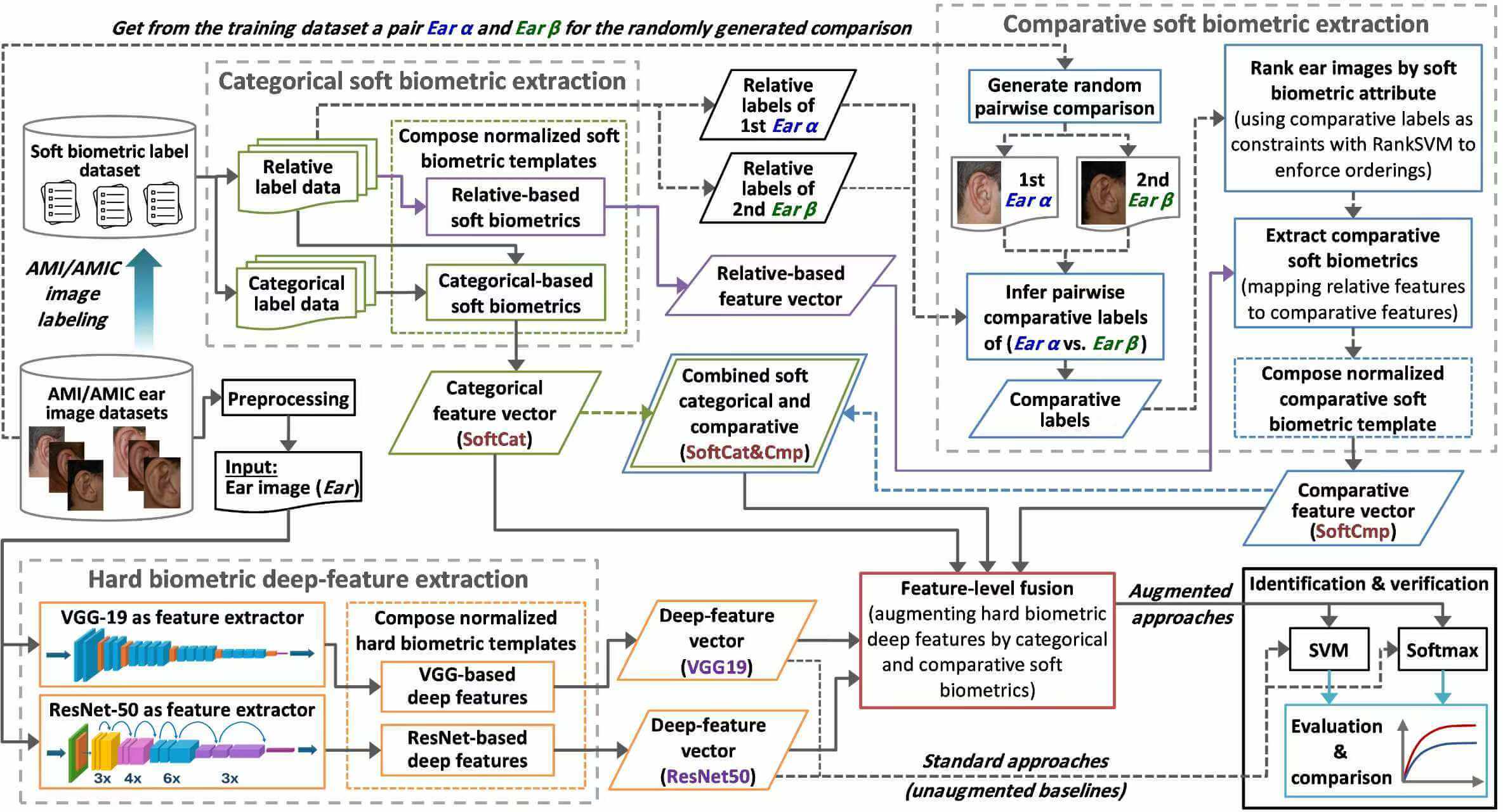
The human ear has been substantiated as a viable nonintrusive biometric modality for identification or verification. Among many feasible techniques for ear biometric recognition, convolutional neural network (CNN) models have recently offered high-performance and reliable systems. However, their performance can still be further improved using the capabilities of soft biometrics, a research question yet to be investigated. This research aims to augment the traditional CNN-based ear recognition performance by adding increased discriminatory ear soft biometric traits. It proposes a novel framework of augmented ear identification/verification using a group of discriminative categorical soft biometrics and deriving new, more perceptive, comparative soft biometrics for feature-level fusion with hard biometric deep features. It conducts several identification and verification experiments for performance evaluation, analysis, and comparison while varying ear image datasets, hard biometric deep-feature extractors, soft biometric augmentation methods, and classifiers used. The experimental work yields promising results, reaching up to 99.94% accuracy and up to 14% improvement using the AMI and AMIC datasets, along with their corresponding soft biometric label data. The results confirm the proposed augmented approaches’ superiority over their standard counterparts and emphasize the robustness of the new ear comparative soft biometrics over their categorical peers.Graphic Abstract
Keywords
Cite This Article
 Copyright © 2025 The Author(s). Published by Tech Science Press.
This work is licensed under a Creative Commons Attribution 4.0 International License , which permits unrestricted use, distribution, and reproduction in any medium, provided the original work is properly cited.
 Downloads
 Citation Tools
