
 Login
Login Register
 Submit a Paper
 Propose a Special lssue
 Open Access
REVIEW

A Comprehensive Review and Algorithmic Analysis of Histogram-Based Contrast Enhancement Techniques for Medical Imaging
1 School of Electrical Engineering and Computer Science, National University of Sciences and Technology, Islamabad, Pakistan
2 College of Engineering and Computing, American University of Bahrain, Riffa, Bahrain
3 Faculty of Computing and IT, Sohar University, Sohar, Sultanate of Oman
4 IRC for Finance and Digital Economy, King Fahd University of Petroleum and Minerals, Dhahran, Saudi Arabia
5 Department of Information Systems, College of Computer and Information Sciences, Princess Nourah bint Abdulrahman University, Riyadh, Saudi Arabia
6 Department of Computer Science, College of Computer Science and Information Systems, Najran University, Najran, Saudi Arabia
7 Immersive Virtual Reality Research Group, Department of Computer Science, King Abdulaziz University, Jeddah, Saudi Arabia
* Corresponding Authors: Maqbool Khan. Email: ; Wadee Alhalabi. Email:
Computer Modeling in Engineering & Sciences 2026, 146(3), 4 https://doi.org/10.32604/cmes.2026.074688
Received 16 October 2025; Accepted 09 February 2026; Issue published 30 March 2026
 View Full Text
 Download PDF
Abstract
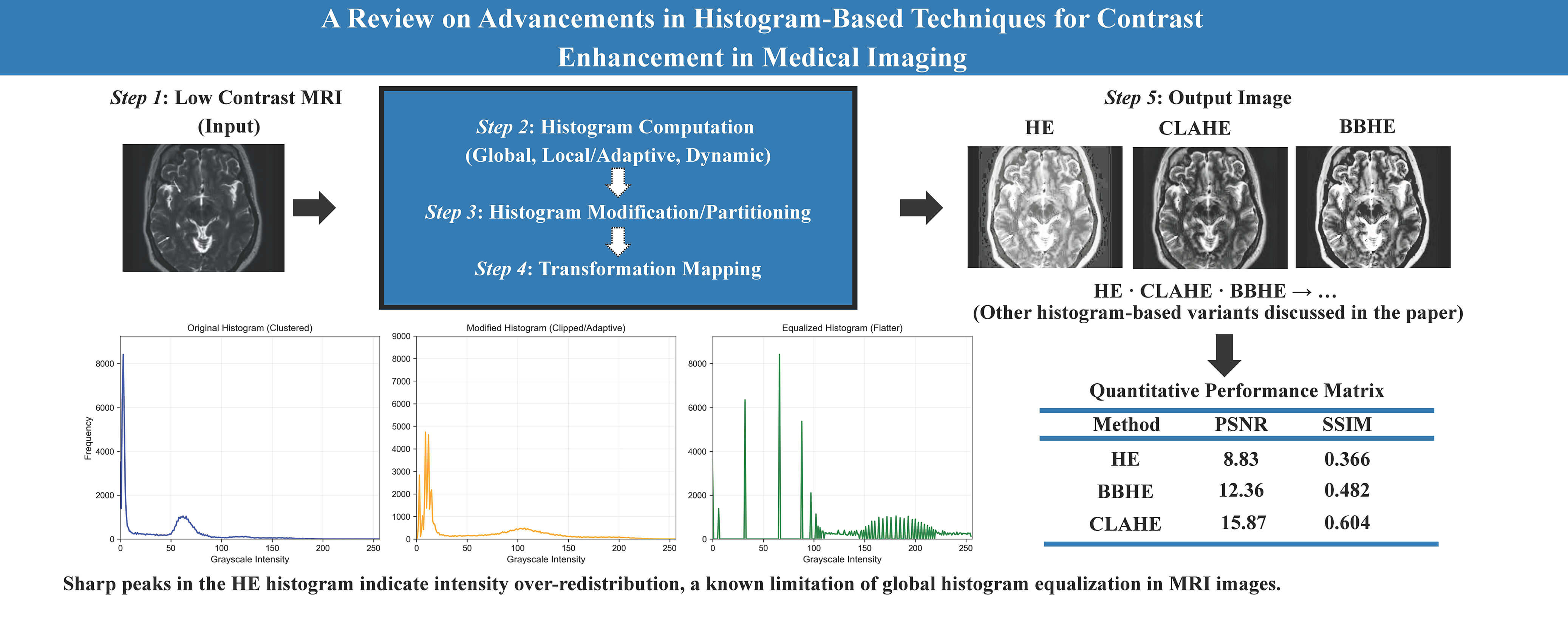
Medical imaging is essential in modern health care, allowing accurate diagnosis and effective treatment planning. These images, however, often demonstrate low contrast, noise, and brightness distortion that reduce their diagnostic reliability. This review presents a structured and comprehensive analysis of advanced histogram equalization (HE)-based techniques for medical image enhancement. Our review methodology encompasses: (1) classical HE approaches and related limitations in medical domains; (2) adaptive schemes like Adaptive Histogram Equalization (AHE) and Contrast Limited Adaptive Histogrma Equalization (CLAHE) and their advance variants; (3) brightness-preserving schemes like BBHE and MMBEBHE and related algorithms; (4) dynamic and recursive histogram equalization methods incorporating DHE and RMSHE; (5) fuzzy logic-based enhancement methodologies addressing uncertainty and noise in medical images; and (6) hybrid optimization methodologies through the application of metaheuristic algorithms (World Cup Optimization, Particle Swarm Optimization, Genetic Algorithms, along with histogram-based methodologies.) There is also a comparative discussion given based on contrast improvement, image brightness preservation, noise management, and computational efficiency. Such advancements have better capabilities of improving image quality, which is more important for improved diagnosis and image analysis.Graphic Abstract
Keywords
Cite This Article
 Copyright © 2026 The Author(s). Published by Tech Science Press.
This work is licensed under a Creative Commons Attribution 4.0 International License , which permits unrestricted use, distribution, and reproduction in any medium, provided the original work is properly cited.
 Downloads
 Citation Tools
