
 Login
Login Register
 Submit a Paper
 Propose a Special lssue
 Open Access
ARTICLE

Frequency-Selective Transmission Control of Ultrasonic Guided Waves in T-Shaped Pipes Using Acoustic Metamaterials: Computer Modeling and Experimental Validation
1 School of Mechanical and Automotive Engineering, South China University of Technology, Guangzhou, China
2 Department of Electromechanical Engineering and Center of Artificial Intelligence and Robotics, University of Macau, Macau, China
* Corresponding Author: Xiaobin Hong. Email:
(This article belongs to the Special Issue: Intelligent Dynamics Modeling, Predictive Operations & Maintenance, and Control Optimization for Complex Systems)
Computer Modeling in Engineering & Sciences 2026, 147(3), 15 https://doi.org/10.32604/cmes.2026.082376
Received 15 March 2026; Accepted 31 May 2026; Issue published 30 June 2026
 View Full Text
 Download PDF
Abstract
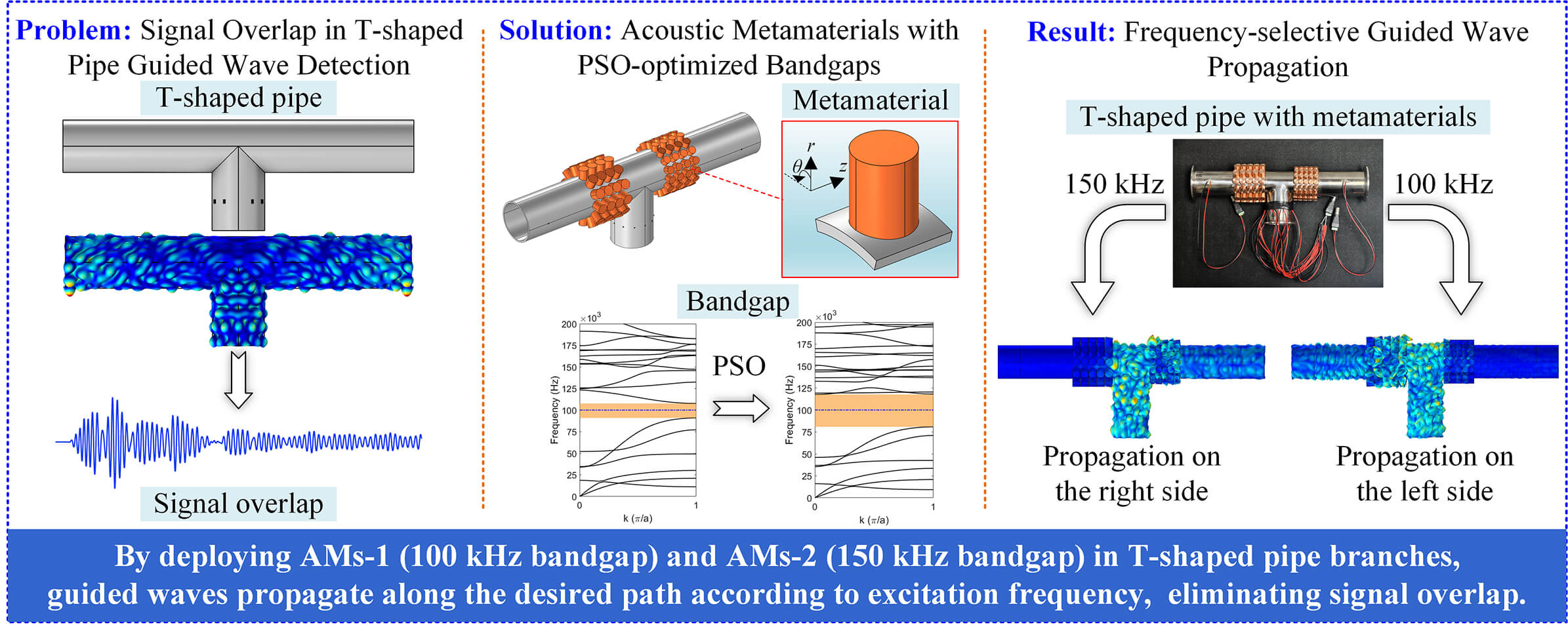
Structural health monitoring (SHM) of ship piping systems is a core component of predictive maintenance strategies for complex marine engineering systems. During the detection of ship T-shaped pipes using ultrasonic guided waves, signal overlap arises from the diffusion of guided wave branches. To address this issue, an intelligent wave-guidance mechanism based on acoustic metamaterials is proposed for dynamic propagation control of ultrasonic guided waves. First, a metamaterial unit composed of a stainless steel substrate and a copper column is designed. The control of bandgap characteristics by lattice constant, column diameter, and column height is systematically investigated, and a design range of structural parameters with optimal bandgap is obtained. The particle swarm optimization algorithm is used to design and optimize two metamaterials, Acoustic-metamaterials-1 (AMs-1) and Acoustic-metamaterials-2 (AMs-2), which further improve the bandgap performance and achieve a transmission loss of over 30 dB for guided waves at 100 and 150 kHz, respectively. Simulation and experimental verification show that when AMs-1 and AMs-2 are deployed in the left and right branches of the T-shaped pipe, respectively, wave propagation can be achieved according to the excitation frequency. At 100 kHz excitation, the guided wave preferentially propagates along the right branch, while at 150 kHz excitation, it preferentially propagates along the left branch. This method actively regulates the guided wave propagation trajectory at the structural level, thereby preventing signal overlap at the T-shaped pipe and offering a novel technical solution for the efficient damage detection and predictive maintenance in ship pipe systems.Graphic Abstract
Keywords
Cite This Article
 Copyright © 2026 The Author(s). Published by Tech Science Press.
This work is licensed under a Creative Commons Attribution 4.0 International License , which permits unrestricted use, distribution, and reproduction in any medium, provided the original work is properly cited.
 Downloads
 Citation Tools
