
 Login
Login Register
 Submit a Paper
 Propose a Special lssue
 Open Access
REVIEW

Xenosialylation as immunological chimerism: a host-centered unifying model for viral and post-vaccination immune complications
1 Independent Researcher, Rome, Italy
2 School of Bioscience and Veterinary Medicine, University of Camerino, Macerata, Italy
* Corresponding Author: Fiorella Carnevali. Email:
(This article belongs to the Special Issue: Inflammation and Cytokine Biology in Chronic Diseases: Mechanisms and Therapeutic Targets)
European Cytokine Network 2026, 37(2), 55-77. https://doi.org/10.32604/ecn.2026.082188
Received 12 March 2026; Accepted 29 May 2026; Issue published 30 June 2026
 View Full Text
 Download PDF
Abstract
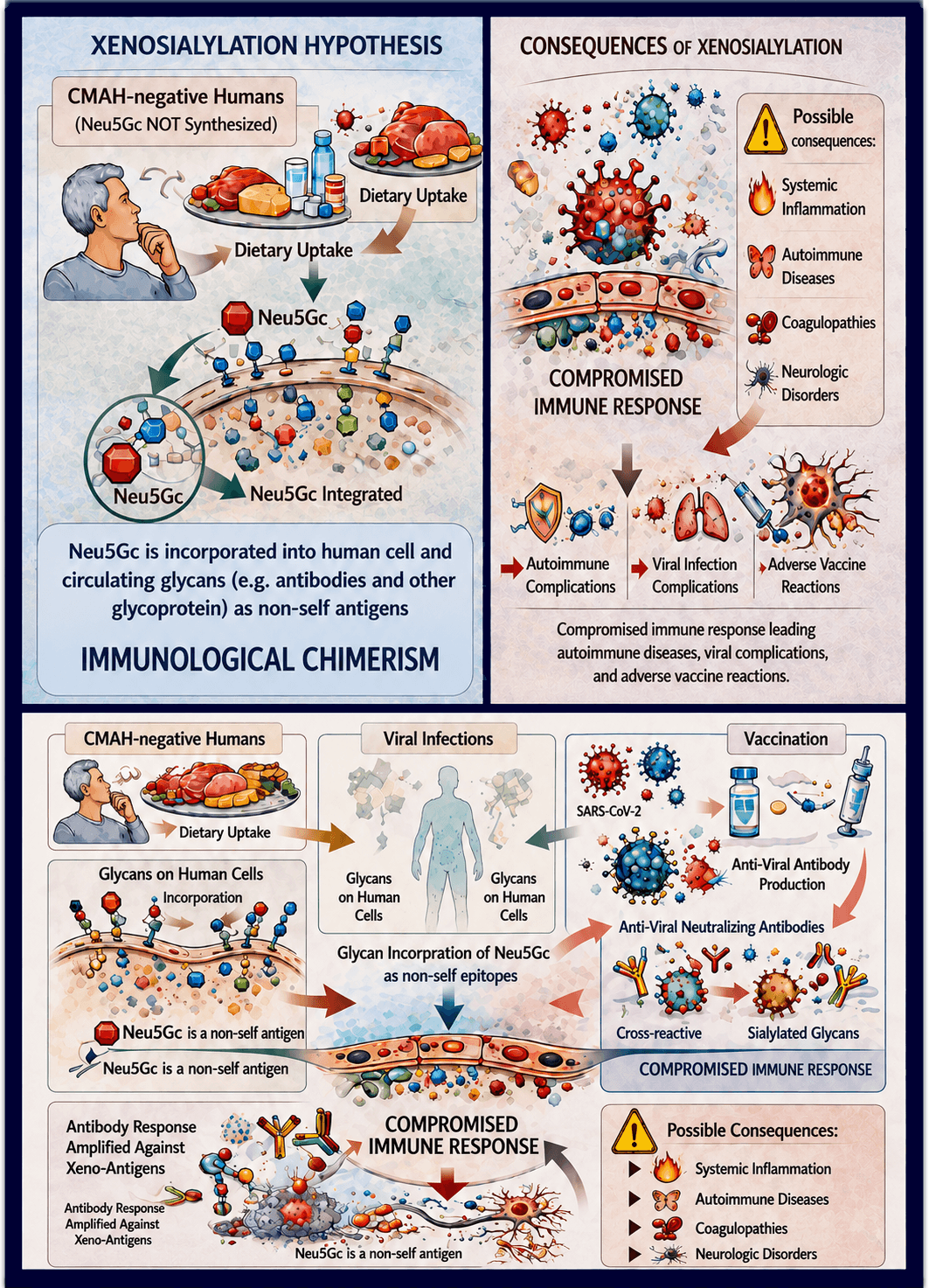
Severe immune-mediated complications following viral infections and vaccinations, including COVID-19 and anti–SARS-CoV-2 immunization, display remarkable clinical overlap despite occurring in distinct biological contexts. In a previous hypothesis-driven work, we proposed that metabolic incorporation of the non-human sialic acid N-glycolylneuraminic acid (Neu5Gc) into human glycoconjugates—defined as xenosialylation—may contribute to post-infectious and post-vaccination immune dysregulation. We further suggest that this phenomenon may represent a form of “immunological chimerism”, in which host glycoconjugates incorporate non-self molecular structures that predispose the immune system to varying degrees of immune imbalance. In its most severe manifestation, this process may culminate in a profound state of immune dysregulation characterized by loss of immune tolerance, aberrant antibody responses, cytokine storm, and thrombo-inflammatory pathology, which we define as “immunological marasmus”. In the present paper, we extend this conceptual framework by integrating glycobiology, Fc immunoglobulin glycosylation, endothelial biology, and sex-dependent immune regulation into a unified, testable immunopathogenic model. We hypothesize that interindividual differences in the extent, tissue distribution, and persistence of xenosialylation may influence susceptibility to exaggerated innate and adaptive immune responses following antigenic challenge. In this context, immune activation may unmask pre-existing xeno-sialylated self-structures embedded within host glycans, promoting varying degrees of glycan dysregulation, autoantibody production, immunothrombosis and chronic inflammatory sequelae. We further propose circulating anti-Neu5Gc antibodies as functional biomarkers for risk stratification and outline preventive strategies based on dietary modulation of xenosialic acid exposure. Taken together, this expanded model provides a potential mechanistic framework for understanding the shared immunological features of post-viral syndromes and vaccine-related adverse immune reactions, while offering a basis for experimental validation and future approaches to personalized risk mitigation.Graphic Abstract
Keywords
Cite This Article
 Copyright © 2026 The Author(s). Published by Tech Science Press.
This work is licensed under a Creative Commons Attribution 4.0 International License , which permits unrestricted use, distribution, and reproduction in any medium, provided the original work is properly cited.
 Downloads
 Citation Tools
