
 Login
Login Register
 Submit a Paper
 Propose a Special lssue
 Open Access
ARTICLE

Maternal Mental Health Literacy and Preschoolers’ Emotional Regulation Ability: A Chain Mediation of Depression and Democratic Parenting
1 Faculty of Education, Baoji University of Arts and Sciences, Baoji, 721013, China
2 Faculty of Teacher Education, Lishui University, Lishui, 323000, China
3 Faculty of Education, Universiti Malaya, Kuala Lumpur, 50603, Malaysia
* Corresponding Author: Yuwei Li. Email:
(This article belongs to the Special Issue: Depression Across the Lifespan: Perspectives on Prevention, Intervention, and Holistic Care)
International Journal of Mental Health Promotion 2026, 28(2), 9 https://doi.org/10.32604/ijmhp.2025.072905
Received 06 September 2025; Accepted 28 November 2025; Issue published 27 February 2026
 View Full Text
 Download PDF
Abstract
Background: Maternal mental health literacy is a cognitive resource that may support preschoolers’ emotional development, yet its influence on emotional regulation and the related mechanisms remains unclear. This study examined whether maternal depressive mood and democratic parenting form a chain pathway linking maternal mental health literacy to preschoolers’ emotional regulation ability. Methods: Mothers of 544 preschoolers in mainland China completed an online questionnaire that assessed maternal mental health literacy, depressive mood, democratic parenting, and child emotional regulation. Structural path analysis was conducted with child age and gender controlled. Indirect effects were tested using 5000 bootstrap samples. Results: Maternal mental health literacy did not directly predict preschoolers’ emotional regulation. Three indirect effects were significant. The pathway through depressive mood had an effect of 0.005, the pathway through democratic parenting had an effect of 0.004, and the chain pathway through depressive mood and democratic parenting had an effect of 0.002. All confidence intervals excluded 0. Conclusion: Maternal mental health literacy influences preschoolers’ emotional regulation only through maternal depressive mood and democratic parenting, indicating that cognitive resources affect child emotional outcomes through emotional and behavioral processes rather than a direct pathway.Keywords
Supplementary Material
Supplementary Material FileMental health literacy (MHL) refers to the knowledge system and belief structure of individuals to identify, understand, prevent, and intervene in psychological disorders [1], and is widely regarded as a key cognitive resource to promote psychological adaptation and enhance the willingness to use psychological services. In adolescent and adult samples, a large number of studies have shown that the improvement of MHL levels can help reduce psychological distress, improve emotional regulation ability (ERA), and help-seeking behavior [2,3]. However, current research focuses on the path of “the patient himself”, and rarely explores whether the knowledge resources of MHL owners can be smoothly transformed into effective parenting behaviors to support the deep mechanism of children’s psychological development when they are the primary caregivers of preschoolers.
In recent years, parental MHL has garnered increasing scholarly attention as a key factor influencing children’s psychological and emotional development [4,5]. These studies have shown that higher levels of parental MHL are associated with more adaptive parenting behaviors and better child development outcomes. However, most of these studies have focused on parents of adolescents, while research on preschoolers, who are in a critical period of emotional development, remains limited. Therefore, rather than simply introducing a new variable, this study builds on existing research, specifically focusing on mothers of preschoolers and elaborating on the inherent transformational pathway from cognitive literacy to parenting practices.
In existing literature, MHL is usually regarded as a cognitive resource at the individual level, and research focuses on how it affects one’s own emotion regulation, stigma cognition or willingness to help others [6,7]. Although some studies have initially focused on the impact of parents’ psychological knowledge on children’s development [8,9], most of them still lack the discussion of the transformation mechanism, especially the lack of research that places MHL in the parenting context and systematically analyzes how it affects children’s psychological development through the caregivers’ emotional state and parenting behavior. Although there are many studies on the effects of depression and parenting style on children’s emotional development, they are usually treated as isolated variables [10,11], and fail to integrate them into the theoretical path as mediating mechanisms for the realization of MHL functions. More importantly, while existing studies have recognized parental MHL as an important psychological resource, few have examined how it operates through multiple levels of transformation, cognition, emotion, and behavior to influence child outcomes in early developmental stages.
In summary, the current literature still has theoretical gaps and empirical deficiencies at multiple key levels. First, existing studies have mostly focused on the impact of MHL on individuals themselves, and rarely placed it in the parenting system to examine its indirect path to preschoolers’ development. Secondly, although the mother’s depression and parenting style have been proven to be closely related to the emotional development of children, the two have not yet been integrated into a unified theoretical model as a mediating mechanism for the realization of MHL functions. Third, there is still a lack of systematic chain path modeling of how MHL completes its functional transformation through emotional state regulation and parenting behavior output. Finally, despite growing attention to parental MHL, its operation in the early family context, particularly among mothers of preschoolers, remains underexplored. The above deficiencies together constitute the entry point of this study.
Taking mothers as an example, preschoolers are highly dependent on their mothers’ emotional modeling, regulatory support, and behavioral discipline in emotional development [12,13]. Emotional socialization theory provides us with an important perspective: the development of children’s emotional ability not only stems from internal maturity, but is also deeply influenced by the caregiver’s emotional expression and parenting style. Building on Eisenberg’s model of emotion socialization [14], this study extends the theoretical framework upward to the cognitive level by proposing maternal MHL as a cognitive antecedent in the emotion socialization process. Whereas Eisenberg’s model primarily focuses on how parents’ emotional states and behaviors influence children’s outcomes, our framework highlights how mothers’ psychological knowledge and beliefs regulate their emotional states and guide subsequent parenting behaviors. In this way, the proposed “cognition–emotion–behavior–development” pathway can be regarded as a conceptual extension of the traditional emotion socialization model, integrating cognitive resources into the emotional mechanism of parenting. This suggests that when studying the impact of maternal MHL on children’s development, we cannot stop at the cognitive level, but also need to reveal how it can be transformed into parenting behavior through the family emotional interaction mechanism.
Existing studies have consistently found that mothers’ mental state and parenting behavior have a key impact on children’s emotional development [15,16]. However, there is still a lack of systematic research to reveal how mothers’ MHL is accepted by emotional mechanisms in the family system and affects children through specific parenting behaviors. This transformation mechanism from cognitive resources to behavioral output may be more complex and more conditional than the “cognition directly affects behavior” assumed in previous studies.
This study proposes that whether a mother’s MHL can support preschoolers’ psychological development depends on whether it undergoes a multi-level path of transformation: the chain path of “cognitive capital-emotional state-parenting behavior-developmental outcomes”. In this model, MHL does not automatically transform into high-quality parenting behavior, and its role depends on the regulation of the emotional system and the execution of behavioral mechanisms. For example, if the mother herself has a high level of depression, the mobilization of her psychological resources may be hindered, making it difficult to externalize into high-quality emotional responses and democratic parenting styles (DPS). This “cognition-emotion-behavior” transformation mechanism reveals the key conditionality of the realization of MHL functions and may explain the mother’s dilemma of “knowing but not being able to act” in reality.
In this chain, the mother’s depression may constitute a blocking mechanism for the transformation of cognitive resources. Studies have shown that maternal depression not only affects her sensitivity and positive response to children’s emotions, but also weakens her ERA, making it more difficult for her to implement rational parenting strategies [17,18]. Therefore, whether MHL can be transformed into effective parenting behavior may be highly dependent on the stability of the mother’s emotional system. Equally important, DPS, as an important behavioral expression of emotional functioning, is the key behavioral pathway through which psychological resources are transformed into parenting practices. This style emphasizes warmth and open communication [19], and has been proven to help create a safe environment for emotional expression and promote the development of preschoolers’ ERA [20,21]. However, the stable implementation of this parenting style is also limited by the mother’s emotional state and ability to allocate psychological resources. Therefore, parenting style should not be regarded as an independent variable, but should be understood as an important behavioral channel for whether MHL is successfully externalized.
Based on the above theoretical integration and empirical evidence, this study constructs a chain mediation model to explore whether mothers’ MHL indirectly affects preschoolers’ ERA through their depression and DPS. This study not only focuses on the statistical path between variables, but also attempts to reveal how psychological knowledge completes the transformation process of its practical function within the family emotional system. The specific hypotheses are as follows:
Hypothesis 1 (H1): Mothers’ MHL is positively correlated with preschoolers’ ERA.
Hypothesis 2 (H2): Mothers’ depression mediates between MHL and preschoolers’ ERA.
Hypothesis 3 (H3): Mothers’ DPS mediates between MHL and preschoolers’ ERA.
Hypothesis 4 (H4): Mothers’ depression and DPS constitute a chain mediation mechanism in this path.
This study uses mainland Chinese mothers as the research subjects and uses structural path analysis to verify the above mechanism model, aiming to expand the theoretical applicability of MHL in the family field and provide mechanism evidence and structural support for the development of evidence-based psychological intervention strategies for parents.
This study used a convenience sampling method to recruit mothers from mainland China through the online questionnaire platform Wenjuanxing. Data collection was conducted from June to August 2024. A total of 574 questionnaires were collected, of which 544 were valid. The subjects had to meet the following conditions: (1) be the primary caregiver of the child; (2) complete all questionnaires; (3) be the mother. Cases with any missing responses were excluded listwise before analysis, as the focus was on complete data to ensure the internal consistency and comparability of path modeling results. Missingness was minimal (<5%) and did not show systematic patterns across demographic variables. To ensure data quality, invalid questionnaires filled out by non-mothers and those that took less than two minutes to answer were excluded.
Participants’ demographic information is presented in Table 1. The sample consisted of 544 mothers of preschoolers (aged 3–6 years, Mean = 4.76, standard deviation [SD] = 1.08) recruited from 22 provinces across eastern, central, and western China through the Wenjuanxing online platform. Among them, 51.84% were male and 48.16% were female. Most respondents lived in urban or suburban areas. In terms of education, 11.95% of mothers had a high school diploma or below, 63.06% held a bachelor’s degree, and 25.00% had a master’s degree or above. Household monthly income varied from below RMB 5000 to above RMB 20,000, indicating moderate socioeconomic diversity within the sample.
Table 1: Sociodemographic characteristics of the participants (N = 544).
| Variable | Category | Percentage (%) |
|---|---|---|
| Child gender | male | 51.84 |
| female | 48.16 | |
| Maternal education | High school or below | 11.95 |
| Bachelor’s degree | 63.06 | |
| Master’s degree or above | 24.99 | |
| Household income (RMB/month) | <5000 | 14.16 |
| 5000–10,000 | 36.03 | |
| 10,001–20,000 | 33.46 | |
| >20,000 | 16.35 | |
| Residence | Urban/suburban | 78.68 |
| Rural | 21.32 |
The study obtained ethical approval from the Faculty of Teacher Education of Lishui University, and all participants confirmed that they were informed and voluntary before filling out the questionnaire. Although the Wenjuanxing platform reaches participants from different provinces, the majority of respondents were from urban areas and had relatively higher educational backgrounds, which should be considered when interpreting the findings.
The Multidimensional Mental Health Literacy Questionnaire (MMLQ) developed by Jung et al. [22] and revised by Ming et al. [23], was used to assess MHL in adults. The Chinese version of the MMLQ has demonstrated good reliability and validity and can be used as a tool for assessing MHL in Chinese adults. Based on Jorm’s core definition of MHL, the MMLQ measures individuals’ cognitive levels of mental health knowledge, beliefs, and resource acquisition. The questionnaire consists of three dimensions: knowledge (10 items), beliefs (8 items), and resource cognition (4 items). For example, one item states, “Psychological counseling and psychotherapy are effective treatments for depression.” The knowledge dimension is positively scored, the beliefs dimension is negatively scored, and the resource dimension consists of true/false questions. Scores for each dimension are calculated and summed to form a total score, ranging from 0 to 22, with higher scores indicating higher levels of mental health literacy. In this study, individual dimensions were not modeled separately; the overall total score was used as the observed variable in the structural path model. The MMLQ demonstrated good internal consistency in this sample (Cronbach’s α = 0.76).
2.2.2 Self-Rating Depression Scale
The Chinese version of the Center for Epidemiological Survey Depression Scale (CES-D) compiled by Radloff [24] was used to assess the mothers’ self-rated depression level. The questionnaire includes 20 items, such as “I feel lonely,” scored using a four-point frequency scale (0 = almost never, 3 = most of the time), and questions 4, 8, 12, and 16 are reverse-scored items. The higher the total score of the scale, the higher the level of depression. The internal consistency of the scale in this study was Cronbach’s α = 0.74, which was within the acceptable range.
The “DPS” subscale of the Parenting Style Questionnaire compiled by Yang et al. [25] was used for measurement. This dimension contains 10 items, which are scored using a five-point Likert scale (1 = never, 5 = always). For example, “Praise or reward the child in an appropriate way.” A higher score indicates a higher frequency of democratic parenting behavior. This study focuses on the total score of this dimension as the observed variable in the path model. The internal consistency coefficient of this subscale is Cronbach’s α = 0.72. This subscale has been widely used and repeatedly validated in Chinese samples over the past two decades [26,27]. These studies consistently support its stable factorial structure and cultural applicability in assessing democratic parenting among Chinese parents. Given its theoretical coherence, long-term cultural validation, and adequate reliability in this study, the measure remains an appropriate and psychometrically sound tool for the current research context.
2.2.4 Emotion Regulation Checklist
The Emotion Regulation Checklist (ERC) compiled by Shields and Cicchetti was used, and the localized version was revised by Zhu et al. [28]. The revised scale includes two dimensions: emotion regulation (8 items) and emotional instability/negativity (13 items), with a total of 21 items, and the scoring adopts a four-point scale (1 = completely inconsistent, 4 = completely consistent). Such as “his/her emotions change quickly.” Some of the items are reverse-scored. The higher the score of the emotion regulation dimension, the better the child’s ERA; the higher the score of the emotional instability/negativity dimension, the more difficult the regulation. This study only uses the total score of the “emotion regulation” dimension for analysis. The internal consistency of this dimension is Cronbach’s α = 0.70.
2.3 Procedure and Data Analysis
SPSS 26.0 (IBM Corp., Armonk, NY, USA) was used for descriptive statistics, correlation analysis, Pearson correlations, and Harman’s single-factor method to assess common method bias. Structural equation model analysis was performed using PROCESS Model 6 to construct a chain mediation model to test the indirect effect of maternal MHL on preschoolers’ ERA through depression level and DPS. The model was fitted using the maximum likelihood estimation method, and the indirect effect was obtained by 5000 bootstraps to obtain a 95% confidence interval.
Since this study used a self-assessment questionnaire from mothers to collect all variable data, there may be common method bias. To reduce this bias, anonymous data was used in the research design, and the confidentiality of the data and the purpose of the research were emphasized in the instructions. At the same time, the Harman single-factor test was used to evaluate potential bias. The results showed that a total of 17 factors with characteristic roots greater than 1 were extracted, and the total variance explained by the first factor was 11.05%, which was far below the critical standard of 40%, indicating that common method bias posed little threat to the results of this study.
3.2 Descriptive Statistics and Correlation Analysis
The means, SDs, and correlation coefficients of the main variables are presented in Table 2. Biserial correlations were calculated for the dichotomous gender variable, and Pearson’s correlations were used for continuous variables. Maternal MHL was significantly positively correlated with DPS (r = 0.14, p < 0.01) and preschoolers’ ERA (r = 0.09, p < 0.01). Depression was significantly negatively correlated with MHL (r = −0.09, p < 0.05) and significantly positively correlated with DPS (r = 0.41, p < 0.001). Depression was negatively correlated with preschoolers’ ERA (r = −0.31, p < 0.001). DPS was positively correlated with preschoolers’ ERA (r = 0.28, p < 0.001). preschoolers’ gender had no significant correlation with other main variables.
Table 2: Descriptive statistics and correlation analysis results.
| Variable | Mean ± SD | MHL | Depression | DPS | ERA | Gender of Preschoolers | Age of Preschoolers (Months) |
|---|---|---|---|---|---|---|---|
| MHL | 10.64 ± 4.28 | 1 | |||||
| Depression | 34.08 ± 7.57 | −0.09* | 1 | ||||
| DPS | 36.74 ± 5.39 | 0.14** | 0.41*** | 1 | |||
| ERA | 21.44 ± 3.01 | 0.09** | −0.31*** | 0.28*** | 1 | ||
| Gender of preschoolersa | — | 0.04 | −0.02 | −0.004 | 0.04 | 1 | |
| Age of preschoolers (months) | 53.26 ± 8.14 | −0.07 | 0.10 | 0.05 | 0.08 | 0.03 | 1 |
3.3 Chain Mediation Model and Effect Analysis
In order to examine the impact path of maternal MHL on preschoolers’ ERA, this study used the PROCESS macro (Model 6) to construct a chain mediation model, setting maternal MHL as the independent variable, maternal depression and DPS as the mediating variables, and preschoolers’ ERA as the dependent variable, while controlling for preschoolers’ gender and age. As shown in Fig. 1, the results of path analysis showed that maternal MHL significantly negatively predicted depression (β = −0.02, SE = 0.01, p <0.05), and significantly positively predicted DPS (β = 0.02, SE = 0.01, p <0.01); depression significantly negatively predicted DPS (β = −0.40, SE = 0.04, p < 0.001), and significantly negatively predicted preschoolers’ ERA (β = −0.24, SE = 0.05, p < 0.001); DPS significantly positively predicted preschoolers’ ERA (β = 0.18, SE = 0.05, p <0.001). The direct path of maternal MHL to preschoolers’ ERA was not significant (β = 0.01, SE = 0.01, p = 0.24), indicating that its influence was mainly exerted its influence through the mediating path.
The bootstrap method (5000 resamples) was further used to test the indirect effect. The results showed that the three mediation paths were significant: the first was the indirect path through the mother’s depression (β = 0.005, 95% CI [0.000, 0.010]), the second was the path through DPS (β = 0.004, 95% CI [0.001, 0.009]), and the third was the chain path through “depression → DPS” (β = 0.002, 95% CI [0.000, 0.003]). The confidence intervals of the three paths did not contain 0, indicating that the mediation effect was significant, explaining 22.73%, 18.18% and 9.09% of the total effect, respectively. The total mediation effect was β = 0.011 (SE = 0.004, 95% CI [0.003, 0.019]), accounting for 50.00% of the total effect; the direct effect was not significant. In summary, the results supported H2, H3, and H4, while H1 was not supported. Table 3 shows the detailed statistical analysis results, while Fig. 1 intuitively presents the structural model of the chain mediation effect. Confidence intervals were obtained from 5000 bootstrap samples using the PROCESS macro for SPSS and are displayed to three decimal places. Values of 0.000 reflect rounding in the output and are not exact zeros.
Table 3: The sequential mediation effect and effect size of maternal MHL on preschoolers’ ERA.
| Path | Effect Value | Boot SE | Boot CI (95%) | Effect Size |
|---|---|---|---|---|
| Direct Effect (C’) | 0.01 | 0.01 | [−0.010, 0.240] | 50.00% |
| MHL—Depression—ERA(C1) | 0.005 | 0.003 | [0.000, 0.010] | 22.73% |
| MHL—DPS—ERA (C2) | 0.004 | 0.002 | [0.001, 0.009] | 18.18% |
| MHL—Depression—DPS—ERA(C3) | 0.002 | 0.001 | [0.000, 0.003] | 9.09% |
| Total Indirect Effect | 0.011 | 0.004 | [0.003, 0.019] | 50.00% |
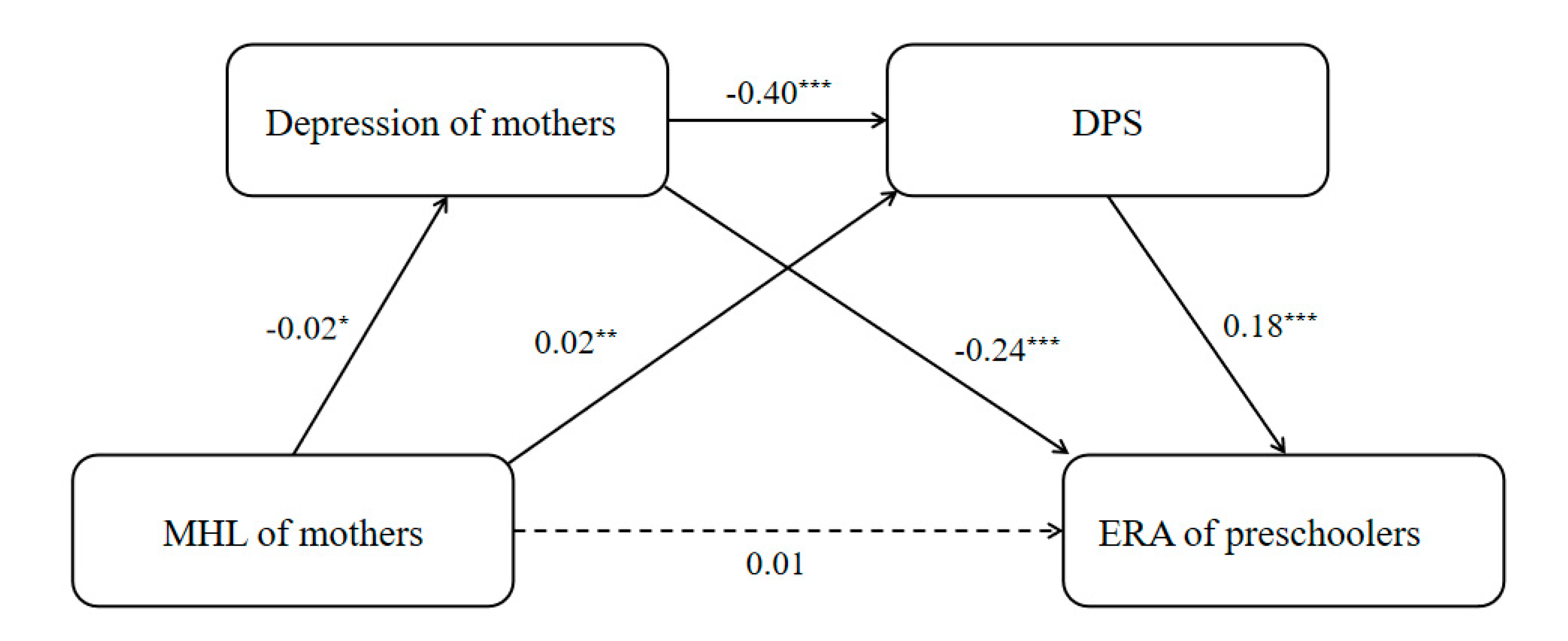
Figure 1: The sequential mediation model of maternal depression and DPS between maternal MHL and preschoolers’ ERA. Note: *p < 0.05, **p < 0.01, ***p < 0.001. Analysis was conducted using the PROCESS macro (Model 6, 5000 bootstrap samples). Abbreviations: DPS, democratic parenting style; MHL, mental health literacy; ERA, Emotional regulation ability.
This study constructed and verified a chain mediation model under the framework of emotion socialization theory, systematically revealing how maternal MHL indirectly affects preschoolers’ ERA through their depression and DPS. The results of this study show that maternal MHL cannot directly predict preschoolers’ ERA, but needs to be transformed through emotional and behavioral mechanisms. This finding challenges the linear rational assumption of “direct transformation of cognition into behavior” implicit in existing MHL research, and points out that the actual function of MHL needs to meet a series of psychological and behavioral conditions, which constitutes a revision of the structural understanding of existing literature. In the following sections, we discuss the results for all four hypotheses, including the nonsignificant direct effect proposed in Hypothesis 1 and the three mediation hypotheses concerning maternal depression, DPS, and their combined chain pathway.
The non-significant direct effect of maternal MHL on preschoolers’ emotional regulation (H1 not supported) provides a theoretically meaningful insight when viewed through the lens of emotion socialization theory. According to Eisenberg’s emotion socialization model [14], children’s emotional ability is primarily shaped through caregivers’ emotional expressions, reactions, and emotion-related discussions rather than directly by parents’ cognitive knowledge [29]. In extending this model, the current study conceptualized mothers’ MHL as a higher-order cognitive antecedent that indirectly influences children’s emotional development through emotion and behavior-based mechanisms. The absence of a direct MHL and ERA link thus supports the theoretical expectation that cognitive literacy alone is insufficient to affect children’s emotional outcomes without being embodied in parents’ emotional regulation and daily interaction patterns. This finding refines Eisenberg’s model by empirically demonstrating that cognitive factors operate upstream in the socialization chain, exerting their impact only when transformed through emotional and behavioral channels. In this sense, the null effect is not a theoretical failure but rather evidence for the necessity of a multi-level “cognition–emotion–behavior–development” pathway in explaining how maternal characteristics shape preschoolers’ ERA.
At the same time, it is also necessary to critically reflect on the construct validity of maternal MHL itself. MHL primarily represents mothers’ cognitive understanding of mental health concepts rather than their direct competence in emotional socialization. Although a higher level of MHL may indicate richer psychological knowledge, it does not automatically translate into effective parenting practices or emotion-related guidance behaviors. This conceptual distinction is particularly important when examining preschoolers’ ERA, as the emotional development of preschoolers relies more on caregivers’ daily emotional interactions, modeling, and responsiveness than on their cognitive awareness alone [30,31]. In this study, maternal MHL was therefore positioned as a cognitive antecedent within the “cognition–emotion–behavior–development” chain, with depression and DPS serving as the emotional and behavioral bridges that enable psychological knowledge to be transformed into practical competence. This design acknowledges that the validity of MHL lies not in its direct behavioral outcomes but in its potential to influence maternal functioning through emotional and behavioral mediators.
Previous studies on MHL, especially at the level of adolescents and adults, often emphasize its direct predictive value for mental health behavior [32], and most of the research hypotheses are based on the linear path model of “sufficient cognition → behavioral improvement” [33]. However, this path structure is not completely established in the family parenting system. In recent years, some studies have begun to note that the impact of MHL on parent groups may be mediated by other factors [4,5], but systematic modeling is still relatively scarce. The chain mediation model of this study is a response to this theoretical rupture. A more integrated perspective is offered in this study by connecting four levels of variables in series, namely cognition emotion behavior development, to illustrate how the function of MHL is filtered through the emotional system and expressed through the behavioral system. This path not only deepens the understanding of the mechanism of MHL but also helps to explain the common phenomenon of “sufficient knowledge but poor parenting effect” in reality.
The study further shows that depression plays a key role as a “psychological filter” in this path. Depression, as a negative emotional state, not only affects mothers’ ability to recognize children’s emotional signals [34], but also damages their will resources to perform parenting behaviors, thereby blocking the externalization of cognitive resources [35,36]. This result is consistent with existing research, suggesting that when mothers experience depressive symptoms, their cognitive resources related to MHL may not be effectively translated into parenting behaviors. In other words, the stability of the emotional system may serve as a key condition for whether MHL can be transformed into effective family practices. Taken together, these findings indicate that maternal depression functions as a significant mediator between maternal MHL and preschoolers ERA, which is consistent with H2.
The key role of parenting style, especially DPS, in the model has also been verified. This study not only reaffirms the positive effect of DPS on preschoolers’ ERA, but also further points out that it is a behavioral reflection of the mother’s psychological state rather than a fixed personality tendency. Existing studies have shown that parenting behavior is significantly affected by the emotional state of parents [37] and the status of psychological resources [38]. The stable implementation of DPS requires mothers to have cognitive knowledge of mental health and a certain degree of self-regulation ability in emotions, so as to form a parenting interaction style with high empathy and high responsiveness. Therefore, this study redefines parenting style as “an overt behavioral indicator of the degree of integration of the psychological system,” providing a procedural explanation for the field’s long-standing static classification of “parenting types,” and also echoes the recent emphasis on parenting style as a dynamic socialization strategy system [39]. In this regard, democratic parenting behaviors operate as a behavioral bridge that links maternal MHL to preschoolers ERA, providing empirical support for H3.
Although the chain mediation effect sizes were relatively small (e.g., 9.09% for the full chain), this does not necessarily undermine the theoretical or practical value of the findings. In complex psychosocial processes such as parenting and emotion socialization, indirect effects are often modest because they involve multiple levels of psychological transformation from cognition to behavior [40,41]. The present study aimed not to test the magnitude of clinical change but to clarify the underlying mechanism through which maternal MHL exerts its influence on preschoolers’ ERA. From this perspective, even small effect sizes can indicate meaningful and systematic pathways that operate in daily family contexts. Moreover, the statistical significance and theoretical coherence of the “cognition–emotion–behavior–development” chain provide an important foundation for future intervention research. Subsequent studies can further evaluate whether strengthening mothers’ MHL may yield practically significant improvements in preschoolers’ emotional outcomes. Moreover, the significant indirect effect observed for the full cognitive emotional behavioral chain shows that maternal depression and DPS jointly construct a sequential mediation pathway from MHL to preschoolers ERA, thereby supporting H4.
Importantly, small indirect effects should be interpreted in light of their cumulative and preventive impact in early development. Even minimal improvements in maternal emotion regulation or parenting sensitivity can have meaningful benefits for preschoolers’ emotional adjustment when they occur consistently over time. Previous large-scale longitudinal studies have shown that small standardized indirect effects (β ≈ 0.01–0.05) often lead to noticeable developmental differences when maintained across many daily interactions [42]. In this sense, the present findings, although statistically small, identify an important leverage point for early intervention. Enhancing mothers’ emotional functioning and parenting style can gradually accumulate into observable developmental gains in children’s emotional regulation. The practical relevance of these effects lies not in their immediate magnitude but in their potential to guide scalable and low-intensity parenting programs that focus on emotion-related processes within families.
It is worth further discussion that the model of this study is based on a “mother-led” mechanism, emphasizing the key role of mothers in early emotional development. However, developmental psychology has long proposed that children are active individuals who have the ability to reversely regulate and construct the family environment. For example, differences in parental parenting behaviors are related to children’s temperament [43,44]. In this study, although the gender and age of preschoolers were controlled, the variables of preschoolers’ traits were not systematically included. Future research can start from the perspective of “parent-child collaborative modeling” to construct a two-way path model to further explore the dynamic interactive relationship between preschoolers and mothers in the process of psychological resource transformation.
Using emotion socialization theory as its core framework, this study constructed and validated a chain mediation model of the impact of maternal MHL on preschoolers’ ERA, systematically revealing the “cognition-emotion-behavior-development” pathway. The study found that maternal MHL does not directly predict preschoolers’ ERA, but rather influences preschoolers’ emotional ability through a dual mechanism involving depressive mood and democratic parenting behaviors. This finding not only revises the previous linear assumption that MHL can directly translate into behavioral improvements [1,32], but also theoretically confirms the processual logic that cognitive resources must be activated through the emotional system and externalized through the behavioral system, deepening our understanding of the mechanisms of family emotion socialization. Depressive mood plays a key role as a “psychological filter” in this pathway [36], determining whether mothers can translate psychological knowledge into effective parenting behaviors. DPS has been redefined as an overt behavioral indicator of maternal psychological system integration, reflecting the dynamic linkage between emotional state and psychological resources [39]. Overall, this study connects cognition, emotion, behavior, and development through an empirical path model, which not only expands the theoretical boundaries of Eisenberg’s emotion socialization model, but also provides a systematic psychological mechanism perspective to explain the phenomenon of “sufficient knowledge but poor parenting results” in reality.
The findings of this study have clear implications for family-based interventions aiming to enhance preschoolers’ ERA through improving maternal MHL. Given that MHL influences preschoolers’ emotional development only when maternal emotional and behavioral systems are effectively activated, intervention programs should combine cognitive and emotional training. Specifically, MHL promotion for mothers should move beyond knowledge dissemination about mental health to include modules that (a) help mothers recognize and manage their own negative emotions, (b) strengthen emotional responsiveness during daily parent–child interactions, and (c) foster democratic communication and empathy-based parenting strategies. Such multidimensional interventions may facilitate the transformation of maternal cognitive resources into effective parenting practices.
In practice, practitioners can identify mothers who would benefit most from MHL based programs by focusing on those who show mild depressive symptoms, report high parenting stress, or display low engagement in emotion-related conversations with preschoolers. These features may signal a disruption in the “cognition–emotion–behavior” chain revealed in this study. Early education institutions, community service centers, and maternal child health professionals could collaborate to develop tiered support systems providing universal MHL education to all mothers while offering targeted emotional support and parenting coaching for those at higher psychological risk. Such efforts would contribute to the early prevention of emotional difficulties among preschoolers by strengthening the psychological and behavioral foundations of mothers within the family context.
5 Limitations and Future Research Directions
First, the study employed a cross-sectional design, which restricts causal interpretation of the proposed mediation pathways. Although the theoretical model implies a sequential process from maternal MHL to preschoolers’ emotional regulation via maternal depression and parenting style, the current findings can only show associations. Future longitudinal or experimental studies are needed to establish temporal precedence and verify whether these mediating mechanisms remain stable over time. Second, all variables were measured through maternal self-report, which may cause common method bias. Although Harman’s single-factor test suggested it was not a major concern, this test alone cannot fully rule out bias. Future research should adopt multi-informant or multi-method designs, such as observational parenting measures or teacher reports of preschoolers’ emotion regulation, to enhance validity. Third, the sample was recruited online through convenience sampling, leading to more urban and higher-educated mothers and limiting generalizability to rural or lower-SES groups. Future studies should use stratified or community-based sampling for greater diversity. In addition, sociodemographic characteristics of mothers (e.g., age, education, employment status, and income) were not included as covariates. These factors may influence both maternal mental health and parenting behaviors. Future research should consider including them to better isolate the effects of maternal MHL.
This study, within the framework of emotion socialization theory, reveals how maternal MHL indirectly affects preschoolers’ ERA through the synergistic path of depression and DPS. The results of the study broke the rational assumption that “cognition is automatically transformed into behavior” and emphasized that cognitive capital plays a role in the family psychological system and needs to rely on the regulation of the emotional system and the output of the behavioral system. This finding not only expands the understanding of the mechanism of MHL in theory, but also provides a path reference for how to accurately support maternal parenting behavior and promote preschoolers’ emotional development in practice. By establishing a structured psychological mechanism model, this study offers an empirical foundation for developing family-based interventions aimed at enhancing maternal MHL and improving preschoolers’ emotional outcomes.
Acknowledgement:
Funding Statement: The authors received no specific funding for this study.
Author Contributions: Selection of manuscript topic, writing and proofreading of the first draft, and submission of manuscript: Jiaojiao He and Yuwei Li; distribution of questionnaires, data analysis: Qing-en Yu; Save and manage data: Jian Li. All authors reviewed the results and approved the final version of the manuscript.
Availability of Data and Materials: Data available on request from the authors. The data that support the findings of this study are available from the corresponding author, [Yuwei Li], upon reasonable request.
Ethics Approval: This study was approved by the Faculty of Teacher Education at Lishui University. The Chinese and English versions of the ethics approval letter are provided in supplemental files.
Informed Consent: All participants confirmed that they were informed and voluntary before filling out the questionnaire.
Conflicts of Interest: The authors declare no conflicts of interest to report regarding the present study.
Supplementary Materials: The supplementary material is available online at https://doi.org/10.32604/ijmhp.2025.072905/s1.
References
1. Jorm AF . Mental health literacy: empowering the community to take action for better mental health. Am Psychol. 2012; 67( 3): 231– 43. doi:10.1037/a0025957. [Google Scholar] [CrossRef]
2. Gallagher CE , Watt MC . Mental health literacy in a sample of Canadian adults. Can J Behav Sci/Rev Can Des Sci Du Comport. 2019; 51( 3): 171– 80. doi:10.1037/cbs0000129. [Google Scholar] [CrossRef]
3. Nobre J , Oliveira AP , Monteiro F , Sequeira C , Ferré-Grau C . Promotion of mental health literacy in adolescents: a scoping review. Int J Environ Res Public Health. 2021; 18( 18): 9500. doi:10.3390/ijerph18189500. [Google Scholar] [CrossRef]
4. Du X , Dong Q , Sun L , Chen X , Jiang J . The effect of social support on the mental health literacy of parents who have children with special needs: a moderated mediating effect. Psychol Res Behav Manag. 2024; 17: 1283– 94. doi:10.2147/PRBM.S454287. [Google Scholar] [CrossRef]
5. Wang X , Wang S , Song T , Feng K , Li Y . Intergenerational transmission of mental health literacy and its mechanism: the mediating effect of parent-child relationship and the moderating effect of school mental health service. Psychol Res Behav Manag. 2024; 17: 1177– 89. doi:10.2147/PRBM.S453122. [Google Scholar] [CrossRef]
6. Pirallahi Z , Alavi M , Akbari M , Aliyari N . The effect of the mental health literacy promotion program on emotion regulation strategies of family caregivers of patients with chronic psychiatric disorders in Isfahan, Iran. Iran J Nurs Midwifery Res. 2025; 30( 1): 116– 22. doi:10.4103/ijnmr.ijnmr_349_23. [Google Scholar] [CrossRef]
7. Wulf IC . Help-seeking and help-outreach intentions of healthcare workers—the role of mental health literacy and stigma in the workplace. Front Educ. 2022; 7: 856458. doi:10.3389/feduc.2022.856458. [Google Scholar] [CrossRef]
8. Stack DM , Serbin LA , Enns LN , Ruttle PL , Barrieau L . Parental effects on children’s emotional development over time and across generations. Infants Young Child. 2010; 23( 1): 52– 69. doi:10.1097/iyc.0b013e3181c97606. [Google Scholar] [CrossRef]
9. Stallard P , Norman P , Huline-Dickens S , Salter E , Cribb J . The effects of parental mental illness upon children: a descriptive study of the views of parents and children. Clin Child Psychol Psychiatry. 2004; 9( 1): 39– 52. doi:10.1177/1359104504039767. [Google Scholar] [CrossRef]
10. Trussell TM , Ward WL , Conners Edge NA . The impact of maternal depression on children: a call for maternal depression screening. Clin Pediatr. 2018; 57( 10): 1137– 47. doi:10.1177/0009922818769450. [Google Scholar] [CrossRef]
11. Zarra-Nezhad M , Noona Kiuru KA . Parenting styles and children’s emotional development during the first grade: the moderating role of child temperament. J Psychol Psychother. 2015; 5( 5): 1000206. doi:10.4172/2161-0487.1000206. [Google Scholar] [CrossRef]
12. Chen X , Wu X , Wang Y . Mothers’ emotional expression and discipline and preschoolers’ emotional regulation strategies: gender differences. J Child Fam Stud. 2018; 27( 11): 3709– 16. doi:10.1007/s10826-018-1199-9. [Google Scholar] [CrossRef]
13. Lincoln CR , Russell BS , Donohue EB , Racine LE . Mother-child interactions and preschoolers’ emotion regulation outcomes: nurturing autonomous emotion regulation. J Child Fam Stud. 2017; 26( 2): 559– 73. doi:10.1007/s10826-016-0561-z. [Google Scholar] [CrossRef]
14. Eisenberg N , Cumberland A , Spinrad TL . Parental socialization of emotion. Psychol Inq. 1998; 9( 4): 241– 73. doi:10.1207/s15327965pli0904_1. [Google Scholar] [CrossRef]
15. Behrendt HF , Scharke W , Herpertz-Dahlmann B , Konrad K , Firk C . Like mother, like child? Maternal determinants of children’s early social-emotional development. Infant Ment Health J. 2019; 40( 2): 234– 47. doi:10.1002/imhj.21765. [Google Scholar] [CrossRef]
16. Giallo R , Cooklin A , Wade C , D’Esposito F , Nicholson JM . Maternal postnatal mental health and later emotional-behavioural development of children: the mediating role of parenting behaviour. Child Care Health Dev. 2014; 40( 3): 327– 36. doi:10.1111/cch.12028. [Google Scholar] [CrossRef]
17. Mazza JR , Pingault JB , Booij L , Boivin M , Tremblay R , Lambert J , et al. Poverty and behavior problems during early childhood. Int J Behav Dev. 2016; 41( 6): 670– 80. doi:10.1177/0165025416657615. [Google Scholar] [CrossRef]
18. Priel A , Zeev-Wolf M , Djalovski A , Feldman R . Maternal depression impairs child emotion understanding and executive functions: the role of dysregulated maternal care across the first decade of life. Emotion. 2020; 20( 6): 1042– 58. doi:10.1037/emo0000614. [Google Scholar] [CrossRef]
19. Zhussipbek G , Nagayeva Z . The need to bridge the gap between research on children’s rights and parenting styles: authoritative/democratic style as an acultural model for the child’s well-being. Soc Sci. 2023; 12( 1): 22. doi:10.3390/socsci12010022. [Google Scholar] [CrossRef]
20. Hu Q , Feng Q . Parenting style and prosocial behaviour among Chinese Preschool children: a moderation model. Early Child Dev Care. 2022; 192( 9): 1444– 61. doi:10.1080/03004430.2021.1888942. [Google Scholar] [CrossRef]
21. Li X , Xie J . Parenting styles of Chinese families and children’s social-emotional and cognitive developmental outcomes. Eur Early Child Educ Res J. 2017; 25( 4): 637– 50. doi:10.1080/1350293X.2017.1331077 [Google Scholar] [CrossRef]
22. Jung H , von Sternberg K , Davis K . The impact of mental health literacy, stigma, and social support on attitudes toward mental health help-seeking. Int J Ment Health Promot. 2017; 19( 5): 252– 67. doi:10.1080/14623730.2017.1345687. [Google Scholar] [CrossRef]
23. Ming ZJ , Chen ZY , Wang YX , Jiang L , Guo F . Reliability and validity of multicomponent mental health literacy measure-Chinese version in male military personnel. Chin J Public Health. 2021; 37( 1): 86– 91. (In Chinese). doi:10.11847/zgggws1123418. [Google Scholar] [CrossRef]
24. Radloff LS . Center for Epidemiological Studies Depression Scale [Databases]. 1977 [cited 2025 Nov 27]. Available from: https://doi.org/10.1037/t02942-000. [Google Scholar]
25. Yang LZ , Yang CQ . Preschoolers’ temperament and mothers’ choice of parenting style. Psychol Sci. 1998; 26( 1): 43– 96. (In Chinese). doi:10.16719/j.cnki.1671-6981.1998.01.011. [Google Scholar] [CrossRef]
26. Lin Z , Chen Y , Lin Y , Lin Q . Analysis of status and factors influencing children’s self-care ability. Chin J Child Health Care. 2016; 24( 11): 1135. (In Chinese). [Google Scholar]
27. Zhao M , Zhu X , Shen X . Relations between emotional problem and parenting style among preschool children under the background of COVID-19 pandemic. Adv Psychol. 2020; 10( 8): 1266– 73. (In Chinese). doi:10.12677/ap.2020.108149. [Google Scholar] [CrossRef]
28. Zhu JJ , Yan CY , Yang TT , Zhu L , Wu M , Wang YJ , et al. Reliability and validity of the emotion regulation checklist to Chinese preschoolers. Chin J Clin Psychol. 2020; 28( 6): 1186– 9. (In Chinese). doi:10.16128/j.cnki.1005-3611.2020.06.022. [Google Scholar] [CrossRef]
29. Morris AS , Silk JS , Steinberg L , Myers SS , Robinson LR . The role of the family context in the development of emotion regulation. Soc Dev. 2007; 16( 2): 361– 88. doi:10.1111/j.1467-9507.2007.00389.x. [Google Scholar] [CrossRef]
30. Ashiabi GS . Promoting the emotional development of preschoolers. Early Child Educ J. 2000; 28( 2): 79– 84. doi:10.1023/a:1009543203089. [Google Scholar] [CrossRef]
31. Cole PM , Martin SE , Dennis TA . Emotion regulation as a scientific construct: methodological challenges and directions for child development research. Child Dev. 2004; 75( 2): 317– 33. doi:10.1111/j.1467-8624.2004.00673.x. [Google Scholar] [CrossRef]
32. Gulliver A , Griffiths KM , Christensen H . Perceived barriers and facilitators to mental health help-seeking in young people: a systematic review. BMC Psychiatry. 2010; 10: 113. doi:10.1186/1471-244X-10-113. [Google Scholar] [CrossRef]
33. Iswanto ED , Ayubi D . The relationship of mental health literacy to help-seeking behavior: systematic review. J Soc Res. 2023; 2( 3): 755– 64. doi:10.55324/josr.v2i3.726. [Google Scholar] [CrossRef]
34. Weissman MM , Feder A , Pilowsky DJ , Olfson M , Fuentes M , Blanco C , et al. Depressed mothers coming to primary care: maternal reports of problems with their children. J Affect Disord. 2004; 78( 2): 93– 100. doi:10.1016/S0165-0327(02)00301-4. [Google Scholar] [CrossRef]
35. Doh HS , Shin N , Park BK , Kim MJ , Kim HI . The effects of mothers’ depression and parenting behavior on preschoolers’ externalizing problem behaviors. Korean J Child Stud. 2014; 35( 4): 179– 98. doi:10.5723/kjcs.2014.35.4.179. [Google Scholar] [CrossRef]
36. Lovejoy MC , Graczyk PA , O’Hare E , Neuman G . Maternal depression and parenting behavior: a meta-analytic review. Clin Psychol Rev. 2000; 20( 5): 561– 92. doi:10.1016/S0272-7358(98)00100-7. [Google Scholar] [CrossRef]
37. Rueger SY , Katz RL , Risser HJ , Lovejoy MC . Relations between parental affect and parenting behaviors: a meta-analytic review. Parenting. 2011; 11( 1): 1– 33. doi:10.1080/15295192.2011.539503. [Google Scholar] [CrossRef]
38. Belsky J . The determinants of parenting: a process model. Child Dev. 1984; 55( 1): 83. doi:10.2307/1129836. [Google Scholar] [CrossRef]
39. Darling N , Steinberg L . Parenting style as context: an integrative model. In: Interpersonal development. Oxfordshire, UK: Routledge; 2007. p. 161– 70. doi:10.4324/9781351153683-8. [Google Scholar] [CrossRef]
40. Grusec JE . Socialization processes in the family: social and emotional development. Annu Rev Psychol. 2011; 62: 243– 69. doi:10.1146/annurev.psych.121208.131650. [Google Scholar] [CrossRef]
41. Wade M , Madigan S , Plamondon A , Rodrigues M , Browne D , Jenkins JM . Cumulative psychosocial risk, parental socialization, and child cognitive functioning: a longitudinal cascade model. Developmental psychology. 2018; 54( 6): 1038. doi:10.1037/dev0000493 [Google Scholar] [CrossRef]
42. Durlak JA . How to select, calculate, and interpret effect sizes. J Pediatr Psychol. 2009; 34( 9): 917– 28. doi:10.1093/jpepsy/jsp004. [Google Scholar] [CrossRef]
43. Achtergarde S , Postert C , Wessing I , Romer G , Müller JM . Parenting and child mental health. Fam J. 2014; 23( 2): 167– 79. doi:10.1177/1066480714564316. [Google Scholar] [CrossRef]
44. Rothbart MK , Bates JE . Temperament. In: Damon W , Lerner RM , editors. Handbook of child psychology. Hoboken, NJ, USA: John Wiley & Sons, Inc.; 2006. p. 99– 166. doi:10.1002/9780470147658.chpsy0303. [Google Scholar] [CrossRef]
Cite This Article
 Copyright © 2026 The Author(s). Published by Tech Science Press.
This work is licensed under a Creative Commons Attribution 4.0 International License , which permits unrestricted use, distribution, and reproduction in any medium, provided the original work is properly cited.
 Downloads
 Citation Tools
