
 Login
Login Register
 Submit a Paper
 Propose a Special lssue
 Open Access
ARTICLE

Latent Risk-Protection Profiles of Suicidal Ideation in Chinese Adolescents: A Gender-Specific Analysis of Environmental Vulnerability and Individual Resilience
1 School of Psychology, South China Normal University, Guangzhou, China
2 Key Laboratory of Brain, Cognition and Education Sciences, South China Normal University, Ministry of Education, Guangzhou, China
3 Center for Studies of Psychological Application, South China Normal University, Guangzhou, China
4 Guangdong Key Laboratory of Mental Health and Cognitive Science, South China Normal University, Guangzhou, China
5 DiggMind Psychometric Testing Technology Co., Ltd., Guangzhou, China
* Corresponding Author: Pinchao Luo. Email:
# These authors contributed equally to this work
(This article belongs to the Special Issue: Adolescence in Contemporary Times: Risks, Resilience and Mental Health)
International Journal of Mental Health Promotion 2026, 28(2), 4 https://doi.org/10.32604/ijmhp.2026.074111
Received 02 October 2025; Accepted 27 January 2026; Issue published 27 February 2026
 View Full Text
 Download PDF
Abstract
Background: Exposure to environmental vulnerability poses significant threats to adolescent suicidal ideation, while individual resilience can mitigate these adverse effects with notable gender commonalities and differences. However, research examining how these factors co-configure at the individual level remains limited, particularly from a gender-specific perspective. Thus, the present study aims to adopt a person-centered analytic approach to identify gender-specific configurations of environmental vulnerability and individual resilience associated with suicidal ideation among Chinese adolescents. Methods: Data were collected from 2616 Chinese primary and secondary school students (aged 10–17; 1223 girls). Participants completed validated scales measuring environmental vulnerability, individual resilience, and suicidal ideation. Latent profile analysis (LPA) was conducted separately by gender. Results: Gender differences were prominent: males exhibited higher resilience and lower suicidal ideation, while females reported higher environmental vulnerability and elevated levels of suicidal ideation. LPA identified three distinct profiles for males: Low Vulnerable–High Protective–Low Risk (LHL), Medium Vulnerable–Low Protective–Low Risk (MLL), and High Vulnerable–Low Protective–High Risk (HLH). Four profiles emerged for females: LHL, MLL, Medium Vulnerable–Low Protective–Medium Risk (MLM), and HLH. Crucially, within the HLH profile, males exhibited particularly deficient humor (η2 = 0.19) and confidence (η2 = 0.16), while females formed a distinct subgroup characterized by severe academic and family stressors (η2 = 0.30–0.36). Conclusion: The study underscores developing gender-specific mental health interventions using a nuanced, person-centered approach that considers both environmental risk and individual resilience factors, which allows for targeted suicide prevention strategies addressing the unique needs of male and female adolescents.Keywords
Adolescence is a critical developmental period marked by profound physical, emotional, and social changes [1]. These transformations render adolescents particularly vulnerable to mental health issues, with suicidal ideation representing one of the most severe manifestations of psychological distress. According to the World Health Organization (WHO), mental health disorders account for 16% of the global burden of disease among individuals aged 10–19 years, and suicide is the fourth leading cause of death among adolescents aged 15–19 years. Suicidal ideation refers to an individual’s thoughts or plans to end their life prior to any suicidal behavior [2]. A recent survey estimates the prevalence of suicidal ideation among Chinese adolescents at approximately 13.6% to 17.1% [3], highlighting the urgent need to understand the multifaceted contributors to this phenomenon. Early identification of at-risk individuals within this population is therefore imperative.
1.1 Environmental Vulnerability as Risk Factors
Adolescent suicidal ideation is shaped by a dynamic interplay between environmental risks factors and individual resilience. The Risk and Protective Factor Framework, as operationalized in the Social Development Model (SDM) [4], offers a comprehensive lens to examine this interplay. The SDM categorizes risks and protective factors across four domains: community, family, school, and peer-individual. Although initially applied to substance abuse prevention, the SDM has proven useful in explaining a range of adolescent maladaptive behaviors, including bullying victimization [5] and suicidality [6].
Previous research has primarily emphasized the role of school and family-related risk factors in suicidal ideation. In the school context, poor academic performance and excessive academic pressure have been associated with elevated risk of suicidality [7], while perceived teacher unfairness can precipitate psychological crises [8]. In the family domain, factors such as parental overcontrol, family conflict, and parental neglect or rejection have been shown to significantly predict suicidal thoughts and behaviors [9,10]. More broadly, interpersonal difficulties are reliably associated with a heightened likelihood of endorsing suicidal ideation [11,12]. Additionally, the lack of social support is widely regarded as a key prediction of suicidality [13].
Recent studies have drawn increasing attention to the combined impact of environmental risk factors. These complex interactions may operate through two distinct mechanisms: cumulative effects and clustering effects [14]. The cumulative effect refers to a dose–response relationship in which the risk of psychological crises escalates as the number of risk factors increases. In contrast, the clustering effect suggests that specific combinations of risk factors interact to produce distinct types of psychological crises—emphasizing interaction over accumulation. Nevertheless, most existing studies have examined family, school, and social risks in isolation, thereby limiting our understanding of how multiple environmental factors may jointly relate to suicidal ideation.
1.2 Individual Resilience as Protective Factors
While environmental risks increase susceptibility, individual resilience can buffer against these effects [15]. The stress-buffering hypothesis [16] posits that protective traits modulate the relationship between stress and psychological crises. For example, humor buffered the impact of perceived stress on suicidal ideation, and resilience has similarly been found to moderate the link between stressful life events and suicidality [17]. In particular, within the Big Five framework [18], traits including extraversion, agreeableness, high conscientiousness, and openness are associated with less depression [19]. However, the buffering effect of a single trait may be limited. Studies incorporating the Big Five personality model have shown that the combined effect of personality dimensions better predicts suicidal behavior than any single trait alone [20]. These findings underscore the need to consider configurations of protective traits when examining suicidal ideation.
1.3 Gender-Specific Patterns in Risk and Protection
Gender disparities in suicidal ideation are also well documented. According to the General Strain Theory [21], males and females exhibit different responses and coping strategies due to gendered socialization: males are more likely to externalize negative experiences, whereas females are more prone to internalization, which may lead to emotional distress, depression, and increased suicide risk [22,23]. Numerous studies support this pattern, showing that females report higher rates of suicide-related behaviors than males [24,25,26]. Moreover, depressive symptoms have been more strongly linked to suicidal ideation in female adolescents [27]. Gender differences have also emerged in specific predictors of suicidal ideation, such as self-confidence [28] and family conflict [29]. A recent latent profile analysis of suicide risk predictors indicated a higher proportion of females in the high-severity profile [30]. Despite these findings, most studies have treated gender as a covariate—examining moderation effects rather than conducting gender-specific subgroup analyses [24,25,26]. For instance, while both males and females may fall into a “high-risk” category, the specific risk–protection profiles leading to this classification may differ. To address this gap, our study applies latent profile analysis (LPA) separately for male and female adolescents.
To summarize, despite extensive research on adolescent suicidal ideation, several critical gaps remain. First, most studies have treated environmental risk factors—such as academic pressure, family conflict, and interpersonal difficulties—as independent variables, failing to examine how these risks co-occur and form integrated vulnerability patterns at the individual level. Second, existing research has largely focused on the buffering effects of single protective traits, with limited attention to how multiple resilience-related attributes combine to shape mental health outcomes. Third, gender differences have typically been examined as moderating effects rather than through subgroup-specific analyses, overlooking the possibility that males and females may exhibit distinct risk-protection configurations.
To address these research gaps, the present study aims to adopt a person-centered analytic approach to identify gender-specific configurations of environmental vulnerability and individual resilience associated with suicidal ideation among Chinese adolescents.
Latent profile analysis (LPA) is a person-centered analytic technique for identifying unobserved subgroups of individuals based on shared response patterns [31]. Unlike traditional linear models that examine predictors in isolation, LPA captures qualitative heterogeneity by detecting unique configurations of environmental vulnerability, individual resilience, and suicidal ideation. Besides, while existing research has predominantly treated suicidal ideation as an outcome variable, this study incorporates it as a central component of the latent risk-protection typologies. Rather than asking, “Which variables predict suicidal ideation?”, this approach seeks to address, “What combinations of traits and vulnerabilities correspond to distinct suicidal ideation profiles?”—thereby enabling a more nuanced understanding of co-occurring risk and protective factors. This method is well-suited to our research aims for three reasons. First, it identifies naturally occurring subgroups characterized by distinct combinations of environmental vulnerability and individual resilience, thereby moving beyond analyses that examine these dimensions in isolation. Second, by conducting separate LPAs for males and females, gender is treated as a fundamental organizer of lived experience rather than merely a statistical covariate, enabling the identification of potentially distinct risk–protection architectures across genders. Third, by incorporating suicidal ideation into the profile indicators, the analysis models it as an integral component of the overall risk configuration rather than solely as a distal outcome, yielding a more nuanced and clinically meaningful typology of risk. Therefore, we posit that LPA is not merely an alternative method but the optimal analytical framework for achieving our study’s objective: to uncover gender-specific, person-centered typologies that reflect how environmental vulnerability and individual resilience jointly pattern with suicidal ideation among Chinese adolescents.
Drawing on prior research linking environmental risk factors to adolescent suicidal ideation [8,9,10,11,12], the present study assessed six dimensions of environmental vulnerability—academic pressure, low family intimacy, frequent family conflict, parental emotional instability, insufficient social support, and strained student–teacher relationships—which have been widely recognized as salient stressors within the adolescent ecological context and empirically associated with increased risk of suicidal ideation. Academic pressure, for instance, plays a central role in shaping adolescent well-being—particularly in highly competitive educational contexts like China—where elevated academic expectations are closely linked to anxiety and depressive symptoms [32,33]. Similarly, both low family intimacy and frequent conflict have been extensively documented as risk factors that impair emotional regulation and attachment security during adolescence [34]. Parental emotional instability and negative student–teacher dynamics further exacerbate psychological vulnerability, contributing to emotional dysregulation and social disengagement [35]. Finally, while social support is widely regarded as a protective buffer, its absence intensifies feelings of isolation and emotional insecurity [13].
The selection of individual resilience indicators in this study was informed by the six-factor personality model, a culturally adapted taxonomy developed for the Chinese population that includes extraversion, neuroticism, conscientiousness, agreeableness, interpersonal relatedness, and openness [36]. This model expands upon the traditional Big Five framework by incorporating interpersonal relatedness, a trait particularly salient in collectivist societies such as China. In determining which traits to include as indicators of resilience, we also drew methodological inspiration from the OECD’s social and emotional skills framework for adolescents, which is grounded in the Big Five personality structure. While comprehensive, the OECD framework includes certain traits—such as trust or curiosity—that are not consistently linked to mental health outcomes. Therefore, following a similar trait-mapping approach but with a stronger focus on psychological crisis relevance, we identified seven individual protective traits that align with the six-factor model and are empirically supported as resilience-related: persistence (conscientiousness), stress resistance and emotional control (both representing neuroticism), optimism (interpersonal relatedness), cooperation (agreeableness), confidence (extraversion), and humor (openness). Particularly, neuroticism, having the strongest empirical association with psychological distress and suicidality [20], was represented by two indicators to more comprehensively capture its role in emotional regulation. Perseverance focuses on emotional recovery from setbacks and correlates with reduced depressive symptoms [37]. Similarly, when confronted with pressure, adolescents’ active coping strategies and emotional management are significantly associated with reduced risk for internalising and externalising problems [38]. Optimism serves as a buffer against depression and suicidality by fostering positive outcome expectations [39], while cooperation has shown negative correlations with depression severity [40]. Confidence enhances adaptive coping behaviors during difficult situations and reduces suicidal risk [41]. Finally, humor functions as an effective emotional regulation strategy, helping individuals reframe stressful situations and maintain positive self-views, thereby reducing self-injurious behaviors [42].
Though this selection does not encompass all possible facets of individual resilience, it offers a theoretically grounded yet targeted assessment of individual resilience, emphasizing those personality-based strengths most relevant to adolescents’ capacity to withstand psychological stress and suicidal ideation.
We hypothesize that multiple typologies will emerge for each gender and that these profiles will vary in the configuration of risk and protective factors, as well as in levels of suicidal ideation. We further anticipate that these findings will highlight the need for gender-sensitive mental health interventions, contributing to broader efforts in adolescent suicide prevention and mental well-being promotion.
2.1 Participants and Procedure
The data were collected in collaboration with local schools and the Education Bureau in a county in Guangdong, China. A stratified random sampling method was employed to select nine schools within the county, including five primary schools, two junior high schools, and two senior high schools, thereby ensuring representation across different educational stages. Within each selected school, three classes per eligible grade were invited to participate in the survey based on organizational convenience. Specifically, the target grades included Grades 4 to 6 in primary schools, Grades 7 and 8 in junior high schools, and Grades 10 and 11 in senior high schools. A total of 3053 students were invited to complete an online questionnaire via DiggMind, a secure, self-developed platform designed for mental health assessment. The administration took place in classroom settings during regular school hours at the end of the academic term, under the guidance and supervision of trained teachers. Prior to participation, informed consent was obtained from both the students and their legal guardians. Participants were informed of their right to withdraw from the survey at any time if they felt uncomfortable.
A total of 2636 responses were received. After excluding cases with extensive missing data, patterned responses, or extreme values on key variables, 2616 valid questionnaires were retained, the questionnaire has an effective rate of 99%. The final sample comprised 1393 males and 1223 females, including 1370 primary school students, 624 junior high school students, and 622 senior high school students. Participants ranged in age from 10 to 17 years (M = 12.72, SD = 2.38). The dataset provides a balanced representation of gender and school levels, allowing for comprehensive subgroup analyses.
In accordance with research ethics, students with high scores on suicidal ideation—identified through the screening process—were reported to the designated school-based mental health teachers. These professionals were responsible for further assessment and confirmation, and for implementing appropriate follow-up interventions based on school protocols.
The study was approved by the Human Research Ethics Committee for Non-Clinical Faculties of the School of Psychology, South China Normal University (protocol number: SCNU-PSY-2024-531; date of approval: 24 February 2024). All procedures were conducted in accordance with relevant ethical guidelines and regulations. Electronic informed consent was obtained from all student participants and their legal guardians. To ensure comprehension among minors, study information and consent materials were presented using age-appropriate language and were explained by trained teachers in classroom settings, with opportunities provided for students to ask questions. Participants were informed of their right to withdraw at any time without penalty. This consent procedure was reviewed and approved by the ethics committee prior to data collection.
2.2.1 Environmental Vulnerability Factors
Environmental vulnerability was investigated across six dimensions, with most items adapted from established, psychometrically validated instruments. The combined scale was developed and validated by a professional Chinese psychometric testing technology company following standard scale-development procedures [43]. Specifically, academic pressure (e.g., “I am extremely worried about getting bad grades.”) was gauged using 4 items sourced from the Guangdong Province Education Quality Monitoring Project. Low family intimacy (e.g., “I feel misunderstood by my family.”) and family conflict (e.g., “My family has quarrels from time to time.”) were measured using five and four items, respectively, selected from the Cohesion and Conflict subscales of the Chinese Version of the Family Environment Scale (FES-CV) [44]. Parental emotional instability (e.g., “I frequently see my parents experiencing emotional breakdown.”) was evaluated using three self-developed items. Insufficient social support (e.g., “I can find comfort from others during tough times.”) was assessed by 5 items from the Chinese adaptation of the Perceived Social Support Scale [45]. Strained teacher-student relationships (e.g., “I am frequently criticized by teachers because of their misinterpretations of my behaviors.”) were examined using the corresponding dimension from the “My Class” Questionnaire [46]. Items were rated on a 4-point Likert scale from 1 (Not at all true) to 4 (Exactly true); higher scores reflect greater vulnerability. The composite scale demonstrated high internal consistency, with a Cronbach’s alpha of 0.927. Reliability coefficients for the individual subscales were also satisfactory, ranging from 0.704 to 0.886. Confirmatory factor analysis (CFA) supported the structural validity of the scale: CFI = 0.931; TLI = 0.921; RSEMA = 0.064, with all standardized factor loadings being statistically significant and within acceptable ranges.
2.2.2 Individual Resilience Factors
Individual resilience was assessed across seven dimensions based on the Chinese six-factor personality model, with most items adapted from established, psychometrically validated instruments [47,48]. Specifically, persistence (e.g., “I never give up until the task is done.”), stress resistance (e.g., “I can overcome difficulties and setbacks.”), optimism (e.g., “I can always spot hope and happiness in life.”), emotional control (e.g., “I can keep calm even in stressful situations.”), and cooperation (e.g., “I am good at collaborating with others.”) were each measured using four items selected from the corresponding subscales of the Social and Emotional Skills Survey Measures [48]. Confidence (e.g., “I can handle all the difficulties with ease.”) was assessed using four items from the General Self-Efficacy Scale [49], while humor (e.g., “I’m often told I have a great sense of humor.”) was measured using four items adapted from the Coping Humor Scale and the humor dimension in the Chinese Virtues Questionnaire [47]. The combined scale was validated by a professional Chinese psychometric testing technology company (DiggMind) following standard scale-development procedures [50]. Items were rated on a 4-point Likert scale, ranging from 1 (Not at all true) to 4 (Exactly true), with higher scores indicating stronger resilience. In this study, the Cronbach’s alpha for the total scale was 0.912, with the Cronbach’s alpha for the seven subscales ranging from 0.710 to 0.856. The results of CFA were as follows: CFI = 0.947; TLI = 0.939; RSEMA = 0.045.
To assess suicidal ideation while minimizing the high false-positive rates typically associated with traditional single-item measures, and to capture the underlying reasons and motivations for suicide [51], we refined the suicidal ideation items from scales such as the Adolescent Suicide Ideation Scale (PANSI) [52] and others [53,54,55,56,57]. Ultimately, 10 items were selected to comprehensively assess various aspects of suicidal thoughts and emotions, including the impulse to commit suicide, feelings of life being meaningless, a sense of being a burden, unmet needs for belonging, and a sense of being trapped in despair [50]. Items were rated on a binary (yes/no) scale, where 0 represented no and 1 represented yes. Thus, higher scores indicate higher levels of suicidal ideation. The Cronbach’s alpha of the scale was 0.863. The results of unidimensional CFA were as follows: CFI = 0.982; TLI = 0.973; RSEMA = 0.044.
All data were processed using SPSS 26.0 (IBM Corp., Armonk, NY, USA) and Mplus 8.3 (Muthén & Muthén, Los Angeles, CA, USA). Preliminary data screening and descriptive statistics were conducted using SPSS. CFA and the LPA were subsequently performed using Mplus.
For the LPA, a total of 14 subscale-level indicators were used, comprising the mean scores of each factor derived from the six environmental vulnerability dimensions, the individual resilience dimensions, and the suicidal ideation scale. LPA was conducted separately for male and female students to identify latent profiles based on environmental vulnerability, individual resilience, and suicidal ideation. The analysis began with a one-class model, assuming that all participants belonged to a single group. The number of latent classes was then progressively increased until the optimal model fit was achieved. Eventually, gender differences in the profile structures were examined.
Model selection was guided by several fit indices, including the Akaike Information Criteria (AIC), Bayesian Information Criterion (BIC), and adjusted BIC (aBIC), with lower values indicating better fit. Entropy was also considered as an index of classification accuracy, where values near 0.80 suggested that classification accuracy exceeded 90%. In addition, the Lo–Mendell–Rubin likelihood ratio chi-square test (LMR) and Bootstrapping Likelihood Ratio Test (BLRT) were used to compare models with k classes versus k − 1 classes; a statistically significant result (p < 0.05) on these tests indicated that the model with one additional class provided a significantly better fit.
Table 1 presents the means, standard deviations, and gender comparisons for the study variables. The results revealed significant gender differences. Specifically, girls scored higher than boys in academic pressure, low family intimacy, family conflict, parental emotional instability, and suicidal ideation, while boys scored higher than girls on stress resistance, emotional control, confidence, and humor.
Table 1: Descriptive statistics and t-test results for variables among male and female participants.
| Variables | Male (N = 1393) | Female (N = 1223) | t Value | p | 95% CI | |||
|---|---|---|---|---|---|---|---|---|
| Mean | SD | Mean | SD | |||||
| Environmental vulnerability | Academic pressure | 2.14 | 0.62 | 2.25 | 0.62 | −4.48 | <0.001 | [−0.24, −0.08] |
| Low family intimacy | 2.12 | 0.73 | 2.23 | 0.76 | −3.70 | <0.001 | [−0.22, −0.07] | |
| Family conflict | 1.64 | 0.65 | 1.72 | 0.68 | −3.24 | <0.001 | [−0.20, −0.05] | |
| Parental emotional instability | 1.50 | 0.63 | 1.57 | 0.66 | −2.65 | 0.01 | [−0.18, −0.03] | |
| Insufficient social support | 2.00 | 0.71 | 2.00 | 0.69 | −0.12 | 0.91 | [−0.08, 0.08] | |
| Strained teacher-student relationships | 1.74 | 0.65 | 1.71 | 0.62 | 1.14 | 0.24 | [−0.03, 0.12] | |
| Individual resilience | Persistence | 3.01 | 0.62 | 3.01 | 0.60 | −0.05 | 0.98 | [−0.08, 0.08] |
| Stress resistance | 2.99 | 0.63 | 2.83 | 0.66 | 6.48 | <0.001 | [0.18, 0.33] | |
| Optimism | 3.23 | 0.58 | 3.20 | 0.59 | 1.11 | 0.22 | [−0.03, 0.13] | |
| Emotional control | 3.00 | 0.64 | 2.87 | 0.66 | 5.01 | <0.001 | [0.12, 0.28] | |
| Cooperation | 3.21 | 0.58 | 3.19 | 0.54 | 1.18 | 0.21 | [−0.03, 0.13] | |
| Confidence | 2.68 | 0.59 | 2.62 | 0.56 | 2.56 | 0.01 | [0.02, 0.18] | |
| Humor | 2.75 | 0.59 | 2.70 | 0.55 | 2.18 | 0.03 | [0.01, 0.16] | |
| Suicidal ideation | 0.05 | 0.17 | 0.07 | 0.20 | −3.32 | <0.001 | [−0.18, −0.03] | |
Separate LPAs were conducted for males and females to determine the optimal number of latent profiles within each group. The fit indices for models with one to six classes are presented in Table 2 (males) and Table 3 (females).
For males, the information criteria (AIC, BIC, and aBIC) consistently decreased as the number of classes increased. Although the entropy values for all models with two to six classes exceeded the recommended threshold of 0.80, both the LMR and BLRT tests yielded significant results (p < 0.05) only when comparing the two-class and three-class models to models with fewer classes, supporting the selection of the three-class solution as the best fit.
For females, the relative decreases in AIC, BIC, and aBIC became smaller beyond the four-class solution. The entropy value was highest for the four-class model, indicating greater classification accuracy. Furthermore, this model identified a small but stable subgroup that consistently appeared in models with four or more classes, supporting its substantive relevance. Therefore, the four-class model was considered the best-fitting solution.
Table 2: Model fit statistics for latent profile models in male participants (N = 1393).
| Model | AIC | BIC | aBIC | p (LMR) | p (BLRT) | Entropy | Group Size |
|---|---|---|---|---|---|---|---|
| 2 | 52,225.658 | 52,450.944 | 52,314.349 | <0.001 | <0.001 | 0.819 | 732/661 |
| 3 | 50,742.475 | 51,046.350 | 50,862.106 | 0.002 | <0.001 | 0.880 | 646/662/85 |
| 4 | 49,897.189 | 50,279.652 | 50,047.759 | 0.220 | <0.001 | 0.878 | 399/475/435/84 |
| 5 | 48,989.777 | 49,450.828 | 49,171.286 | 0.095 | <0.001 | 0.879 | 448/161/365/75/344 |
| 6 | 48,448.266 | 48,987.905 | 48,660.713 | 0.150 | <0.001 | 0.896 | 27/149/352/443/366/56 |
Table 3: Model fit statistics for latent profile models in female participants (N = 1223).
| Model | AIC | BIC | aBIC | p (LMR) | p (BLRT) | Entropy | Group Size |
|---|---|---|---|---|---|---|---|
| 2 | 45,353.618 | 45,573.308 | 45,436.722 | <0.001 | <0.001 | 0.835 | 575/648 |
| 3 | 43,887.462 | 44,183.788 | 43,999.556 | 0.030 | <0.001 | 0.887 | 515/589/119 |
| 4 | 42,825.944 | 43,198.906 | 42,967.027 | 0.013 | <0.001 | 0.921 | 566/508/110/39 |
| 5 | 42,173.200 | 42,622.797 | 42,343.272 | 0.289 | <0.001 | 0.898 | 111/358/418/298/38 |
| 6 | 41,527.393 | 42,053.626 | 41,726.455 | 0.623 | <0.001 | 0.884 | 329/178/314/111/253/38 |
The naming of the profiles for both male and female participants was based on a comprehensive consideration of their levels of environmental vulnerability, individual resilience, and the risk of suicidal ideation.
Fig. 1 presents the profile plot for the three-class solution in male participants. The first typology, named the “Low Vulnerable–High Protective–Low Risk Profile” (LHL), included 46.4% of the participants. The second typology, the “Medium Vulnerable–Low Protective–Low Risk Profile” (MLL), compromised 47.5% of the participants. The smallest proportion of participants (6.2%) belonged to the third typology, termed the “High Vulnerable–Low protective–High Risk Profile” (HLH), which highlighted individuals with significant vulnerability and insufficient protective traits (with particularly low levels of confidence and humor), resulting in a high risk of suicidal ideation. Significant differences across these profiles are presented in Table 4.
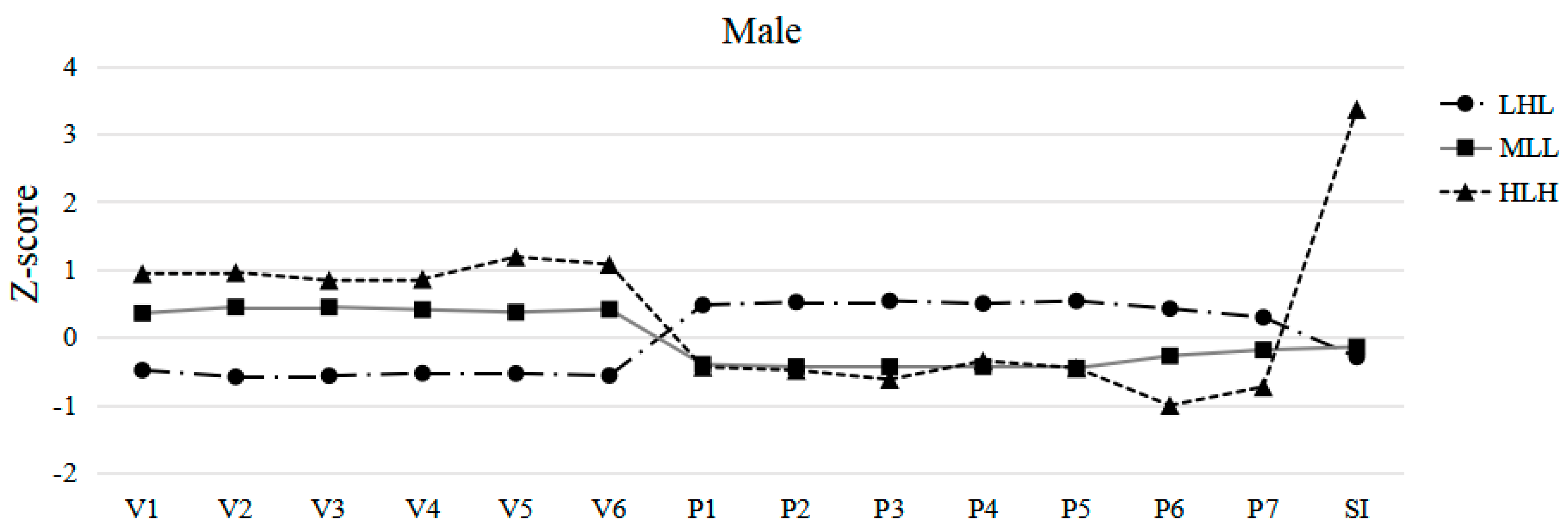
Figure 1: Latent profiles plot for male participants. Note: V1: academic pressure; V2: low family intimacy; V3: family conflict; V4: parental emotional instability; V5: insufficient social support; V6: strained teacher-student relationships; P1: persistence; P2: stress resistance; P3: optimism; P4: emotional control; P5: cooperation; P6: confidence; P7: humor; SI: suicidal ideation; LHL: Low Vulnerable–High Protective–Low Risk Profile; MLL: Medium Vulnerable–Low Protective–Low Risk Profile; HLH: High Vulnerable–Low protective–High Risk Profile.
Table 4: Environmental vulnerability, individual resilience, and suicidal ideation across latent profiles among male participants.
| Variables | 1 LHL (N = 646) | 2 MLL (N = 662) | 3 HLH (N = 85) | F | p | η2 | Posthoc |
|---|---|---|---|---|---|---|---|
| Academic pressure | 1.84 (0.54) | 2.38 (0.51) | 2.72 (0.74) | 213.21 | <0.001 | 0.22 | 1 < 2 < 3 |
| Low family intimacy | 1.70 (0.59) | 2.45 (0.59) | 2.82 (0.78) | 319.28 | <0.001 | 0.29 | 1 < 2 < 3 |
| Family conflict | 1.26 (0.41) | 1.94 (0.61) | 2.18 (0.86) | 288.63 | <0.001 | 0.31 | 1 < 2 < 3 |
| Parental emotional instability | 1.17 (0.36) | 1.77 (0.64) | 2.03 (0.83) | 244.47 | <0.001 | 0.28 | 1 < 2 < 3 |
| Insufficient social support | 1.61 (0.59) | 2.26 (0.57) | 2.85 (0.80) | 283.83 | <0.001 | 0.25 | 1 < 2 < 3 |
| Strained teacher-student relationships | 1.36 (0.47) | 2.02 (0.55) | 2.44 (0.83) | 322.77 | <0.001 | 0.31 | 1 < 2 < 3 |
| Persistence | 3.31 (0.54) | 2.75 (0.55) | 2.74 (0.76) | 172.15 | <0.001 | 0.19 | 2 < 1; 3 < 1 |
| Stress resistance | 3.32 (0.50) | 2.71 (0.56) | 2.69 (0.76) | 214.56 | <0.001 | 0.25 | 2 < 1; 3 < 1 |
| Optimism | 3.55 (0.42) | 2.97 (0.54) | 2.88 (0.76) | 242.17 | <0.001 | 0.27 | 2 < 1; 3 < 1 |
| Emotional control | 3.32 (0.52) | 2.71 (0.58) | 2.78 (0.78) | 191.45 | <0.001 | 0.23 | 2 < 1; 3 < 1 |
| Cooperation | 3.53 (0.45) | 2.94 (0.52) | 2.96 (0.72) | 230.40 | <0.001 | 0.26 | 2 < 1; 3 < 1 |
| Confidence | 2.93 (0.54) | 2.51 (0.50) | 2.08 (0.68) | 159.44 | <0.001 | 0.16 | 3 < 2 < 1 |
| Humor | 2.73 (0.42) | 2.50 (0.40) | 2.37 (0.45) | 66.42 | <0.001 | 0.19 | 3 < 2 < 1 |
| Suicidal ideation | 0.05 (0.13) | 0.10 (0.17) | 1.07 (0.48) | 1147.21 | <0.001 | 0.69 | 1 < 2 < 3 |
Fig. 2 presents the profile plot for the four-class solution in female participants. The first typology was named as the “Low Vulnerable–High Protective–Low Risk Profile” (LHL), compromising 41.5% of the participants. Typology 2, named the “Medium Vulnerable–Low Protective–Low Risk Profile” (MLL), included 46.3% of the participants. The third typology, the “Medium Vulnerable–Low Protective–Medium Risk Profile” (MLM), accounted for 9.0% of the participants. Typology 4, the “High Vulnerable–Low Protective–High Risk Profile” (HLH), represented the smallest group, with 3.2% of the participants. Although this high-risk subgroup was relatively small in proportion, the model selection was supported by fit indices, including the highest entropy value (0.921) and significant p-values (p < 0.05) for both the BLRT and LMR tests. The best log-likelihood value was consistently replicated across a large number of random start values, and the smallest class emerged reliably with a highly similar indicator profile, supporting the stability of the solution. Moreover, this profile showed significantly higher levels of environmental vulnerability and extremely elevated suicidal ideation compared to the other groups, highlighting its unique clinical significance and theoretical relevance. Therefore, the four-class model was retained to ensure that the characteristics of this high-risk group were not overlooked. Significant differences across profiles are presented in Table 5.
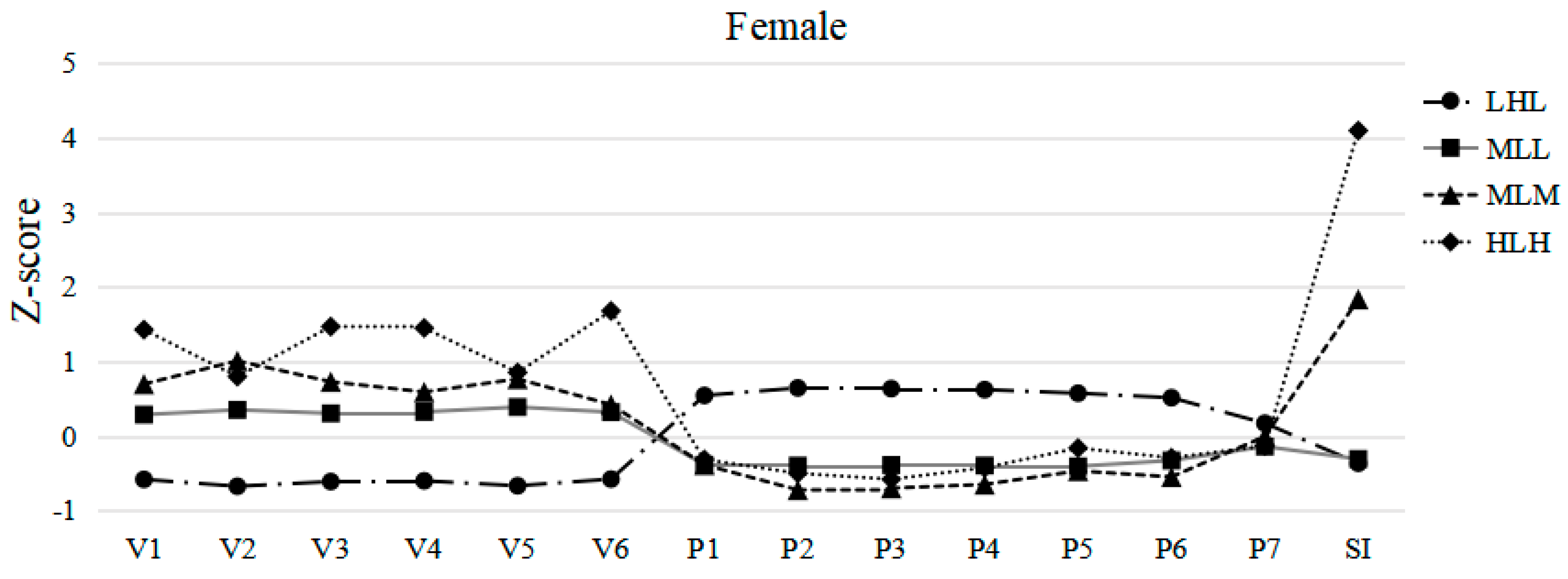
Figure 2: Latent profiles plot for female participants. Note: V1: academic pressure; V2: low family intimacy; V3: family conflict; V4: parental emotional instability; V5: insufficient social support; V6: strained teacher-student relationships; P1: persistence; P2:stress resistance; P3: optimism; P4: emotional control; P5:cooperation; P6: confidence; P7: humor; SI: suicidal ideation; LHL: Low Vulnerable–High Protective–Low Risk Profile; MLL: Medium Vulnerable–Low Protective–Low Risk Profile; HLH: High Vulnerable–Low protective–High Risk Profile.
Table 5: Environmental vulnerability, individual resilience, and suicidal ideation across latent profiles among female participants.
| Variables | 1 LHL (N = 566) | 2 MLL (N = 508) | 3 MLM (N = 110) | 4 HLH (N = 39) | F | p | η2 | Posthoc |
|---|---|---|---|---|---|---|---|---|
| Academic pressure | 1.88 (0.52) | 2.44 (0.52) | 2.69 (0.55) | 3.14 (0.60) | 171.43 | <0.001 | 0.30 | 1 < 2 < 3 < 4 |
| Low family intimacy | 1.72 (0.58) | 2.50 (0.61) | 3.00 (0.68) | 2.85 (0.75) | 226.71 | <0.001 | 0.36 | 1 < 2 < 3;1 < 2 < 4 |
| Family conflict | 1.31 (0.43) | 1.93 (0.60) | 2.21 (0.77) | 2.71 (0.72) | 189.94 | <0.001 | 0.32 | 1 < 2 < 3 < 4 |
| Parental emotional instability | 1.17 (0.36) | 1.80 (0.61) | 2.00 (0.75) | 2.50 (0.84) | 177.36 | <0.001 | 0.30 | 1 < 2 < 3 < 4 |
| Insufficient social support | 1.56 (0.51) | 2.25 (0.53) | 2.50 (0.59) | 2.55 (0.80) | 203.33 | <0.001 | 0.33 | 1 < 2 < 3; 1 < 2 < 4 |
| Strained teacher-student relationships | 1.35 (0.44) | 1.91 (0.54) | 1.97 (0.58) | 2.73 (0.86) | 171.00 | <0.001 | 0.30 | 1 < 2 < 3 < 4 |
| Persistence | 3.34 (0.52) | 2.77 (0.53) | 2.78 (0.56) | 2.82 (0.52) | 116.84 | <0.001 | 0.23 | 2 < 1;3 < 1;4 < 1 |
| Stress resistance | 3.26 (0.49) | 2.56 (0.56) | 2.35 (0.67) | 2.5 (0.69) | 181.18 | <0.001 | 0.31 | 3 < 2 < 1; 4 < 1 |
| Optimism | 3.59 (0.42) | 2.97 (0.50) | 2.80 (0.62) | 2.86 (0.80) | 175.66 | <0.001 | 0.30 | 3 < 2 < 1; 4 < 1 |
| Emotional control | 3.28 (0.55) | 2.60 (0.52) | 2.44 (0.68) | 2.59 (0.78) | 157.82 | <0.001 | 0.28 | 3 < 2 < 1; 4 < 1 |
| Cooperation | 3.50 (0.43) | 2.96 (0.47) | 2.93 (0.57) | 3.10 (0.61) | 131.69 | <0.001 | 0.24 | 2 < 1;3 < 1; 4 < 1 |
| Confidence | 2.91 (0.54) | 2.44 (0.49) | 2.32 (0.51) | 2.45 (0.75) | 93.52 | <0.001 | 0.19 | 3 < 2 < 1; 4 < 1 |
| Humor | 2.66 (0.40) | 2.50 (0.39) | 2.47 (0.45) | 2.43 (0.58) | 18.18 | <0.001 | 0.14 | 2 < 1; 3 < 1; 4 < 1 |
| Suicidal ideation | 0.05 (0.15) | 0.10 (0.18) | 0.60 (0.37) | 1.32 (0.49) | 604.47 | <0.001 | 0.60 | 1 < 2 < 3 < 4 |
This study aimed to explore gender-specific latent profiles of environmental vulnerability, individual resilience, and suicidal ideation among Chinese adolescents using latent profile analysis. Our findings revealed both commonalities and differences between male and female participants in the configuration of these factors. Three latent profiles were identified in males and four in females, with notable gender-specific risk patterns. These results provide important insights into the interplay of risk and protective factors in adolescent suicidal ideation and highlight the necessity for gender-sensitive prevention and intervention strategies.
4.1 Gender Differences in Variables
The t-test results revealed significant gender differences across the variables. Specifically, males scored higher than females on resilience traits such as stress resistance, emotional control, confidence, and humor. These results partially align with previous studies. For instance, Gil found that men demonstrated greater personal strength and self-confidence regarding psychological resilience than women [58]. Additionally, Čekrlija et al. reported that men scored significantly higher than women on humor [59]. A recent latent class analysis revealed that high life satisfaction and resilience were more prevalent among males than females [60]. In Asian countries, female adolescents are more likely to experience suicidal ideation compared to their male counterparts [61]. Our study similarly found that females reported significantly higher levels of environmental vulnerability and suicidal ideation. This finding is consistent with earlier research emphasizing females’ heightened sensitivity to family and social stressors [62].
These gender differences may be attributed to various factors. Sociocultural expectations and gender roles likely play a significant role [63]. For example, males are often socialized to suppress emotions and rely less on social support, which can shape their humor and self-confidence in high-stress situations [64]. In contrast, females may face unique familial pressures and expectations, making them more vulnerable to academic and family-related stressors [65]. Additionally, biological and developmental differences between males and females may also contribute. Girls tend to experience the pressure of physiological changes and social transformation earlier than boys [66]. Under stress, females generally release more oxytocin, promoting the need for social connection, while males release more testosterone, which may enhance competitiveness and aggression, thus shaping their coping mechanisms [67].
4.2 Gender Commonalities in Profiles
The LPAs revealed distinct patterns of individual resilience, environmental vulnerability, and suicidal ideation risk across genders. Three latent profiles were identified in males and four in females. Both genders shared common profiles, including the LHL, MLL, and HLH types.
The LHL profile, present in both males (46.4%) and females (41.5%), was characterized by low environmental vulnerability, high resilience, and low suicidal ideation. This finding supports prior research suggesting that a combination of low environmental risk and positive individual traits acts as a protective factor for mental health [14,68]. Our results extend this principle to the co-configuration of environmental and personal resources. This profile represents a clear empirical instantiation of the Demands–Resources Model [69], reflecting a resource-rich configuration characterized by an abundance of both contextual resources (low environmental vulnerability) and personal resources (high resilience). These resources jointly mitigate stress and promote well-being, thereby exemplifying the protective pathway proposed by the Demands–Resources framework.
The HLH profile, common to both male and female participants, serves as a critical indicator of high suicidal risk. It reflects the detrimental effects of significant vulnerability paired with insufficient resilience, highlighting the urgent need for targeted interventions for individuals in this high-risk group. According to the three-dimensional psychological pain model [70], individuals in this profile may struggle to cope with accumulated environmental risks due to deficits in emotional regulation—such as a lack of pain-avoidance strategies—thereby increasing their susceptibility to suicidal ideation and behavior.
The MLL profile identified a group of individuals with lower resilience and moderate environmental vulnerability, yet a low risk of suicidal ideation. This finding aligns with results from a previous LPA study on risks and resources, which reported that individuals in high-risk and low-endogenous-resource groups can still exhibit a strong sense of meaning in life [71]. This partially reflects the cumulative effect [72]: While the accumulation of risk factors is generally associated with greater psychological crises, a threshold effect exists—when environmental vulnerability does not exceed an individual’s tolerance, low resilience may not necessarily lead to a severe crisis. Additionally, the number of protective factors can mediate the relationship between risk exposure and suicidal behavior [73]. In our study, although resilience scores in the MLL group were generally low, some protective traits were significantly stronger compared to those in the HLH group. These findings underscore how environmental risks and individual resilience interact in specific configurations to shape adolescent suicidal ideation.
4.3 Gender Differences in Profiles
Notable differences emerged between male and female participants in their latent profiles, which can be interpreted through an integrated bio-psycho-social framework [74].
For males in the HLH profile, a defining feature was the particularly low levels of humor and confidence. This pattern is consistent with General Strain Theory [21], which suggests that males are socialized to adopt predominantly externalizing coping strategies in response to stress [75]. Within this gendered context, humor and confidence operate as culturally sanctioned personal resources for stress management [67,76], often facilitating distraction-based and problem-focused coping [77,78]. Pronounced deficits in these traits therefore signal a breakdown of expected coping mechanisms, impeding effective strain dissipation and heightening vulnerability to internalizing crises such as suicidal ideation. This interpretation is further supported by recent evidence indicating that internalizing-prone characteristics (e.g., low self-efficacy) substantially increase the likelihood of suicidal ideation, whereas cumulative environmental risk alone may not reach statistical significance in certain models [79]. Taken together, these findings suggest that, for these boys, deficits in key personal resources—rather than environmental stressor load per se—are the primary drivers of the transition to high suicide risk.
In contrast, female participants in the HLH profile exhibited markedly elevated environmental vulnerability across academic, familial, and school-relational domains, highlighting a predominantly context-driven pathway to crisis. This pattern aligns with the Social Development Model [3], which emphasizes the synergistic clustering of risk factors across ecological systems [13]—a phenomenon also documented in recent studies of Asian adolescents [80]. Socioculturally, this heightened sensitivity intersects with the principle of cultural consonance [81], whereby stressors that undermine culturally valued goals—such as academic achievement and familial harmony in Confucian societies—provoke particularly intense distress. Women’s social identity in these contexts has historically been closely tied to the maintenance of such harmonies [82]. Although females often draw upon strong social support networks as a culturally endorsed coping strategy [67], these resources may prove insufficient when stressors are deeply intertwined with self-worth and identity.
The female-specific MLM profile exhibited significantly higher environmental vulnerability across all domains than the MLL profile and was associated with moderate levels of suicidal ideation. This pervasive, multi-domain strain is likely to not only erode psychological resources but also co-occur with clustered behavioral risks (e.g., poor sleep and unhealthy eating), which have been linked to elevated internalizing symptoms [83]. This pattern is consistent with Conservation of Resources Theory [84], which posits that sustained demands in the context of limited personal resources can trigger a loss spiral, ultimately culminating in heightened psychological distress [85].
Biologically, the observed gender-specific profiles can be further elucidated through an integrated neuroendocrine model of adolescent emotion regulation, in which hormonal, neural, and circadian systems interact. Under stress, cortisol activation heightens amygdala reactivity involved in fear processing while attenuating prefrontal cortex (PFC) regulatory control and hippocampal contextualization, thereby increasing emotional sensitivity [86]. Gender differences emerge within this circuitry. In females, higher and more fluctuating estrogen levels modulate serotonin receptor sensitivity and may weaken PFC inhibition of the amygdala, resulting in prolonged cortisol activation and sustained emotional encoding, which biologically predisposes girls toward internalizing pathways [87]. In contrast, higher testosterone levels in males tend to dampen hypothalamic–pituitary–adrenal (HPA) axis reactivity and enhance dopamine-related approach behaviors, favoring more externalizing stress responses [87]. When circadian rhythms are disrupted—for example, through poor sleep or excessive screen exposure—melatonin suppression further dysregulates cortisol diurnal patterns, amplifying this sensitized stress–emotion circuit, particularly in females [88]. Consequently, similar external stressors, such as academic pressure or social conflict, are more likely to consolidate into persistent distress, anxiety, or depressive recall in females, whereas in males they may be expressed through impulsivity or behavioral disengagement. This neurobiological framework helps explain why environmental vulnerabilities cluster so strongly in female high-risk profiles, and why deficits in specific, externally oriented coping resources characterize male high-risk configurations.
4.4 Comparative Analysis with Extant Latent Profile Studies
Our findings align with core insights from prior latent profile analysis (LPA) research while refining them in several important ways. First, the identification of substantial moderate-risk groups (MLL, MLM) corroborates a consistent observation in LPA studies that the majority of adolescents exhibit co-occurring, moderate levels of risk and well-being [89]. Likewise, the distinct high-severity profile (HLH) mirrors a robust and replicated finding in suicide-focused LPA research, namely the presence of a subgroup characterized by compounded vulnerabilities [30].
Beyond replication, our results extend prior work by elucidating mechanisms and adding conceptual nuance. The central role of clustered environmental stressors—particularly among girls in the HLH profile—accords with network-analytic evidence showing that stress-related factors often function as the most highly interconnected nodes across risk profiles [90]. Moreover, our gender-stratified analyses provide empirical support for methodological observations that female adolescents often require a greater number of latent classes to adequately capture their heterogeneous emotional patterns [91], as reflected in the emergence of a female-specific MLM profile.
Importantly, our study advances theoretical understanding of protective configurations. Whereas prior research has shown that holistic constellations of protective factors best predict positive adjustment [92], our findings complement this literature from an inverse perspective. Specifically, the most severe risk profile (HLH) was correspondingly defined by a holistic deficit in key protective resources—most notably humor and confidence among males. Together, these patterns suggest a coherent theoretical continuum: optimal outcomes are associated with synergistic protective resources, whereas acute risk is marked by their synergistic absence, particularly among boys.
Situating our findings within the broader Dual-Factor Model literature further clarifies an important boundary condition. For example, Choi identified a “high risk but satisfied” profile, in which adolescents engage in externalizing risk behaviors yet report relatively low internalizing distress [93]. Conceptually, this pattern parallels a potential “high vulnerability–low suicidal ideation” configuration. The absence of such a profile in the present study suggests that protective factors capable of buffering general distress may be insufficient—or may operate differently—when the outcome of interest is a severe, acute internalizing crisis such as suicidal ideation.
In summary, our findings advance a gender-specific typology that both clarifies configurations associated with severe suicidal ideation and underscores the context-dependent nature of resilience.
4.5 Practical and Clinical Implications
These empirically derived profiles also carry direct implications for school-based mental health promotion through a practical, two-tiered prevention framework. First, brief screening tools assessing core profile indicators (e.g., salient resilience deficits and environmental stressors) can efficiently identify students approximating high-risk configurations, enabling timely referral. Second, the profiles map naturally onto a tiered intervention model. Universal wellness promotion is likely sufficient for the low-risk majority (LHL), whereas students in moderate-risk profiles (MLL/MLM) may benefit from targeted, group-based skill-building interventions. Critically, students matching the high-risk HLH profile require intensive, gender-specific support.
For males in the HLH profile—characterized by pronounced deficits in humor and confidence—interventions should prioritize rebuilding these core personal resources through approaches that foster cognitive reappraisal, positive peer modeling, and strengths-based feedback from educators and parents [94,95,96]. For females in the HLH profile, defined by clustered academic and relational stressors, effective intervention requires a coordinated, multisystemic approach integrating family-level conflict resolution, school-based academic and relational accommodations, and individual coping-skills training.
Overall, this profile-driven framework supports efficient resource allocation and precise intervention matching within school-based mental health support systems.
4.6 Limitations and Future Directions
While this study enhances our understanding of gender-specific mental health typologies among adolescents, several limitations must be acknowledged. First, the cross-sectional design precludes causal inference regarding the relationships between environmental vulnerabilities, individual resilience, and suicidal ideation. Second, the reliance on self-reported data may introduce biases such as social desirability or recall bias. Third, the sample was drawn from a single county in Guangdong Province, which may limit the geographical generalizability of the findings to adolescents in other sociocultural or regional contexts within China. Fourth, although the study focused on traditional academic and familial stressors, it did not incorporate emerging digital-era vulnerabilities—such as cyberbullying, problematic social media use, and online social comparison—which represent significant contemporary risks to adolescent mental health. Finally, although key resilience traits were assessed, other dynamic processes, such as specific coping strategies, were not examined, which could further elucidate the underlying mechanisms.
Future research should address these limitations in several ways. Longitudinal designs are needed to examine the stability and developmental trajectories of the identified latent profiles and to establish temporal precedence among key variables. Mixed-methods approaches could further enrich understanding of the subjective experiences and contextual nuances underlying these statistical profiles, particularly among the small but clinically significant high-risk subgroups. Expanding sampling to more diverse geographical and cultural contexts will be essential for testing the robustness and generalizability of the profile structures. In addition, future studies should incorporate measures of digital-era stressors and detailed coping strategies to develop a more comprehensive model of risk and protection within the contemporary adolescent ecosystem.
This study aimed to explore how environmental vulnerability and individual resilience interact in their associations with adolescent suicidal ideation, with a focus on gender differences. Based on the findings, it is evident that suicidal ideation among adolescents is intricately shaped by both these factors, with notable gender-specific patterns.
For boys, particularly those in the high-risk (HLH) profile characterized by pronounced deficits in humor and confidence, interventions should directly target and strengthen these core protective traits. Such approaches may include structured humor-skills training that emphasizes cognitive reappraisal and perspective-taking, as well as confidence-building programs incorporating group-based activities, peer modeling, and strengths-focused feedback from educators and parents.
For girls, especially those in the HLH profile who experience a convergence of severe academic, familial, and relational stressors, a multisystemic intervention approach is essential. Effective strategies should simultaneously: (1) provide family-centered support to enhance conflict resolution and improve the emotional climate; (2) implement school-based accommodations to alleviate academic pressure and promote supportive teacher–student relationships; and (3) offer individual cognitive-behavioral interventions to strengthen emotion regulation and stress management skills.
In conclusion, these gender-specific profiles provide a blueprint for developing precisely tailored suicide prevention strategies. Future longitudinal and intervention research is needed to evaluate the efficacy of these targeted approaches and to explore the role of additional factors, such as digital stressors and coping flexibility, in shaping adolescent mental health trajectories.
Acknowledgement:
Funding Statement: This study was supported by the Major Planning Project of Philosophy and Social Science of Guangdong Province (GD23ZD17); the Humanities and Social Sciences Program of the Ministry of Education (23YJA190006); the Ministry of Education (MOE) Major Project of Philosophy and Social Sciences Research (2025JZDZ024); the MOE Project of the Key Research Institute of Humanities and Social Sciences in Universities (22JJD190008); a grant from the Research Center for Brain Cognition and Human Development of Guangdong (2024B0303390003); and the Psychological Services and Counseling Base for the Happy Guangzhou Project. The funders had no role in the study design, data collection and analysis, decision to publish, or preparation of the manuscript.
Author Contributions: Conceptualization, Xiaoyin Li and Ruixiang Gao; methodology, Ruixiang Gao; software, Xiaoyin Li; validation and Jiaxian Luo; formal analysis, Xiaoyin Li and Jiaxian Luo; investigation, Ruixiang Gao and Yongxing Guo; resources, Yongxing Guo; data curation, Yongxing Guo; writing—original draft preparation, Xiaoyin Li, Ruixiang Gao, and Jiaxian Luo; writing—review and editing, Yongxing Guo and Pinchao Luo; visualization, Jiaxian Luo; supervision, Pinchao Luo; project administration, Ruixiang Gao; funding acquisition, Pinchao Luo. All authors reviewed and approved the final version of the manuscript.
Availability of Data and Materials: The data that support the findings of this study are available from the corresponding author upon reasonable request. Due to considerations of participant confidentiality and ethical obligations, these data are not publicly available.
Ethics Approval: The study was approved by the Human Research Ethics Committee for Non-Clinical Faculties of the School of Psychology, South China Normal University (protocol number: SCNU-PSY-2024-531; date of approval: 24 February 2024). All procedures were conducted in accordance with relevant ethical guidelines and regulations. Electronic informed consent was obtained from all student participants and their legal guardians. To ensure comprehension among minors, study information and consent materials were presented using age-appropriate language and were explained by trained teachers in classroom settings, with opportunities provided for students to ask questions. Participants were informed of their right to withdraw at any time without penalty. This consent procedure was reviewed and approved by the ethics committee prior to data collection.
Conflicts of Interest: The authors declare no conflicts of interest.
Abbreviations
| LPA | Latent profile analysis |
| LHL | Low Vulnerable–High Protective–Low Risk |
| MLL | Medium Vulnerable–Low Protective–Low Risk |
| HLH | High Vulnerable–Low Protective–High Risk |
| MLM | Medium Vulnerable–Low Protective–Medium Risk |
| WHO | World Health Organization |
| SDM | Social Development Model |
| SI | Suicidal ideation |
References
1. Li Z , Li J , Kong J , Li Z , Wang R , Jiang F . Adolescent mental health interventions: a narrative review of the positive effects of physical activity and implementation strategies. Front Psychol. 2024; 15: 1433698. doi:10.3389/fpsyg.2024.1433698. [Google Scholar] [CrossRef]
2. Nock MK . Self-injury. Annu Rev Clin Psychol. 2010; 6: 339– 63. doi:10.1146/annurev.clinpsy.121208.131258. [Google Scholar] [CrossRef]
3. Yu G . The mental health condition and effectiveness of relevant education in chinese schools: evidence from research. Basic Educ Rev. 2023; 9: 3– 14. (In Chinese). [Google Scholar]
4. Catalano RF , Hawkins JD . The social development model: a theory of antisocial behavior. Cambidge, UK: Cambridge University Press; 1996. [Google Scholar]
5. Low E , Monsen J , Schow L , Roberts R , Collins L , Johnson H , et al. Predicting bullying victimization among adolescents using the risk and protective factor framework: a large-scale machine learning approach. BMC Public Health. 2025; 25( 1): 321. doi:10.1186/s12889-025-21521-0. [Google Scholar] [CrossRef]
6. Weller O , Sagers L , Hanson C , Barnes M , Snell Q , Tass ES . Predicting suicidal thoughts and behavior among adolescents using the risk and protective factor framework: a large-scale machine learning approach. PLoS One. 2021; 16( 11): e0258535. doi:10.1371/journal.pone.0258535. [Google Scholar] [CrossRef]
7. Xiao QQ , Huang XH , Yang J , Mu YF , Wang C , Deng ZY , et al. Suicidal ideation and suicide attempts among students aged 12 to 24 after the lifting of COVID-19 restrictions in China: prevalence and associated factors. Front Psychiatry. 2024; 15: 1383992. doi:10.3389/fpsyt.2024.1383992. [Google Scholar] [CrossRef]
8. Gini G , Marino C , Pozzoli T , Holt M . Associations between peer victimization, perceived teacher unfairness, and adolescents’ adjustment and well-being. J Sch Psychol. 2018; 67: 56– 68. doi:10.1016/j.jsp.2017.09.005. [Google Scholar] [CrossRef]
9. Wang R , Jin C . Parenting styles and suicidal ideation among Chinese college students: the mediating role of perceived social support. Acta Psychol. 2025; 255: 104992. doi:10.1016/j.actpsy.2025.104992. [Google Scholar] [CrossRef]
10. Ping Y , Wang W , Li Y , Li Y . Fathers’ parenting stress, parenting styles and children’s problem behavior: the mediating role of parental burnout. Curr Psychol. 2023; 42( 29): 25683– 95. doi:10.1007/s12144-022-03667-x. [Google Scholar] [CrossRef]
11. Turecki G , Brent DA . Suicide and suicidal behaviour. Lancet. 2016; 387( 10024): 1227– 39. doi:10.1016/S0140-6736(15)00234-2. [Google Scholar] [CrossRef]
12. Bailey A , Bauer BW , Mittal VA , Ellman LM , Strauss GP , Walker EF , et al. Interpersonal difficulties and suicidal ideation in young people at clinical high-risk for psychosis and help-seeking clinical controls. Psychiatry Res. 2025; 348: 116467. doi:10.1016/j.psychres.2025.116467. [Google Scholar] [CrossRef]
13. Bränström R , Stormbom I , Bergendal M , Pachankis JE . Transgender-based disparities in suicidality: a population-based study of key predictions from four theoretical models. Suicide Life Threat Behav. 2022; 52( 3): 401– 12. doi:10.1111/sltb.12830. [Google Scholar] [CrossRef]
14. Benson PL , Scales PC , Syvertsen AK . The contribution of the developmental assets framework to positive youth development theory and practice. Adv Child Dev Behav. 2011; 41: 197– 230. doi:10.1016/B978-0-12-386492-5.00008-7. [Google Scholar] [CrossRef]
15. Ungar M , Theron L . Resilience and mental health: how multisystemic processes contribute to positive outcomes. Lancet Psychiatry. 2020; 7( 5): 441– 8. doi:10.1016/S2215-0366(19)30434-1. [Google Scholar] [CrossRef]
16. Cohen S , Wills TA . Stress, social support, and the buffering hypothesis. Psychol Bull. 1985; 98( 2): 310– 57. doi:10.1037/0033-2909.98.2.310. [Google Scholar] [CrossRef]
17. Sojer P , Kainbacher S , Hufner K , Freudenthaler H , Kemmler G , Deisenhammer EA . The association of intrapersonal trait emotional intelligence and resilience with suicidal ideation in university students. Psychiat Danub. 2021; 33( 3): 298– 305. doi:10.24869/psyd.2021.298. [Google Scholar] [CrossRef]
18. McCrae RR , Costa PT . Validation of the five-factor model of personality across instruments and observers. J Pers Soc Psychol. 1987; 52( 1): 81– 90. doi:10.1037/0022-3514.52.1.81. [Google Scholar] [CrossRef]
19. Agrawal M , Singh R . Factors associated with police depression: a systematic review. Int J Crim Justice Sci. 2020; 15( 1): 30– 50. doi:10.5281/zenodo.3819100/IJCJS. [Google Scholar] [CrossRef]
20. Planellas I , Calderón C . Detecting the risk of suicidal-related behaviours in teenagers by means of combined personality dimensions. Child Youth Serv Rev. 2022; 138: 106500. doi:10.1016/j.childyouth.2022.106500. [Google Scholar] [CrossRef]
21. Agnew R . Foundation for a general strain theory of crime and delinquency. Criminology. 1992; 30( 1): 47– 88. doi:10.1111/j.1745-9125.1992.tb01093.x. [Google Scholar] [CrossRef]
22. Baier D , Hong JS , Kliem S , Bergmann MC . Consequences of bullying on adolescents’ mental health in Germany: comparing face-to-face bullying and cyberbullying. J Child Fam Stud. 2019; 28( 9): 2347– 57. doi:10.1007/s10826-018-1181-6. [Google Scholar] [CrossRef]
23. Hay C , Meldrum R . Bullying victimization and adolescent self-harm: testing hypotheses from general strain theory. J Youth Adolesc. 2010; 39( 5): 446– 59. doi:10.1007/s10964-009-9502-0. [Google Scholar] [CrossRef]
24. Li R , Deng R , Song T , Xiao Y , Wang Q , Fang Z , et al. Gender-specific factors of suicidal ideation among high school students in Yunnan Province, China: a machine learning approach. J Affect Disord. 2024; 364: 157– 66. doi:10.1016/j.jad.2024.08.072. [Google Scholar] [CrossRef]
25. Takahashi M , Imahara K , Miyamoto Y , Myojo K , Yasuda M . Association between the Big Five personality traits and suicide-related behaviors in Japanese institutionalized youths. PCN Rep. 2024; 3: e186. doi:10.1002/pcn5.186. [Google Scholar] [CrossRef]
26. Andersson HW , Mosti MP , Nordfjærn T . Suicidal ideation among inpatients with substance use disorders: prevalence, correlates and gender differences. Psychiatry Res. 2022; 317: 114848. doi:10.1016/j.psychres.2022.114848. [Google Scholar] [CrossRef]
27. Hill SY , Jones BL , Haas GL . Suicidal ideation and aggression in childhood, genetic variation and young adult depression. J Affect Disord. 2020; 276: 954– 62. doi:10.1016/j.jad.2020.07.049. [Google Scholar] [CrossRef]
28. Cross CP , Brown GR , Morgan TJH , Laland KN . Sex differences in confidence influence patterns of conformity. Br J Psychol. 2017; 108( 4): 655– 67. doi:10.1111/bjop.12232. [Google Scholar] [CrossRef]
29. Skeer MR , McCormick MC , Normand ST , Mimiaga MJ , Buka SL , Gilman SE . Gender differences in the association between family conflict and adolescent substance use disorders. J Adolesc Health. 2011; 49( 2): 187– 92. doi:10.1016/j.jadohealth.2010.12.003. [Google Scholar] [CrossRef]
30. Janackovski A , Deane FP , Hains A , Kelly PJ , Robinson LD . Generalisability of the interpersonal theory of suicide to latent profiles of young people attending treatment in a suicide prevention service. Psychol Psychother. 2024; 97( 2): 248– 70. doi:10.1111/papt.12512. [Google Scholar] [CrossRef]
31. Muthén B . Latent variable hybrids: overview of old and new models. In: Advances in latent variable mixture models. Bingley, UK: Emerald Publishing Limited; 2008. p. 1– 24. doi:10.1108/978-1-60752-634-620251002. [Google Scholar] [CrossRef]
32. Zhu A , Kong Z , Zhou A . Romantic relationships and adolescent depression in China: moderating effects of peer norms. Front Psychiatry. 2025; 16: 1644371. doi:10.3389/fpsyt.2025.1644371. [Google Scholar] [CrossRef]
33. Sun F , Li H , Song W , Bao J , Zhen Z . Patterns of psychological pain and self-harm behaviors in adolescents. Suicide Life Threat Behav. 2022; 52( 5): 1012– 23. doi:10.1111/sltb.12898. [Google Scholar] [CrossRef]
34. Sheeber L , Hops H , Davis B . Family processes in adolescent depression. Clin Child Fam Psychol Rev. 2001; 4( 1): 19– 35. doi:10.1023/A:1009524626436. [Google Scholar] [CrossRef]
35. Chen Y , Kubzansky LD , VanderWeele TJ . Parental warmth and flourishing in mid-life. Soc Sci Med. 2019; 220: 65– 72. doi:10.1016/j.socscimed.2018.10.026. [Google Scholar] [CrossRef]
36. Tu Y . Six-factor personality model. In: The ECPH encyclopedia of psychology. Singapore: Springer Nature; 2024. p. 1– 2. doi:10.1007/978-981-99-6000-2_633-1. [Google Scholar] [CrossRef]
37. Van Doren N , Tharp JA , Johnson SL , Staudenmaier PJ , Anderson C , Freeman MA . Perseverance of effort is related to lower depressive symptoms via authentic pride and perceived power. Pers Individ Differ. 2019; 137: 45– 9. doi:10.1016/j.paid.2018.07.044. [Google Scholar] [CrossRef]
38. Zhou X , Bambling M , Bai X , Edirippulige S . Chinese school adolescents’ stress experience and coping strategies: a qualitative study. BMC Psychol. 2023; 11( 1): 91. doi:10.1186/s40359-023-01137-y. [Google Scholar] [CrossRef]
39. Luo J , Cao W , Zhao J , Zeng X , Pan Y . The moderating role of optimism between social trauma and depression among Chinese college students: a cross-sectional study. BMC Psychol. 2023; 11( 1): 270. doi:10.1186/s40359-023-01314-z. [Google Scholar] [CrossRef]
40. Surbey MK . Adaptive significance of low levels of self-deception and cooperation in depression. Evol Hum Behav. 2011; 32( 1): 29– 40. doi:10.1016/j.evolhumbehav.2010.08.009. [Google Scholar] [CrossRef]
41. Daruwala SE , LaCroix JM , Perera KU , Tucker J , Colborn V , Weaver J , et al. Suicide ideation and self-efficacy to avoid suicidal action among psychiatrically hospitalized military personnel. Psychiatry Res. 2018; 270: 1131– 6. doi:10.1016/j.psychres.2018.10.023. [Google Scholar] [CrossRef]
42. Wu N , Du Q , Zeng Q , Weng L , Liu X , Ding R . How Interparental conflict relates to adolescent non-suicidal self-injury longitudinally? The role of adolescent emotional insecurity, depressive symptoms, and humor. Curr Psychol. 2024; 43( 20): 18319– 29. doi:10.1007/s12144-024-05620-6. [Google Scholar] [CrossRef]
43. DiggMind . Technical report on the development and psychometric validation of the adolescent environmental vulnerability scales (Internal technical report). Guangzhou, China: DiggMind; 2023. (In Chinese). [Google Scholar]
44. Wang X . Effect of family environment and internet game addiction on aggressive behavior of university students [ master’s thesis]. Hengyang, China: Nanhua University; 2011. (In Chinese). [Google Scholar]
45. Jiang Q . The perceived social support scale. Chin J Behav Med Sci. 2001;( 10): 41– 2. (In Chinese). [Google Scholar]
46. Jiang G . Class environment in the Chinese school system: structure and measurement. Psychol Sci. 2004; 27( 4): 839– 43. (In Chinese). doi:10.3969/j.issn.1671-6981.2004.04.018. [Google Scholar] [CrossRef]
47. Peng K , Sun P , Ni S , editors. The handbook of positive psychology assessment in China. Beijing, China: Tsinghua University Press; 2022. (In Chinese). [Google Scholar]
48. Yin M , Szabo J , Baumgartner E . SSES Survey Measures: Online Appendix. Houston, TX, USA: Houston Education Research Consortium, Kinder Institute for Urban Research, Rice University; 2023 [cited 2025 Jan 1]. Available from: https://rice.app.box.com/v/SSESOnlineAppendix. [Google Scholar]
49. Wang C , Hu Z , Liu Y . Evidences for reliability and validity of the Chinese version of general self efficacy scale. Chin J Appl Psychol. 2001; 7( 1): 37– 40. (In Chinese). [Google Scholar]
50. Luo CJ . Positive personality buffer the impact of negative life events on suicide ideation in adolescents: based on the configuration analysis [ master’s thesis]. Changsha, China: Hunan Normal University; 2025. (In Chinese). [Google Scholar]
51. Li Z , Hsu YC , Yip PSF . Unraveling the complexities between reasons and motivations behind suicide behaviors: a population-based study of Hong Kong secondary school students. J Adolesc Health. 2025; 76( 5): 830– 8. doi:10.1016/j.jadohealth.2025.01.005. [Google Scholar] [CrossRef]
52. Chang HJ , Lin CC , Chou KR , Ma WF , Yang CY . Chinese version of the positive and negative suicide ideation: instrument development. J Adv Nurs. 2009; 65( 7): 1485– 96. doi:10.1111/j.1365-2648.2009.05005.x. [Google Scholar] [CrossRef]
53. Balsamo M , Carlucci L , Innamorati M , Lester D , Pompili M . Further insights into the beck hopelessness scale (BHS): unidimensionality among psychiatric inpatients. Front Psychiatry. 2020; 11: 727. doi:10.3389/fpsyt.2020.00727. [Google Scholar] [CrossRef]
54. Klonsky ED , May AM , Saffer BY . Suicide, suicide attempts, and suicidal ideation. Annu Rev Clin Psychol. 2016; 12: 307– 30. doi:10.1146/annurev-clinpsy-021815-093204. [Google Scholar] [CrossRef]
55. Mazzer K , Curll S , Barzinjy H , Goecke R , Larsen M , Batterham PJ , et al. Changes in mental state for help-seekers of lifeline Australia’s online chat service: lexical analysis approach. JMIR Form Res. 2025; 9: e63257. doi:10.2196/63257. [Google Scholar] [CrossRef]
56. Van Orden KA , Cukrowicz KC , Witte TK , Joiner TE . Thwarted belongingness and perceived burdensomeness: construct validity and psychometric properties of the interpersonal needs questionnaire. Psychol Assess. 2012; 24( 1): 197– 215. doi:10.1037/a0025358. [Google Scholar] [CrossRef]
57. Zung WWK . A self-rating depression scale. Arch Gen Psychiatry. 1965; 12( 1): 63. doi:10.1001/archpsyc.1965.01720310065008. [Google Scholar] [CrossRef]
58. Vera Gil S . The influence of gender on academic performance and psychological resilience, and the relationship between both: understanding the differences through gender stereotypes. Trends Psychol. 2024: 1– 20. doi:10.1007/s43076-024-00370-7. [Google Scholar] [CrossRef]
59. Čekrlija Đ , Kulakow S , Aluja A , Garca LF . The relationship between humor styles, optimism and quality of life, and the role of the gender, age and socio-economic status: a typological approach. Int J Appl Posit Psychol. 2024; 10( 1): 13. doi:10.1007/s41042-024-00208-8. [Google Scholar] [CrossRef]
60. Kyriazos T , Poga M . Life satisfaction, anxiety, stress, depression, and resilience: a multigroup latent class analysis. Trends Psychol. 2024: 1– 24. doi:10.1007/s43076-024-00396-x. [Google Scholar] [CrossRef]
61. Blum R , Sudhinaraset M , Emerson MR . Youth at risk: suicidal thoughts and attempts in Vietnam, China, and Taiwan. J Adolesc Health. 2012; 50( 3): S37– 44. doi:10.1016/j.jadohealth.2011.12.006. [Google Scholar] [CrossRef]
62. Chen Y , Zheng W , He M , Guo Y , Zhang M , Feng R , et al. Family risk profiles and mental health among Chinese adolescents: a latent class analysis. Appl Res Qual Life. 2024; 19( 6): 3189– 218. doi:10.1007/s11482-024-10371-4. [Google Scholar] [CrossRef]
63. Eshun S . Role of gender and rumination in suicide ideation: a comparison of college samples from Ghana and the United States. Cross Cult Res. 2000; 34( 3): 250– 63. doi:10.1177/106939710003400303. [Google Scholar] [CrossRef]
64. Nixon CL , Jairam D , Davis S , Linkie CA , Chatters S , Hodge JJ . Effects of students’ grade level, gender, and form of bullying victimization on coping strategy effectiveness. Int J Bullying Prev. 2020; 2( 3): 190– 204. doi:10.1007/s42380-019-00027-5. [Google Scholar] [CrossRef]
65. Wei Y , Chen Q , Wu D , Fu X , Song H . Exploring the role of psychological assistance hotlines in improving mental health problems among Chinese adult women: a perspective based on social expectations and gender roles. Asian J Psychiatry. 2024; 96: 104026. doi:10.1016/j.ajp.2024.104026. [Google Scholar] [CrossRef]
66. Chiu YC , Tseng CY , Lin FG . Gender differences and stage-specific influence of parent–adolescent conflicts on adolescent suicidal ideation. Psychiatry Res. 2017; 255: 424– 31. doi:10.1016/j.psychres.2017.06.077. [Google Scholar] [CrossRef]
67. Rose AJ , Rudolph KD . A review of sex differences in peer relationship processes: potential trade-offs for the emotional and behavioral development of girls and boys. Psychol Bull. 2006; 132( 1): 98– 131. doi:10.1037/0033-2909.132.1.98. [Google Scholar] [CrossRef]
68. Peláez-Fernández MA , Mérida-López S , Yudes C , Extremera N . How can the social family climate contribute to emotional intelligence in preventing suicidal ideation and promoting life satisfaction among adolescents? Appl Res Qual Life. 2024; 19( 5): 2915– 32. doi:10.1007/s11482-024-10354-5. [Google Scholar] [CrossRef]
69. Salmela-Aro K , Moeller J , Schneider B , Spicer J , Lavonen J . Integrating the light and dark sides of student engagement using person-oriented and situation-specific approaches. Learn Instr. 2016; 43: 61– 70. doi:10.1016/j.learninstruc.2016.01.001. [Google Scholar] [CrossRef]
70. Li H , Xie W , Luo X , Fu R , Shi C , Ying X , et al. Clarifying the role of psychological pain in the risks of suicidal ideation and suicidal acts among patients with major depressive episodes. Suicide Life Threat Behav. 2014; 44( 1): 78– 88. doi:10.1111/sltb.12056. [Google Scholar] [CrossRef]
71. He M , Guo W , Sun Y , Meng J , Yu H . Meaning in life for migrant children in China: a latent profile analysis based on risks and resources. Child Abuse Negl. 2025; 161: 107310. doi:10.1016/j.chiabu.2025.107310. [Google Scholar] [CrossRef]
72. Kaess M , Eppelmann L , Brunner R , Parzer P , Resch F , Carli V , et al. Life events predicting the first onset of adolescent direct self-injurious behavior—a prospective multicenter study. J Adolesc Health. 2020; 66( 2): 195– 201. doi:10.1016/j.jadohealth.2019.08.018. [Google Scholar] [CrossRef]
73. Mackin J , Perkins T , Furrer C . The power of protection: a population-based comparison of native and non-native youth suicide attempters. Am Indian Alas Native Ment Health Res. 2012; 19( 2): 20– 54. doi:10.5820/aian.1902.2012.20. [Google Scholar] [CrossRef]
74. Casey BM , Ganley CM . An examination of gender differences in spatial skills and math attitudes in relation to mathematics success: a bio-psycho-social model. Dev Rev. 2021; 60: 100963. doi:10.1016/j.dr.2021.100963. [Google Scholar] [CrossRef]
75. Lv J , Meng C , Guo X , Fei J , Yuan T , Yue J , et al. The association between sex-specific typologies of mobile phone addiction, alexithymia and negative emotions among college students: a latent profile analysis. Child Youth Serv Rev. 2023; 155: 107287. doi:10.1016/j.childyouth.2023.107287. [Google Scholar] [CrossRef]
76. Copeland EP , Hess RS . Differences in young adolescents’ coping strategies based on gender and ethnicity. J Early Adolesc. 1995; 15( 2): 203– 19. doi:10.1177/0272431695015002002. [Google Scholar] [CrossRef]
77. Varo C , del Mar Aires-González M , García-Jiménez M , Trigo ME , Cano-García FJ . Effective coping with academic stress is a matter of personality types: revisiting the person-centred approach. Behav Sci. 2023; 13( 8): 687. doi:10.3390/bs13080687. [Google Scholar] [CrossRef]
78. Miller PA , Kliewer W , Partch J . Socialization of children’s recall and use of strategies for coping with interparental conflict. J Child Fam Stud. 2010; 19( 4): 429– 43. doi:10.1007/s10826-009-9314-6. [Google Scholar] [CrossRef]
79. Efa YT , Lathief S , Roder D , Shi Z , Li M . Clustering of lifestyle habits and association with depressive symptoms and suicidal behaviors in adolescents: a systematic review and meta-analysis. Adolesc Res Rev. 2025; 10( 3): 381– 401. doi:10.1007/s40894-024-00253-z. [Google Scholar] [CrossRef]
80. Li N , Guo S , Park H . Cyberbullying among adolescents in East Asian societies: explanations based on general strain theory. Int J Bullying Prev. 2024: 1– 15. doi:10.1007/s42380-023-00204-7. [Google Scholar] [CrossRef]
81. Dressler WW , Balieiro MC , Ribeiro RP , Dos Santos JE . Cultural consonance and psychological distress: examining the associations in multiple cultural domains. Cult Med Psychiatry. 2007; 31( 2): 195– 224. doi:10.1007/s11013-007-9046-2. [Google Scholar] [CrossRef]
82. Park M , Chesla C . Revisiting Confucianism as a conceptual framework for Asian family study. J Fam Nurs. 2007; 13( 3): 293– 311. doi:10.1177/1074840707304400. [Google Scholar] [CrossRef]
83. Tao S , Qu Y , Zhang Y , Gan H , Mou X , Zhou P , et al. COVID-19 risk perception moderates the relationships between health risk behaviors clustering and anxiety-depression comorbidity in adolescents. BMC Psychol. 2025; 13( 1): 590. doi:10.1186/s40359-025-02937-0. [Google Scholar] [CrossRef]
84. Hobfoll SE . Conservation of resources: a new attempt at conceptualizing stress. Am Psychol. 1989; 44( 3): 513– 24. doi:10.1037/0003-066x.44.3.513. [Google Scholar] [CrossRef]
85. Yu Y , Wu AMS , Fong VWI , Zhang J , Li JB , Lau JTF . Association between Internet gaming disorder and suicidal ideation mediated by psychosocial resources and psychosocial problems among adolescent Internet gamers in China: cross-sectional study. JMIR Serious Games. 2024; 12: e48439. doi:10.2196/48439. [Google Scholar] [CrossRef]
86. Petrican R , Fornito A , Murgatroyd C , Boyland E , Hardman CA . Genetic risk predicts adolescent mood pathology via sexual differentiation of brain function and physiological aging. Nat Commun. 2025; 16: 5593. doi:10.1038/s41467-025-60686-5. [Google Scholar] [CrossRef]
87. Shobeiri P , Kalantari A , Teixeira AL , Rezaei N . Shedding light on biological sex differences and microbiota–gut–brain axis: a comprehensive review of its roles in neuropsychiatric disorders. Biol Sex Differ. 2022; 13( 1): 12. doi:10.1186/s13293-022-00422-6. [Google Scholar] [CrossRef]
88. Wang J , Xie Y , Xu H , Wan Y , Tao F . Moderating effects of smoking and drinking on the relationship between biological rhythm and psychological health and gender differences among adolescents. BMC Psychiatry. 2023; 23( 1): 731. doi:10.1186/s12888-023-05253-2. [Google Scholar] [CrossRef]
89. Butter S , Shevlin M , Gibson-Miller J , McBride O , Hartman TK , Bentall RP , et al. Psychological distress, wellbeing and resilience: modelling adolescent mental health profiles during the COVID-19 pandemic. Discov Ment Health. 2024; 4( 1): 16. doi:10.1007/s44192-024-00071-8. [Google Scholar] [CrossRef]
90. Çimen F , Seçer İ , Ay E . Latent profile and network analysis of school attendance problems in adolescents: an evaluation in terms of mental health issues, academic achievement, and school dropout. Sch Ment Health. 2025: 1– 15. doi:10.1007/s12310-025-09824-4. [Google Scholar] [CrossRef]
91. Wang Z , Zheng J , Wang X , Lu K , Liu F , He J . Profiles, transitions, and influencing factors of mental health among Chinese adolescents: the dual-factor mental health perspective. Curr Psychol. 2025; 44( 10): 8424– 35. doi:10.1007/s12144-025-07805-z. [Google Scholar] [CrossRef]
92. Meng F , Li X , Ying H , Qian J , Cheng C , Chen D , et al. Relations between perceived parental acceptance-rejection and adaptive mental health in Chinese junior high school students: a latent profile analysis. Curr Psychol. 2025; 44( 1): 616– 34. doi:10.1007/s12144-024-07091-1. [Google Scholar] [CrossRef]
93. Choi JY . A dual-factor approach to mental health among general adults in Korea: a latent profile analysis. Int J Ment Health Addict. 2025: 1– 17. doi:10.1007/s11469-025-01564-5. [Google Scholar] [CrossRef]
94. Wu CL , Huang HJ , Chen PZ , Chen HC . Influence of junior high school students’ humor styles and perceptions of their class teachers’ humor styles on teacher-student interaction. Curr Psychol. 2023; 42( 19): 16442– 50. doi:10.1007/s12144-022-03387-2. [Google Scholar] [CrossRef]
95. Puozzo IC , Audrin C . Improving self-efficacy and creative self-efficacy to foster creativity and learning in schools. Think Ski Creat. 2021; 42: 100966. doi:10.1016/j.tsc.2021.100966. [Google Scholar] [CrossRef]
96. Shukla J , Singh RM . Knowledge exploration among students: role of feedback, feeling of confidence, and academic motivation. Metacogn Learn. 2024; 19( 3): 1137– 59. doi:10.1007/s11409-024-09404-y. [Google Scholar] [CrossRef]
Cite This Article
 Copyright © 2026 The Author(s). Published by Tech Science Press.
This work is licensed under a Creative Commons Attribution 4.0 International License , which permits unrestricted use, distribution, and reproduction in any medium, provided the original work is properly cited.
 Downloads
 Citation Tools
