
 Login
Login Register
 Submit a Paper
 Propose a Special lssue
 Open Access
ARTICLE
University Students’ Perceptions of Curriculum-Based Meditation for Mental Health Promotion: A Q Methodology Study
Department of Counseling and Coaching, Dongguk University-Seoul, 30, Pildong-ro 1-gil, Jung-gu, Seoul, Republic of Korea
* Corresponding Author: Song Yi Lee. Email:
(This article belongs to the Special Issue: Mental Health Promotion in Higher Education: Interventions and Strategies for the Psychological Well-being of Teachers and Students)
International Journal of Mental Health Promotion 2026, 28(9), 9 https://doi.org/10.32604/ijmhp.2026.082997
Received 26 March 2026; Accepted 28 May 2026; Issue published 22 September 2026
 View Full Text
 Download PDF
Abstract
Background: Mental health issues among university students are rising, leading to increased interest in curriculum-based meditation courses as an educational strategy in higher education. This study aims to identify university students’ subjective perception types regarding a formal curriculum-based meditation course and to describe the characteristics of each type. Methods: This study used Q methodology to explore university students’ subjective perceptions of meditation courses in the formal curriculum for mental health promotion. We recruited 46 students from Dongguk University in Seoul who completed a meditation course and asked them to participate in a Q-sorting process using 32 statements. We analyzed the data using principal component analysis with Varimax rotation in Ken-Q software. Results: Four distinct perception types were identified: (1) Credit-Oriented Minimal Involvement, (2) Transformation Through Self-Understanding and Self-Acceptance, (3) Preference for an Experiential Learning Environment, and (4) Integrated Academic and Mental Well-Being. The four-factor solution explained 52% of the total variance. Conclusions: These findings suggest that students interpret and experience the same meditation course differently based on their expectations, values, and learning orientations. This study extends beyond the dominant effectiveness-focused approach in previous research by exploring the meanings and functions that students assign to meditation courses based on their subjective perceptions. The findings provide exploratory insights into students’ perceptions of curriculum-based meditation courses in higher education and suggest the importance of developing learner-centered instructional approaches that reflect diverse student needs, motivations, and engagement modes.Keywords
Mental health problems among university students have emerged as a major concern in higher education worldwide [1,2]. International studies have reported that university students globally experience mental health problems and psychological distress [3,4]. Mental disorders are prevalent among university students, with many problems starting before or during university entry, as reported by the World Health Organization World Mental Health Surveys International College Student Project [5,6]. Recently, university students in Korea have faced various psychological and social difficulties after entering college, including academic burden, career-related anxiety, interpersonal problems, and employment stress [7,8,9]. These difficulties can increase symptoms of anxiety and depression, reduce adjustment to university life, and heighten dropout risk [10], thereby threatening university students’ mental health and quality of life [11,12].
The university years constitute a developmental period in which students address multiple tasks simultaneously, including academic performance, career exploration, and interpersonal relationships [13]. The stress and emotional difficulties experienced during this period affect individual psychological well-being and the continuity and achievement of overall university life [11,14]. Accordingly, researchers increasingly recognize mental health problems during this stage as personal challenges and educational and social issues that higher education systems must address systematically [10,15].
International studies have reported that university students experience significant stress and psychological distress due to academic demands, social adjustment, and the transition to independent living. Researchers have consistently documented the prevalence of mental health problems in this population [16,17]. In particular, studies conducted after the coronavirus disease 2019 (COVID-19) pandemic have demonstrated that symptoms of depression and anxiety among university students have intensified [18], highlighting the need for systematic responses to mental health concerns at the university level [19]. As university students’ mental health problems continue to emerge as structural and persistent issues, higher education institutions must shift from individualized therapeutic approaches to preventive and universal strategies that promote mental health for all students [20,21].
Previous studies have shown that protective factors such as emotion, self-efficacy, and resilience are crucial in university students’ mental health and adjustment to university life [22,23,24], underscoring the need to provide educational environments that can strengthen these protective factors [25,26]. Curriculum-based approaches are gaining attention for reducing stigma and access barriers to counseling services, while providing a structured method for students to manage their mental health daily [27,28,29].
In the context of higher education, researchers have identified meditation and mindfulness as educational resources that strengthen these protective factors [30]. A growing body of research reports their positive effects on stress reduction, emotion regulation, self-reflection, and the enhancement of psychological well-being [16,31,32]. Based on these findings, universities have incorporated meditation and mindfulness into programs and formal curricula as educational interventions to promote students’ mental health [24,33]. In addition, previous studies have reported that meditation-based courses may help reduce anxiety and stress among university students [34,35,36].
Existing studies on meditation and mindfulness primarily focus on verifying intervention effectiveness by examining changes in psychological indicators such as stress, depression, anxiety, and well-being [16,34,37]. However, meditation courses in the formal curriculum require a multilayered approach because universities implement them as educational support systems for all students. Although learners experience and interpret meditation courses differently, relatively few studies explore these variations [38]. Since meditation courses involve embodied and psychological experiences alongside inner reflection [39], learners’ experiences, perceptions, and interpretations become important factors in shaping learning outcomes.
From this perspective, Kolb’s experiential learning theory [40] provides a useful framework for understanding meditation courses. Kolb proposes that learning occurs through a cyclical process of concrete experience, reflective observation, abstract conceptualization, and active experimentation, and learners may derive different learning outcomes from the same experience depending on how they interpret and reflect on it. In this study, experiential learning theory was not applied to directly explain mental health outcomes but to interpret the varied experiences, reflections, and engagement of students in meditation courses as educational experiences.
Meditation directly supports the processes of concrete experience and reflective observation, as it involves attending to present-moment experience and internal states [41]. Even when universities offer the same meditation courses with identical content and structure, students perceive the experience differently based on their expectations, values, prior experiences, and interpretive frameworks. These differences in perception may influence how students engage with and interpret meditation courses within higher education contexts.
However, relatively few studies have systematically examined university students’ experiences of meditation courses from the perspective of learners’ subjective perception structures. Evaluating curriculum-based meditation courses using only a few effectiveness indicators fails to capture their significance for learners and their role as mental health resources [42,43]. Therefore, researchers should understand meditation courses through the subjective structures of learners’ experiences. Thus, researchers must explore how learners perceive and interpret these courses to understand them within educational and mental health-related contexts.
This study used Q methodology to explore university students’ perceptions and interpretations of meditation courses in the formal curriculum. It examined how learners experience and interpret a meditation course as a mental health phenomenon, rather than measuring intervention effectiveness or changes in psychological indicators. Furthermore, by analyzing the types of perceptions held by college students and the characteristics of each type, we aim to provide a foundation for curriculum-based mental health promotion strategies and learner-centered instructional design in the context of higher education.
Therefore, this study addresses the following research questions (RQs).
RQ1. How can we classify university students’ perceptions of meditation courses offered within the formal curriculum?
RQ2. What are the characteristics of each perception type among university students regarding meditation courses?
Stephenson [44], a British physicist and psychologist, developed Q methodology to scientifically investigate subjectivity, including human attitudes, beliefs, and values. Q methodology systematically identifies individuals’ subjective beliefs and viewpoints, evolving as a mixed-methods approach that combines qualitative and quantitative data and analytical techniques [45,46]. It identifies diverse patterns of thought on a given topic and differentiates the range of opinions surrounding that topic [45,46]. Accordingly, this study employed Q methodology to effectively classify the subjective perceptions of students who completed the same meditation course and examine the characteristics of those perception types.
We conducted the study in five stages following the Q methodology framework proposed by Watts and Stenner [46]. First, we constructed the Q concourse by thoroughly reviewing the literature, in-depth interviews, and generative artificial intelligence (AI). Second, we reviewed and refined the collected statements and selected 32 Q-sample statements. Third, we selected 46 participants who met the study criteria as the P-sample. Fourth, we asked participants to sort each statement using a forced distribution on a nine-point scale. Fifth, we analyzed the Q-sort data to derive perception types. Table 1 presents the overall research procedure.
This study was conducted after receiving approval from the Institutional Review Board of Dongguk University (DUIRB2025-10-05). Participants were informed about the purpose and procedures of the study, the use of the data for research purposes, anonymity, voluntary participation, and the right to withdraw at any time. Additionally, written informed consent was obtained from all participants before data collection.
Table 1: Q methodology procedure.
| Stage | Procedure |
|---|---|
| Q concourse | Literature review, in-depth interviews, and ChatGPT |
| Q sample | Selection of 32 statements |
| P sample | Selection of 46 participants |
| Q sorting | Forced distribution on a nine-point scale by the P-sample |
| Data analyses | Ken-Q Analysis (v 1.3.1), principal component analysis, and varimax rotation |
2.2 Curriculum Description: Self and Meditation Course
The course examined in this study is “Self and Meditation,” a required general education course offered at Dongguk University. The curriculum consists of a two-semester course (Self and Meditation 1, Self and Meditation 2) and covers a variety of meditation practices, ranging from traditional Buddhist Seon meditation to modern mindfulness practices. Dongguk University, a private educational institution affiliated with Korean Buddhism, has designed its meditation curriculum within the framework of a Buddhist institution. Since all undergraduate students are required to complete this course before graduation, it is an ideal setting to examine students’ perspectives on curriculum-based meditation classes in a higher education institution.
Each course consists of 15 weekly 50-min meditation sessions. Student evaluation is based on class participation, assignments, and reflective activities, and is graded on a pass/fail basis. Classes are typically held in a dedicated meditation room equipped with meditation cushions and related materials, although some classes were conducted online during the COVID-19 pandemic.
The curriculum primarily focuses on self-reflection and psychological well-being, incorporating Buddhist terminology and philosophical elements. The courses are taught by ordained Buddhist monks who have completed doctoral-level education. However, the course is not intended to promote the acquisition of specific religious beliefs or doctrines among students. Rather, the classes focus on experiential activities that incorporate a range of meditation practices, from traditional Seon meditation to contemporary mindfulness-based approaches.
Accordingly, the meditation course examined in this study differs from the secularized mindfulness courses commonly investigated in Western universities in terms of its institutional and cultural background. This context should be considered when interpreting students’ perceptual structures and evaluating the transferability of the findings to other universities or cultural settings.
The Q concourse consists of various statements encompassing all possible opinions and perspectives on the research topic [44]. These statements reflect individuals’ subjective thoughts and feelings regarding the topic [45]. When constructing a Q concourse, researchers must include statements that clearly express how individuals perceive and interpret the subject matter [44]. Although researchers can draw conclusions from various topic-related sources, they mainly rely on literature reviews and interviews [47].
In this study, we constructed the Q concourse using diverse statements about the purpose, content, methods, learning environment, instructor, effects, and limitations of meditation courses. Additionally, we developed the Q concourse through literature analysis, in-depth interviews, and generative AI. For the literature analysis, we reviewed domestic and international studies on university students’ meditation, mindfulness courses, and learning experiences, extracting 246 statements.
We then conducted in-depth interviews in October 2025 with six students at Dongguk University in Seoul who completed the formal meditation course Self and Meditation. Before the interviews, we informed participants about the study’s purpose, interview content, expected duration, and data collection procedures for obtaining their consent. Each interview lasted approximately an hour. We selected participants to reflect various academic disciplines and year levels, including the humanities, social sciences, science and engineering, and the arts. Table 2 presents their demographic characteristics.
Table 2: Demographic characteristics of participants.
| Participant | Major | Year | Age | Gender | Semester(s) of Meditation Course Completion |
|---|---|---|---|---|---|
| I1 | Bio-Environmental Science | 4 | 22 | Female | 2023, 1st and 2nd semesters |
| I2 | Industrial Engineering | 3 | 23 | Male | 2022, 1st and 2nd semesters |
| I3 | International Trade | 3 | 23 | Male | 2021, 1st and 2nd semesters |
| I4 | Buddhist Art | 3 | 21 | Female | 2023, 1st and 2nd semesters |
| I5 | Business Administration | 3 | 22 | Female | 2023, 1st and 2nd semesters |
| I6 | History | 2 | 21 | Male | 2024, 1st and 2nd semesters |
We conducted semi-structured interviews with participants using the following guiding questions:
- •What activity or meditation practice in the course did you find most memorable?
- •Which aspects of the course did you find challenging, uncomfortable, or difficult to find meaningful?
- •How did the class environment, including space and materials, influence your meditation experience?
- •What effects or changes did the course bring about for you?
These interviews yielded an additional 104 statements. To supplement the diversity of the Q concourse, we also generated additional statements using ChatGPT, a generative AI tool. Researchers can use ChatGPT in Q methodology to expand and supplement diverse subjective statements [48]. Accordingly, we used ChatGPT-4 (OpenAI) as a supplementary tool to generate additional statements that complemented those collected through the literature review and interviews. On 30 October 2025, we entered the following single prompt into ChatGPT: “We are conducting a Q methodology study on university students’ subjectivity regarding meditation courses. The participants are students who have taken meditation courses at a university, and the purpose of this study is to explore their subjective perceptions based on these course experiences. Please generate statements that reflect the thoughts and opinions of students who have experienced meditation courses.” In response, ChatGPT generated 40 statements across eight categories, including course structure, teaching and learning, meditation activities, emotional changes, self-understanding, difficulties, university life, and values.
The AI-generated statements were reviewed together with the concourse materials collected through the literature review and interviews. We reviewed all collected statements based on their relevance to the research purpose, redundancy, level of generalization, and potential bias. Statements derived from the literature review were refined by integrating semantically similar expressions and excluding content with low relevance to the research topic, resulting in 246 statements. For the interview data, 104 statements reflecting participants’ experiences and perceptions were extracted. Statements generated by ChatGPT were used only as supplementary materials to enhance the diversity of the Q concourse. These statements were reviewed for appropriateness, overlap with the literature and interview data, and diversity of viewpoints, and 40 statements were retained. Expressions that did not sufficiently reflect differences in perspectives on meditation courses were revised or excluded. As a result, the final Q concourse for Q-sample selection consisted of 390 statements.
Thus, ChatGPT served only as a supplementary tool in constructing the concourse, whereas the final selection, refinement, and interpretation of the Q sample relied on the researcher’s theoretical and interpretive judgment.
The Q sample consists of a set of statements selected from the Q concourse to represent the major perspectives and issues related to the research topic [45,47]. In this study, the Q sample was developed through an iterative and inductive refinement process appropriate to the exploratory nature of Q methodology.
We repeatedly reviewed the 390 statements collected through the literature review, in-depth interviews, and ChatGPT-4 (OpenAI). During this process, statements with overlapping meanings or conceptual similarity were integrated into representative statements. Statements with low relevance to the research purpose, those that did not sufficiently reflect learners’ perceptions of meditation courses, or statements with ambiguous wording were excluded.
Subsequently, we organized the remaining statements into the following thematic domains that emerged during the review process: course structure, course content, learning environment, instructor, learning attitude, everyday application of the meditation course, and self-reflection. We then selected representative statements with high representativeness and semantic clarity from each domain. Through this process, the initial 390 statements were reduced to 40 preliminary Q-sample statements.
Next, three doctoral students familiar with Q methodology reviewed the 40 preliminary statements and evaluated their comprehensibility, semantic overlap, clarity of expression, and balance of positive, negative, and neutral statements. During this process, semantically similar statements were integrated, and statements with ambiguous wording or those likely to induce biased responses were revised or excluded.
Finally, a Q-methodology expert examined the content validity of the statements. Based on the expert review, several statements were revised, supplemented, or excluded to improve clarity and representativeness. As a result, the final Q sample consisted of 32 statements. Table 3 presents the final Q sample.
Table 3: Q sample.
| No. | Statement | Source |
|---|---|---|
| 1 | One hour per week is an appropriate amount of time for the meditation course. | Interview |
| 2 | The Buddhist terminology used in the course feels unfamiliar. | Interview |
| 3 | I felt burdened by having to share my reflections after meditation. | Interview |
| 4 | I do not mind meditation being offered as a required course. | Interview |
| 5 | This course helped me develop a more positive and familiar understanding of Buddhism. | Interview |
| 6 | Through the meditation course, I am better able to prioritize what I need to do. | Interview |
| 7 | The meditation course improved my ability to concentrate on studying. | Mixed |
| 8 | The meditation course helped me grow as a person. | Mixed |
| 9 | Students who arrive late interfere with my concentration during class. | Interview |
| 10 | I wish the meditation course placed greater emphasis on practice than on theory. | Interview |
| 11 | The meditation hall is more conducive to learning than a regular classroom. | Interview |
| 12 | The meditation course is a course in which students can earn credits with relatively little effort. | Interview |
| 13 | The tools used in class (e.g., singing bowls and bells) help me concentrate. | Interview |
| 14 | During the meditation course, I sometimes wondered whether I was practicing correctly. | Interview |
| 15 | The assignments in the meditation course help me understand and reflect on myself. | Interview |
| 16 | Through the meditation course, I have learned to use meditation effectively in situations involving worry or stress. | Mixed |
| 17 | I prefer the meditation course to be taught by a professor who is also a monk. | Interview |
| 18 | The meditation course helped improve my relationships with friends. | Interview |
| 19 | Although the meditation course lasts for two semesters, one semester would be sufficient. | Interview |
| 20 | The meditation course is one that I would like to recommend to others. | Interview |
| 21 | Active forms of meditation (e.g., tea meditation and walking meditation) were interesting. | Interview |
| 22 | The professor’s repeated reassuring remarks helped me stay engaged in class. | Interview |
| 23 | Through the meditation course, my prejudice that meditation is difficult disappeared. | Interview |
| 24 | The meditation course is beneficial because it allows me to take care of my academic credits and my mental health. | Literature |
| 25 | The meditation course helps me clarify the purpose and direction of my life. | Literature |
| 26 | The meditation course helps me develop the ability to accept myself as I am and view myself objectively. | Literature |
| 27 | Compared with other courses, this course is more attentive to students’ states of mind. | AI |
| 28 | The sitting posture is uncomfortable, making it difficult to concentrate during class. | Interview |
| 29 | The periods of silence during class felt awkward. | AI |
| 30 | It was not clear to me how the meditation activities connected to everyday life. | AI |
| 31 | I wish the professor had explained the meditation methods more systematically. | AI |
| 32 | The textbook was not particularly helpful. | Interview |
In Q methodology, the P sample consists of research participants who sort the Q sample statements [49]. Unlike sampling in traditional quantitative research, Q methodology uses purposive sampling to select participants to represent the breadth and diversity of viewpoints within a given population [50]. Since the purpose of Q methodology is to explore individuals’ subjective perspectives within a group, it is important to secure sufficient variation among participants to capture the full range of relevant viewpoints [46,51]. Herein, we composed the P sample of participants with experience in meditation courses to maintain diverse perspectives.
Since Q methodology does not aim to generalize findings to a large population, sample size carries less importance. Previous studies have indicated that 40–60 participants are appropriate [46,50]. Brown [50] emphasizes that Q methodology prioritizes quality over quantity. Herein, the P sample included 46 university students at Dongguk University in Seoul who completed at least one semester of the required general education course Self and Meditation. We selected participants based on their prior experience with the course and ensured diversity by considering major, academic year, gender, and number of semesters completed.
We informed participants about the study’s purpose and procedures before data collection and conducted Q sorting after obtaining their consent.
Q sorting refers to the process in which research participants (the P sample) rank and sort the Q sample statements according to prescribed rules and instructions [50,51]. Herein, we asked participants to read 32 statement cards and sort them into a forced distribution approximating a normal distribution based on their level of agreement [46,52,53]. As shown in Fig. 1, the Q-sorting scale uses a nine-point continuum ranging from the most positive (+4) to the most negative (−4). Brown [50] suggested that a nine-point scale (−4 to +4) is suitable for Q samples containing 40 items or fewer.
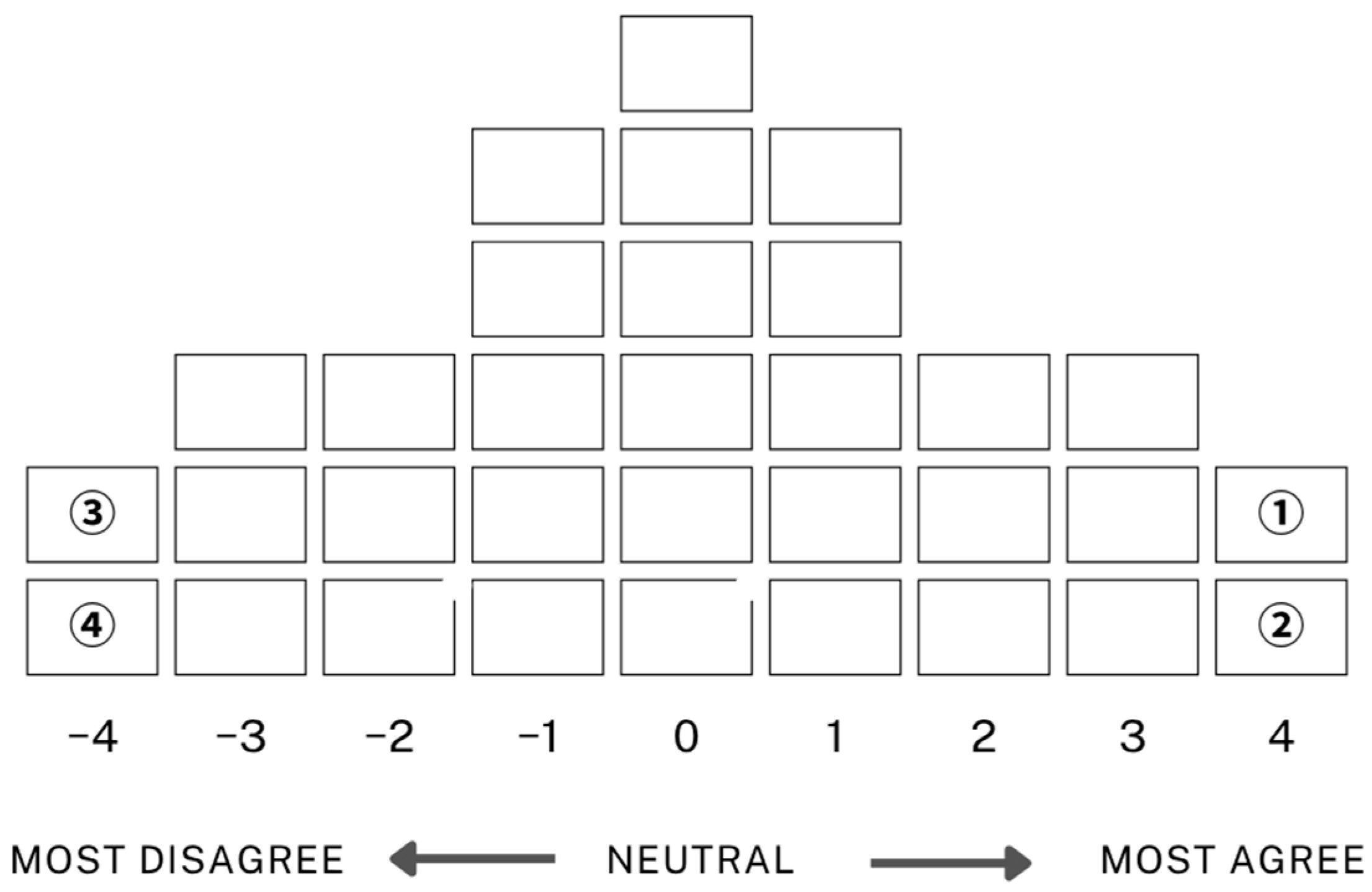
Figure 1: Q-sort distribution.
Participants placed their most agreed-upon statements on the far right of the distribution grid and their most disagreed-upon statements on the far left. They then positioned neutral statements progressively toward the center of the grid. After completing the Q sorting, participants provided demographic information, including academic year, major, year of admission, gender, and religion, and explained their reasons for the two statements with which they most strongly agreed (+4) and the two statements with which they most strongly disagreed (−4).
We collected the Q-sort data from 46 participants in the P sample and scored the responses sequentially from −4 (most disagree) to +4 (most agree) based on the statement numbers recorded in the Q-sort distribution. We then entered the data into Ken-Q Analysis software (ver. 1.3.1; developed by Shawn Banasick, Niigata University, Niigata, Japan), conducted principal component analysis, and applied varimax rotation. Thus, we extracted four independent perception types based on the criterion of eigenvalues greater than 1.0.
For each factor, we identified associated statements using Z-scores and Q-sort values and interpreted them to define the distinctive characteristics of each type. In addition, participants with high factor loadings explained their reasons for selecting the statements with which they most strongly agreed and most strongly disagreed. We used these explanations as key data to interpret the characteristics of each type. An asterisk (*p < 0.01) indicates statistically distinguishing statements between types and does not refer to the criterion for defining factor loadings or type assignment.
In Q methodology, statistical criteria alone are insufficient for determining the optimal factor solution [45,46]. Therefore, alternative three-factor and five-factor solutions were also examined in this study. Solutions were compared based on the number of significantly loaded defining Q-sorts for each factor, the interpretive coherence around distinguishing statements, and the minimization of confounded Q-sorts [46]. Therefore, the four-factor solution was retained because each factor included adequately defined Q-sorts and provided a stable and interpretable typological structure. Specifically, Type 1 included 13 defining Q-sorts, Type 2 included 10, Type 3 included 13, and Type 4 included 9. In addition, no confounded Q-sorts that loaded significantly on more than one factor at the p < 0.01 level were identified.
One participant (P27) showed a negative loading on Type 3 (factor loading = −0.28). However, this participant was not included as a defining Q-sort for the interpretation of Type 3. The negative loading may indicate the presence of perspectives contrasting with the viewpoint represented by Type 3.
The factor correlation matrix showed moderate correlations among some factors (e.g., r = 0.55 between Type 1 and Type 4; r = 0.54 between Type 3 and Type 4), indicating that the types were formed within the shared educational context of the meditation course. However, each type demonstrated distinguishing statements and a coherent interpretive structure regarding core motivations, engagement modes, and meanings assigned to the meditation course, consistent with the interpretive principles of Q methodology [45,51]. Therefore, the four-factor solution was considered to provide the most meaningful representation of participants’ subjective viewpoints.
As shown in Table 4, we identified four perception types. The eigenvalues for each type were 13.46 (Type 1), 4.71 (Type 2), 3.33 (Type 3), and 2.69 (Type 4), with a cumulative variance of 52%.
Table 4: Eigenvalues and explained variance for the four types.
| Measure | Type 1 | Type 2 | Type 3 | Type 4 |
|---|---|---|---|---|
| Eigenvalue | 13.46 | 4.71 | 3.33 | 2.69 |
| Variance explained (%) | 29 | 10 | 7 | 6 |
| Cumulative variance (%) | 29 | 39 | 46 | 52 |
In addition, Table 5 presents the correlations among the four types, indicating the degree of similarity between them.
Table 5: Correlation among the four factor types.
| Type 1 | Type 2 | Type 3 | Type 4 | |
|---|---|---|---|---|
| Type 1 | 1 | 0.26 | 0.45 | 0.55 |
| Type 2 | 1 | 0.40 | 0.37 | |
| Type 3 | 1 | 0.54 | ||
| Type 4 | 1 |
Table 6 presents the demographic characteristics and factor weights of the P sample in this study. The Q-sorting results for the 46 participants revealed four types: Type 1 (N = 13), Type 2 (N = 10), Type 3 (N = 13), and Type 4 (N = 9). In each type, participants with high factor weights corresponded to that type. Specifically, P29 showed the highest factor weight for Type 1 (0.75), P45 for Type 2 (0.65), P22 for Type 3 (0.79), and P2 for Type 4 (0.82).
Table 6: Demographic characteristics and factor weights of the P sample.
| Type | P Sample | Factor Weight | Major | Year | Age | Gender | Semester(s) of Meditation Course Completion | Religion |
|---|---|---|---|---|---|---|---|---|
| Type 1 (N = 13) | P29 | 0.75 | Police and Criminal Justice | 2 | 20 | Female | Two semesters | No religion |
| P38 | 0.73 | Mathematics Education | 3 | 23 | Male | Two semesters | No response | |
| P13 | 0.72 | Food and Biotechnology | 1 | 19 | Female | One semester | No response | |
| P15 | 0.65 | Fine Arts, Western Painting | 3 | 21 | Female | Two semesters | No response | |
| P14 | 0.64 | Convergence Security Engineering | 3 | 25 | Female | Two semesters | No religion | |
| P10 | 0.64 | Interdisciplinary Studies | 1 | 19 | Female | One semester | Protestant | |
| P21 | 0.62 | Medicine | 3 | 21 | Male | Two semesters | No response | |
| P36 | 0.60 | Police andCriminal Justice | 2 | 21 | Female | Two semesters | No response | |
| P24 | 0.56 | Police and riminal Justice | 1 | 20 | Female | One semester | No response | |
| P1 | 0.53 | Business Administration | 2 | 21 | Female | Two semesters | No response | |
| P42 | 0.51 | Bio-Environmental Engineering | 4 | 21 | Female | Two semesters | Catholic | |
| P32 | 0.48 | Fine Arts, Korean Painting | 2 | 20 | Female | Two semesters | No religion | |
| P41 | 0.46 | Electronic Engineering | 3 | 22 | Male | Two semesters | No response | |
| Type 2 (N = 10) | P45 | 0.65 | History | 2 | 21 | Male | Two semesters | No response |
| P44 | 0.62 | Bio-Environmental Science | 4 | 22 | Female | Two semesters | No response | |
| P30 | 0.58 | Food and Biotechnology | 4 | 24 | Male | Two semesters | No response | |
| P43 | 0.57 | Mathematics Education | 3 | 24 | Male | Two semesters | No religion | |
| P7 | 0.56 | Geography Education | 4 | 22 | Female | Two semesters | Catholic | |
| P37 | 0.56 | Drama | 3 | 21 | Female | Two semesters | No religion | |
| P17 | 0.51 | International Trade | 3 | 23 | Male | Two semesters | Buddhist | |
| P23 | 0.49 | Police and Criminal Justice | 4 | 23 | Female | Two semesters | No response | |
| P46 | 0.47 | Industrial Systems Engineering | 3 | 23 | Male | Two semesters | Buddhist | |
| P26 | 0.46 | Law | 4 | 24 | Male | Two semesters | No response | |
| Type 3 (N = 13) | P22 | 0.79 | Physical Education | 1 | 20 | Male | Two semesters | No religion |
| P39 | 0.78 | Public Administration | 1 | 20 | Female | One semester | No religion | |
| P4 | 0.76 | Fine Arts, Korean Painting | 1 | 19 | Female | Two semesters | Buddhist | |
| P20 | 0.69 | Bio-Environmental Science | 2 | 22 | Female | Two semesters | No response | |
| P34 | 0.64 | Physical Education | 4 | 25 | Male | Two semesters | Buddhist | |
| P33 | 0.62 | Chemical & Biochemical Engineering | 4 | 24 | Female | Two semesters | Buddhist | |
| P11 | 0.60 | Law | 4 | 24 | Male | Two semesters | No religion | |
| P40 | 0.54 | Business Administration | 4 | 25 | Male | Two semesters | No response | |
| P25 | 0.51 | English Language and Literature | 2 | 20 | Female | Two semesters | No religion | |
| P3 | 0.49 | Public Administration | 1 | 19 | Female | One semester | No response | |
| P28 | 0.48 | Architectural Engineering | 2 | 20 | Female | Two semesters | No response | |
| P31 | 0.46 | Fine Arts, Korean Painting | 2 | 21 | Female | Two semesters | No religion | |
| P18 | 0.40 | North Korean Studies | 2 | 22 | Male | One semester | No response | |
| Type 4 (N = 9) | P2 | 0.82 | Media Communication | 3 | 23 | Female | Two semesters | No religion |
| P19 | 0.75 | Fine Arts, Korean Painting | 3 | 22 | Female | Two semesters | No religion | |
| P9 | 0.66 | Mechanical Engineering | 4 | 25 | Male | Two semesters | No religion | |
| P16 | 0.58 | Drama | 2 | 23 | Female | One semester | No religion | |
| P5 | 0.58 | Bio-Environmental Science | 4 | 23 | Female | Two semesters | No response | |
| P8 | 0.55 | Fine Arts, Korean Painting | 2 | 20 | Female | Two semesters | No response | |
| P35 | 0.51 | Information and Communication Engineering | 4 | 26 | Male | Two semesters | Buddhist | |
| P12 | 0.51 | Artificial Intelligence | 4 | 23 | Female | Two semesters | No response | |
| P6 | 0.36 | Energy and Electrical Engineering | 1 | 19 | Male | Two semesters | No response |
3.2 Characteristics of the Perception Types Regarding Meditation Courses
Table 7 presents the Z-scores and Q-sort values for the Q statements by factor type. The Q-sort values indicate the arrangement of statements within the forced distribution for each type.
Table 7: Z-scores and Q-sort values of the Q statements by factor type.
| No. | Q Statement | Type 1 Z | Type 1 Q | Type 2 Z | Type 2 Q | Type 3 Z | Type 3 Q | Type 4 Z | Type 4 Q |
|---|---|---|---|---|---|---|---|---|---|
| 1 | One hour per week is an appropriate amount of time for the meditation course. | 1.55 | 3* | 0.42 | 1 | 0.80 | 1 | 0.46 | 1 |
| 2 | The Buddhist terminology used in the course feels unfamiliar. | −0.09 | 0 | −1.11 | −2* | −0.52 | 0 | −0.08 | 0 |
| 3 | I felt burdened by having to share my reflections after meditation. | 0.73 | 2 | −0.97 | −2 | −0.65 | −1 | 0.62 | 1 |
| 4 | I do not mind meditation being offered as a required course. | 0.15 | 0 | 0.30 | 0 | 0.94 | 2 | 1.26 | 2 |
| 5 | This course helped me develop a more positive and familiar understanding of Buddhism. | −0.12 | −1 | 0.34 | 0 | 0.42 | 0 | 1.28 | 3* |
| 6 | Through the meditation course, I am better able to prioritize what I need to do. | −1.39 | −3 | −0.23 | 0* | −0.85 | −2 | −1.32 | −3 |
| 7 | The meditation course improved my ability to concentrate on studying. | −1.36 | −3 | −0.30 | −1* | −1.19 | −3 | −1.72 | −4 |
| 8 | The meditation course helped me grow as a person. | −1.41 | −3* | 1.05 | 3* | −0.72 | −1* | −0.13 | 0* |
| 9 | Students who arrive late interfere with my concentration during class. | −0.51 | −1 | −1.85 | −4* | −0.85 | −2 | −0.37 | −1 |
| 10 | I wish the meditation course placed greater emphasis on practice than on theory. | 1.11 | 2 | 0.99 | 2 | 1.42 | 4 | 0.74 | 2 |
| 11 | The meditation hall is more conducive to learning than a regular classroom. | 0.61 | 1 | 0.66 | 1 | 1.39 | 4 | 1.43 | 3 |
| 12 | The meditation course is a course in which students can earn credits with relatively little effort. | 1.52 | 3 | 0.36 | 0 | 0.82 | 1 | 1.20 | 2 |
| 13 | The tools used in class (e.g., singing bowls and bells) help me concentrate. | 0.28 | 1* | −0.62 | −1* | 1.32 | 3* | 1.87 | 4* |
| 14 | During the meditation course, I sometimes wondered whether I was practicing correctly. | 0.04 | 0 | −1.13 | −2* | 0.16 | 0 | 0.00 | 0 |
| 15 | The assignments in the meditation course help me understand and reflect on myself. | −0.56 | −1 | −0.21 | 0 | 0.11 | 0 | −0.87 | −2 |
| 16 | Through the meditation course, I have learned to use meditation effectively in situations involving worry or stress. | −0.68 | −1 | 0.62 | 1* | −0.71 | −1 | −1.04 | −2 |
| 17 | I prefer the meditation course to be taught by a professor who is also a monk. | 1.35 | 3 | 1.56 | 3 | 1.02 | 2 | 0.56 | 1 |
| 18 | The meditation course helped improve my relationships with friends. | −1.84 | −4 | −1.22 | −3 | −1.23 | −3 | −1.46 | −4 |
| 19 | Although the meditation course lasts for two semesters, one semester would be sufficient. | 1.72 | 4* | 0.27 | 0 | 0.13 | 0 | −1.38 | −3* |
| 20 | The meditation course is one that I would like to recommend to others. | −0.03 | 0 | 1.09 | 3 | 1.08 | 3 | 0.48 | 1 |
| 21 | Active meditation practices, such as tea meditation and walking meditation, were interesting. | 0.87 | 2* | −0.77 | −1 | 1.38 | 3* | −0.58 | −1 |
| 22 | The professor’s repeated reassuring remarks helped me stay engaged in class. | 0.09 | 0 | −0.49 | −1 | 0.54 | 1 | −0.26 | 0 |
| 23 | Through the meditation course, my prejudice that meditation is difficult disappeared. | 0.16 | 0 | 0.99 | 2 | 1.02 | 2 | 0.04 | 1 |
| 24 | The meditation course is beneficial because it allows me to take care of my academic credits and my mental health. | 0.21 | 1 | 0.74 | 2 | 0.60 | 1 | 1.74 | 4* |
| 25 | The meditation course helps me clarify the purpose and direction of my life. | −1.54 | −4 | 0.43 | 1 | −0.69 | −1 | −1.18 | −3 |
| 26 | The meditation course helps me develop the ability to accept myself as I am and view myself objectively. | −1.01 | −2* | 1.78 | 4* | 0.32 | 0 | −0.18 | 0 |
| 27 | Compared with other courses, this course is more attentive to students’ states of mind. | −0.47 | −1 | 0.40 | 1 | 0.58 | 1 | −0.12 | 0 |
| 28 | The sitting posture is uncomfortable, making it difficult to concentrate during class. | 0.53 | 1* | −0.93 | −1 | −1.23 | −3 | −0.65 | −1 |
| 29 | The periods of silence during class felt awkward. | −0.83 | −2 | −1.22 | −3 | −2.08 | −4* | −0.78 | −2 |
| 30 | It was not clear to me how the meditation activities connected to everyday life. | 0.21 | 1 | −1.21 | −3 | −1.03 | −2 | −0.28 | −1 |
| 31 | I wish the professor had explained the meditation methods more systematically. | −0.94 | −2 | −1.51 | −4* | −0.60 | −1 | −0.66 | −1 |
| 32 | The textbook was not particularly helpful. | 1.66 | 4 | 1.74 | 4 | −1.68 | −4* | 1.40 | 3 |
3.2.1 Type 1: Credit-Oriented Minimal Involvement
Type 1 participants perceived the meditation course primarily as a necessary general education requirement, seeing it as low in burden and downplaying its duration and intensity. They considered the course more as a simple academic requirement than as a valuable opportunity for self-development.
Type 1 showed the strongest agreement with statement Q19, “Although the meditation course lasts for two semesters, one semester would be sufficient” (Z = 1.72*). They also agreed with Q32, “The textbook was not particularly helpful” (Z = 1.68), Q1, “One hour per week is an appropriate amount of time for the meditation course” (Z = 1.55*), and Q12, “The meditation course is a course in which students can earn credits with relatively little effort” (Z = 1.52). These responses suggest that participants of this type primarily valued the course as an easy way to earn academic credits.
In contrast, they disagreed with Q18, “The meditation course helped improve my relationships with friends” (Z = −1.84), Q25, “The meditation course helps me clarify the purpose and direction of my life” (Z = −1.54), and Q8, “The meditation course helped me grow as a person” (Z = −1.41*). These responses indicate that participants of this type did not perceive the meditation course as strongly related to self-development or broader life change.
Among the participants with high factor weights in Type 1, P29 showed the strongest agreement with Q19 and commented that “dividing a one-credit course across two semesters is inefficient in terms of time use.” In contrast, P29 most strongly disagreed with Q8, stating, “I do not understand the relationship between meditation and personal growth.” P38 most strongly disagreed with Q25, explaining that “although it was good to have time to organize my thoughts and reflect on problems through meditation, the time spent and the attitude toward meditation seemed too light for it to become a meaningful experience for setting life goals or direction.” Similarly, P13 stated that “meditation helps calm the mind, but I am not sure whether it helps in setting life goals or direction.” Accordingly, we labeled Type 1 “Credit-Oriented Minimal Involvement,” reflecting participants’ tendency to view the meditation course primarily as a low-burden academic requirement rather than a transformative educational experience.
3.2.2 Type 2: Transformation through Self-Understanding and Self-Acceptance
Type 2 showed the clearest experience of inner change among the four types. Participants of this type engaged in self-reflection and perceived meditation practices as helpful in emotionally difficult situations in daily life.
The statement with which Type 2 most strongly agreed was Q26: “The meditation course helps me develop the ability to accept myself as I am and view myself objectively” (Z = 1.78*). Additionally, they agreed with Q17, “I prefer the meditation course to be taught by a professor who is also a monk” (Z = 1.56), and Q8, “The meditation course helped me grow as a person” (Z = 1.05*). These responses suggest that participants of this type trusted the instructor’s expertise and perceived the meditation course as an opportunity for self-understanding and self-acceptance.
The statement with which they most strongly disagreed was Q9, “Students who arrive late interfere with my concentration during class” (Z = −1.85*). They also disagreed with Q31, “I wish the professor had explained the meditation methods more systematically” (Z = −1.51*), Q29, “The periods of silence during class felt awkward” (Z = −1.22), and Q30, “It was not clear to me how the meditation activities connected to everyday life” (Z = −1.21), indicating that participants generally adapted well to the course structure and learning environment.
Among the participants with high factor weights in Type 2, P44 provided comments that reflected the central meaning of this type. P44, in relation to Q8, stated that “through meditation, I had time to reflect on myself, and the course led me to think about my future dreams and goals and what I truly want, so that I was able to make plans and take action for growth.” Regarding Q26, P44 further noted, “Through meditation, I was able to organize my mind and thoughts, return to my inner self, and make objective judgments. Through the meditation course, meditation became familiar to me, and I developed the ability to think for myself.” These responses indicate that participants of this type experienced meditation as a process of self-reflection, self-understanding, and acceptance.
P45 also described a change in the way meditation was perceived and used in daily life, commenting, “Meditation had felt distant and difficult to me, but through the course, it came to feel comfortable and easy, and I have been applying it well in daily life.” This account further illustrates how the meditation course was connected to everyday emotional regulation and continued practice for some participants in this type. In contrast, P44 most strongly disagreed with Q30, explaining, “When situations arose in daily life that stirred my mind, meditation helped me become emotionally and mentally peaceful. Even after the course ended, whenever I felt emotionally overwhelmed or burdened, I recovered through meditation.” Therefore, we labeled this type “Transformation through Self-Understanding and Self-Acceptance,” reflecting participants’ tendency to perceive meditation as a meaningful process of inner reflection, emotional recovery, and personal growth.
3.2.3 Type 3: Preference for an Experiential Learning Environment
Type 3 focused on the experiential elements of the meditation course and learning environment. They tended to use the textbook as a means of structuring and organizing these experiences.
The statement with which Type 3 most strongly agreed was Q10: “I wish the meditation course placed greater emphasis on practice than on theory” (Z = 1.42). They also agreed with Q11, “The meditation hall is more conducive to learning than a regular classroom” (Z = 1.39), Q21, “Active meditation practices, such as tea meditation and walking meditation, were interesting” (Z = 1.38*), and Q13, “The tools used in class (e.g., singing bowls and bells) help me concentrate” (Z = 1.32*). These responses suggest that participants of this type primarily valued the course structure and meditation environment.
The statement with which they most strongly disagreed was Q29, “The periods of silence during class felt awkward” (Z = −2.08*). They also disagreed with Q32, “The textbook was not particularly helpful” (Z = −1.68*), and Q28, “The sitting posture is uncomfortable, making it difficult to concentrate during class” (Z = −1.23). These responses indicate that participants generally perceived silence, posture, and the physical environment as supportive elements of the meditation experience. Likewise, they perceived the textbook as a useful tool for understanding and organizing their experiences.
Among the participants with high factor weights in Type 3, P22 showed the strongest agreement with Q10 and Q21, stating that “there was not enough practice time, and active forms of meditation made meditation easier to approach and more enjoyable.” In contrast, P22 most strongly disagreed with Q32, explaining that “the textbook was helpful because it allowed me to organize the emotions, thoughts, and sensations I experienced during meditation.” P39 also showed the strongest agreement with Q10 and Q21, commenting that:
Meditation has great value when experienced through practice, and it is necessary to try it directly and feel it for oneself. Expanding practice activities would be desirable to engage students’ interest, and meditations involving sensory experience, such as tea meditation and walking meditation, were enjoyable and new.
Conversely, P39 most strongly disagreed with Q29, stating, “Being in a quiet and still atmosphere away from the noisy and chaotic outside world reduced my tension and brought me peace of mind. I wished the period of silence had been even longer.” Accordingly, we labeled this type “Preference for an Experiential Learning Environment,” reflecting participants’ strong preference for practical activities, sensory engagement, and supportive learning environments.
3.2.4 Type 4: Integrated Academic and Mental Well-Being
Type 4 perceived the meditation course as a continuous curricular resource for self-care and mental well-being throughout their university life. Participants of this type viewed the course not only as a means of earning academic credits but also as a supportive educational experience related to emotional stability, self-understanding, and mind management. They also interpreted the two-semester course sequence positively, regarding it as an opportunity for continued practice and deeper engagement.
The statement with which Type 4 most strongly agreed was Q13: “The tools used in class (e.g., singing bowls and bells) help me concentrate” (Z = 1.87*). They also showed high agreement with Q24, “The meditation course is beneficial because it allows me to take care of my academic credits and my mental health” (Z = 1.74*), Q11, “The meditation hall is more conducive to learning than a regular classroom” (Z = 1.43), and Q5, “This course helped me develop a more positive and familiar understanding of Buddhism” (Z = 1.28*). These responses suggest that participants in this type perceived the sensory tools and meditation room as supportive learning-environment elements that facilitated their meditation experiences. In addition, they appeared to recognize the course as part of the formal curriculum related to self-management and emotional stability. However, because Q24 combined academic credit acquisition and mental health management within a single statement, it is possible that participants reacted more strongly to one aspect than the other when sorting the statement.
In contrast, they most strongly disagreed with Q7, “The meditation course improved my ability to concentrate on studying” (Z = −1.72), Q18, “The meditation course helped improve my relationships with friends” (Z = −1.46), and Q19, “Although the meditation course lasts for two semesters, one semester would be sufficient” (Z = −1.38*). These findings indicate that participants did not primarily interpret the course as a means of improving academic performance or interpersonal relationships, but as an ongoing resource for emotional balance and self-care.
Among the participants with high factor weights in Type 4, P19 emphasized the role of sensory tools in supporting concentration during meditation. P19 stated that “through the meditation course, I came to think of Buddhism in a more familiar and positive way, and the resonance of the singing bowl helped me concentrate more deeply during meditation.” This response is consistent with the high agreement with Q13 and suggests that the use of tools such as singing bowls and bells contributed to immersion in the meditation experience.
Several participants also described the meditation course as a space for rest, self-care, and mind management within the formal curriculum. P9 explained that “the meditation course gave me time to pause, and it helped me move away from unhealthy habits such as smoking, gaming, and drinking.” P16 stated that “it felt reasonable to be able to manage my mind through meditation while also earning academic credits.” Similarly, P5 noted that “during the semester, when lectures and exams were overwhelming, the meditation course provided a space for rest, and it was a course that not only allowed me to earn credits but was also very helpful for my mental health.” These comments show that participants of this type tended to connect the course with opportunities for rest, self-care, and emotional stability in university life. At the same time, because Q24 combines academic credit acquisition and mental health care in a single statement, this interpretation was made in relation to participants’ qualitative comments and other highly ranked statements rather than on the basis of Q24 alone.
P2 also described the course as a distinctive learning experience shaped by its religious and physical environment, stating that “through meditation practice, I became more familiar with Buddhism as a religion, and the meditation hall was a new and suitable place for concentrating on meditation.” P2 most strongly disagreed with Q7, explaining that “although meditation practice made me feel at ease, it seemed to have little direct connection to academic concentration.” In addition, P19 most strongly disagreed with Q19, stating that “the two-semester course was conducted in different ways, so it was not boring and felt appropriate in length.”
Accordingly, we labeled this type “Integrated Academic and Mental Well-Being,” reflecting participants’ tendency to perceive the meditation course as a personally meaningful curricular experience related to rest, self-care, emotional stability, and continued reflective practice. This interpretation was made by considering the overall pattern of highly ranked statements and participants’ qualitative explanations, while taking into account the interpretive limitation of Q24.
Table 8 illustrates the differences among the four perception types regarding students’ interpretations of the meditation course’s purpose, their motivations for participation, their engagement levels, and their preferred learning environments. These findings indicate that students’ subjective orientations and expectations lead to diverse experiences in curriculum-based meditation courses.
Table 8: Comparative summary of the four perception types regarding meditation courses.
| Type | Core Perception | Primary Motivation | Engagement Style | Instructional Implications |
|---|---|---|---|---|
| Credit-Oriented Minimal Involvement | A low-burden required course for earning academic credits | Earning academic credits with minimal effort | Minimal participation and limited engagement in self-reflection and everyday application | Need for motivational strategies that connect the course to students’ personal development |
| Transformation through Self-Understanding and Self-Acceptance | A curricular resource that supports inner growth and self-acceptance | Inner growth, emotional regulation, and exploration of life direction | Reflective and actively engaged in both classroom learning and everyday practice | Provision of advanced reflective tasks and pathways for sustained practice |
| Preference for an Experiential Learning Environment | A meditation course in which a supportive environment and experiential activities shape the quality of the learning experience | Diverse practical experiences and highly engaging, immersive learning | Active engagement in practice-based meditation activities, sensitive to the learning environment, and uses the textbook to organize experiences | Emphasis on practice-centered design and therapeutic learning environments |
| Integrated Academic and Mental Well-Being | A curricular resource that supports both academic credit attainment and mental health | Simultaneously fulfilling academic requirements and self-care needs | Accepts the course as a formal well-being curriculum and uses it as a long-term self-management resource | Design of a curricular structure that integrates academic learning and well-being |
This study used Q methodology to classify university students’ perceptions of meditation courses offered within the formal curriculum and explore the characteristics of each type. The findings revealed four perception types: Type 1, Credit-Oriented Minimal Involvement; Type 2, Transformation through Self-Understanding and Self-Acceptance; Type 3, Preference for an Experiential Learning Environment; and Type 4, Integrated Academic and Mental Well-Being. The results demonstrate that students interpreted the same meditation course differently based on their experiences, values, expectations, and interpretive frameworks. Thus, the findings addressing RQ1 identified four distinct perception types regarding curriculum-based meditation courses.
Students in Type 1, Credit-Oriented Minimal Involvement, viewed the meditation course as a way to earn credits through minimal effort. They tended to reduce the time and effort they invested in the course. Additionally, they expressed skepticism about the course’s role in fostering self-growth or clarifying life direction and did not view meditation as a meaningful driver of broader life change. This finding is consistent with previous research showing that although meditation interventions can improve mental health indicators among university students, their educational and psychological outcomes vary depending on how learners interpret and engage with them in actual educational contexts [54].
Although these students participated in meditation activities, they did not advance to deeper stages of learning, such as reflecting on their experiences, forming conceptual understanding, or applying insights to daily life. This interpretation aligns with Kolb’s theory, which emphasizes that learning requires transforming experience through reflection and conceptualization, not just participation. Additionally, this interpretation is consistent with previous studies suggesting that participants’ motivation and engagement may shape how mindfulness-based programs are perceived and experienced [55,56,57].
Furthermore, these findings may be related to the instrumental tendencies observed in contemporary higher education, in which students increasingly prioritize grades, academic credits, and graduation requirements over intrinsic learning experiences [58]. Accordingly, some students may have engaged in the meditation course strategically as a low-burden curricular requirement rather than as an opportunity for self-reflection or mental health promotion. Nevertheless, even minimal or instrumental participation may still provide students with experiences related to emotional regulation and self-awareness, potentially leading to unintended educational and psychological benefits.
Type 1 highlights an important educational limitation: even when institutions provide meditation- and well-being-related courses, some learners may not perceive the course as personally meaningful or relevant to their everyday lives. Therefore, educators should help students connect the course content to daily life and academic experiences in ways that feel personally relevant. In addition, instructors may provide brief and practical activities with immediate reflective feedback to encourage more active engagement and help students perceive the course as a meaningful and applicable educational experience rather than simply a formal curricular requirement.
Type 2, Transformation Through Self-Understanding and Self-Acceptance, showed an integrative pattern of applying the meditation course to self-reflection and emotional self-regulation in daily life. Participants reported that the course enhanced their self-understanding and fostered inner growth. Therefore, they developed the capacity to prepare for social and professional life by clarifying their plans and actions.
Participants in Type 2 progressed from in-class meditation experiences to reflective self-observation, then to abstract conceptualization involving the reestablishment of life direction and goals, and finally to the practical use of meditation in everyday life. This pattern shows that Kolb’s experiential cycle—experience, reflection, conceptualization, and application—operates naturally. Thus, Type 2 exemplifies Kolb’s concept of knowledge creation through the transformation of experience [40,41].
Through the meditation course, participants cultivated self-acceptance and emotional regulation, both of which serve as key protective factors for mental health [59,60]. This finding is consistent with previous studies showing that meditation-based interventions strengthen protective factors such as emotional regulation, self-understanding, and resilience [22,23,24]. Participants also reported that they actively regulated their emotions through meditation and continued to practice it after completing the course [61,62]. These responses suggest that meditation courses can function as pathways for strengthening mental health resources related to stress coping and emotional care [63,64]. This interpretation corroborates with previous studies showing that meditation courses effectively reduce anxiety and stress [34,35,65,66].
Type 2 demonstrated how educators can implement a universal preventive strategy within the formal curriculum in practice, as these learners trusted and accepted the meditation course and actively integrated it into their lives.
Type 3, Preference for an Experiential Learning Environment, emphasized the experiential elements of the meditation course and its learning environment. This finding is consistent with previous research showing that practice-oriented course design, active forms of meditation, the use of meditation tools, and a well-designed meditation hall reduce participation barriers and increase immersion in the class [31,67]. The results indicate that a calm meditation space promotes psychological stability and provides a refuge from daily stress. These results show that the course content and learning environment design shape the effects of meditation courses [31].
Type 3 differed from the other types by positively evaluating textbook use. From the perspective of experiential learning theory [41], these learners valued the qualitative conditions of concrete experience and actively used textbooks to structure, organize, and deepen their reflection and conceptualization. Therefore, instructors can effectively support these learners using the textbook as a mediating tool that guides reflection, facilitates conceptual understanding, and encourages the application of learning to daily life.
Overall, these findings suggest that course designers should enhance learner immersion in mental health-focused courses by intentionally shaping the physical environment, incorporating sensory elements, and offering diverse experiential activities [67].
Type 4, Integrated Academic and Mental Well-Being, perceived the meditation course not as an outcome-focused program but as an ongoing practice for self-care and emotional stability throughout university life. These findings support previous studies showing that formal curricular offerings in higher education can promote mental health [33,34,35]. Herein, participants recognized the course’s continuing educational value and prioritized emotional stability and mind management over academic achievement or improvements in interpersonal relationships.
From the perspective of experiential learning theory, these learners interpreted their course experience in terms of emotional stability and mind-management capacity. They integrated the course into the credit system as a structure for sustained practice, thereby illustrating Kolb’s view that experiential learning deepens through cyclical processes. These participants also perceived the meditation course as enabling academic credit acquisition and mental health promotion [68]. This interpretation matches previous findings that meditation courses can alleviate academic stress and enhance resilience among university students [24,32,69,70].
In addition, growing evidence shows that mindfulness-based interventions effectively reduce addictive behaviors. In this context, the findings suggest that meditation courses can function as positive self-management strategies that replace unhealthy coping behaviors, consistent with prior research [71,72,73]. Although university students often tend to give up self-care practices because of academic burden [74], Type 4 demonstrated that students can manage academic requirements and mental health simultaneously through meditation courses.
As Dunuwila et al. [33] and Haberlin and Bradshaw [69] emphasize, institutions can promote mental health through the formal curriculum by integrating well-being into academic life rather than treating it as a separate domain. In addition, a universal curricular approach can reduce the stigma associated with seeking counseling services and emphasize the educational advantages of integrating mental health promotion into daily academic life.
RQ2 was addressed by interpreting the characteristics, motivations, and meanings associated with each perception type.
All four types preferred a course structure that emphasized practice over theory. This pattern indicates that students found more value in direct experience and reflection than in theoretical knowledge, despite interpreting the meditation course differently [75,76]. Therefore, educators should design meditation courses based on practice over theory, using theory to support experiential understanding and its application in daily life. This interpretation aligns with previous studies indicating that experience and reflection strengthen the mental health benefits of meditation courses [32]. This study suggests that students perceived meditation courses as potentially supportive of well-being and self-reflection.
First, some students may perceive meditation courses within the formal curriculum as accessible educational resources related to emotional well-being and self-care. In Types 2 and 4, the curriculum served as an integrated well-being resource, reducing stigma around counseling services, enhancing accessibility, and supporting emotion regulation, self-understanding, and healthy coping strategies. However, some students, such as those in Type 1, viewed the course primarily as a means of earning academic credit. This pattern indicates that students perceived the educational value or personal relevance of the course differently. Therefore, educators should incorporate motivational strategies to link the course purpose to learners’ individual needs.
However, different motivational orientations shape students’ engagement with meditation courses. Although some students participated primarily for academic credit or graduation requirements, repeated exposure to meditation practices may still foster positive experiences related to emotional regulation and self-awareness. In contrast, intrinsically motivated students may be more likely to sustain meditation practices and extend them into deeper reflective processes. These findings highlight the importance of considering motivational differences when interpreting the long-term effectiveness of curriculum-based meditation education.
Second, students responded to the same meditation course with four distinct perception types. This variation shows that a uniform teaching approach is unlikely to meet the learning needs of all students and highlights the importance of differentiated instructional strategies. For students with low motivation, such as those in Type 1, instructors should clearly demonstrate how meditation benefits academic life and everyday living and should provide brief practices with immediate feedback to create tangible experiences of change. For Types 2 and 4, who actively internalize meditation, educators should provide advanced reflective tasks, higher-level courses, and pathways that support sustained mental health development beyond the formal curriculum. For Type 3, instructors should expand opportunities to engage with diverse meditation techniques and learning environments, thereby enhancing instructional settings such as meditation halls as therapeutic spaces.
Third, experiential learning theory [40,41] provides an important theoretical basis for maximizing students’ engagement with and perceived value of meditation courses. Educators must guide students to reflect on their meditation experiences, transform those experiences into concepts such as self-understanding and mental health, and apply them in daily life. Among the four types, Type 2 exhibited a relatively complete cycle of experience–reflection–conceptualization–application. Conversely, Type 1 showed an early disruption in this cycle. Type 3 emphasized the experience stage, while Type 4 focused more on conceptualization and application. Therefore, educators should implement structured strategies and stage-specific learning objectives to guide learners through the full experiential cycle.
Fourth, universities should integrate meditation and mindfulness courses with broader mental health support systems. Meditation courses alone may not fully meet the diverse emotional and psychological support needs perceived by students, so institutions should connect them with counseling centers, community mental health centers, and related support services. Institutions should provide clear referral pathways to appropriate support agencies when students experience mental health crises during a course. This integrated approach may provide a broader framework for supporting student well-being within higher education that combines universal prevention in the formal curriculum with targeted interventions for high-risk groups.
Lastly, these findings suggest that universities should carefully place meditation- and well-being-based courses in the formal curriculum. While mandatory courses may broaden students’ access to self-care and mental health education, they may also lead to superficial or credit-oriented participation among some students. In contrast, elective courses may promote more profound engagement among intrinsically motivated students but may fail to reach students who are less likely to voluntarily seek psychological support. Therefore, universities may benefit from adopting hybrid approaches that combine broad foundational well-being education with more advanced elective or extracurricular contemplative programs.
This study focused on a required meditation course at a Buddhist-affiliated university in South Korea, featuring Buddhist terminology, philosophical perspectives, and contemplative practices led by monk-instructors. Some students perceived the Buddhist atmosphere and traditional meditation practices positively, suggesting that the institutional and cultural context may have influenced their perceptions.
In particular, the preference for monk-instructors observed in Type 2 may reflect a cultural perception that ordained monks possess legitimacy and expertise in meditation practice. Such perceptions may not emerge in the same way within Western or secular educational contexts. In addition, the positive attitudes toward Buddhism in Type 4 suggest that some students viewed the course as both an educational activity related to emotional well-being and a partially spiritual or religious experience.
Ongoing discussions regarding the positioning of meditation and mindfulness within higher education relate to these findings. Although mindfulness originated from Buddhist contemplative traditions, it has increasingly been secularized in educational and clinical contexts and reframed around psychological constructs such as attention regulation, emotional regulation, and stress coping rather than religious doctrine [77,78]. In this context, meditation courses may function not only as religious practices but also as educational resources related to self-care and reflective learning within higher education [79].
Furthermore, the findings suggest that the cultural and religious framing of meditation courses may influence students’ acceptance, interpretation, and engagement in different ways. Therefore, future research should examine how meditation courses are experienced across diverse cultural, religious, and educational contexts.
The perception types identified in this study should be seen as specific to the institutional and Buddhist cultural context of Korean universities, rather than universal views on meditation courses in higher education. Therefore, students in Western, non-Buddhist, or highly secular educational settings may interpret and experience meditation courses differently. Meditation in international higher education should be framed as a psychoeducational approach focused on self-understanding, emotional regulation, and promoting well-being, rather than as a religious or spiritual practice [80,81,82]. Educational and ethical considerations, including the use of nonreligious language, diverse practice formats, learner autonomy, and sensitivity to cultural and religious diversity, should also be considered [80,81].
This cultural specificity suggests the need for similar Q methodological studies across diverse institutional and cultural contexts. In addition, if universities institutionalize meditation- and mindfulness-based courses as part of student mental health promotion strategies, these courses should be connected with counseling centers and community mental health services. This approach may contribute to a multilayered mental health promotion model that combines universal prevention with selective interventions for high-risk students. Therefore, the findings of this study should be interpreted within the specific institutional and Buddhist cultural context of the university rather than generalized to higher education settings in general.
5 Limitations and Suggestions for Future Research
This study has several limitations that warrant consideration. First, this study used Q methodology to examine university students’ subjective perceptions of meditation courses, which limits statistical generalizability. In addition, since the study employed a cross-sectional and exploratory design, the findings should not be interpreted as evidence of causal relationships or objective mental health outcomes. Future studies should employ mixed-methods, longitudinal, or experimental designs that connect perception types with measurable indicators such as depression, anxiety, stress, resilience, and well-being.
Second, the study drew its P sample from students at Dongguk University in Seoul who had taken the Self and Meditation course. This sampling approach limits the transferability of the findings. Furthermore, since participation was voluntary, self-selection bias may have occurred, as students with relatively stronger interests in meditation or more favorable attitudes toward the course may have been more likely to participate. Social desirability effects may also have influenced some participants’ Q sorting and interview responses. Future research should examine whether these perception types emerge in meditation-related courses at other universities, elective general education courses, extracurricular programs, and other mental health promotion initiatives.
In addition, since the study was conducted within a Buddhist-affiliated university context in South Korea, the identified perception types may reflect culturally and institutionally specific interpretations of meditation courses. Future studies should investigate whether similar perception types emerge in Western, secular, or religiously diverse higher education settings.
Third, this study did not systematically analyze the relationships between participants’ demographic characteristics and the identified perception types. Future studies should conduct comparative analyses to examine how factors such as religious background, academic major, gender, and experiences with non-face-to-face instruction during the COVID-19 pandemic influence the formation of these perception types.
In addition, there is a design-related limitation concerning Q24 in the Q sample. Q24 combined two related propositions—academic credit management and mental health benefits—within a single statement. As a result, it is difficult to determine whether participants agreed or disagreed more strongly with one aspect than the other. This double-barreled structure may have influenced the interpretation of Type 4; therefore, the findings related to this type should be interpreted together with other major statements and participants’ qualitative explanations. Future Q-methodology studies should consider separating academic and mental health-related benefits into independent statements to improve the construct validity and interpretive clarity of the Q sample.
This study used Q methodology to explore university students’ subjective perceptions of meditation courses offered within the formal curriculum regarding mental health and well-being. First, the analysis identified four perception types among students—Credit-Oriented Minimal Involvement, Transformation through Self-Understanding and Self-Acceptance, Preference for an Experiential Learning Environment, and Integrated Academic and Mental Well-Being—and examined the characteristics of each type. The findings suggest that students interpret and engage with meditation courses differently depending on their motivations, expectations, and learning experiences. These results indicate the importance of adopting differentiated teaching and learning strategies that reflect learners’ diverse perceptions and engagement modes.
Second, this study highlights how students subjectively experience and interpret meditation-based learning processes within higher education contexts by examining the cyclical stages of each type through the lens of experiential learning theory.
Third, this study extends beyond prior research focused on intervention effectiveness by exploring the meanings and functions that students assign to curriculum-based meditation courses through their subjective perception structures.
As mental health challenges among university students continue to receive increasing attention, these findings provide exploratory insights into students’ perceptions of meditation courses in the formal curriculum. The findings also suggest the importance of developing learner-centered educational approaches and support systems that consider the diversity of students’ perceptions, motivations, and experiences.
Acknowledgement:
Funding Statement: The authors received no specific funding for this study.
Author Contributions: The authors confirm their contributions to the paper as follows: Conceptualization, Yeon Ju Lee and Song Yi Lee; methodology, Yeon Ju Lee; software, Yeon Ju Lee; validation, Song Yi Lee; investigation, Yeon Ju Lee; resources, Yeon Ju Lee; data curation, Song Yi Lee; writing—original draft preparation, Yeon Ju Lee and Song Yi Lee; writing—review and editing, Yeon Ju Lee and Song Yi Lee; visualization, Song Yi Lee; supervision, Song Yi Lee; project administration, Song Yi Lee. All authors reviewed and approved the final version of the manuscript.
Availability of Data and Materials: The data that support the findings of this study are available from the corresponding author (Song Yi Lee) upon reasonable request.
Ethics Approval: This study involved human participants and was reviewed and approved by the Institutional Review Board of Dongguk University (DUIRB2025-10-05). All participants provided informed consent prior to participation.
Conflicts of Interest: The authors declare no conflicts of interest.
References
1. Hunt J , Eisenberg D . Mental health problems and help-seeking behavior among college students. J Adolesc Health. 2010; 46( 1): 3– 10. doi:10.1016/j.jadohealth.2009.08.008. [Google Scholar] [CrossRef]
2. Paiva U , Cortese S , Flor M , Moncada-Parra A , Lecumberri A , Eudave L , et al. Prevalence of mental disorder symptoms among university students: An umbrella review. Neurosci Biobehav Rev. 2025; 175: 106244. doi:10.1016/j.neubiorev.2025.106244. [Google Scholar] [CrossRef]
3. Sheldon E , Simmonds-Buckley M , Bone C , Mascarenhas T , Chan N , Wincott M , et al. Prevalence and risk factors for mental health problems in university undergraduate students: A systematic review with meta-analysis. J Affect Disord. 2021; 287: 282– 92. doi:10.1016/j.jad.2021.03.054. [Google Scholar] [CrossRef]
4. Ibrahim AK , Kelly SJ , Adams CE , Glazebrook C . A systematic review of studies of depression prevalence in university students. J Psychiatr Res. 2013; 47( 3): 391– 400. doi:10.1016/j.jpsychires.2012.11.015. [Google Scholar] [CrossRef]
5. Auerbach RP , Mortier P , Bruffaerts R , Formazin M , Kessler RC . WHO world mental health surveys international college student project: Preliminary findings. J Am Coll Health. 2016; 64( 4): 273– 81. [Google Scholar]
6. Auerbach RP , Mortier P , Bruffaerts R , Alonso J , Benjet C , Cuijpers P , et al. WHO world mental health surveys international college student project: Prevalence and distribution of mental disorders. J Abnorm Psychol. 2018; 127( 7): 623– 38. doi:10.1037/abn0000362. [Google Scholar] [CrossRef]
7. Kim EY , Yoo HS . A comparative study of the stressors, stress management behaviors, and the behavior contents among Korean, Japanese and Chinese university students. J Educ Cult. 2018; 24( 1): 193– 211. doi:10.24159/joec.2018.24.1.193. [Google Scholar] [CrossRef]
8. Lee S . The impacts of college educational satisfaction and helpfulness of career support on life satisfaction among Korean youth: The mediating role of mental health. PLoS One. 2024; 19( 1): e0296702. doi:10.1371/journal.pone.0296702. [Google Scholar] [CrossRef]
9. Kwak Y , Kim Y , Chae H . Job search anxiety and flourishing among university students: The serial mediating effects of social support and strengths use. BMC Psychol. 2025; 13( 1): 652. doi:10.1186/s40359-025-02995-4. [Google Scholar] [CrossRef]
10. Lee J , Park E , Cho H . The effect of college students’ career identity on dropout intention through the mediating of depression: Moderated mediating effect of social support. K Assoc Edu Res. 2025; 10( 2): 619– 40. doi:10.48033/jss.10.2.30. [Google Scholar] [CrossRef]
11. Shin DG , Park EY . The effect of career stress of college students on depression: The moderated mediating effect of the maladjustment in college life and grit. Korean Data Anal Soc. 2021; 23( 6): 2751– 70. doi:10.37727/jkdas.2021.23.6.2751. [Google Scholar] [CrossRef]
12. Kim MS . Relationship between daily stress, mental health (depression, anxiety), and resilience among college students. J Edu Ther. 2023; 15( 1): 57– 70. doi:10.35185/kjet.15.1.3. [Google Scholar] [CrossRef]
13. Arnett JJ . Emerging adulthood: A theory of development from the late teens through the twenties. Am Psychol. 2000; 55( 5): 469– 80. doi:10.1037/0003-066X.55.5.469. [Google Scholar] [CrossRef]
14. Jeong SR . Mediating effects of stress on the relationship between interpersonal problems and depression in college students. Korea J Youth Couns. 2020; 28( 1): 221– 42. [Google Scholar]
15. Eisenberg D , Hunt J , Speer N . Mental health in American colleges and universities: Variation across student subgroups and across campuses. J Nerv Ment Dis. 2013; 201( 1): 60– 7. doi:10.1097/NMD.0b013e31827ab077. [Google Scholar] [CrossRef]
16. González-Martín AM , Aibar-Almazán A , Rivas-Campo Y , Castellote-Caballero Y , del Carmen Carcelén-Fraile M . Mindfulness to improve the mental health of university students: A systematic review and meta-analysis. Front Public Health. 2023; 11: 1284632. doi:10.3389/fpubh.2023.1284632. [Google Scholar] [CrossRef]
17. Li W , Zhao Z , Chen D , Peng Y , Lu Z . Prevalence and associated factors of depression and anxiety symptoms among college students: A systematic review and meta-analysis. J Child Psychol Psychiatry. 2022; 63( 11): 1222– 30. doi:10.1111/jcpp.13606. [Google Scholar] [CrossRef]
18. Elmer T , Mepham K , Stadtfeld C . Students under lockdown: Comparisons of students’ social networks and mental health before and during the COVID-19 crisis in Switzerland. PLoS One. 2020; 15( 7): e0236337. doi:10.1371/journal.pone.0236337. [Google Scholar] [CrossRef]
19. Barbayannis G , Bandari M , Zheng X , Baquerizo H , Pecor KW , Ming X . Academic stress and mental well-being in college students: Correlations, affected groups, and COVID-19. Front Psychol. 2022; 13: 886344. doi:10.3389/fpsyg.2022.886344. [Google Scholar] [CrossRef]
20. Conley CS , Durlak JA , Dickson DA . An evaluative review of outcome research on universal mental health promotion and prevention programs for higher education students. J Am Coll Health. 2013; 61( 5): 286– 301. doi:10.1080/07448481.2013.802237. [Google Scholar] [CrossRef]
21. Fernández A , Howse E , Rubio-Valera M , Thorncraft K , Noone J , Luu X , et al. Setting-based interventions to promote mental health at the university: A systematic review. Int J Public Health. 2016; 61( 7): 797– 807. doi:10.1007/s00038-016-0846-4. [Google Scholar] [CrossRef]
22. Yu A , Kim JM , Lee JS , Lee JM . The effects of university students’ emotional intelligence on depression and anxiety: Moderating effect of negative affect intensity. J Emot Behav Disord. 2020; 36( 2): 147– 68. doi:10.33770/jebd.36.2.7. [Google Scholar] [CrossRef]
23. Cai Z , Kutty FM , Amran MS . The association between mindfulness and learning burnout among university students: A systematic review and meta-analysis. Int J Ment Health Promot. 2025; 27( 6): 753– 69. doi:10.32604/ijmhp.2025.064983. [Google Scholar] [CrossRef]
24. Weston LY . Impact of for-credit mindfulness course on student resilience, engagement, and mental health. J Appl Yoga Stud. 2024; 1( 1): 3. [Google Scholar]
25. Broglia E , Millings A , Barkham M . Student mental health profiles and barriers to help seeking: When and why students seek help for a mental health concern. Couns Psychother Res. 2021; 21( 4): 816– 26. doi:10.1002/capr.12462. [Google Scholar] [CrossRef]
26. Wei Y , Kutcher S , Austen E , Comfort A , Gilham C , MacDougall C , et al. The impact of transitions, a mental health literacy intervention with embedded life skills for postsecondary students: Preliminary findings from a naturalistic cohort study. Can J Psychiatry. 2022; 67( 6): 452– 61. doi:10.1177/07067437211037131. [Google Scholar] [CrossRef]
27. Upsher R , Percy Z , Nobili A , Foster J , Hughes G , Byrom N . A non-randomised controlled study of interventions embedded in the curriculum to improve student well-being at university. Educ Sci. 2022; 12( 9): 622. doi:10.3390/educsci12090622. [Google Scholar] [CrossRef]
28. Bannigan G , McGrath D , Matthews J . Whole-university approaches to embedding well-being in the curriculum: A scoping review. Front Educ. 2025; 10: 1534244. doi:10.3389/feduc.2025.1534244. [Google Scholar] [CrossRef]
29. Lee N . Mental health literacy in university general education: A case study of the youth and mental health course and its educational implications. Korean J Gen Edu. 2025; 19( 5): 189– 206. doi:10.46392/kjge.2025.19.5.189. [Google Scholar] [CrossRef]
30. Brown KW , Ryan RM . The benefits of being present: Mindfulness and its role in psychological well-being. J Personal Soc Psychol. 2003; 84( 4): 822– 48. doi:10.1037/0022-3514.84.4.822. [Google Scholar] [CrossRef]
31. Johnson BT , Acabchuk RL , George EA , Nardi W , Sun S , Salmoirago-Blotcher E , et al. Mental and physical health impacts of mindfulness training for college undergraduates: A systematic review and meta-analysis of randomized controlled trials. Mindfulness. 2023; 14( 9): 2077– 96. doi:10.1007/s12671-023-02212-6. [Google Scholar] [CrossRef]
32. Swargiary K , Roy K . Impact of mindfulness meditation on cognitive performance and academic well-being among university students: A quasi-experimental study. SSRN. 2024. doi:10.2139/ssrn.4879109. [Google Scholar] [CrossRef]
33. Dunuwila E , Lockerby EC , MacKenzie ER , Patel DM . Integrating mindfulness into the academic curriculum: A qualitative study. J Am Coll Health. 2026; 74( 1): 177– 85. doi:10.1080/07448481.2025.2512961. [Google Scholar] [CrossRef]
34. St Martin MW , Vidic Z , Oxhandler R . Exploring the impact of a mindfulness meditation class on college student stress levels and quality of life. J Am Coll Health. 2024; 72( 8): 2829– 35. doi:10.1080/07448481.2022.2133962. [Google Scholar] [CrossRef]
35. Crowley C , Kapitula LR , Munk D . Mindfulness, happiness, and anxiety in a sample of college students before and after taking a meditation course. J Am Coll Health. 2022; 70( 2): 493– 500. doi:10.1080/07448481.2020.1754839. [Google Scholar] [CrossRef]
36. Bamber MD , Schneider JK . Mindfulness-based meditation to decrease stress and anxiety in college students: A narrative synthesis of the research. Educ Res Rev. 2016; 18: 1– 32. doi:10.1016/j.edurev.2015.12.004. [Google Scholar] [CrossRef]
37. Lew KH . A study on the effectiveness of mindfulness-based liberal arts classes for university students. J Educ Cult. 2023; 29( 3): 215– 28. doi:10.24159/joec.2023.29.3.215. [Google Scholar] [CrossRef]
38. Bamber MD , Schneider JK . College students’ perceptions of mindfulness-based interventions: A narrative review of the qualitative research. Curr Psychol. 2022; 41( 2): 667– 80. doi:10.1007/s12144-019-00592-4. [Google Scholar] [CrossRef]
39. Xue P , Abdullah SMS . A systematic review of mindfulness-based stress reduction (MBSR) and its effects on mental health and academic performance in university students. Open Psychol J. 2025; 18: e18743501379520. doi:10.2174/0118743501379520250716121048. [Google Scholar] [CrossRef]
40. Kolb DA . Experiential learning: Experience as the source of learning and development. Upper Saddle River, NJ, USA: FT Press; 2014. [Google Scholar]
41. Yeganeh B , Kolb D . Mindfulness and experiential learning. In: Dirani LL , Madsen JH , Neal MF , editors. Handbook for strategic HR: Best practices in organizational development from the OD Network. San Francisco, CA, USA: Pfeiffer; 2009. p. 152– 61. [Google Scholar]
42. Kvalsund R , Baardsen B , Allgood E . Mindfulness subjectivity through Q methodology: Training and practising mindfulness in an educational program as influential and transformative. Operant Subj. 2016; 38( 2): 33– 59. doi:10.22488/okstate.16.100550. [Google Scholar] [CrossRef]
43. O’Driscoll M , Byrne S , Byrne H , Lambert S , Sahm LJ . Undergraduate pharmacy students’ experiences of a mindfulness-based intervention. Curr Pharm Teach Learn. 2019; 11( 11): 1083– 94. doi:10.1016/j.cptl.2019.07.014. [Google Scholar] [CrossRef]
44. Stephenson W . The study of behavior: Q-technique and its methodology. Chicago, IL, USA: University of Chicago Press; 1953. [Google Scholar]
45. Brown SR . Political subjectivity: Applications of Q methodology in political science. New Haven, CT, USA: Yale University Press; 1980. [Google Scholar]
46. Watts S , Stenner P . Doing Q methodological research: Theory, method and interpretation. London, UK: SAGE; 2012. doi:10.4135/9781446251911. [Google Scholar] [CrossRef]
47. Kim HG . Q methodology: Philosophy of science, theory, analysis, and application. Seoul, Republic of Korea: Communication Books; 2008. [Google Scholar]
48. Ramlo SE . Integrated data collection in Q methodology: Using ChatGPT from concourse to Q-sample to Q-sort. J Mix Methods Res. 2025; 19( 2): 191– 205. doi:10.1177/15586898241262824. [Google Scholar] [CrossRef]
49. Stickl JE , Wester KL , Wachter Morris CA . Making sense of subjectivity: Q methodology in counseling research. Couns Outcome Res Eval. 2019; 10( 2): 106– 18. doi:10.1080/21501378.2017.1419425. [Google Scholar] [CrossRef]
50. Brown SR . A primer on Q methodology. Operant Subj. 1993; 16( 3–4): 91– 138. doi:10.22488/okstate.93.100504. [Google Scholar] [CrossRef]
51. McKeown B , Thomas DB . Q methodology. 2nd ed. Thousand Oaks, CA, USA: SAGE Publications; 2013. [Google Scholar]
52. Jedlicska N , Lichtenberg S , Berberat PO , Schick K . How to design a Q-sample: A seven-step approach based on interview data. GMS J Med Educ. 2026; 43( 1): Doc8. doi:10.3205/zma001802. [Google Scholar] [CrossRef]
53. Cross RM . Exploring attitudes: The case for Q methodology. Health Educ Res. 2005; 20( 2): 206– 13. doi:10.1093/her/cyg121. [Google Scholar] [CrossRef]
54. Dawson AF , Brown WW , Anderson J , Datta B , Donald JN , Hong K , et al. Mindfulness-based interventions for university students: A systematic review and meta-analysis of randomised controlled trials. Appl Psychol Health Well Being. 2020; 12( 2): 384– 410. doi:10.1111/aphw.12188. [Google Scholar] [CrossRef]
55. Reangsing C , Abdullahi SG , Schneider JK . Effects of online mindfulness-based interventions on depressive symptoms in college and university students: A systematic review and meta-analysis. J Integr Complement Med. 2023; 29( 5): 292– 302. doi:10.1089/jicm.2022.0606. [Google Scholar] [CrossRef]
56. Parsons CE , Crane C , Parsons LJ , Fjorback LO , Kuyken W . Home practice in mindfulness-based cognitive therapy and mindfulness-based stress reduction: A systematic review and meta-analysis of participants’ mindfulness practice and its association with outcomes. Behav Res Ther. 2017; 95: 29– 41. doi:10.1016/j.brat.2017.05.004. [Google Scholar] [CrossRef]
57. Ryan RM , Deci EL . Self-determination theory and the facilitation of intrinsic motivation, social development, and well-being. Am Psychol. 2000; 55( 1): 68– 78. doi:10.1037//0003-066x.55.1.68. [Google Scholar] [CrossRef]
58. Molesworth M , Nixon E , Scullion R . Having, being and higher education: The marketisation of the university and the transformation of the student into consumer. Teach High Educ. 2009; 14( 3): 277– 87. doi:10.1080/13562510902898841. [Google Scholar] [CrossRef]
59. Carson SH , Langer EJ . Mindfulness and self-acceptance. J Ration Emotive Cogn Behav Ther. 2006; 24( 1): 29– 43. doi:10.1007/s10942-006-0022-5. [Google Scholar] [CrossRef]
60. Roemer L , Williston SK , Rollins LG . Mindfulness and emotion regulation. Curr Opin Psychol. 2015; 3: 52– 7. doi:10.1016/j.copsyc.2015.02.006. [Google Scholar] [CrossRef]
61. Greeson JM , Juberg MK , Maytan M , James K , Rogers H . A randomized controlled trial of Koru: A mindfulness program for college students and other emerging adults. J Am Coll Health. 2014; 62( 4): 222– 33. doi:10.1080/07448481.2014.887571. [Google Scholar] [CrossRef]
62. Gallo GG , Curado DF , Machado MPA , Espíndola MI , Scattone VV , Noto AR . A randomized controlled trial of mindfulness: Effects on university students’ mental health. Int J Ment Health Syst. 2023; 17( 1): 32. doi:10.1186/s13033-023-00604-8. [Google Scholar] [CrossRef]
63. Guendelman S , Medeiros S , Rampes H . Mindfulness and emotion regulation: Insights from neurobiological, psychological, and clinical studies. Front Psychol. 2017; 8: 220. doi:10.3389/fpsyg.2017.00220. [Google Scholar] [CrossRef]
64. Yavuz Sercekman M . Exploring the sustained impact of the Mindfulness-Based Stress Reduction program: A thematic analysis. Front Psychol. 2024; 15: 1347336. doi:10.3389/fpsyg.2024.1347336. [Google Scholar] [CrossRef]
65. Witarto BS , Visuddho V , Witarto AP , Bestari D , Sawitri B , Melapi TAS , et al. Effectiveness of online mindfulness-based interventions in improving mental health during the COVID-19 pandemic: A systematic review and meta-analysis of randomized controlled trials. PLoS One. 2022; 17( 9): e0274177. doi:10.1371/journal.pone.0274177. [Google Scholar] [CrossRef]
66. Zhu JL , Schülke R , Vatansever D , Xi D , Yan J , Zhao H , et al. Mindfulness practice for protecting mental health during the COVID-19 pandemic. Transl Psychiatry. 2021; 11( 1): 329. doi:10.1038/s41398-021-01459-8. [Google Scholar] [CrossRef]
67. Chrisinger BW , Rich T . Contemplation by design: Leveraging the “power of the pause” on a large university campus through built and social environments. Front Public Health. 2020; 8: 31. doi:10.3389/fpubh.2020.00031. [Google Scholar] [CrossRef]
68. Kim Y , Khil J , Seo W , Keum N . The effects of mindfulness and Buddhist meditation coaching on mental health outcomes in college students. Evid Based Complement Alternat Med. 2022; 2022( 1): 8178930. doi:10.1155/2022/8178930. [Google Scholar] [CrossRef]
69. Haberlin S , Bradshaw T . The integration of meditation into higher education: A systematic literature review. J Am Coll Health. 2025; 73( 10): 3855– 67. doi:10.1080/07448481.2025.2451974. [Google Scholar] [CrossRef]
70. Galante J , Dufour G , Vainre M , Wagner AP , Stochl J , Benton A , et al. A mindfulness-based intervention to increase resilience to stress in university students (the Mindful Student Study): A pragmatic randomised controlled trial. Lancet Public Health. 2018; 3( 2): e72– 81. doi:10.1016/S2468-2667(17)30231-1. [Google Scholar] [CrossRef]
71. Chiesa A , Serretti A . Are mindfulness-based interventions effective for substance use disorders? A systematic review of the evidence. Subst Use Misuse. 2014; 49( 5): 492– 512. doi:10.3109/10826084.2013.770027. [Google Scholar] [CrossRef]
72. Korecki JR , Schwebel FJ , Votaw VR , Witkiewitz K . Mindfulness-based programs for substance use disorders: A systematic review of manualized treatments. Subst Abuse Treat Prev Policy. 2020; 15( 1): 51. doi:10.1186/s13011-020-00293-3. [Google Scholar] [CrossRef]
73. Sancho M , De Gracia M , Rodríguez RC , Mallorquí-Bagué N , Sánchez-González J , Trujols J , et al. Mindfulness-based interventions for the treatment of substance and behavioral addictions: A systematic review. Front Psychiatry. 2018; 9: 95. doi:10.3389/fpsyt.2018.00095. [Google Scholar] [CrossRef]
74. Acharya L , Jin L , Collins W . College life is stressful today: Emerging stressors and depressive symptoms in college students. J Am Coll Health. 2018; 66( 7): 655– 64. doi:10.1080/07448481.2018.1451869. [Google Scholar] [CrossRef]
75. Zajonc A . Contemplative pedagogy: A quiet revolution in higher education. New Dir Teach Learn. 2013; 2013( 134): 83– 94. doi:10.1002/tl.20057. [Google Scholar] [CrossRef]
76. Sensiper S . Teaching meditation to college students within an historical and cultural context: A qualitative analysis of undergraduate reflections on contemplative practice. Curr Psychol. 2023; 42( 18): 15356– 67. doi:10.1007/s12144-022-02811-x. [Google Scholar] [CrossRef]
77. Kabat-Zinn J . Mindfulness-based interventions in context: Past, present, and future. Clin Psychol Sci Pract. 2003; 10( 2): 144– 56. doi:10.1093/clipsy.bpg016. [Google Scholar] [CrossRef]
78. Bishop SR , Lau M , Shapiro S , Carlson L , Anderson ND , Carmody J , et al. Mindfulness: A proposed operational definition. Clin Psychol Sci Pract. 2004; 11( 3): 230– 41. doi:10.1093/clipsy.bph077. [Google Scholar] [CrossRef]
79. Shapiro SL , Brown KW , Astin J . Toward the integration of meditation into higher education: A review of research evidence. Teach Coll Rec. 2011; 113( 3): 493– 528. doi:10.1177/016146811111300306. [Google Scholar] [CrossRef]
80. McCaw CT , Sun H , Galante J , Joyce C , Van Dam NT . Introducing interdisciplinary contemplative pedagogy: A case study of ‘The Art and Science of Meditation’. Pedagogy Cult Soc. 2025: 1– 22. doi:10.1080/14681366.2025.2599345. [Google Scholar] [CrossRef]
81. Hyde A , Johnson JD . Critical contemplative pedagogy: An introduction. Threshold Educ. 2024; 47( 2): 105– 11. [Google Scholar]
82. Sweeney A , Burke J , Meehan T . The impact of mindful pedagogy on creativity in higher education students, a systematic review. Int J Educ Res Open. 2025; 9: 100504. doi:10.1016/j.ijedro.2025.100504. [Google Scholar] [CrossRef]
Cite This Article
 Copyright © 2026 The Author(s). Published by Tech Science Press.
This work is licensed under a Creative Commons Attribution 4.0 International License , which permits unrestricted use, distribution, and reproduction in any medium, provided the original work is properly cited.
 Downloads
 Citation Tools
