
 Login
Login Register
 Submit a Paper
 Propose a Special lssue
 Open Access
ARTICLE

Anti-Photoaging Activities of Limosilactobacillus reuteri Culture Broth
1 Department of Biosmetics, Dongshin University, 185, Gunjaero, Naju, 58245, Jeonnam, Republic of Korea
2 Microbiological Resources Center, Korea Research Institute of Bioscience and Biotechnology (KRIBB), Daejeon, 34141, Republic of Korea
3 Central R&D Center, B&Tech Co., Ltd., 584-10, Noansam-ro, Naju, 58205, Jeonnam, Republic of Korea
4 Medicinal Nanomaterial Institute, BIO-FD&C Co., Ltd., 106, Sandan-gil, Hwasun, Hwasun-gun, 58141, Jeonnam, Republic of Korea
* Corresponding Author: Kyung Mok Park. Email:
# These authors contributed equally to this work
BIOCELL 2025, 49(7), 1291-1310. https://doi.org/10.32604/biocell.2025.065467
Received 13 March 2025; Accepted 09 June 2025; Issue published 25 July 2025
 View Full Text
 Download PDF
Abstract
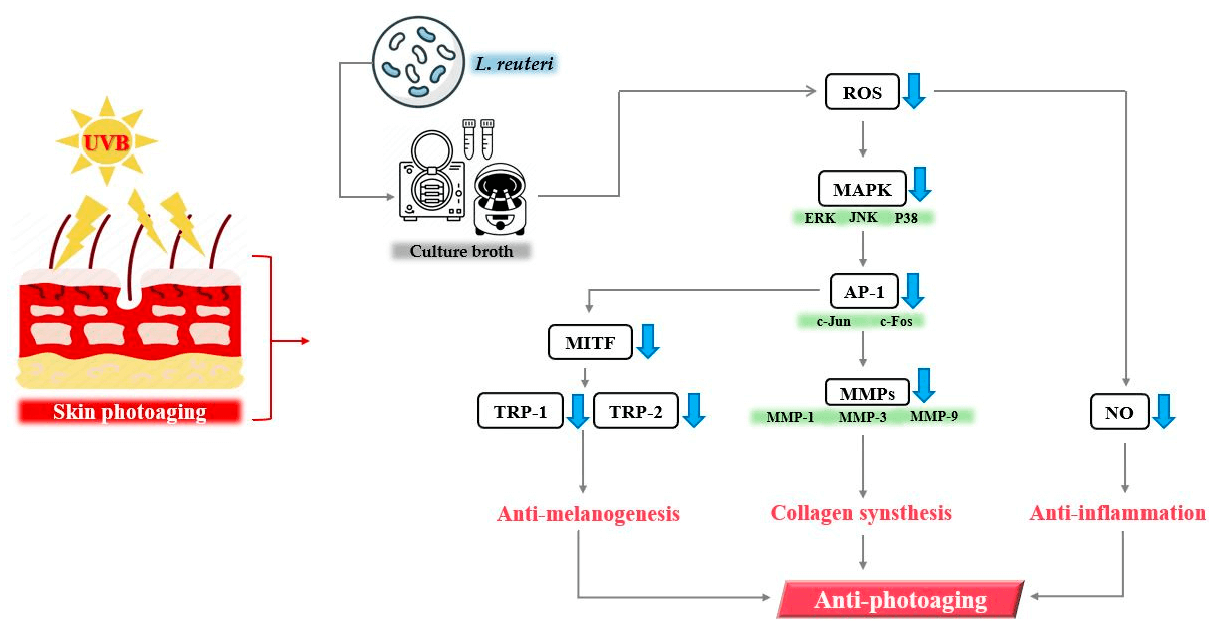
Objectives: Limosilactobacillus reuteri is a beneficial Lactobacillus widely used in foods and supplements to promote overall health. Some studies also suggest it supports skin health and prevents allergies and cardiovascular disease. However, research on its skin-protective effects against photoaging has not been conducted. This study evaluated the potential of culture broths from three L. reuteri strains (DS0333, DS0384, and DS0385) to inhibit skin photoaging. Methods: To assess their anti-photoaging potential, the culture broths were examined for antioxidant capacity, melanin inhibition, and collagen synthesis promotion. Radical scavenging activity was tested using 2,2-diphenyl-1-picrylhydrazyl (DPPH) and 2,2′-azino-bis (3-ethylbenzothiazoline-6-sulfonic acid) (ABTS) assays. The biosynthetic activity of melanin and associated protein markers involved in melanogenesis was examined in a B16F10 mouse melanoma model. Type I procollagen synthesis and matrix metalloproteinase-1 (MMP-1) inhibition were evaluated in ultraviolet B (UVB)-damaged human dermal fibroblasts (HDFs). Results: The culture broths exhibited concentration-dependent antioxidant activity and significantly suppressed melanin synthesis triggered by α-melanocyte-stimulating hormone (α-MSH). Transcription factors involved in melanogenesis, namely microphthalmia-associated transcription factor (MITF), tyrosinase-related protein 1 (TRP-1), and 2 (TRP-2), were significantly downregulated following treatment. Treatment with culture broths also enhanced type I procollagen production and inhibited MMP-1 activity and protein expression in UVB-exposed HDFs. Among the strains, DS0333 demonstrated the strongest efficacy and was further investigated. It enhanced the proliferation of skin cells and attenuated the levels of age-associated markers such as MMP-1, mitogen-activated protein kinase (MAPK), and activator protein 1 (AP-1). High-performance liquid chromatography (HPLC) analysis identified phenyllactic acid (PLA) as the predominant active compound. Conclusions: These results indicate that DS0333 culture broth exhibits strong anti-aging effects and can be applied in functional cosmetics aimed at promoting skin health.Graphic Abstract
Keywords
Cite This Article
 Copyright © 2025 The Author(s). Published by Tech Science Press.
This work is licensed under a Creative Commons Attribution 4.0 International License , which permits unrestricted use, distribution, and reproduction in any medium, provided the original work is properly cited.
 Downloads
 Citation Tools
