
 Login
Login Register
 Submit a Paper
 Propose a Special lssue
 Open Access
REVIEW

The Yin–Yang of Stress and Senescence: Integrated Stress Response and SASP Crosstalk in Stem Cell Fate, Regeneration, and Disease
Department of Obstetrics and Gynecology, C. S. Mott Center for Human Growth and Development, Institute of Environmental Health Sciences, Wayne State University, Detroit, MI 48201, USA
* Corresponding Author: Douglas M. Ruden. Email:
BIOCELL 2026, 50(1), 2 https://doi.org/10.32604/biocell.2025.072273
Received 23 August 2025; Accepted 24 October 2025; Issue published 23 January 2026
 View Full Text
 Download PDF
Abstract
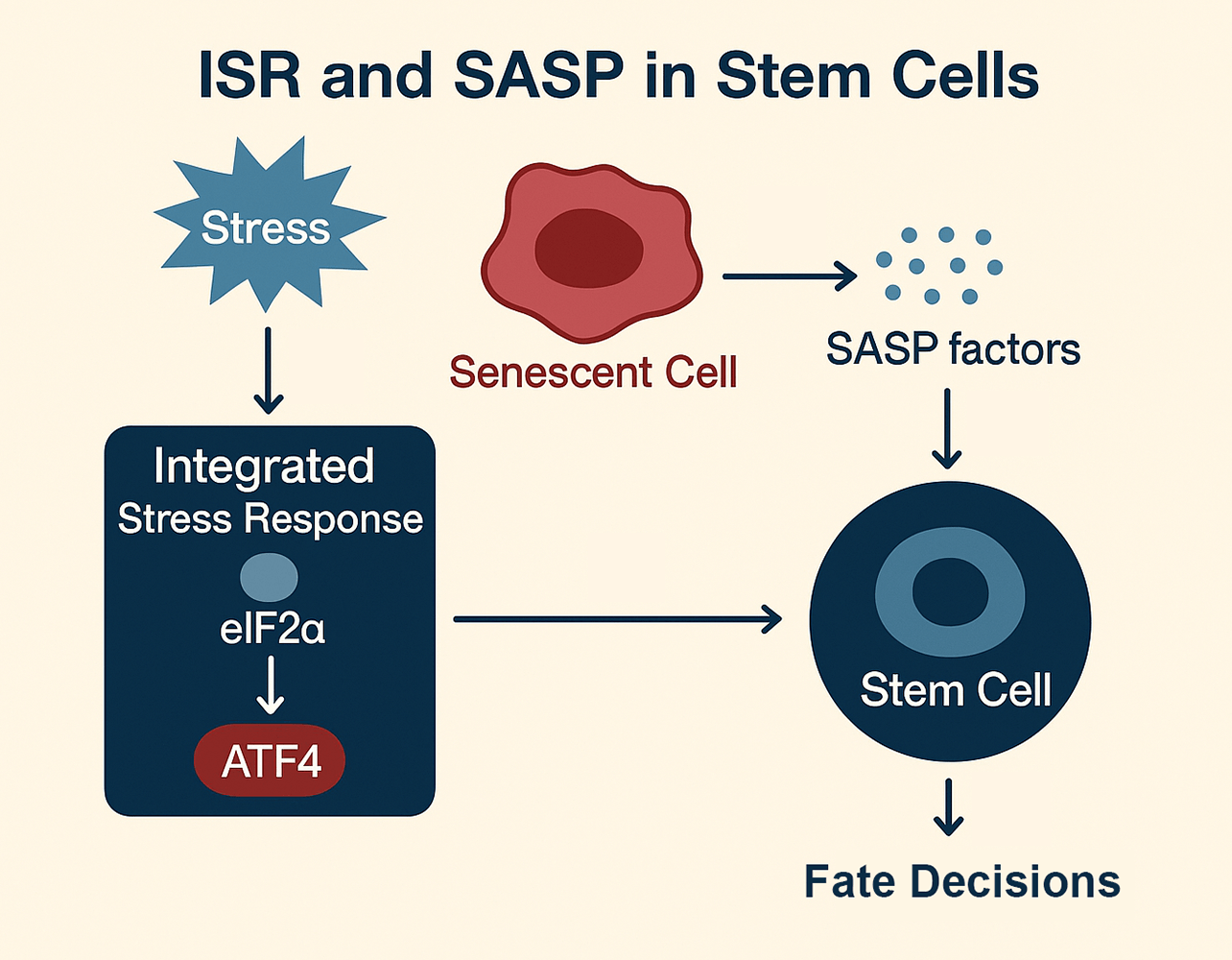
Stem cell fate decisions are increasingly understood through the dynamic interplay of two fundamental stress-adaptive programs: the integrated stress response (ISR) and the senescence-associated secretory phenotype (SASP). These pathways act as a Yin–Yang system, balancing beneficial and detrimental outcomes across development, tissue homeostasis, and disease. On the yin (protective) side, transient ISR activation and acute SASP signaling foster adaptation, embryonic patterning, wound healing, and regeneration. On the yang (maladaptive) side, chronic ISR signaling and unresolved SASP output drive stem cell exhaustion, fibrosis, inflammation, and tumorigenesis. This duality highlights their roles as both guardians and disruptors of stem cell integrity. Mechanistically, ISR regulates translational control via eukaryotic initiation factor 2 alpha (eIF2α) phosphorylation and activating transcription factor 4 (ATF4)-dependent transcription, while SASP reprograms the extracellular milieu through cytokines, growth factors, and proteases. Their crosstalk creates feedback loops that shape tissue niches and long-term stem cell potential. Framing ISR–SASP interactions through a Yin–Yang lens underscores the balance between resilience and decline, to offer new insights into regenerative medicine, anti-aging interventions, and cancer therapeutics.Graphic Abstract
Keywords
Integrated stress response (ISR); senescence-associated secretory phenotype (SASP); stem cells; activating transcription factor 4 (ATF4); eukaryotic initiation factor 2 alpha (eIF2α); inflammation; cancer
Cite This Article
APA Style
Ruden, D.M. (2026). The Yin–Yang of Stress and Senescence: Integrated Stress Response and SASP Crosstalk in Stem Cell Fate, Regeneration, and Disease. BIOCELL, 50(1), 2. https://doi.org/10.32604/biocell.2025.072273
Vancouver Style
Ruden DM. The Yin–Yang of Stress and Senescence: Integrated Stress Response and SASP Crosstalk in Stem Cell Fate, Regeneration, and Disease. BIOCELL. 2026;50(1):2. https://doi.org/10.32604/biocell.2025.072273
IEEE Style
D. M. Ruden, “The Yin–Yang of Stress and Senescence: Integrated Stress Response and SASP Crosstalk in Stem Cell Fate, Regeneration, and Disease,” BIOCELL, vol. 50, no. 1, pp. 2, 2026. https://doi.org/10.32604/biocell.2025.072273
 Copyright © 2026 The Author(s). Published by Tech Science Press.
This work is licensed under a Creative Commons Attribution 4.0 International License , which permits unrestricted use, distribution, and reproduction in any medium, provided the original work is properly cited.
 Downloads
 Citation Tools
