
 Login
Login Register
 Submit a Paper
 Propose a Special lssue
 Open Access
ARTICLE

PD-1 Blockade Reduces Parasite Load and Restores Anti-Parasitic Immunity in Murine Visceral Leishmaniasis
1 Department of Pathogenic Biology, West China School of Basic Medical Sciences and Forensic Medicine, Sichuan University, Chengdu, China
2 Department of Pharmaceutics, School of Pharmacy, Chengdu Medical College, Chengdu, China
* Corresponding Authors: Jianping Chen. Email: ; Jinlei He. Email:
# These authors contributed equally to this work
BIOCELL 2026, 50(5), 9 https://doi.org/10.32604/biocell.2026.077240
Received 04 December 2025; Accepted 21 February 2026; Issue published 13 May 2026
 View Full Text
 Download PDF
Abstract
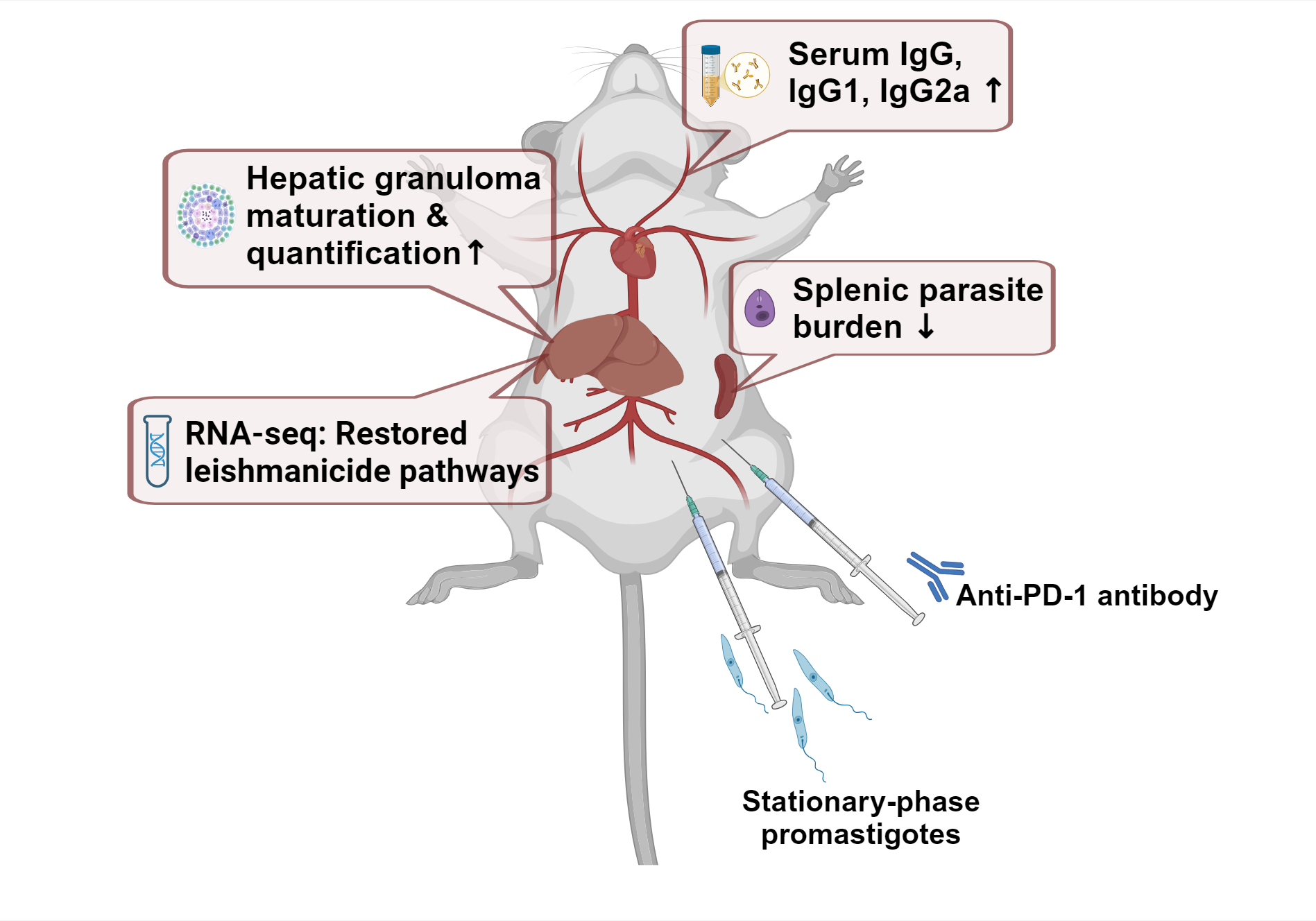
Objective: Immune checkpoint blockade holds therapeutic potential in visceral leishmaniasis; its underlying mechanism remains unclear. This study aimed to investigate the therapeutic potential and underlying immune mechanisms of Programmed cell death protein 1 (PD-1) blockade in experimental visceral leishmaniasis. Methods: BALB/c mice infected with Leishmania donovani received anti-PD-1 antibody at 35–44 days post-infection. Parasite burden in target organs, serum antibodies, hepatopathology, and transcriptome of the liver were analyzed. T cell exhaustion, activation, apoptosis, and inflammation genes were quantified in target organs. Results: PD-1 blockade reduced splenic parasite load (reduction rate = 82.6%, ***p < 0.001), enhanced hepatic granulomatous maturation, and elevated anti-Leishmania IgG/IgG1/IgG2a levels. qPCR analysis revealed that the expressions of exhaustion marker genes Programmed cell death 1 (Pdcd1) and B and T lymphocyte attenuator (Btla) were upregulated in the liver and spleen following Leishmania infection, indicating an exhausted state. After PD-1 blockade, the expression of pro-inflammatory cytokine genes Tumor necrosis factor alpha (Tnfa), Interferon gamma (Ifng), and Nitric Oxide Synthase 2 (Nos2) was upregulated in the spleen, while the expression of anti-inflammatory cytokine genes Interleukin 4 (Il4) and Interleukin 10 (Il10) was downregulated in the liver. Transcriptome suggested that antigen processing & presentation, Natural Killer cell-mediated cytotoxicity, and neutrophil extracellular trap formation pathways were restored after blockade. Six hub genes associated with immune restoration were identified, of which Activating transcription factor 3 (Atf3) was chosen to be overexpressed in RAW 264.7 and manifested a reduced infection rate and average Leishmania at 12 h post-infection. Conclusion: This study demonstrated PD-1 blockade reinvigorated anti-parasitic immunity through multimodal mechanisms and illuminated both the potential and intricate dynamics of immune checkpoint modulation in leishmaniasis, where treatment success hinges on coordinated immune activation.Graphic Abstract
Keywords
Cite This Article
 Copyright © 2026 The Author(s). Published by Tech Science Press.
This work is licensed under a Creative Commons Attribution 4.0 International License , which permits unrestricted use, distribution, and reproduction in any medium, provided the original work is properly cited.
 Downloads
 Citation Tools
