
 Login
Login Register
 Submit a Paper
 Propose a Special lssue
 Open Access
ARTICLE

A Hybrid Artificial Intelligence Model for Accurate Prediction of Gas Emissions in Power Plant Turbines
1Smart Power Generation Unit, Institute of Power Engineering (IPE), Universiti Tenaga Nasional (UNITEN), Kajang, 43000, Malaysia
2 College of Engineering, University of Information Technology and Communications, Baghdad, 10066, Iraq
3 Faculty of Engineering, Sohar University, P.O. Box 44, Sohar, PCI 311, Oman
4 Operations and Information Management Department, Aston Business School, Birmingham, B4 7ET, UK
5 Mechanical Engineering Department, University of Technology-Iraq, Baghdad, 10001, Iraq
* Corresponding Author: Firas Basim Ismail. Email:
(This article belongs to the Special Issue: Advancements in Energy Resources and Their Processes, Systems, Materials and Policies for Affordable Energy Sustainability)
Energy Engineering 2026, 123(3), 19 https://doi.org/10.32604/ee.2025.073955
Received 29 September 2025; Accepted 21 November 2025; Issue published 27 February 2026
 View Full Text
 Download PDF
Abstract
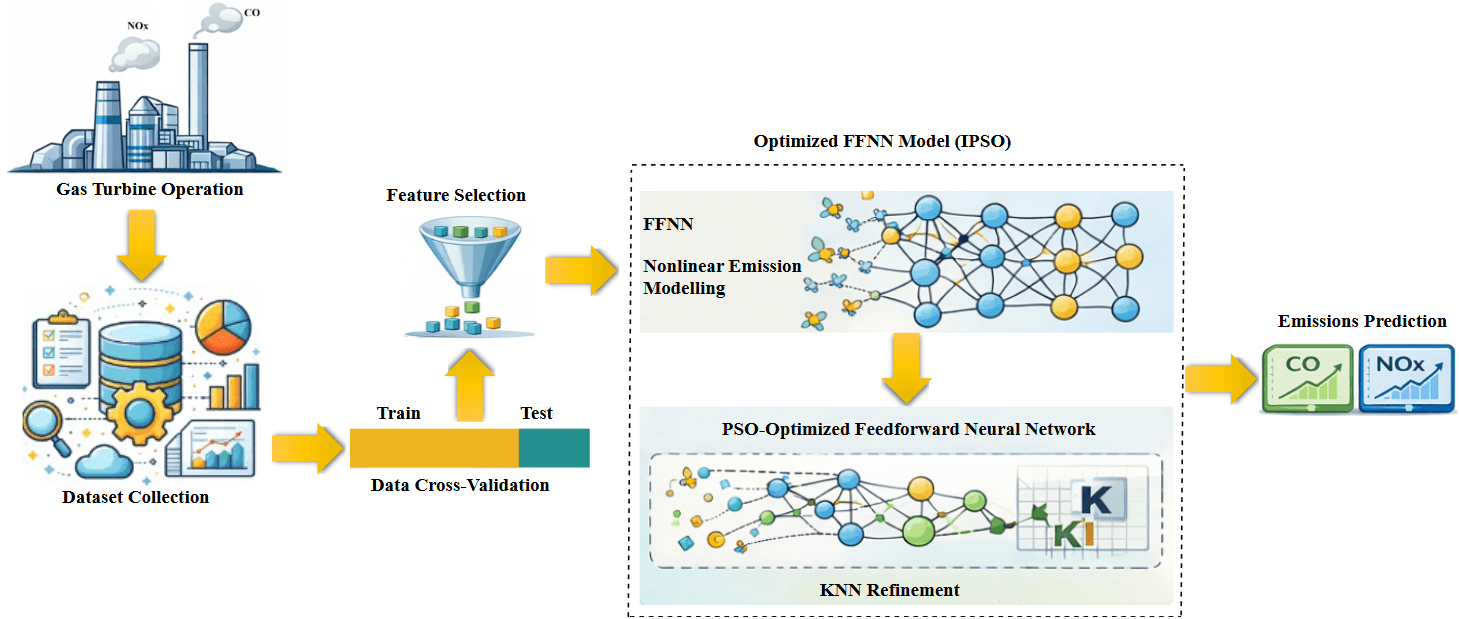
Thermal power plants are the main contributors to greenhouse gas emissions. The prediction of the emission supports the decision makers and environmental sustainability. The objective of this study is to enhance the accuracy of emission prediction models, supporting more effective real-time monitoring and enabling informed operational decisions that align with environmental compliance efforts. This paper presents a data-driven approach for the accurate prediction of gas emissions, specifically nitrogen oxides (NOx) and carbon monoxide (CO), in natural gas power plants using an optimized hybrid machine learning framework. The proposed model integrates a Feedforward Neural Network (FFNN) trained using Particle Swarm Optimization to capture the nonlinear emission dynamics under varying gas turbine operating conditions. To further enhance predictive performance, the K-Nearest Neighbor (K-NN) algorithm serves as a post-processing method to enhance IPSO-FFNN predictions through adjustment and refinement, improving overall prediction accuracy, while Neighbor Component Analysis is used to identify and rank the most influential operational variables. The study makes a significant contribution through the combination of NCA feature selection with PSO global optimization, FFNN nonlinear modelling, and K-NN error correction into one unified system, which delivers precise emission predictions. The model was developed and tested using a real-world dataset collected from gas-fired turbine operations, with validated results demonstrating robust accuracy, achieving Root Mean Square Error values of 0.355 for CO and 0.368 for NOx. When benchmarked against conventional models such as standard FFNN, Support Vector Regression, and Long Short-Term Memory networks, the hybrid model achieved substantial improvements, up to 97.8% in Mean Squared Error, 95% in Mean Absolute Error (MAE), and 85.19% in RMSE for CO; and 97.16% in MSE, 93.4% in MAE, and 83.15% in RMSE for NOx. These results underscore the model’s potential for improving emission prediction, thereby supporting enhanced operational efficiency and adherence to environmental standards.Graphic Abstract
Keywords
Cite This Article
 Copyright © 2026 The Author(s). Published by Tech Science Press.
This work is licensed under a Creative Commons Attribution 4.0 International License , which permits unrestricted use, distribution, and reproduction in any medium, provided the original work is properly cited.
 Downloads
 Citation Tools
