
 Login
Login Register
 Submit a Paper
 Propose a Special lssue
 Open Access
ARTICLE

Influence Mechanism of the Nano-Structure on Phase Change Liquid Cooling Features for Data Centers
School of Energy and Safety Engineering, Tianjin Chengjian University, Tianjin, 300384, China
* Corresponding Authors: Yifan Li. Email: ; Rong Gao. Email:
Energy Engineering 2025, 122(11), 4523-4539. https://doi.org/10.32604/ee.2025.068480
Received 30 May 2025; Accepted 24 July 2025; Issue published 27 October 2025
 View Full Text
 Download PDF
Abstract
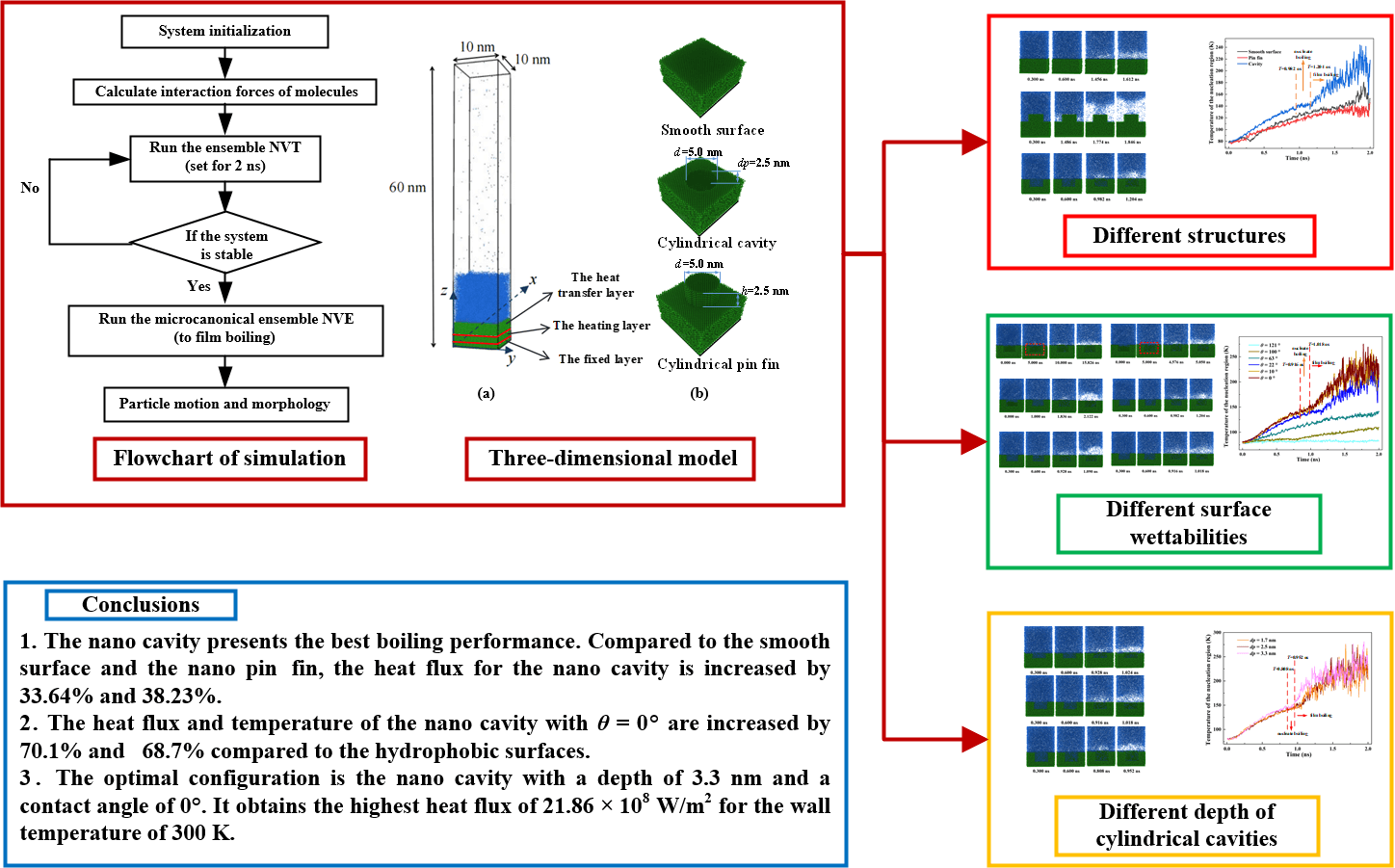
The local overheating issue is a serious threat to the safe operation of data centers (DCs). The chip-level liquid cooling with pool boiling is expected to solve this problem. The effect of nano configuration and surface wettability on the boiling characteristics of copper surfaces is studied using molecular dynamics (MD) simulation. The argon is chosen as the coolant, and the wall temperature is 300 K. The main findings and innovations are as follows. (1) Compared to the smooth surface and fin surface, the cylindrical nano cavity obtains the superior boiling performance with earlier onset of nucleate boiling (ONB), larger heat flux because of the higher heat transport rate. (2) The nano cavity with hydrophilicity can improve the response speed and heat dissipation efficiency. Compared to the contact angle θ = 121°, the formation times of nucleate bubble and film boiling for the θ = 0° are reduced by 90.84% and 93.57%, respectively. (3) A deeper cavity of 3.3 nm is beneficial for triggering boiling and improving the heat dissipation rate. The highest heat flux can be achieved at 21.86 × 10⁸ W/m2, which can meet the cooling requirements of the micro devices with ultra-high heat flux (107–108 W/m2). The coupling effect of nano configuration and surface wettability is illustrated, and the essential reasons for the enhanced heat transport are revealed. The findings can guide the optimization of cooling systems and promote the practical application of phase change liquid cooling in DCs.Graphic Abstract
Keywords
Pool boiling characteristic; nano configuration; surface wettability; structure parameter; liquid cooling efficiency
Cite This Article
APA Style
Li, Y., Zhu, C., Gao, R., Yang, B. (2025). Influence Mechanism of the Nano-Structure on Phase Change Liquid Cooling Features for Data Centers. Energy Engineering, 122(11), 4523–4539. https://doi.org/10.32604/ee.2025.068480
Vancouver Style
Li Y, Zhu C, Gao R, Yang B. Influence Mechanism of the Nano-Structure on Phase Change Liquid Cooling Features for Data Centers. Energ Eng. 2025;122(11):4523–4539. https://doi.org/10.32604/ee.2025.068480
IEEE Style
Y. Li, C. Zhu, R. Gao, and B. Yang, “Influence Mechanism of the Nano-Structure on Phase Change Liquid Cooling Features for Data Centers,” Energ. Eng., vol. 122, no. 11, pp. 4523–4539, 2025. https://doi.org/10.32604/ee.2025.068480
 Copyright © 2025 The Author(s). Published by Tech Science Press.
This work is licensed under a Creative Commons Attribution 4.0 International License , which permits unrestricted use, distribution, and reproduction in any medium, provided the original work is properly cited.
 Downloads
 Citation Tools
