
 Login
Login Register
 Submit a Paper
 Propose a Special lssue
 Open Access
ARTICLE

Development of Micro Hydropower Systems in Amazonia Using Multiple Axial-Flow Turbines
1 Laboratory of Fluid Dynamics and Particulate, Federal University of Pará, Tucuruí, 68455-901, Brazil
2 School of Environmental and Sanitary Engineering, Federal University of Pará, Belém, 66075-110, Brazil
* Corresponding Author: André L. Amarante Mesquita. Email:
(This article belongs to the Special Issue: Selected Papers from the SDEWES 2024 Conference on Sustainable Development of Energy, Water and Environment Systems)
Energy Engineering 2025, 122(6), 2197-2213. https://doi.org/10.32604/ee.2025.064196
Received 08 February 2025; Accepted 23 April 2025; Issue published 29 May 2025
 View Full Text
 Download PDF
Abstract
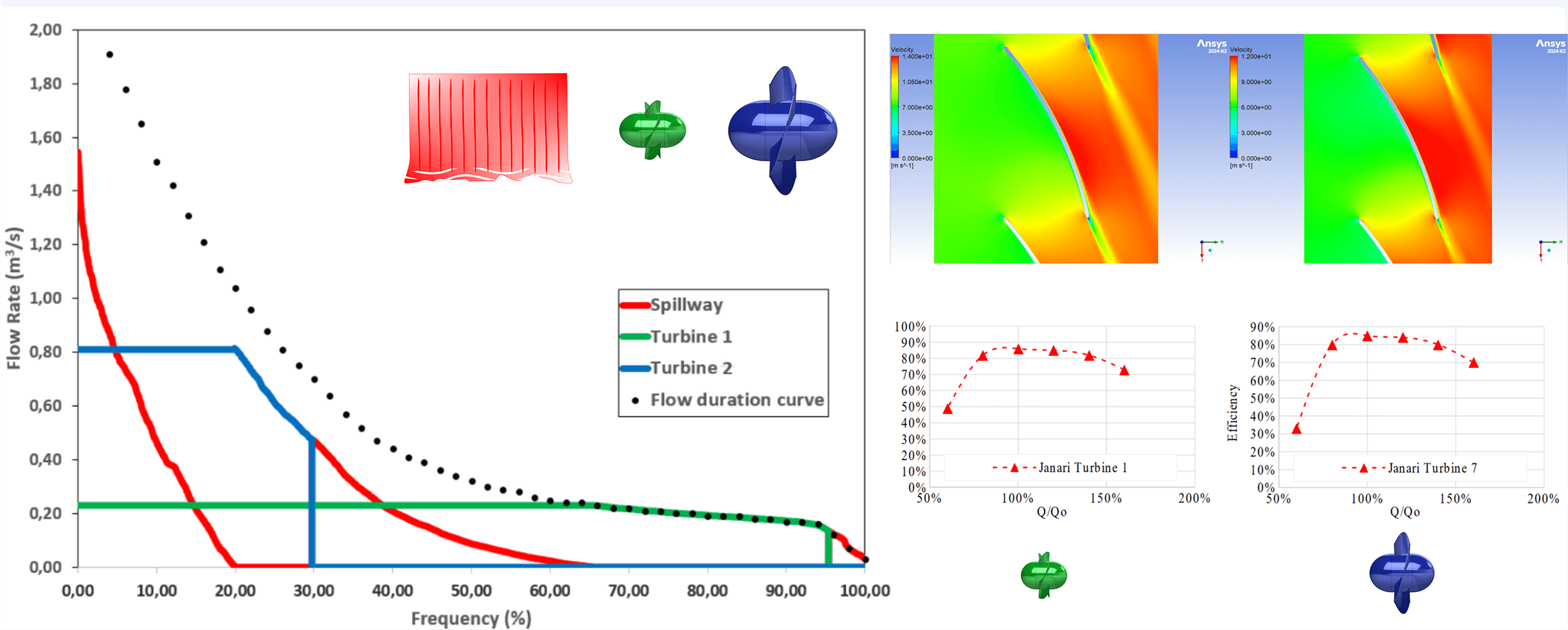
Despite significant Brazilian social programs to expand energy access, approximately one million people in rural Amazonia still lack electricity. Moreover, the existing rural electricity grid in the region is inadequate for supporting efficient small-scale production systems due to both the poor quality and high cost of supplied energy. In parallel, traditional wooden bridges in the Amazon have been progressively replaced by more durable concrete structures in recent years. In this context, this study explores the application of very low-head hydropower installations in the Amazon, focusing on integrating axial-flow turbines beneath small concrete bridges. The methodology involves analyzing flow duration curves and key hydraulic parameters upstream and downstream to design a micro-hydropower system comprising two or more units, thereby maximizing annual energy generation. Additionally, the study assesses the applicability of the minimum pressure coefficient criterion to improve the efficiency of very low-head turbines. This design criterion is first validated against an existing experimental study featuring a propeller turbine with a simple curved plate blade. The proposed methodology is then applied to a case study involving a small dam-bridge with a head variation from 1.4 to 2.4 m and a flow rate ranging from 0.23 to 0.92 m3/s. The optimal configuration achieves an energy output of 26.2 MWh/year with an efficiency of up to 86%.Graphic Abstract
Keywords
Cite This Article
 Copyright © 2025 The Author(s). Published by Tech Science Press.
This work is licensed under a Creative Commons Attribution 4.0 International License , which permits unrestricted use, distribution, and reproduction in any medium, provided the original work is properly cited.
 Downloads
 Citation Tools
