
 Login
Login Register
 Submit a Paper
 Propose a Special lssue
 Open Access
ARTICLE
Effect of Thermoelectric Cooler Arrangements on Thermal Performance and Energy Saving in Electronic Applications: An Experimental Study
Department of Electromechanical Engineering, University of Technology-Iraq, Baghdad, 10066, Iraq
* Corresponding Author: Ali A. Ismaeel. Email:
(This article belongs to the Special Issue: Advancements in Energy Resources and Their Processes, Systems, Materials and Policies for Affordable Energy Sustainability)
Energy Engineering 2026, 123(1), 24 https://doi.org/10.32604/ee.2025.073437
Received 18 September 2025; Accepted 21 October 2025; Issue published 27 December 2025
 View Full Text
 Download PDF
Abstract
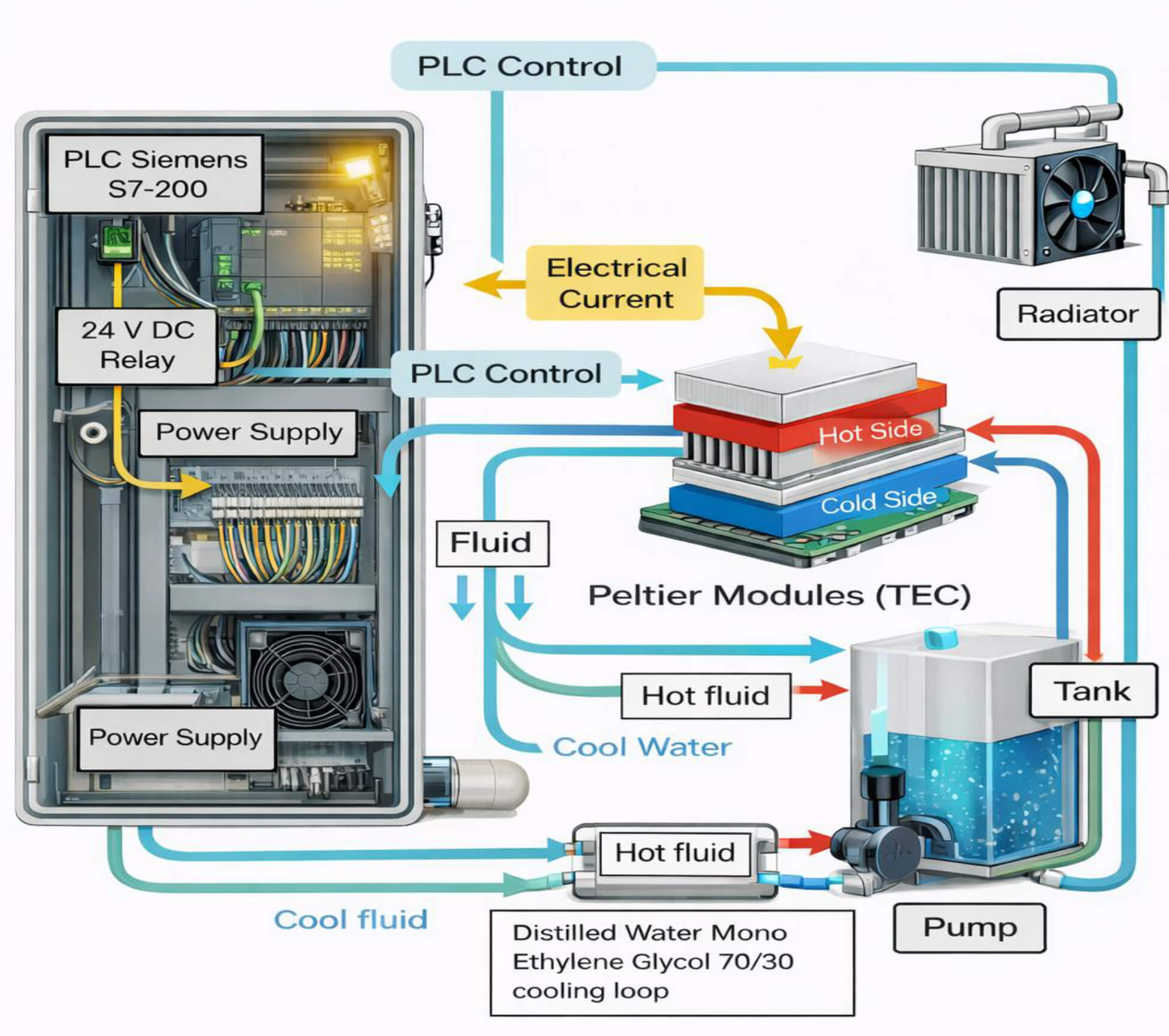
Electrical and electronic devices face significant challenges in heat management due to their compact size and high heat flux, which negatively impact performance and reliability. Conventional cooling methods, such as forced air cooling, often struggle to transfer heat efficiently. In contrast, thermoelectric coolers (TECs) provide an innovative active cooling solution to meet growing thermal management demands. In this research, a refrigerant based on mono ethylene glycol and distilled water was used instead of using gases, in addition to using thermoelectric cooling units instead of using a compressor in traditional refrigeration systems. This study evaluates the performance of a Peltier-based thermal management system by analyzing the effects of using two, three, and four Peltier modules on cooling rates, power consumption, temperature reduction, and system efficiency. Experimental results indicate that increasing the number of Peltier modules significantly enhances cooling performance. The four-module system achieved an optimal balance between cooling speed and energy efficiency, reducing the temperature of a liquid mixture (30% mono ethylene glycol + 70% distilled water plus laser dyes) to 8°C in just 17 min. It demonstrated a cooling rate of 0.794°C/min and a high coefficient of performance (COP) of 1.2 while consuming less energy than the two-and three-module systems. Furthermore, the study revealed that increasing the number of modules led to faster air cooling and improved temperature reduction. These findings highlight the importance of selecting the optimal number of Peltier modules to enhance efficiency and cooling speed while minimizing energy consumption. This makes TEC technology a sustainable and effective solution for applications requiring rapid and reliable thermal management.Graphic Abstract
Keywords
Cite This Article
 Copyright © 2026 The Author(s). Published by Tech Science Press.
This work is licensed under a Creative Commons Attribution 4.0 International License , which permits unrestricted use, distribution, and reproduction in any medium, provided the original work is properly cited.
 Downloads
 Citation Tools
