
 Login
Login Register
 Submit a Paper
 Propose a Special lssue
 Open Access
REVIEW
A Review of the Application of Bionic Microchannels in the Thermal Management of Electronic Components
School of Low-Carbon Energy and Power Engineering, China University of Mining and Technology, Xuzhou, China
* Corresponding Author: Cong Qi. Email:
Energy Engineering 2026, 123(11), 2 https://doi.org/10.32604/ee.2026.079423
Received 21 January 2026; Accepted 16 March 2026; Issue published 24 September 2026
 View Full Text
 Download PDF
Abstract
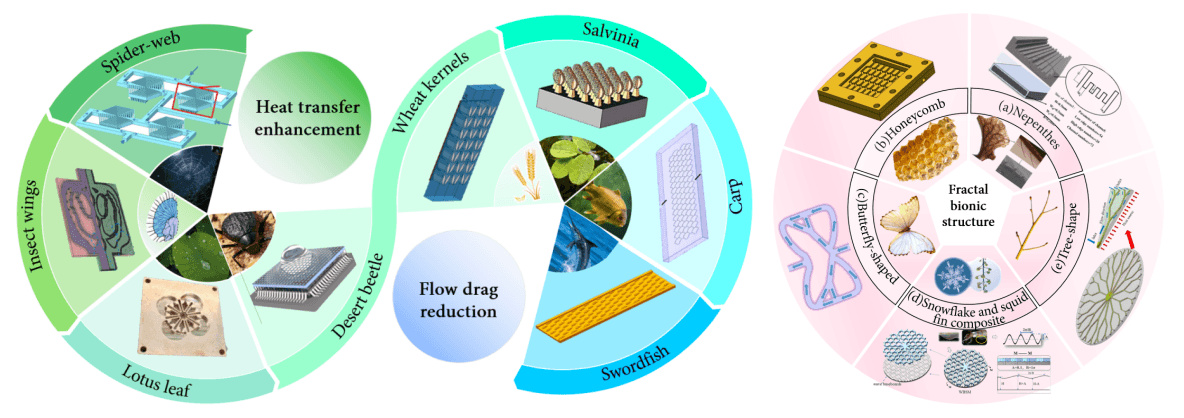
The relentless increase in power density and integration of electronic devices is pushing conventional thermal dissipation technologies beyond their limits. Bionic microchannels, leveraging their unique structural advantages, have emerged as a critical research direction to overcome this bottleneck. This paper systematically reviewed the research progress of bionic microchannels in the thermal management of electronic components, elucidating the intrinsic logic and synergistic relationships among structural mechanisms, optimization methods, and engineering applications. From a mechanistic perspective, bionic structures are categorized into two types: heat transfer enhancement structures (such as variable cross-sections, turbulators, fractal networks) and flow drag reduction structures (such as streamlined contours, adaptive structures). This review highlighted the application strategies and effectiveness of multi-objective optimization and topology optimization in addressing the trade-off between heat transfer enhancement and flow resistance, comparing their core principles, applicable scenarios, computational costs, and limitations. Based on the thermal management requirements of various electronic components, the cooling performance of bionic structures was evaluated. Furthermore, the heat transfer advantages arising from their coupling with nanofluids, porous media, phase change materials, pulsating flow, and impinging jet cooling were explored. The research encompassed both laminar and turbulent flow regimes, as well as single-phase and two-phase heat transfer. Bionic structures demonstrate an enhancement in heat transfer coefficient by 8.2%–78.1% and a reduction in pressure drop by 7.8%–79.1% under heat fluxes of 5–1000 W/cm2, achieving a Performance Evaluation Coefficient (PEC) up to 1.82. The novelty lies in elucidating the intrinsic structure-performance correlation and identifying critical Reynolds number failure mechanisms. It identifies ongoing challenges in standardizing performance evaluation, topology optimization for multiple operating conditions, intelligent adaptive structures, high-precision additive manufacturing, and long-term reliability. The aim is to provide a theoretical foundation and design paradigm for next-generation high-performance and low-energy electronic cooling technologies.Graphic Abstract
Keywords
Microchannel; bionic structure; thermal management; heat transfer enhancement; flow drag reduction
Cite This Article
APA Style
Feng, G., Qi, C., Luo, J., Zhu, L. (2026). A Review of the Application of Bionic Microchannels in the Thermal Management of Electronic Components. Energy Engineering, 123(11), 2. https://doi.org/10.32604/ee.2026.079423
Vancouver Style
Feng G, Qi C, Luo J, Zhu L. A Review of the Application of Bionic Microchannels in the Thermal Management of Electronic Components. Energ Eng. 2026;123(11):2. https://doi.org/10.32604/ee.2026.079423
IEEE Style
G. Feng, C. Qi, J. Luo, and L. Zhu, “A Review of the Application of Bionic Microchannels in the Thermal Management of Electronic Components,” Energ. Eng., vol. 123, no. 11, pp. 2, 2026. https://doi.org/10.32604/ee.2026.079423
 Copyright © 2026 The Author(s). Published by Tech Science Press.
This work is licensed under a Creative Commons Attribution 4.0 International License , which permits unrestricted use, distribution, and reproduction in any medium, provided the original work is properly cited.
 Downloads
 Citation Tools
