
 Login
Login Register
 Submit a Paper
 Propose a Special lssue
 Open Access
ARTICLE
Low-Carbon Economic Dispatch of a Virtual Power Plant Considering Concentrated Solar Power-Hydrogen Synergy and Asymmetric User Satisfaction
School of Intelligence Science and Technology, Xinjiang University, Urumqi, China
* Corresponding Author: Yue Meng. Email:
(This article belongs to the Special Issue: Integration of Renewable Energies with the Grid: An Integrated Study of Solar, Wind, Storage, Electric Vehicles, PV and Wind Materials and AI-Driven Technologies)
Energy Engineering 2026, 123(11), 21 https://doi.org/10.32604/ee.2026.083169
Received 30 March 2026; Accepted 08 June 2026; Issue published 24 September 2026
 View Full Text
 Download PDF
Abstract
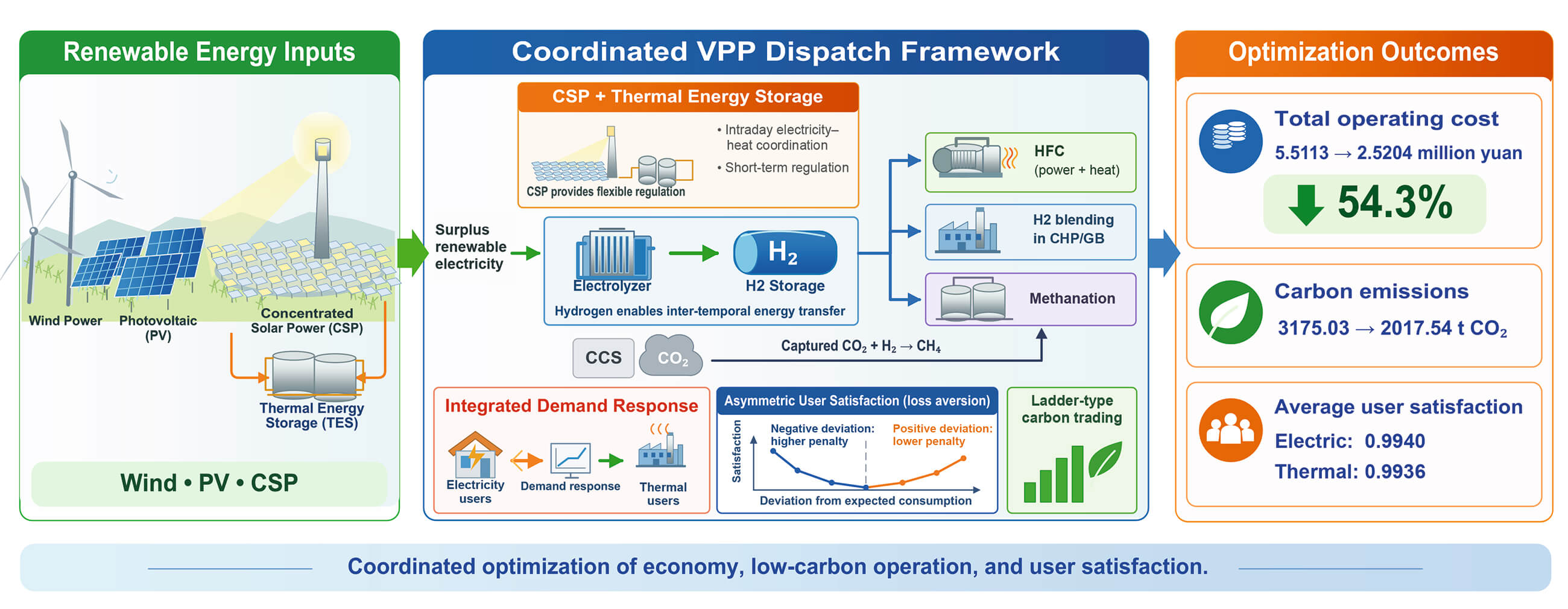
To address the difficulty of balancing economy, low-carbon performance, and user-side acceptability in virtual power plant operation under high penetration of renewable energy, this paper proposes a low-carbon optimal dispatch model for a virtual power plant considering concentrated solar power (CSP)-hydrogen synergy and asymmetric user satisfaction. First, a coordinated operation model of CSP and hydrogen energy is established by incorporating a CSP plant, hydrogen conversion devices, hydrogen-blended gas equipment, and multiple types of energy storage systems into a unified dispatch framework. Second, to overcome the limitation of conventional user satisfaction models in reflecting users’ differentiated perceptions of load deviations in different directions, an asymmetric user satisfaction model is developed based on loss aversion theory. Combined with an integrated demand response mechanism, the proposed model improves the rationality of user response characterization. On this basis, a ladder-type carbon trading mechanism is introduced, and an optimal dispatch model is established with the objective of minimizing the total operating cost over the scheduling horizon while simultaneously considering economy, low-carbon performance, and user satisfaction. Case study results show that, compared with the baseline operating scenario, the proposed model reduces the total operating cost by 54.3% and significantly decreases carbon emissions. Compared with the conventional symmetric user satisfaction model, the average satisfaction levels of both electric and thermal loads are improved, with a more pronounced enhancement observed for thermal loads. The results demonstrate that the proposed model can achieve coordinated optimization of low-carbon operation, economic dispatch, and user satisfaction while satisfying users’ basic energy demands.Graphic Abstract
Keywords
Cite This Article
 Copyright © 2026 The Author(s). Published by Tech Science Press.
This work is licensed under a Creative Commons Attribution 4.0 International License , which permits unrestricted use, distribution, and reproduction in any medium, provided the original work is properly cited.
 Downloads
 Citation Tools
