
 Login
Login Register
 Submit a Paper
 Propose a Special lssue
 Open Access
ARTICLE

Investigation of Sputtered TiO2 Thin Films and Modeling of TiO2-Based Heterojunctions with p-Si and p-GaAs
1 Energy and Materials Engineering Laboratory (LGEM), Faculty of Science and Technology, Sultan Moulay Slimane University, Beni-Mellal, Morocco
2 Material Sciences Unit (USM), DERS, National Center for Energy, Sciences and Nuclear Techniques (CNESTEN), Rabat, Morocco
3 Research Center on Advanced Materials and Technologies (RAMTECH), Department of Exact and Natural Sciences, Institute of Interdisciplinary Research, Alexandru Ioan Cuza University of Iasi, 11 bd. Carol I, Iasi, Romania
4 Laboratory of Industrial Engineering and Surface Engineering, Faculty of Science and Technology, University Sultan Moulay Slimane, Beni Mellal, Morocco
* Corresponding Authors: Sana Handor. Email: ; Abdelati Razouk. Email:
(This article belongs to the Special Issue: Advances and Emerging Trends in Photovoltaic Technologies, Energy Storage, and Green Hydrogen)
Energy Engineering 2026, 123(9), 11 https://doi.org/10.32604/ee.2026.082739
Received 21 March 2026; Accepted 07 May 2026; Issue published 06 August 2026
 View Full Text
 Download PDF
Abstract
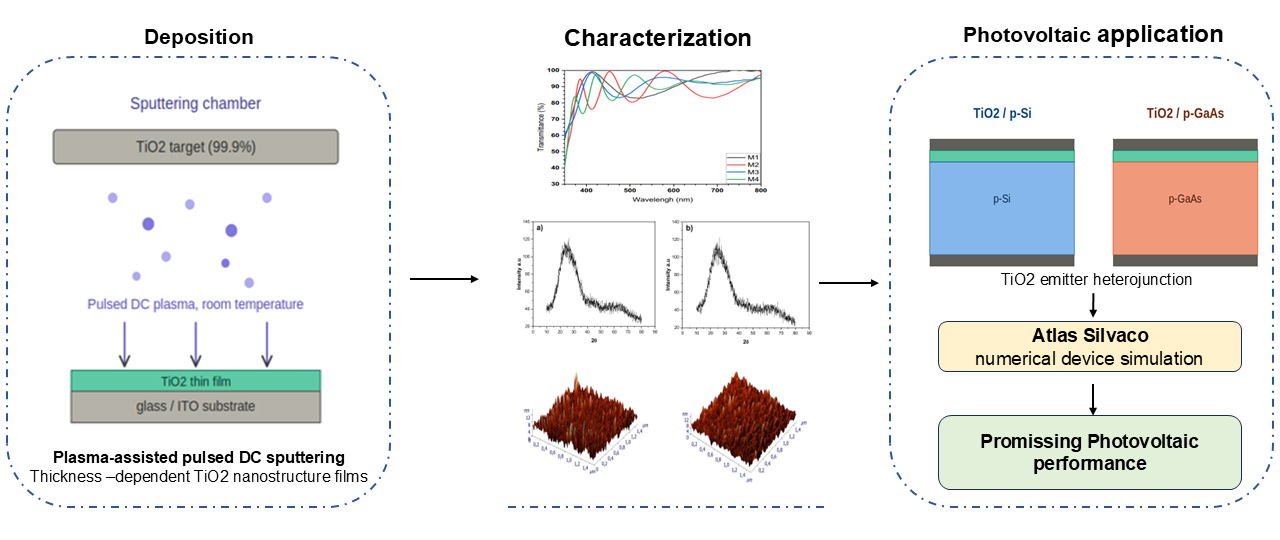
In this study, thin films of titanium dioxide (TiO2) were deposited onto glass and indium tin oxide (ITO) substrates at room temperature, using plasma-assisted pulsed DC sputtering with a 99.9% pure stoichiometric TiO2 target. Our research aims to investigate the influence of film thickness on the optical, structural, and morphological properties of TiO2 nanostructured thin films, as well as its impact on the photovoltaic performance of heterojunctions where TiO2 serves as the emitter. Using advanced PRISA software, parameters such as refractive index, film thickness, and band gap energy were determined. Spectrophotometry analysis shows that TiO2 thin film samples exhibited up to 90% optical transparency in the UV-Vis spectral region. Using X-ray diffraction (XRD) analysis revealed an amorphous phase, particularly at lower scan angles, while atomic force microscopy (AFM) images show an homogeneous surface of deposited films with low roughness. A notable reduction in the optical band gap was observed with increasing film thickness. Finally, numerical simulations of TiO2/p-Si and TiO2/p-GaAs heterojunction Solar cells, performed using Atlas SILVACO software, predict promising photovoltaic performance based on the optical data of the elaborated TiO2 thin films.Graphic Abstract
Keywords
Cite This Article
 Copyright © 2026 The Author(s). Published by Tech Science Press.
This work is licensed under a Creative Commons Attribution 4.0 International License , which permits unrestricted use, distribution, and reproduction in any medium, provided the original work is properly cited.
 Downloads
 Citation Tools
